财政发力

Search documents
钢矿周度报告2025-05-19:贸易冲突缓和,黑色低位反弹-20250519
Zheng Xin Qi Huo· 2025-05-19 08:41
Report Title - Trade conflict eases, black commodities rebound from lows. Steel and ore weekly report (May 19, 2025) [1] Report Authors - Xie Chen, Yang Hui from the Black Industry Group of Zhengxin Futures Industry Research Center [2] Report Main Views Steel - Price: Spot prices soared, and the futures market rebounded from lows. The main contract of rebar rose 1.99% to close at 3014, and the spot price in East China reached 3210 yuan/ton, up 40 yuan [6][11]. - Supply: Blast furnace production declined from its peak, while electric furnace production stopped falling and rebounded. The blast furnace operating rate of 247 steel mills was 84.15%, down 0.47 percentage points week-on-week. The average operating rate of 90 independent electric arc furnace steel mills was 75.2%, up 2.47 percentage points week-on-week [6][14][22]. - Inventory: Building material inventories were depleted at an accelerated pace, and plate inventories decreased simultaneously. Rebar mill inventories decreased by 3.28 tons week-on-week, and social inventories decreased by 30.48 tons. Hot-rolled coil mill inventories decreased by 6.58 tons, and social inventories decreased by 10.97 tons [6][39][43]. - Demand: Building material demand increased month-on-month, and plate demand remained resilient. From May 8th to May 14th, the national cement delivery volume was 3.5835 million tons, up 7.5% month-on-month. The apparent demand for hot-rolled coils remained high due to the 90-day export rush [6][28][31]. - Profit: Blast furnace profits continued to expand, and electric furnace profits at off-peak hours turned positive. The steel mill profitability rate was 59.31%, up 0.44 percentage points week-on-week. The average profit of independent electric arc furnace construction steel mills was -81 yuan/ton, and the off-peak profit was 24 yuan/ton, up 10 yuan/ton week-on-week [6][36]. - Basis: The basis narrowed slightly, and attention was paid to reverse arbitrage opportunities. The basis of rebar 10 contract narrowed by 10 compared with last week [6][47]. - Summary: The easing of trade conflicts has digested the bullish factors, and the market may return to seasonal characteristics. Maintain a medium-term shorting strategy. Hold existing short positions and consider shorting lightly for those with no positions [6]. Iron Ore - Price: Ore prices rose slightly, and the futures market rebounded strongly. The main contract of iron ore rose 4.6% to close at 728, and the spot price of PB fines at Qingdao Port rose 11 yuan to 765 yuan/ton [6][59]. - Supply: Australian and Brazilian shipments declined, and arrivals decreased simultaneously. The global iron ore shipment volume was 30.29 million tons, down 220,000 tons week-on-week. The 47-port iron ore arrival volume was 25.7 million tons, down 640,000 tons week-on-week [6][62][68]. - Demand: Blast furnace production declined, but demand remained at a relatively high level. The average daily hot metal output of 247 steel mills was 2.4477 million tons, down 8,700 tons week-on-week [6][70][71]. - Inventory: Port inventories decreased slightly, and downstream inventories declined simultaneously. The 47-port iron ore inventory was 147.4699 million tons, down 180,000 tons week-on-week. The imported sinter powder inventory of 114 steel mills was 27.1467 million tons, down 443,300 tons week-on-week [6][78][81]. - Shipping: Shipping prices rebounded. The freight rate from Western Australia to China was 7.85 US dollars/ton, up 0.3 US dollars/ton week-on-week. The freight rate from Brazil to China was 18.8 US dollars/ton, up 0.37 US dollars/ton week-on-week [6][84]. - Spread: The futures spread widened, and the coke-to-ore ratio dropped significantly. The 9-1 spread of iron ore was 36, up 10 compared with last week. The coke-to-ore ratio was 1.99, and the rebar-to-ore ratio was 4.25, both narrowing [6][87][90]. - Summary: Last week, supply and demand both declined month-on-month. Affected by macro shocks, ore prices rebounded strongly. Considering the drag of finished products in the off-season, the probability of further price increases is low. Maintain a long-term bearish view and pay attention to trading opportunities when prices fall back to previous lows [6].
中金图说中国:2025年二季度
中金点睛· 2025-04-22 23:48
中金研究 中金公司研究部发布了2025年二季度图说中国,本产品汇集了中金公司研究部宏观、策略、量化及ESG、固收、大宗、外汇等各组对于当前中国经 济、市场和资产价格的最新观点和数据更新。近120页的图册提供了对于中国市场的一个全景式展示和介绍,这对于希望快速了解中国市场的投资者是 一个很好的总结和更新。 点击小程序查看报告原文 目求 | ● 中金研究团队介绍 p. 2 | | --- | | · 宏观经济 p. 3 | | ● 市场策略 p. 14 | | ● 量化及ESG p. 45 | | ● 固定收益 … p. 52 | | ● 大宗商品 ……………………………… p. 74 | | · 外汇研究 p. 94 | 注:除特别说明,本产品中所有价格数据均截至2025年4月21日 返回目塞 中金研究团队介绍 | 宏观经济 | 市场策略 | 量化及ESG | 固定收益 | 大宗商品 | | --- | --- | --- | --- | --- | | · 彭文生 | · 缪延亮 | · 刘均伟 | · 陈健恒 | · 郭朝辉 | | · 张文朗 | · 刘刚, CFA | · 周萧漬 | · 许艳 | · ...
中金公司 关税下如何看待建筑建材?
中金· 2025-04-08 15:42
Investment Rating - The report maintains a positive investment outlook for the construction and building materials sector, emphasizing its resilience to tariffs and trade wars due to its reliance on domestic demand [2][3]. Core Insights - The construction and building materials sector is expected to benefit from fiscal stimulus aimed at domestic consumption and infrastructure projects, making it a key investment focus [3][6]. - Supply-side reforms are likely to favor sectors such as cement, fiberglass, and steel, which are positioned to benefit from reduced competition and improved profitability [3][8]. - Defensive stocks with high cash flow, high ROE, and high dividend yields are highlighted as valuable during market volatility, particularly cement and state-owned enterprises [3][8]. Summary by Sections Investment Opportunities Post-Tariff - The construction and building materials sector remains attractive post-tariff due to its focus on domestic demand and local operations, making it less vulnerable to external shocks [2][3]. - Key beneficiaries include sectors directly impacted by fiscal policies, such as cement and consumer building materials [3][8]. Demand Factors for Building Materials - There are clear demand drivers for building materials, particularly from infrastructure projects and consumer home improvements, indicating a stable outlook for both B-end and C-end demand [6][17]. Sector Selection Strategy - The report suggests a balanced approach between defensive cement stocks and more aggressive consumer building materials, with a preference for companies like Three Trees and North New Materials [4][7]. Cement Industry Outlook - The cement sector is projected to see improved demand driven by fiscal stimulus, with expectations for a stable or improving national cement shipment rate [10][13]. - Recommended stocks include Huaxin Cement and Conch Cement, which are expected to perform well in the upcoming demand season [10][13]. Glass Industry Forecast - The glass sector faces challenges due to declining construction-related demand, but low export exposure and potential rebounds in the second half of the year are noted [11][13]. - Companies like Xinyi Glass are highlighted for their resilience and dividend yield, making them suitable for investment [11][13]. Fiberglass Sector Analysis - The fiberglass industry is less affected by tariffs due to low export ratios, with strong domestic demand in wind energy and thermoplastics providing a buffer [12][13]. - China Jushi is identified as a key player with a strong position in North America and Europe, mitigating tariff impacts [12][13]. Consumer Building Materials Market - The consumer building materials market is experiencing a decline in demand for waterproof materials, while gypsum board demand remains stable [17][19]. - Companies like North New Materials and Three Trees are noted for their strong performance and strategic pricing approaches [19][20]. Future Demand Drivers - Future demand in the consumer building materials sector is expected to be driven by infrastructure and home renovation projects, with Three Trees positioned for aggressive growth [24].

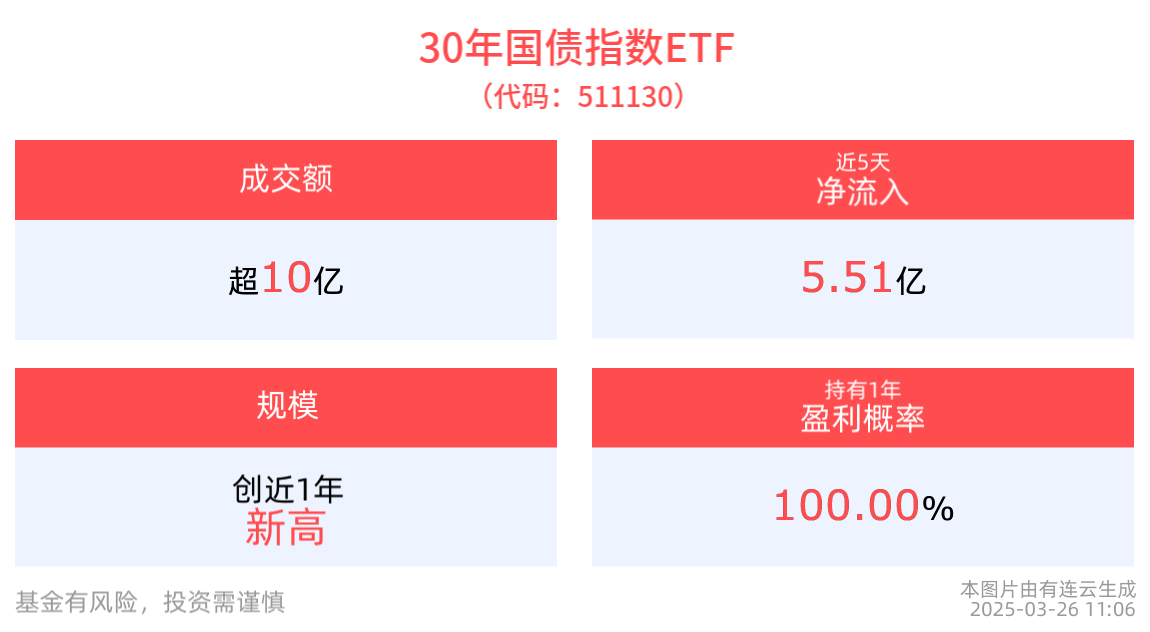
二季度债市或仍需保持谨慎,30年国债指数ETF(511130)近5个交易日合计“吸金”超5.5亿元
Jie Mian Xin Wen· 2025-03-26 03:33
二季度债市或仍需保持谨慎,30年国债指数ETF(511130)近5个交易日合计"吸 金"超5.5亿元 超额收益方面,截至2025年3月25日,30年国债指数ETF成立以来超越基准年化收益为0.14%。 截至2025年3月26日 11:06,30年国债指数ETF(511130)多空胶着,最新报价108.39元,盘中成交额已达10.28亿元,换手率16.63%。 规模方面,30年国债指数ETF最新规模达61.89亿元,创近1年新高。 资金流入方面,30年国债指数ETF近5个交易日内有4日资金净流入,合计"吸金"5.51亿元,日均净流入达1.10亿元。 数据显示,杠杆资金持续布局中。30年国债指数ETF本月以来融资净买额达648.01万元,最新融资余额达1.80亿元。 绝对收益方面,截至2025年3月25日,30年国债指数ETF自成立以来,最高单月回报为5.35%,最长连涨月数为4个月,最长连涨涨幅为10.58%,涨跌月 数比为8/3,上涨月份平均收益率为1.90%,月盈利百分比为72.73%,月盈利概率为72.89%,历史持有1年盈利概率为100.00%。 回撤方面,截至2025年3月25日,30年国债指数ETF ...