鸽派降息

Search documents
今夜!暴涨,创新高!
中国基金报· 2025-12-05 16:14
Market Performance - US stock markets saw an increase, with the Dow Jones rising over 100 points and both the Nasdaq and S&P 500 indices up approximately 0.4% [1] - Chinese concept stocks surged over 1%, with Baidu experiencing a significant rise of over 5% [2] Key Indices and Stocks - The Nasdaq China Golden Dragon Index rose by 1.37%, reaching 7837.91 [3] - Notable performers included: - Sohu: +12.03% - Qidian Island: +11.39% - Dingdong Maicai: +10.33% - Huya: +8.04% - Baidu: +5.15% [4] Silver Prices - Spot silver prices broke through $59, setting a new historical high [5] Positive Factors Behind Market Rise - Positive developments in US-China trade relations were reported, with discussions between Chinese and US officials focusing on practical cooperation and resolving trade concerns [7] - US inflation data showed a core personal consumption expenditures (PCE) price index at an annual rate of 2.8%, lower than the expected 2.9%, which may influence the Federal Reserve's interest rate decisions [8] - The US consumer confidence index rose for the first time in five months, indicating improved sentiment regarding personal financial prospects [9]


彭博:下周降息已成共识,美银Hartnett担心:美联储若过于鸽派,可能终结美股圣诞反弹行情?
美股IPO· 2025-12-05 16:03
Core Viewpoint - The article discusses the prevailing expectation on Wall Street for a 25 basis point interest rate cut by the Federal Reserve next week, with major banks like Morgan Stanley, JPMorgan, and Bank of America shifting their forecasts towards this outcome. However, there are warnings that overly dovish signals could mislead the market about the severity of economic slowdown, potentially leading to a sell-off in long-term government bonds and impacting the stock market [1][3][4]. Group 1: Interest Rate Expectations - Major banks have changed their stance to expect a rate cut in December, influenced by weak economic data and dovish comments from key Federal Reserve officials [4]. - The swap market indicates that investor bets on a 25 basis point cut on December 10 have surged from 60% a month ago to over 90%, with expectations of three rate cuts by September 2026 fully priced in [3][4]. - Morgan Stanley now anticipates rate cuts in January and April, adjusting their previous forecast, while Bank of America predicts cuts in June and July [5]. Group 2: Market Risks - Bank of America strategist Hartnett warns that overly dovish signals from the Fed could imply a greater economic slowdown than expected, which may trigger a sell-off in long-term bonds and affect the stock market [5][6]. - The S&P 500 index is currently about 0.5% away from its historical high, but a dovish stance from the Fed could lead to market sell-offs [3][6]. - Hartnett's team suggests that investors prepare for potential government intervention in the economy, recommending investments in undervalued mid-cap stocks and sectors related to the economic cycle [6]. Group 3: Internal Fed Disagreements - A Bloomberg survey indicates that a significant majority of economists expect a split vote at the upcoming Fed meeting, reflecting increasing tensions within the Federal Open Market Committee [7]. - Some Fed officials, including Kansas City Fed President Jeff Schmid, are expected to vote against the rate cut due to concerns over inflation [8]. - The divergence in opinions among Fed officials stems from differing assessments of the balance between price stability and full employment, with some expressing worries about persistent inflation driven by tariffs [8][10]. Group 4: Economic Data Signals - Recent economic data has provided mixed signals, with large companies announcing layoffs while weekly unemployment claims remain low [9]. - The Labor Department has not released updated inflation reports due to a government shutdown, complicating the decision-making process for the Fed [9][10]. - Most economists view a significant weakening of the labor market as the primary challenge for policymakers, with only a minority considering severe inflation as a greater risk [10].
下周降息板上钉钉?美银Hartnett警告:美联储若鸽派降息,可能终结美股圣诞反弹行情
Hua Er Jie Jian Wen· 2025-12-05 13:43
Core Viewpoint - The cautious economic outlook from the Federal Reserve may threaten the year-end stock market rally, with the S&P 500 index currently only about 0.5% away from its historical high. If the Fed signals an overly dovish stance in the upcoming meeting, it could imply a more significant economic slowdown than expected, leading to market sell-offs [1]. Group 1: Federal Reserve's Interest Rate Expectations - Major financial institutions, including Morgan Stanley, JPMorgan, and Bank of America, have shifted their expectations towards a rate cut in December, influenced by weak economic data and dovish statements from key Fed officials [2]. - The swap market indicates that investor bets on a 25 basis point rate cut on December 10 have surged from 60% a month ago to over 90%, with traders fully pricing in three rate cuts by the Fed before September 2026 [1][2]. - Morgan Stanley now anticipates rate cuts in January and April, adjusting their previous forecast, while Bank of America suggests potential rate cuts in June and July of next year [2]. Group 2: Internal Disagreements within the Federal Reserve - A Bloomberg survey of 41 economists indicates that a split vote is expected in the upcoming Fed meeting, reflecting increasing tensions within the Federal Open Market Committee [4]. - Several regional Fed presidents, including Jeff Schmid and Alberto Musalem, are anticipated to vote against the proposed rate cut due to concerns over inflation [4][5]. - The divergence in opinions among Fed officials stems from differing assessments of the balance between price stability and full employment, with some expressing worries about persistent inflation driven by tariffs [5]. Group 3: Economic Data and Labor Market Signals - Recent economic data has provided mixed signals, with large companies like Verizon and Amazon announcing significant layoffs, yet weekly unemployment claims remain low [6]. - The Labor Department has not released updated inflation reports due to a government shutdown, with the last available data showing a 3% year-over-year increase in the Consumer Price Index for September [6]. - Most economists view a significant weakening of the labor market as the primary challenge for policymakers, with only 18% considering more severe inflation as a greater risk [7].
美银警告:美联储鸽派降息恐终结股市涨势
Sou Hu Cai Jing· 2025-12-05 11:40
美国 银行策略师警告称,若美联储对经济前景持过度谨慎态度,可能危及年末股市的上涨行情。在标 普500指数逼近历史高点之际,投资者正期待最理想情景——即美联储降息伴随通胀回落,同时经济保 持韧性。但美银策略师迈克尔·哈内特指出,若美联储在下周会议上释放鸽派信号,这种乐观情绪将面 临考验,因为这可能暗示经济放缓程度超预期。哈内特在报告中写道:"唯一可能扼杀'圣诞行情'的, 就是鸽派降息引发长期债券抛售。"他指的是期限较长的美国国债。 ...
美联储如期降息,如何影响A股港股?外资观点来了
证券时报· 2025-09-19 09:53
Core Viewpoint - The Federal Reserve announced a 25 basis point rate cut, lowering the federal funds rate target range to 4.00%-4.25%, indicating a shift in focus from controlling inflation to stabilizing growth and employment [1][2]. Group 1: Federal Reserve's Rate Cut - The rate cut aligns with market expectations and reflects a risk management approach to balance inflation and employment risks [2][4]. - The Fed's decision suggests a growing concern over labor market weakness, with future rate cuts dependent on economic data performance [2][3]. - The Fed's dot plot indicates three rate cuts in 2025 and one in both 2026 and 2027, with some institutions predicting additional cuts in November and December [3][4]. Group 2: Market Reactions and Global Implications - Following the rate cut, U.S. equity markets remained stable, indicating that the market had largely priced in the expected cut [6]. - There is an anticipated increase in foreign capital allocation to A-shares and Hong Kong stocks, driven by a weaker dollar and global capital rebalancing [6][7]. - Non-U.S. equity markets, particularly in China, Japan, and Europe, are viewed positively as potential investment opportunities [6][7]. Group 3: Economic Outlook and Future Considerations - The Fed emphasizes that future policy decisions will be data-driven, with ongoing structural tensions between inflation and employment complicating monetary policy [4][5]. - The potential for further dovish rate cuts could lead to a steepening of U.S. Treasury yields, impacting investor expectations for risk premiums [7]. - The overall economic environment post-rate cut may lead to a resurgence in global economic fundamentals, necessitating close monitoring of subsequent developments [6][7].
美联储如期降息,如何影响A股港股?外资观点来了
券商中国· 2025-09-19 08:59
Core Viewpoint - The Federal Reserve announced a 25 basis point rate cut, lowering the federal funds rate target range to 4.00%-4.25%, indicating a shift in focus from controlling inflation to stabilizing growth and employment [1][2]. Group 1: Federal Reserve's Rate Cut - The rate cut aligns with market expectations and reflects a risk management approach to balance inflation and employment risks, with increasing concerns about job market downturns [2][4]. - Various foreign institutions interpret the rate cut as a sign of the Fed's shift in focus from persistent inflation to labor market weakness, potentially easing concerns about the U.S. interest rate advantage [2][3]. - The Fed's dot plot suggests three rate cuts in 2025 and one in both 2026 and 2027, with some institutions predicting additional cuts in November and December [3][4]. Group 2: Market Implications - Following the rate cut, U.S. stock markets remained stable, indicating that the market had largely priced in the 25 basis point cut [5]. - The outlook for small-cap stocks is optimistic, driven by expectations of further monetary easing from the Fed, with a favorable view on non-U.S. equity markets, particularly in China, Japan, and Europe [6]. - A weaker dollar is expected to facilitate global capital rebalancing, with increased foreign investment demand in A-shares and Hong Kong stocks [6]. Group 3: Economic Outlook - The Fed emphasizes that future policy decisions will be data-dependent, with ongoing structural conflicts between labor markets and inflation complicating future actions [4][6]. - The potential for a dovish rate cut could lead to a steepening of U.S. Treasury yields, while uncertainties regarding tariffs may impact corporate earnings, particularly in the tech sector [6].
美联储降息终于兑现,黄金要冲更多新高取决于什么?
Sou Hu Cai Jing· 2025-09-17 10:37
Group 1 - The core viewpoint indicates that the Federal Reserve is expected to implement its first interest rate cut of the year by 25 basis points, with a lower likelihood of a 50 basis point cut due to signs of slowing employment growth [1][3] - Recent economic data supports a more accommodative monetary policy, with August non-farm payrolls adding only 22,000 jobs and the unemployment rate rising to 4.4%, marking the first negative growth in non-farm employment since 2020 [3] - Inflation is showing signs of cooling, with the August CPI rising 2.9% year-over-year, which aligns with expectations [3] Group 2 - Key focus areas for the upcoming Federal Reserve decision include the potential adjustments in economic growth forecasts due to consumer slowdown and labor market weakness, as well as any changes in core PCE inflation expectations [7] - The market is particularly attentive to the "dot plot" from the Federal Reserve, which indicates a potential 50 basis points of rate cuts this year, with expectations of a total of 75 basis points in cuts by year-end [5][7] - The market's reaction to the Federal Reserve's statements and the dot plot will be crucial in determining future volatility [5] Group 3 - Gold prices have surged over 40% this year, outperforming major assets like the S&P 500, and have recently reached record highs, supported by a declining dollar index [7][9] - The trajectory of gold prices post-Federal Reserve decision will depend on the signals released by the Fed and market interpretations of those signals [7][9] - A dovish stance from the Federal Reserve could enhance gold's appeal, potentially pushing prices above $3,700, while a hawkish stance may lead to profit-taking and short-term price corrections [9]
一年中最凶险的月份到来,美股能否成功渡劫?
Jin Shi Shu Ju· 2025-09-02 03:29
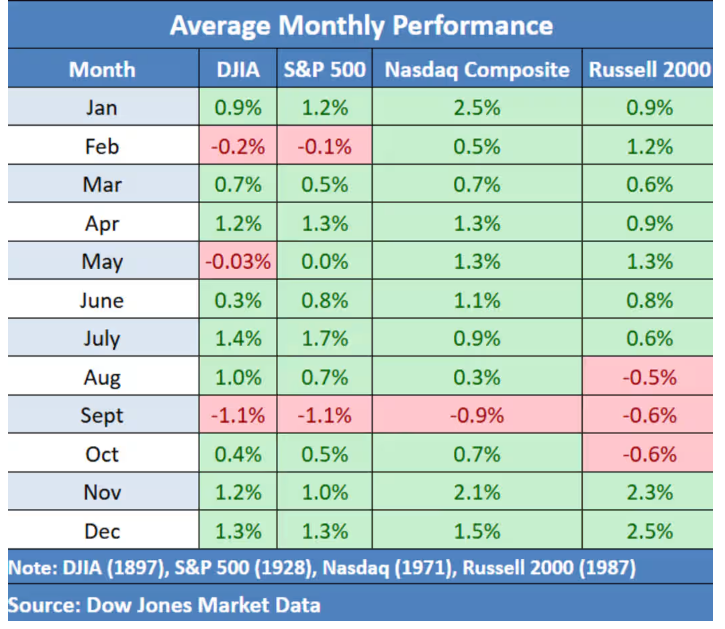
Core Viewpoint - September is historically the most challenging month for the U.S. stock market, with increased volatility and a tendency for seasonal weakness [1][2] Group 1: Historical Performance - The Dow Jones Industrial Average (DJI) has an average monthly decline of 1.1% in September, with only 42.2% of years showing an increase [2] - The S&P 500 and Nasdaq Composite also perform poorly in September, with average declines of 1.1% and 0.9% respectively [2] - Historical data shows that if the market is in an upward trend before September, the seasonal weakness may dissipate [2][3] Group 2: Recent Market Trends - The U.S. stock market had a strong performance in August, with the DJI rising 3.2%, marking its best August since 2020 [3] - The Russell 2000 index saw a significant increase of 7% in August, the best monthly performance in 25 years [3] - The S&P 500 was above its 200-day moving average, which historically correlates with a higher likelihood of positive performance in September [4][3] Group 3: Economic Indicators and Expectations - Key events influencing September's market include the upcoming non-farm payroll report and the Federal Reserve's policy meeting, where a 25 basis point rate cut is expected [5] - The uncertainty surrounding whether the rate cut will be dovish or hawkish is a significant factor for market direction [5] - The VIX index, a measure of market volatility, has recently dropped, indicating a low volatility environment that may precede increased market fluctuations [5][6][7]