A股增量资金

Search documents
2026年A股增量资金展望:中高净值的存款搬家很可能已形成趋势
GF SECURITIES· 2025-12-21 07:22
Group 1 - The core narrative for A-shares in 2025 is "asymmetric upside returns and limited downside risks," supported by regulatory measures and insurance capital to curb index declines, while domestic deposit migration and overseas dollar inflows create upward potential for indices [10][11][18] - In 2025, the inflow of external funds remains in the early stages, with limited participation from residents and foreign investors, despite a recovery in risk appetite [10][11][13] - The report highlights that the investment willingness of urban depositors has improved since Q3 2024, but remains at low absolute levels, indicating a gradual recovery in risk appetite [10][25][40] Group 2 - Looking ahead to 2026, the report anticipates a continuation of the supportive role of insurance capital and regulation, with a more pronounced migration of deposits, particularly among high-net-worth individuals, and increased foreign investment [10][36] - Factors supporting resident capital inflow include reduced market volatility due to insurance and regulatory backing, easing pressure on household balance sheets, and a higher degree of liquidity in deposits [10][36][40] - The report notes that the current environment offers limited high-yield alternatives to stocks, enhancing the attractiveness of the equity market [10][58] Group 3 - The report indicates that the migration of deposits among high-net-worth individuals is accelerating, with significant new registrations in private equity funds, reaching 386 billion yuan from January to October 2025 [10][61] - External factors include a potential increase in global capital allocation to non-US assets due to downward pressure on the dollar, alongside expectations of improving fundamentals in A-shares [10][68] - The report emphasizes that A-shares are at a turning point in the profit cycle, with expectations for fundamental improvements in 2026, which could attract more foreign capital [10][75][82]
A股新变量“涌现”
Xin Lang Cai Jing· 2025-12-09 12:29
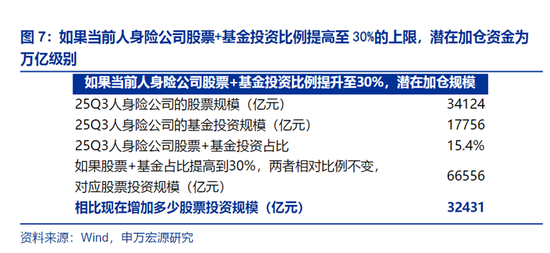
Core Viewpoint - The article emphasizes a significant shift in the investment behavior of insurance funds, which are becoming a new source of long-term capital for the A-share market, driven by regulatory changes and a declining interest rate environment [2][24]. Group 1: Changes in Insurance Fund Investment - Insurance funds are experiencing a directional adjustment, with over 1 trillion yuan added to stock investments this year [2][12]. - Recent regulatory adjustments have lowered the "invisible costs" associated with insurance funds entering the stock market, making it more attractive for them to invest [2][10]. - The adjustment in risk factors for long-term holdings in major indices indicates a clearer path for insurance funds to allocate capital [4][5]. Group 2: Impact of Regulatory Changes - The risk factor for stocks held over three years in the CSI 300 index has been reduced from 0.3 to 0.27, and for stocks in the Sci-Tech Innovation Board from 0.4 to 0.36 [4][5]. - Lower risk factors mean that insurance companies need to set aside less capital for potential losses, effectively reducing their internal cost of investment [10][11]. - This reduction in "invisible burden" is expected to increase the potential investment space for insurance funds [11][32]. Group 3: Future Investment Potential - By the end of Q3 2025, the direct stock holdings of insurance funds are projected to increase from 2.43 trillion yuan to 3.62 trillion yuan, reflecting a significant increase in investment activity [12][33]. - If the investment ratio of stocks and funds by life insurance companies increases from 15% to 30%, the potential additional investment could reach approximately 3.2 trillion yuan [39]. - Regulatory proposals suggest that from 2025, large state-owned insurance companies will allocate 30% of new premiums to A-share investments, potentially adding around 2 trillion yuan to the market by 2026 [40].

12月8日热门路演速递 | 降息、重估、大宗、资金流,五场连击洞见2026
Wind万得· 2025-12-07 22:59
Group 1 - The article discusses the potential impact of the Federal Reserve's interest rate cuts and the upcoming Central Economic Work Conference on the macroeconomic landscape [2][4] - It highlights the expected changes in dollar liquidity and the reasons behind the recent strength of the Renminbi [4][5] - The article emphasizes the anticipated shift in global liquidity favoring AH shares and the revaluation of Renminbi assets, alongside the potential for a bull-bear transition in the US stock market [7][8] Group 2 - The analysis includes projections for the agricultural product market, questioning whether a global upcycle is beginning and identifying trading opportunities in grains, oils, cotton, sugar, and live pigs [10] - It estimates that the reallocation of household assets could bring approximately 5.4 to 12.0 trillion yuan of incremental funds to the A-share market by 2030 [12] - The potential incremental funds from insurance capital entering the A-share market are projected to be around 6.0 to 9.6 trillion yuan by 2026 [13]



“重估牛”系列之资金篇(三):A 股增量资金空间测算:居民存款与机构资金潜展望
Changjiang Securities· 2025-11-26 11:21
Group 1 - The report indicates that A-shares are expected to gradually emerge from a structural "slow bull" market, with potential liquidity support from resident deposits and institutional funds in the medium to long term [3][18] - By 2030, the reallocation of resident assets is projected to bring in approximately CNY 5.4 to 12.0 trillion into the market, with contributions from deposit "migration" estimated at CNY 3.5 to 6.2 trillion and asset reallocation contributing CNY 1.9 to 5.7 trillion [3][7] - Insurance funds are expected to cumulatively increase their allocation to stocks and funds by about CNY 4.5 to 6.5 trillion over the next nine quarters [3][8] Group 2 - The potential "migration" space for resident deposits in China by 2030 is estimated to be between CNY 15.1 trillion and 24.0 trillion, based on different GDP growth scenarios and historical deposit decline rates [6][30] - The report outlines two scenarios for deposit migration: a rapid transfer scenario (2013Q1-2015Q2) leading to an upper limit of CNY 23.8 to 24.0 trillion, and a moderate transfer scenario (2020Q2-2021Q4) resulting in a lower limit of CNY 15.1 to 15.2 trillion [6][31] - The potential incremental funds from resident asset reallocation to the A-share market could range from CNY 3.5 to 6.2 trillion under different scenarios of deposit migration [7][34] Group 3 - The report estimates that by 2026, the potential incremental funds for the A-share market could be around CNY 6.0 to 9.6 trillion, with contributions from various channels including the primary market, active funds, private equity, and ETF funds [9][20] - The primary market is projected to contribute approximately CNY 347.2 to 559.4 billion, while private equity funds could contribute CNY 1.25 to 2.32 trillion, and ETF funds could add CNY 2.61 to 3.95 trillion [9][20] - The current margin balance as a percentage of the circulating market value remains healthy, indicating further potential for leverage funds to be released [9][35]
买买买!是谁在做多市场?
天天基金网· 2025-08-21 05:08
Core Viewpoint - The article discusses the recent influx of incremental funds into the A-share market, highlighting the active participation of institutional investors compared to retail investors, and the overall market sentiment towards potential growth opportunities [2][3]. Group 1: Retail Investor Participation - Recent grassroots research indicates a moderate increase in retail investor accounts, primarily among younger generations, but no significant surge in online account openings has been observed [4][5]. - The current participation level of retail investors is estimated at around 120 points on a scale where last year's peak was 200-300 points, indicating a cautious approach rather than a rush to enter the market [4][5]. - Overall, retail investor enthusiasm remains subdued, with new account openings in July at 1.96 million, similar to April levels, suggesting a lack of concentrated inflow from outside investors [5][6]. Group 2: Active Funds Driving the Market - Institutional investors are identified as the main drivers of recent market uptrends, with a notable increase in institutional account openings compared to retail accounts [7][8]. - High-net-worth investors, including private equity and leveraged funds, are actively participating, with daily inflows of leveraged funds averaging 5.5 billion since July [7][8]. - The private equity sector has seen significant growth, with an average stock long position of 61.1% in June, reflecting increased confidence and investment activity [8]. Group 3: Foreign Investment Trends - Foreign capital is increasingly optimistic about the Chinese stock market, with global hedge funds rapidly buying Chinese stocks, primarily driven by long positions [9][10]. - South Korean investors have significantly increased their trading volume in Chinese stocks, with cumulative transactions reaching $5.514 billion by the end of July, surpassing last year's total [9][10]. - Despite growing interest, there remains a divergence in foreign investors' strategies regarding Chinese assets, with some expressing caution despite increased attention [9][10].