
权益基金

Search documents
三大基金代销巨头,最新披露!
证券时报· 2026-03-28 03:08
Core Viewpoint - The fund distribution industry has shown significant growth in 2025, with major players like Ant Fund, Tian Tian Fund, and China Merchants Bank reporting strong financial performance driven by market recovery and strategic adjustments [2][5][11]. Group 1: Ant Fund Performance - Ant Fund achieved a net profit exceeding 1 billion yuan, with total revenue reaching 20.23 billion yuan, a 24% increase year-on-year [5]. - The fund's net profit grew by 141% to 1.085 billion yuan, with a net profit margin of 5.4% [5]. - By the end of 2025, Ant Fund's equity fund holdings surpassed 1 trillion yuan, marking it as the first in the industry to achieve this milestone [6]. Group 2: China Merchants Bank Performance - China Merchants Bank reported a non-monetary public fund sales volume of 706.47 billion yuan, an 18.13% increase year-on-year [8]. - The bank's retail wealth management fees and commissions reached 23.79 billion yuan, with fund income accounting for 25.65% of this total [8]. - By the end of 2025, the bank's equity fund holdings reached 610.5 billion yuan, a 24% increase from the previous half-year [8]. Group 3: Tian Tian Fund Performance - Tian Tian Fund reported a revenue of 3.203 billion yuan, a 12.27% increase year-on-year, and a net profit of 180 million yuan, up 19.21% from the previous year [11]. - The fund's sales volume reached 2.6 trillion yuan, a significant 38.51% increase compared to 1.88 trillion yuan in 2024, surpassing its previous record [11]. - By the end of 2025, Tian Tian Fund's non-monetary market public fund holdings reached 770.13 billion yuan, a 25.97% increase year-on-year [12].



三大基金代销巨头,最新披露!各家“秘密武器”大曝光
券商中国· 2026-03-28 00:59
Core Insights - The article highlights the strong performance of fund distribution companies in 2025, driven by a recovering capital market and strategic adjustments, including the use of AI technology to enhance customer service capabilities [1][2]. Ant Financial - Ant Financial's net profit exceeded 1 billion yuan in 2025, with total revenue reaching 20.234 billion yuan, a year-on-year increase of 24% [2]. - The company achieved a net profit of 1.085 billion yuan, marking a 141% increase, with a net profit margin of 5.4% [2]. - By the end of 2025, Ant Financial's equity fund holdings surpassed 1 trillion yuan, becoming the first in the industry to do so, with a growth of 23.7% from the previous half-year [3]. China Merchants Bank - China Merchants Bank reported a fund sales volume of 706.466 billion yuan in 2025, an increase of 18.13% year-on-year [4]. - The bank's retail wealth management fee and commission income reached 23.794 billion yuan, with fund agency income accounting for 25.65% [4]. - By the end of 2025, the bank's equity fund holdings reached 610.5 billion yuan, a 24% increase from the previous half-year [4]. Tian Tian Fund - Tian Tian Fund achieved a revenue of 3.203 billion yuan in 2025, a year-on-year increase of 12.27%, and a net profit of 180 million yuan, up 19.21% from 2024 [6]. - The fund sales volume reached 2.6 trillion yuan, a significant increase of 38.51% compared to 1.88 trillion yuan in 2024, surpassing its previous record [6]. - By the end of 2025, Tian Tian Fund's non-monetary market public fund holdings reached 770.133 billion yuan, a growth of 25.97% year-on-year [7].
黄金白银跌幅扩大,商品基金下跌7.48%
Tai Ping Yang Zheng Quan· 2026-03-24 13:30
Investment Rating - The report does not explicitly provide an investment rating for the industry. Core Insights - The report highlights a significant decline in gold and silver prices, with commodity funds experiencing a drop of 7.48% this week. The ongoing geopolitical issues, particularly related to the US-Iran situation, have negatively impacted various indices, including the Shanghai Composite Index and the Nasdaq [14][41]. Summary by Sections 1. Major Asset Market Overview (a) Equity - The Shanghai Composite Index closed at 3957.05, with a weekly decline of 3.38%. Other indices such as the Shenzhen Component and the ChiNext Index also saw declines of -2.90% and -3.86%, respectively. Notably, the telecommunications and banking sectors performed relatively well, with increases of 2.10% and 0.36%, while the non-ferrous and basic chemical sectors faced significant declines of -11.82% and -10.53% [7][8]. (b) Bonds - The report indicates that the 1-year, 3-year, and 10-year government bond yields are 1.26%, 1.35%, and 1.83%, respectively. The yield spread between the 10-year and 1-year bonds increased by 3.56 basis points to 57.31 basis points this week. In the credit bond market, the 1-year AAA corporate bond spread and the 1-year local government bond spread changed by 0.49 and 0.72 basis points, respectively [22][23]. (c) Commodities - In the commodities market, crude oil prices increased by 3.05%, while gold prices fell by 8.23%. Other commodities such as copper and aluminum also saw declines of -5.66% and -4.09%, respectively. The report notes that the South China index for various commodities, including precious metals, has shown a significant drop of -11.29% [28][29]. (d) Foreign Exchange - The report details the exchange rates of major currencies against the RMB, with the US dollar depreciating by 0.31%. The dollar index remained stable at 99.51, while COMEX gold prices fell to $4492 per ounce, down 10.57% from the previous week [33][34]. 2. Fund Market Overview (a) New Fund Establishments - A total of 47 new funds were established this week, including 28 equity funds and 13 fixed income + funds. The largest fund launched was the E Fund Hong Kong Stock Connect Technology ETF, with a size of 9.061 billion RMB [35][36]. (b) Fund Performance - The report indicates that commodity funds experienced the largest decline of 7.48%, while equity funds and balanced funds also faced significant drops of 3.28% and 3.10%, respectively. The ongoing geopolitical tensions have adversely affected the performance of major indices [41][42]. (c) Fund Size and Quantity - As of March 20, 2026, there are 13,795 open-end public funds with a total size of 37.75 trillion RMB. Equity funds account for the largest number at 7,420, while fixed income funds represent the largest share in terms of size at 23.65 trillion RMB [37][38].
2025H2公募基金销售机构保有数据点评:全品类规模均增长,头部集中度上行,积极布局指数产品
CMS· 2026-03-22 09:26
Investment Rating - The report maintains a positive investment rating for the industry, highlighting significant growth in fund holdings and a shift towards index products [6]. Core Insights - The overall fund holdings have shown substantial growth, with non-monetary fund holdings of the top 100 sales institutions reaching 11.7 trillion, a 14.7% increase from the previous half [2]. - Equity fund holdings have rebounded, with a 16.7% increase to 6.0 trillion, while fixed income holdings grew by 12.7% to 5.7 trillion [2]. - The growth rate of passive funds outpaces that of active funds, with stock index funds increasing by 23.7% to 2.4 trillion [2]. - The concentration of top institutions is rising, with 57 brokerage firms in the top 100, and notable entries and exits among various categories [3]. Summary by Sections Fund Holdings Growth - Non-monetary fund holdings of the top 100 institutions reached 11.7 trillion, up 14.7% from the previous half [2]. - Equity fund holdings increased to 6.0 trillion, a 16.7% rise, while fixed income holdings reached 5.7 trillion, up 12.7% [2]. Performance of Different Fund Types - The three major indices saw an average increase of 27.2%, with the Wind equity fund index rising by 23.5% [2]. - Passive equity funds grew significantly, while active equity funds saw a more modest increase of 12.4% [2]. Institutional Concentration - The top 100 institutions include 57 brokerage firms, 25 banks, and 17 internet firms, with notable changes in rankings [3]. - The market share of banks increased to 21.5%, while internet firms reached 17.7%, and brokerage firms accounted for 11.4% [3]. Internet Sector Insights - Ant Group maintains a strong position with a non-monetary scale of 1.8 trillion, a 15.5% increase, and a market share of 8.0% [4]. - There is a notable differentiation in fixed income and equity layouts among internet firms, with significant growth in specific funds [4]. Banking Sector Insights - China Merchants Bank leads the banking sector with a non-monetary scale of 1.2 trillion, a 19.8% increase, and a market share of 5.5% [10]. - The bank is actively embracing index products, with significant growth in its equity and fixed income holdings [10]. Brokerage Sector Insights - Brokerage firms have seen a strong increase in index fund holdings, with a total of 1.3 trillion, a 21.7% rise [11]. - There is a notable divergence in the performance of active equity funds among different brokerage firms, with some experiencing significant declines [11]. Investment Recommendations - The report suggests focusing on brokerage firms with strong wealth management capabilities, such as GF Securities and Guotai Junan, as the market evolves [11].





公募新发创四年新高:代销百强洗牌与指数突围
市值风云· 2026-03-19 10:14
Core Viewpoint - The public fund industry in China is experiencing significant growth, with total assets surpassing 37 trillion yuan by the end of 2025, indicating a competitive landscape among fund distribution channels [3]. Group 1: Market Growth and Competition - By the end of 2025, the top 100 fund distribution institutions held a total of 11.7 trillion yuan in non-monetary market fund assets, a 14.7% increase from mid-2025, while equity fund assets reached 6 trillion yuan, growing by 16.7% [4]. - Ant Fund emerged as the first distribution institution to surpass 1 trillion yuan in equity fund assets, reaching 1,017.8 billion yuan by the end of 2025, marking a 23.7% increase from mid-2025 [4][5]. Group 2: Index Fund Expansion - The stock index fund segment is identified as a key growth area, with the top 100 institutions holding a total of 2.42 trillion yuan in stock index funds by the end of 2025, reflecting a substantial 23.7% growth [6]. - Major securities firms have seen their stock index fund holdings exceed 50% of their equity fund assets, with Citic Securities at 91% and Huatai Securities at 96% [6]. Group 3: Institutional Dynamics - The competitive landscape is shifting, with 57 securities firms, 25 banks, and 17 independent fund sales institutions represented in the top 100 list, indicating a redefined power structure [8]. - Despite banks maintaining the largest share of non-monetary and equity fund assets at 41.66% and 40.2% respectively, their market share has declined by 1.44% and 1.59% since mid-2025 [8]. - Independent institutions have shown resilience in the active equity segment, with their product scale reaching 12.137 trillion yuan by the end of 2025, a 24.2% increase [8]. Group 4: Changing Competition Logic - The competition among distribution institutions is evolving from merely focusing on initial sales volume to a customer-centric asset management model [9]. - As domestic funding costs decrease, there is a growing need for professional investment advisory services and efficient tools to attract and retain assets in the competitive fund distribution market [9].

金融工程点评:原油延续上涨,商品基金涨幅0.77%
Tai Ping Yang Zheng Quan· 2026-03-16 13:25
Investment Rating - The report does not explicitly provide an investment rating for the industry. Core Insights - The report highlights that the oil market continues to rise, with a significant increase in crude oil prices by 16.35% this week, contributing to a 0.77% increase in commodity funds [21][50]. - The A-share market saw a decline, with the Shanghai Composite Index closing at 4095.45, down 0.70%. Notably, the coal, electric equipment, and construction decoration sectors experienced substantial gains of 5.03%, 4.55%, and 4.12%, respectively [7][50]. - In the bond market, the 10-year government bond yield rose to 1.81%, reflecting a week-on-week increase of 3.33 basis points [24]. - The commodity market showed varied performance, with significant increases in crude oil and other commodities, while gold prices fell by 3.05% [32][50]. Summary by Sections 1. Major Asset Market Overview (1) Equity - The A-share market indices showed mixed results, with the Shanghai Composite Index down 0.70% and the Shenzhen Component Index up 0.76%. The coal and electric equipment sectors performed well, while military and oil sectors faced declines [7][8]. (2) Bonds - The report indicates a net cash outflow of 1011 billion yuan from the central bank's reverse repos. The 1-year, 3-year, and 10-year government bond yields were reported at 1.28%, 1.37%, and 1.81%, respectively [24]. (3) Commodities - The commodity market saw crude oil prices rise by 16.35%, while other commodities like copper and aluminum had mixed results. The South China index showed a 9.76% increase in the energy and chemical sectors [32][50]. (4) Foreign Exchange - The report notes fluctuations in currency exchange rates against the RMB, with the US dollar appreciating slightly by 0.07% [39]. 2. Fund Market Overview (1) New Fund Establishments - A total of 25 new funds were established this week, including 16 equity funds and 2 fixed income + funds, with notable large-scale funds such as the Huatai-PineBridge CSI 300 Free Cash Flow Index A at 11.761 billion yuan [42]. (2) Fund Size and Quantity - As of March 13, 2026, there are 13,756 open-end public funds with a total size of 37.71 trillion yuan, with equity funds making up the largest number at 7,392 [45]. (3) Performance - Commodity funds outperformed with a 0.77% increase, while QDII and equity funds saw declines of -0.20% and -0.69%, respectively. The report attributes the performance to ongoing geopolitical issues affecting oil prices [49][50].
权益基金月度观察(2026/02):新锐基金涌现,主动权益制胜-20260313
Huafu Securities· 2026-03-13 03:50
- The report introduces a method for evaluating equity funds by using 22 benchmark indices as independent variables and fund returns as dependent variables, performing single-variable linear regression for each index, and calculating the R² for each period. A rolling window regression is applied with a 6-month look-back period to determine the benchmark index with the highest average R² over the last six periods, which serves as the performance reference index for the fund[18][19][21] - Equity funds are categorized into five styles: large-cap, mid-small-cap, value, growth, and sector themes. Performance metrics for February 2026 show mid-small-cap funds had the highest median return at 3.14%, followed by value funds at 2.09%, sector theme funds at 2.65%, growth funds at 0.73%, and large-cap funds at 0.34%[24][25][28] - Sector-themed equity funds are divided into categories such as healthcare, cyclical, infrastructure/real estate, consumer, technology, finance, and advanced manufacturing. In February 2026, cyclical and advanced manufacturing funds performed best, with notable products like "Qianhai Open Source Core Resources A" achieving 11.1% and "China Carbon Neutral A" achieving 16.9%[27][30][31] - The report tracks high-rated funds that consistently achieve high ratings over the past three months. These funds are evaluated based on their reference indices, fund managers, tenure, and recent scores. Examples include "BoDao ShengYan A" with a reference index of CSI 500 and an R² of 0.72, and "HuaTai BaiRui Quantitative Wisdom A" with an R² of 0.95[59][60][61] - Newly rated funds are highlighted as "emerging funds" with high potential for returns and differentiated strategies. These funds are managed by fund managers with less than three years of experience and were rated for the first time this month. Examples include "ChangCheng Cycle Optimization A" linked to the cyclical index and "HuaXia Digital Industry A" linked to the digital economy index[66][67] - Funds with significant rating improvements are categorized as "rating leap funds," reflecting enhanced performance and optimized management strategies. Examples include "PengYang YuanHe Quantitative Large-Cap Selection A" linked to CSI 300 and "GuoTou RuiYin Prosperous Industry" linked to CSI 300[68][69]
投顾周刊:开年吸金超百亿元,混合理财产品热销
Wind万得· 2026-03-07 22:30
Economic Growth and Policy Focus - The government aims for an economic growth target of 4.5%-5% for the year, with a focus on maintaining medium to high-speed growth while nurturing new productive forces and transforming the economic structure [3] - The report emphasizes strengthening housing security for newly married and childbearing families, and encourages multiple channels to revitalize existing housing stock [3] Artificial Intelligence Industry - By 2025, China's core artificial intelligence industry is projected to exceed 1.2 trillion yuan, with over 6,200 companies, indicating strong growth in embodied intelligence and computing infrastructure [4] - The rapid development of AI is seen as a core engine for the transformation and upgrading of China's real economy [4] Financial Products and Market Trends - In early 2026, mixed financial products have seen significant popularity, with over 60 new products issued, totaling nearly 15 billion yuan, reflecting a shift in investor preference towards stable and enhanced returns [4] - Public fund institutions have initiated a self-purchase trend, accumulating over 910 million yuan, primarily in equity funds, signaling confidence in long-term investment value [6] Global Market Insights - IDC predicts that the global intelligent robotics hardware market will approach 30 billion USD by 2026, with China leading the market, expected to surpass 11 billion USD [7] - Recent geopolitical tensions, particularly involving Iran, have heightened risk perceptions in international energy markets, impacting oil prices [7] Stock Market Performance - Major global stock markets have experienced declines, with the Shanghai Composite Index down 0.93% and the Hang Seng Index down 3.28% [8][9] - The recent week saw a general downturn across various indices, indicating a cautious market sentiment [8][9] Bond Market Trends - Recent bond yield movements show a mixed performance, with 1-year Chinese government bond yields decreasing by 3.10 basis points to 1.29% [12] - The 10-year U.S. Treasury yield increased by 18 basis points to 4.15%, reflecting differing market conditions [12] Fund Performance and Market Dynamics - The overall fund index has shown a downward trend, with the total index down 1.35% in the recent week [14] - Fixed income and pure bond funds dominate the market, accounting for nearly 70% of the total number of products and over 90% of the total scale [17] Commodity Market Movements - Precious metals have seen a pullback, with COMEX gold down 1.27% and silver down 9.21%, while international oil prices surged by 28.06% [15][16] - The dollar index has risen by 1.34%, indicating a stronger dollar against other currencies [15][16]

开年公募发行“春意盎然”,权益基金成主力
2 1 Shi Ji Jing Ji Bao Dao· 2026-02-27 23:11
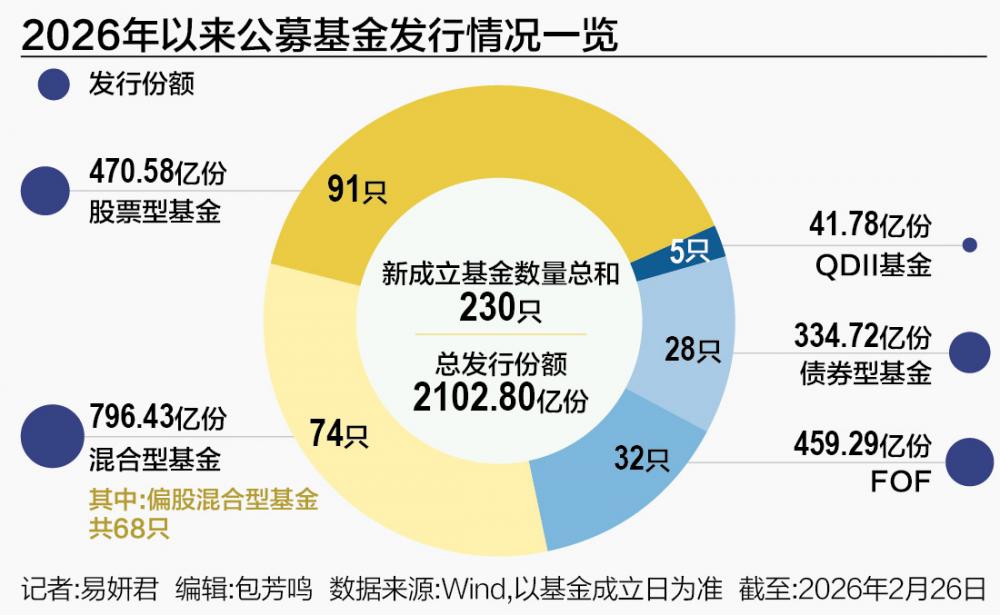
Core Insights - The public fund issuance market in 2026 is showing strong growth, with 230 new funds established and a total issuance scale of 210.28 billion yuan, representing a year-on-year increase of over 41% [1][11][12] Fund Structure Changes - The structure of new funds has shifted significantly, with equity funds dominating, while FOF and fixed income products are also gaining traction [12][17] - In the first two months of 2026, 74 new mixed funds were established with a total issuance of 79.64 billion yuan, accounting for approximately 38% of the total new fund issuance [3][16] - A total of 91 new stock funds were launched, with an issuance scale of 47.06 billion yuan, representing about 22% of the total [3][16] Equity Fund Performance - The total issuance scale of newly established equity funds (stock funds + equity mixed funds) reached 120.84 billion yuan in the first two months of 2026 [3][16] - The issuance of equity funds is expected to bring significant incremental capital into the A-share market, improving liquidity and enhancing institutional pricing power [13][19] Trends in Fund Issuance - The current trends in public fund issuance include a focus on equity, an increase in passive and tool-based products, improved fundraising efficiency, and a concentration on thematic investment tracks [5][19] - The issuance of bond funds has seen a notable decline, with only 28 new bond funds established in the first two months of 2026, totaling 33.47 billion yuan, compared to 73.64 billion yuan in the same period of 2025 [18][19] Future Outlook - The issuance of equity funds is likely to continue, with 58 new funds scheduled for release in March 2026, including 22 stock funds and 12 mixed funds [21] - Investment opportunities in 2026 are expected to be more diverse, driven by macroeconomic cycles and technological innovations, particularly in AI and semiconductors [23][24]
超1200亿元!开年公募发行“春意盎然”,权益基金成主力
2 1 Shi Ji Jing Ji Bao Dao· 2026-02-27 12:53
Core Insights - The public fund issuance market in 2026 shows significant growth, with 230 new funds established and a total issuance scale of 210.28 billion yuan, representing a year-on-year increase of over 41% in both quantity and scale [1][2] Fund Structure Changes - The structure of new funds has shifted, with equity funds dominating, while FOF and fixed income+ products are emerging strongly [2][5] - In the first two months of 2026, 74 new mixed funds were established, totaling 79.64 billion yuan, accounting for approximately 38% of the total new fund issuance [3] - New stock funds primarily consist of ETF products, with 91 new stock funds launched, totaling 47.06 billion yuan, representing about 22% of the total [4] Equity Fund Dominance - The total issuance scale of newly established equity funds (stock funds + equity mixed funds) reached 120.84 billion yuan in the first two months of 2026 [4] - The trend indicates a strong willingness for new capital to enter the market, improving liquidity and enhancing institutional pricing power [2][11] Fixed Income Fund Trends - The issuance scale of newly established bond funds has significantly declined, with a total of 28 new bond funds launched, totaling 33.47 billion yuan, compared to 73.64 billion yuan in the same period of 2025 [6][7] - The decline in bond fund issuance reflects a shift in investor preference towards equity assets [11] Market Outlook - The hot issuance of equity funds is expected to attract significant incremental capital into the A-share market, potentially leading to a positive impact on liquidity and pricing power [8][11] - There are 58 new funds scheduled for issuance in March, indicating continued interest in equity investments [10] Investment Themes - Newly established equity funds cover various themes, including technology, consumption, and resource sectors, reflecting a diverse investment strategy [9] - The focus for 2026 is expected to be on performance realization and domestic production, particularly in AI and semiconductor sectors [12][13]