
CPO技术

Search documents
美股光通信概念股走高,英伟达推进CPO技术部署,A股融资净买入活跃
Jin Rong Jie· 2026-02-10 05:28
Group 1 - The core viewpoint of the articles highlights the significant rise in optical communication concept stocks in the U.S. market, driven by advancements in Co-Packaged Optics (CPO) technology and supportive government policies [1][2]. - Companies such as Credo Technology, Corning, Ciena Technologies, and Lumentum have shown notable stock price increases, indicating strong market interest in optical communication technologies [1]. - NVIDIA is advancing the scale deployment of CPO technology to address the growing power consumption and reliability challenges of AI supercomputers, integrating optical engines into the same package as switching chips [1]. Group 2 - In the A-share market, as of February 6, ten CPO concept stocks have received net financing purchases exceeding 100 million yuan, with Tianfu Communication and Zhongji Xuchuang leading at 2.542 billion yuan and 2.21 billion yuan respectively [2]. - Tianfu Communication has reported that its 1.6T optical engine products have entered normal delivery stages, and the company is coordinating supply chain resources to enhance production capacity [2]. - New Yisong expects to achieve a net profit attributable to shareholders of 9.4 billion to 9.9 billion yuan by 2025, representing a year-on-year growth of 231.24% to 248.86%, and has successfully mass-produced and delivered 1.6T optical module products [2].


光模块的焦虑:“CPO冲击”存在误读,“筹码过度集中”需要时间消化
Hua Er Jie Jian Wen· 2026-02-10 01:21
Core Viewpoint - The report by Guosheng Securities analysts argues that market concerns regarding CPO technology replacing pluggable optical modules are based on a misunderstanding of industry fundamentals, leading to irrational market valuations [1] Group 1: CPO vs. Pluggable Modules - CPO and pluggable optical modules are not mutually exclusive but can develop in parallel, with pluggable modules remaining the mainstream solution for "scale-out" interconnections in data centers for the next two to three years [2] - CPO technology is primarily suited for "scale-up" scenarios within cabinets, promoted by chip manufacturers like Nvidia, and is not intended to replace existing market solutions [2] - CSP manufacturers are not planning large-scale deployments of CPO technology, indicating that pluggable modules will continue to dominate the market [2] Group 2: Market Dynamics and Technology Barriers - Concerns about ecosystem exclusion, where chip manufacturers and TSMC collaborate on CPO technology while excluding optical module manufacturers, are unfounded [3] - The dependency of CPO technology on silicon photonics capabilities actually strengthens the competitive position of leading optical module manufacturers, who have already invested in relevant technology [3] Group 3: Market Structure and Trading Dynamics - Recent volatility in the optical module sector is attributed to a concentrated trading structure that requires time for optimization and self-correction [4] - Strong fundamentals have led to high visibility in the performance of optical module manufacturers, attracting significant institutional investment and resulting in concentrated holdings [4] - The rapid influx of capital has created instability in holdings, making them sensitive to negative news and market shifts, which can exacerbate stock price volatility [5][6] - The sector is expected to stabilize as the performance of optical module manufacturers is gradually released, leading to a more convergent understanding of the market [6]
CPO概念股集体上涨,创业板人工智能ETF涨超6%
Sou Hu Cai Jing· 2026-02-09 06:17
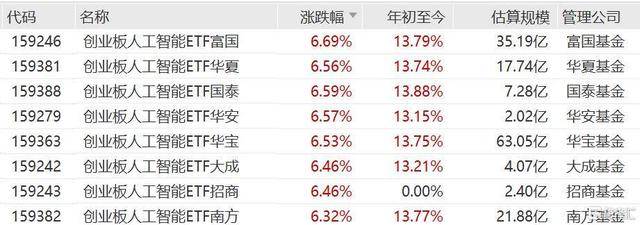
Core Viewpoint - The A-share CPO concept stocks have collectively risen, with Tianfu Communication surging 17% to reach a historical high, indicating strong market interest in AI-related investments and the potential for growth in the optical module sector [1] Group 1: Stock Performance - Tianfu Communication's stock price increased by 17%, reaching a historical high [1] - New Yisheng rose over 7%, while Zhongji Xuchuang increased by over 5% [1] - Various AI ETFs, including those from Fuguo, Huaxia, Guotai, Hu'an, Huabao, Dacheng, and Southern, all saw gains exceeding 6% [1] Group 2: ETF Performance - Fuguo's AI ETF increased by 6.69% with a year-to-date return of 13.79% and an estimated scale of 35.19 billion [2] - Huaxia's AI ETF rose by 6.56% with a year-to-date return of 13.74% and an estimated scale of 17.74 billion [2] - Guotai's AI ETF saw a 6.59% increase with a year-to-date return of 13.88% and an estimated scale of 7.28 billion [2] Group 3: Market Dynamics - The optical module sector is experiencing a concentrated chip structure that requires time for optimization and self-correction [3] - Despite being a traditionally slow season, the demand for optical modules shows strong certainty and profitability growth, attracting significant investment [3] - The current concentration of chips indicates a large amount of short-term floating profit, which may lead to increased stock price volatility [3] Group 4: CPO Technology Outlook - There is a notable expectation gap regarding the rapid replacement of pluggable optical modules by CPO technology, primarily due to misinterpretations of developments by companies like Nvidia [4] - The industry fundamentals suggest that CPO and pluggable modules will coexist, with pluggable modules remaining the mainstream demand for the next few years [4] - Leading optical module manufacturers are not excluded from the CPO ecosystem and have established strong barriers in core areas like silicon photonics [4] Group 5: Future Demand Projections - Confidence in future demand for optical modules is increasing, with major CSPs like Amazon, Google, Microsoft, and Meta projected to spend a total of $660 billion on capital expenditures by 2026, a 60% year-on-year increase [5] - The demand for optical modules is expected to maintain a rapid upward trend due to the anticipated growth in AI-related capital investments and the ongoing evolution of chip technology [5] - The overall total cost of ownership (TCO) indicates that optical modules will remain competitive for an extended period, supporting continued growth in related companies' performance [5]


【金牌纪要库】相比光模块,CPO可大幅降低功耗、提升速率,初步进入小批量出货验证阶段,这两家企业已向英伟达和博通送样测试
财联社· 2026-02-09 04:25
Group 1 - The core viewpoint of the article emphasizes the advantages of CPO technology over traditional optical modules, including significant reductions in power consumption and enhancements in speed, with initial small-batch shipment verification underway [1] - Two companies have begun testing samples with major players like NVIDIA and Broadcom, indicating a strong interest in CPO technology from leading tech firms [1] - The packaging of optical engines and switching chips presents the highest difficulty in the CPO process, with advanced packaging being a cornerstone of CPO technology [1] Group 2 - A domestic company capable of providing 2.5D/3D packaging technology is expected to play an increasingly important role in the industry [1] - The emergence of CPO technology will significantly raise the component threshold for both active and passive optical devices, necessitating improved performance of CW light sources and higher precision for FAU [1] - Another company identified as a core supplier in this field also possesses the capability to supply FAU products, highlighting its strategic importance in the evolving market [1]

英伟达市值暴增3250亿美元!拟200亿投资OpenAI,CPO技术引爆硅光产业链
Jin Rong Jie· 2026-02-09 01:20
Group 1: Company Developments - Nvidia's stock price surged nearly 8%, adding $325 billion to its market value, driven by CEO Jensen Huang's assertion that substantial AI investments are reasonable and sustainable as long as AI companies can achieve profitability from these investments [1] - Nvidia is nearing a $20 billion investment agreement with OpenAI, which would create a strategic alliance to advance AI technology [1][2] - Nvidia's recent CES 2026 announcements included the launch of the NVIDIA Spectrum-X Ethernet co-packaged optical devices, further promoting the application of CPO technology in AI data centers [1][3] Group 2: Industry Trends - The demand for high-speed optical modules is expected to rise alongside the acceleration of AI data center construction, with Nvidia's CPO technology driving manufacturers to enhance their development and production of co-packaged optical products [4] - The silicon photonics industry is set to expand due to Nvidia's collaboration with Tower Semiconductor, optimizing silicon photonic chip performance to meet AI data center transmission needs [4] - The AI data center construction industry will see increased participation from more companies, focusing on high-performance computing clusters and optimizing data center infrastructure to accommodate new interconnection solutions like CPO technology [5] Group 3: Key Companies in the Supply Chain - Zhongji Xuchuang specializes in the research and manufacturing of optical module products, positioning itself to benefit from the growing demand for high-speed transmission solutions and CPO technology [6] - Tianfu Communication focuses on optical communication devices, providing essential optical components for CPO products, with plans to enhance product compatibility and transmission efficiency [7] - Shiyun Circuit has entered Nvidia's supply chain through OEM partnerships, leveraging its advanced PCB technology to meet the high specifications required for AI servers, with future business growth expected to align with Nvidia's expansion [7]
算力需求强劲,关注CPO等新技术演进
Orient Securities· 2026-02-07 09:53
Investment Rating - The report maintains a "Positive" investment rating for the electronic industry, indicating an expectation of returns stronger than the market benchmark by over 5% [5]. Core Insights - Strong demand for computing power driven by AI applications is expected to continue, with significant investments from major cloud providers [8]. - The hardware supply-demand imbalance is spreading across various sectors, leading to price increases [8]. - New technologies such as CPO (Co-Packaged Optics) are anticipated to create additional demand [8]. Summary by Sections Investment Recommendations and Targets - Key investment targets include: - Semiconductor manufacturing: SMIC (688981, Buy), Hua Hong Semiconductor (01347, Buy) - Testing and packaging: Changdian Technology (600584, Buy), Tongfu Microelectronics (002156, Buy), and others [9]. - Server storage: Lianqi Technology (688008, Buy) - CPUs: Haiguang Information (688041, Buy), Longxin Technology (688047, Not Rated), and others [9]. - Passive components: Sanhua Group (300408, Buy), Fenghua Advanced Technology (000636, Not Rated) [9]. - Server manufacturing: Industrial Fulian (601138, Buy), Huaqin Technology (603296, Buy) [9]. - Analog and power chips: Naxin Micro (688052, Buy), Sierui Technology (688536, Not Rated), and others [9]. - Semiconductor equipment: Zhongwei Company (688012, Buy), Northern Huachuang (002371, Buy), and others [9]. - Optical devices/chips: Zhishang Technology (301486, Not Rated), Tianfu Communication (300394, Not Rated), and others [9]. AI Applications and Edge Computing - Key targets in edge AI applications include: - AI main control chips: Amlogic (688099, Buy), Hengxuan Technology (688608, Buy) - Edge storage: Zhaoyi Innovation (603986, Buy), Bawei Storage (688525, Buy) [10]. - Terminal manufacturers: Hikvision (002415, Buy), Luxshare Precision (002475, Buy), BYD Electronics (00285, Not Rated), and others [10]. - Core components for AI edge: Huanxu Electronics (601231, Buy), Sunny Optical Technology (02382, Buy), and others [10].





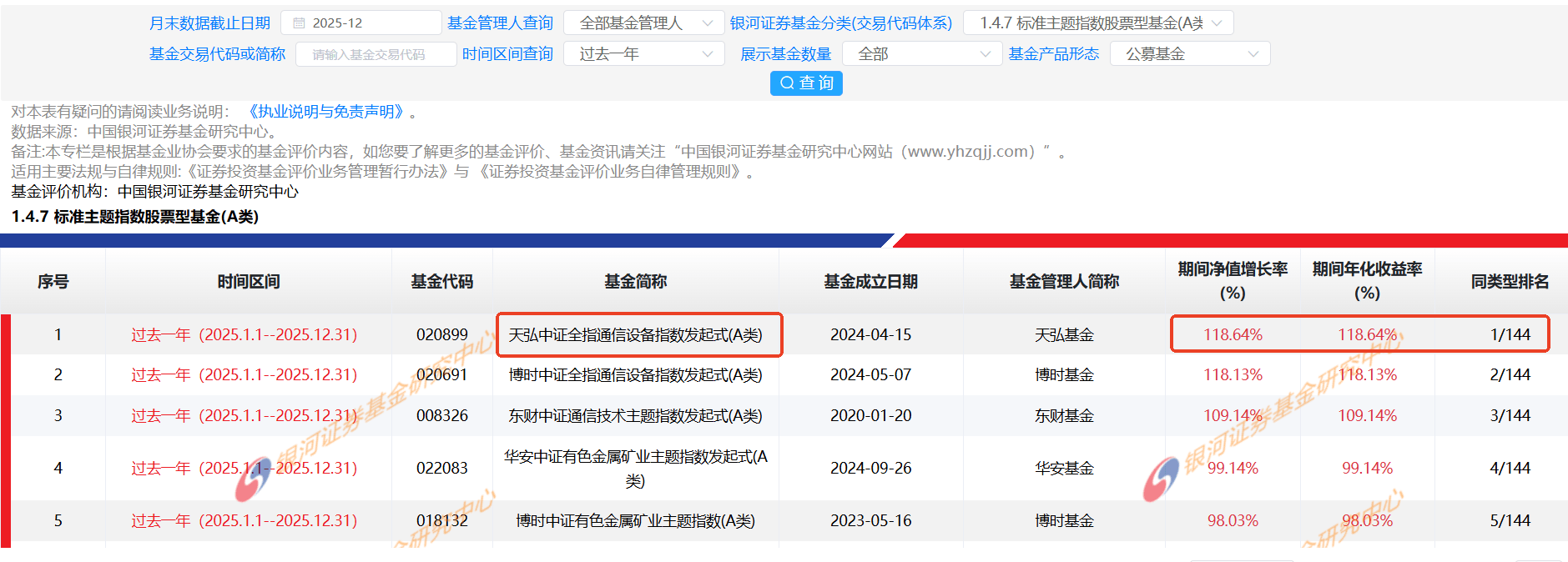
AI需求提振下,光通信龙头业绩指引超预期,天弘中证全指通信设备指数基金(A/C:020899/020900)捕捉CPO技术+AI算力双重机遇
Sou Hu Cai Jing· 2026-02-05 07:17
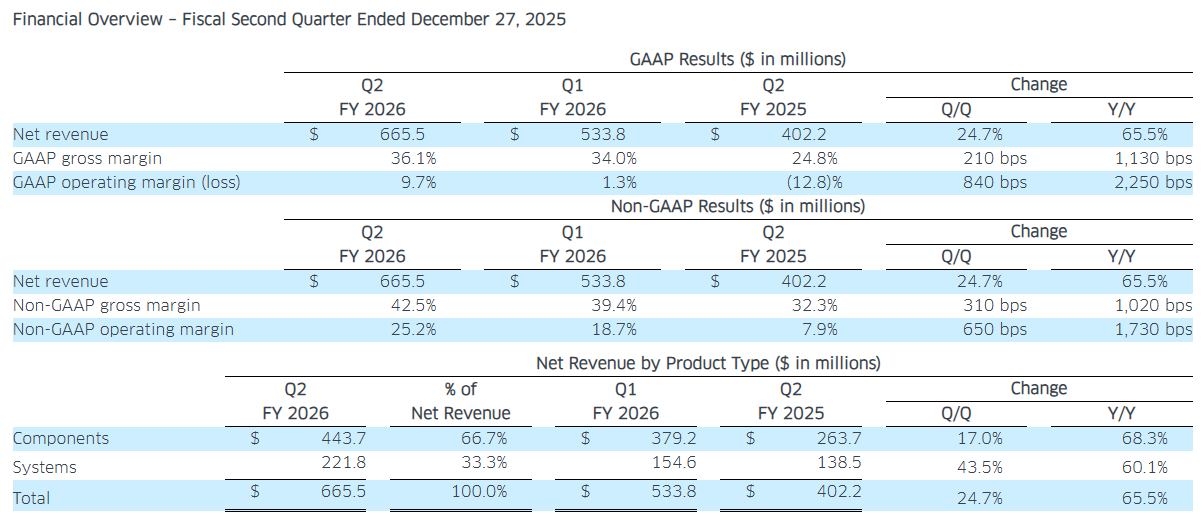
Group 1 - Lumentum's stock rose nearly 10% in pre-market trading, expected to reach a new historical high, driven by a significant revenue increase of 65% year-over-year to $665 million for the second quarter ending December 27, surpassing analyst expectations of $652 million [1] - The company's GAAP earnings per share (EPS) was $0.89, significantly above the analyst consensus of $0.49, while the adjusted EPS was $1.67, also exceeding the expected $1.41 [1] - The surge in AI computing power has created an extreme demand for high-speed connectivity, with CPO technology being a core solution to overcome bandwidth and power consumption bottlenecks [1] Group 2 - CITIC Securities noted that since 2025, both Chinese and American tech stocks have performed well, with the computing power sector leading the market, and there are emerging opportunities in models and applications [2] - Looking ahead to 2026, domestic computing power is expected to thrive, with performance elasticity and investment certainty, potentially replicating the long bull market seen in U.S. stocks since 2023 [2] - The urgency for domestic development of semiconductor equipment and AI chips has increased due to overseas restrictions, making localization a prevailing trend [2] Group 3 - The Tianhong CSI All-Share Communication Equipment Index Fund (A Class: 020899, C Class: 020900) achieved the highest annual return among similar themed index equity funds in 2025, reflecting the benefits of the AI computing power explosion [2] - The fund focuses on the optical communication sector, with its top ten weighted stocks heavily concentrated in leading optical communication companies, which are closely tied to the global AI computing supply chain [3] Group 4 - Fund manager Zhang Ge has a deep insight into the communication equipment sector, utilizing a dual-driven investment framework of "AI computing explosion + communication infrastructure upgrade" to guide fund operations [4] - The Tianhong CSI All-Share Communication Equipment Index Fund closely tracks the CSI All-Share Communication Equipment Index, which selects 50 listed companies involved in the communication equipment field to reflect the overall performance of this theme [4]
环旭电子20260204
2026-02-05 02:21
Summary of Huanxu Electronics Conference Call Company Overview - **Company**: Huanxu Electronics - **Industry**: Electronics Manufacturing Key Financial Metrics - **Q4 2025 Revenue**: 15.55 billion RMB, a decrease of 5.3% quarter-over-quarter and 6.8% year-over-year [2][3] - **Full Year 2025 Revenue**: 59.2 billion RMB, a slight decline of 2.46% [3] - **Net Profit**: 1.85 billion RMB for the year, with a net profit margin of 3.1%, an increase of 0.4 percentage points year-over-year [2][3] - **Operating Gross Profit**: 5.62 billion RMB for the year, remaining stable year-over-year [6] Product Performance - **Communication Products**: Revenue of 4.7 billion RMB, down 21.6% year-over-year [5] - **Consumer Electronics**: Revenue of 5.76 billion RMB, up 3.8% year-over-year [5] - **Industrial Products**: Revenue of 2.03 billion RMB, up 4.3% year-over-year [5] - **Cloud and Storage Products**: Revenue of 1.81 billion RMB, up 15.8% year-over-year [5] - **Automotive Electronics**: Revenue of 890 million RMB, down 30.7% year-over-year [5] - **Medical Products**: Revenue of 110 million RMB, up nearly 42% year-over-year [5] Gross Margin Insights - **Q4 Gross Margin**: 9%, a slight decrease of 0.1 percentage points year-over-year and 0.4 percentage points quarter-over-quarter [6] - **Cloud and Storage Products**: Significant gross margin increase due to favorable material price adjustments [6] - **Communication and Consumer Electronics**: Gross margins decreased due to market competition and customer structure changes [6] Capital Expenditure Plans - **Investment Plans**: Expansion in Taiwan and Vietnam with a total investment of approximately 70 million RMB, including 26 million RMB for smart glasses and 40 million RMB for AI acceleration cards and server-related businesses [7][19] - **2026 CapEx**: Expected to increase to 250-260 million USD, with significant investments in new facilities [19] Strategic Development - **Focus on AI and Hardware Integration**: Anticipation of long-term demand for AI-integrated hardware, particularly in wearable devices [4][9] - **Data Center Business**: Emphasis on computing boards, optical communication, and server power supply, with plans to complete product solutions and expand high-voltage regulation modules [11] - **Collaboration with Chengdu Guangchuang Technology**: Strategic partnership to advance silicon photonics technology [8] Future Outlook - **Growth in Smart Glasses**: Significant revenue growth expected from SIP modules in smart glasses, with active development of North American clients [4][10] - **Cloud and Optical Communication Expansion**: Targeting major cloud service providers and expanding into the North American market [24] - **CPO Technology Development**: Anticipation of CPO technology achieving scale in the next 2-3 years, with ongoing challenges [14] Additional Insights - **Vertical Power Supply Systems**: Development of vertical power supply solutions to minimize power loss, with plans to showcase a complete static architecture sample by 2027 [20] - **SIP Technology Trends**: Continued focus on market share in consumer electronics, with significant potential in AI applications for smart glasses [23] This summary encapsulates the key points from the conference call, highlighting the financial performance, product insights, strategic plans, and future outlook of Huanxu Electronics.

光通信龙头Lumentum(LITE.US)盘后大涨!AI需求提振下 Q2业绩及Q3指引均超预期
智通财经网· 2026-02-03 23:39
智通财经APP获悉,在公布了好于预期的2026财年第二季度业绩及远超市场预期的第三季度业绩指引后,截至发稿,Lumentum(LITE.US)周二美股盘后涨超 7%。财报显示,这家云计算与网络设备公司在截至去年12月27日的第二季度实现营收6.65亿美元,同比大幅增长65%,高于分析师平均预期的6.52亿美元。 GAAP每股收益为0.89美元,显著高于分析师平均预期的0.49美元;调整后的每股收益为1.67美元,同样高于分析师平均预期的1.41美元。 对于2026财年第三季度,Lumentum预计,调整后每股收益将介于2.15美元至2.35美元之间,显著高于分析师平均预期的1.59美元。该公司预计第三季度营收 将介于7.8亿美元至8.3亿美元之间,预测区间中值为8.05亿美元,同样远高于分析师平均预期的7.07亿美元。 在上个月早些时候,美国银行就重申对Lumentum的"中性"评级,并将对该股目标价从210美元上调至375美元。该行表示,由于市场对光收发器和光组件的 需求旺盛,大幅上调了其目标价,并指出目前这些领域的供应仍然无法满足需求。 | | | | | | | | GAAP Results ($ in ...

磷化铟,火了
3 6 Ke· 2026-01-23 03:28
Core Insights - The future of computing power will be determined by optical transmission efficiency, highlighting the critical role of optical interconnect technology and the growing market enthusiasm for indium phosphide (InP) materials [1][2] - The global AI infrastructure spending is expected to exceed $1 trillion by 2026, driving the rapid iteration of data center optical modules to 800G/1.6T and beyond [1] - The demand for InP materials is surging due to their unique properties, with a significant supply-demand gap projected to persist until 2026 [1][9] Group 1: InP Material Advantages - InP exhibits over ten times the electron mobility of silicon, making it suitable for high-frequency and high-speed applications, particularly in optical communication at critical wavelengths [3][4] - InP's high thermal resistance and radiation tolerance are essential for AI servers and data centers operating in high-temperature environments [3] - InP is positioned as the core material for high-end long-distance communication, outperforming silicon and gallium arsenide in efficiency and adaptability [4] Group 2: Market Demand Drivers - The explosive growth of AI data centers is the primary driver for the increasing demand for InP, with 800G optical modules becoming standard [6] - The introduction of Co-Packaged Optics (CPO) technology is expected to significantly increase the demand density for InP substrates, with a projected market growth of 166 times by 2030 [7] - In addition to data centers, InP is penetrating advanced fields such as LiDAR, 5G/6G mobile communications, low Earth orbit satellite communications, and quantum computing [8] Group 3: Global Market Dynamics - The global InP industry is characterized by a high degree of oligopoly, with major players like Sumitomo Electric and AXT dominating over 95% of the market [9] - A significant supply-demand gap is anticipated, with a projected need for 2 million InP devices by 2025 against a production capacity of only 600,000 [9] - Major manufacturers are ramping up production capacity to address this gap, with AXT planning to double its capacity by 2026 [9][10] Group 4: Domestic Industry Developments - Chinese companies are accelerating efforts to break the foreign monopoly in the InP market, with several firms achieving significant milestones in production capacity and technology [10][11] - The domestic market is witnessing a collaborative push towards a full-chain upgrade in the InP industry, enhancing quality and efficiency [12] - Government policies are supporting the development of InP materials, including tax reductions and funding for research in high-purity indium production [12] Group 5: Future Outlook and Challenges - The InP industry is on the brink of a significant scale-up, driven by the urgent need for high-performance materials in AI and optical communication [18] - Despite the promising outlook, challenges such as low crystal growth yield and high costs remain, necessitating technological advancements and cost reductions [14][15] - Geopolitical factors and export controls are creating uncertainties in the global supply chain, impacting the InP industry's growth trajectory [16]


