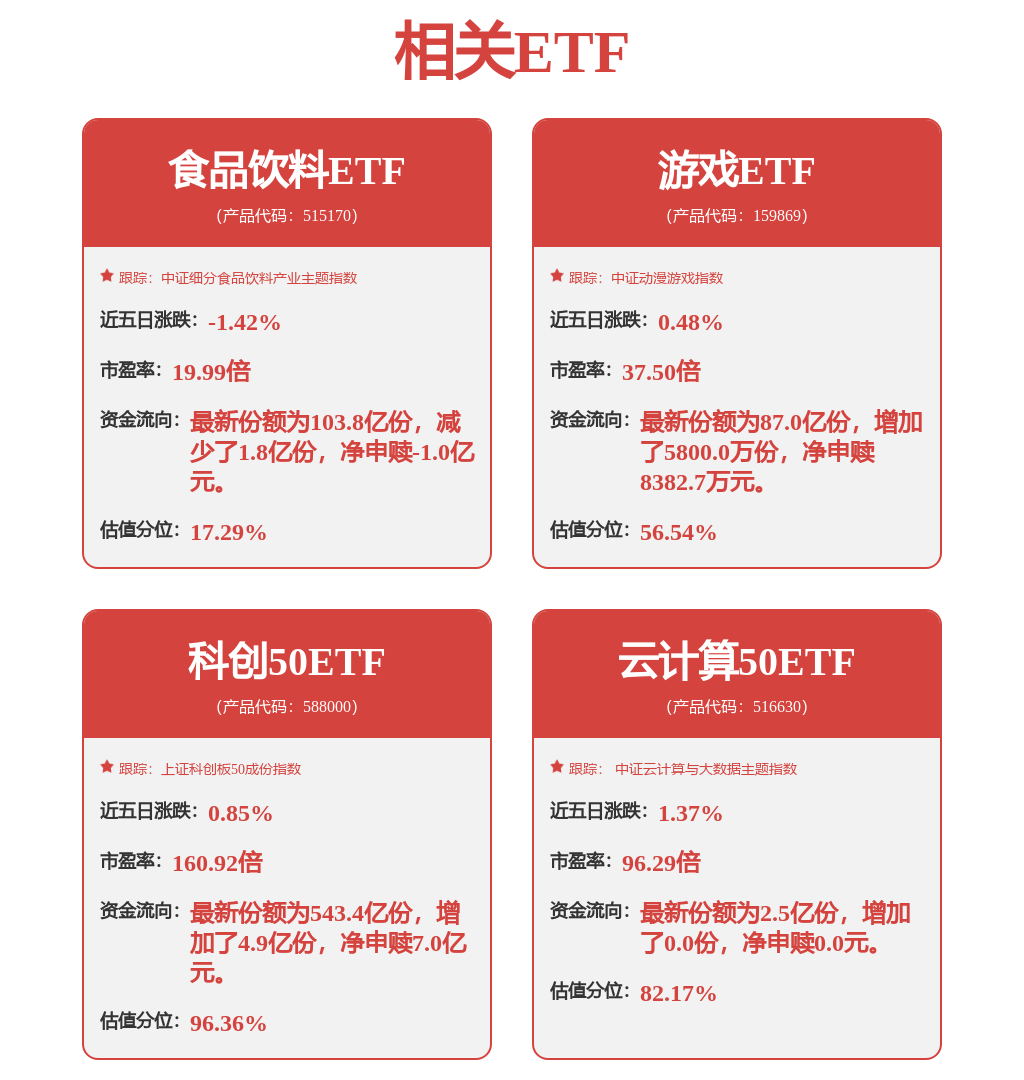
ETF资金流向

Search documents
超630亿元“跑了”
中国基金报· 2026-01-23 05:56
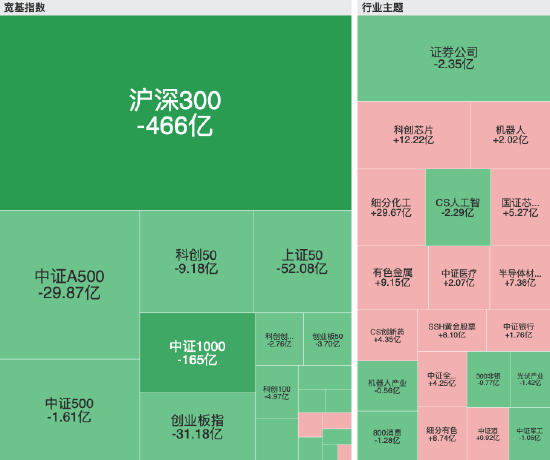
Core Viewpoint - On January 22, the stock ETF market experienced a significant net outflow of 63.31 billion yuan, indicating a preference for stability amid market volatility [2][4]. Group 1: ETF Market Overview - As of January 22, the total scale of all stock ETFs in the market reached 4.62 trillion yuan, with a net outflow of 63.31 billion yuan on that day [4]. - The industry theme ETFs and commodity ETFs saw substantial inflows, with net inflows of 12.04 billion yuan and 1.99 billion yuan, respectively [5]. Group 2: Sector Performance - The semiconductor sector had the most notable net inflow, amounting to 3.86 billion yuan on January 22, with the Jiashan Fund's Sci-Tech Chip ETF leading with a net inflow of 0.93 billion yuan [5]. - The chemical sector also performed well, with a net inflow of 2.97 billion yuan, driven by the Penghua Fund's chemical ETF, which saw a net inflow of 1.36 billion yuan [5]. - Other sectors with significant inflows included electric grid equipment, non-ferrous metals, gold, and pharmaceuticals, with the Huaxia Fund's electric grid equipment ETF receiving a net inflow of 0.87 billion yuan [5]. Group 3: Outflows from Broad-based ETFs - Broad-based ETFs experienced substantial outflows, totaling 76.95 billion yuan, with the CSI 300 ETF leading the outflows at 46.76 billion yuan [10]. - Other notable outflows included the CSI 1000 ETF with 16.6 billion yuan, the SSE 50 ETF with 5.26 billion yuan, and the ChiNext ETF with 3.54 billion yuan [10].


1月22日ETF资金流向:沪深300单日流出466亿元,中证1000流出165亿元,化工、芯片、有色板块逆势吸金
Xin Lang Cai Jing· 2026-01-23 02:01
Core Viewpoint - The ETF fund flow continues to show a divergence trend, with significant outflows from broad-based ETFs like the CSI 300, while sector-specific ETFs in chemicals, non-ferrous metals, semiconductors, and power grid equipment are attracting investments [14][19]. Group 1: ETF Fund Flows - The CSI 300 ETF experienced a net outflow of 46.644 billion yuan on January 22, with a cumulative outflow of 167.4 billion yuan over the past week, indicating a strong withdrawal trend [19][20]. - Other broad-based ETFs such as the CSI 1000 and SSE 50 also faced significant outflows of 16.528 billion yuan and 5.208 billion yuan, respectively [19][20]. - The overall sentiment in growth sectors remains cautious, as evidenced by net outflows from the ChiNext Index and STAR 50 ETFs, which recorded outflows of 3.118 billion yuan and 0.918 billion yuan, respectively [19][20]. Group 2: Top Outflowing ETFs - The top four ETFs with the highest net outflows are all CSI 300 ETFs, with the Huatai-PineBridge CSI 300 ETF and E Fund CSI 300 ETF seeing outflows of 16.255 billion yuan and 15.252 billion yuan, respectively [20][22]. - The total outflow from these four products reached approximately 46.7 billion yuan, accounting for a significant portion of the total outflow from broad-based ETFs on that day [20][22]. - The Huaxia SSE 50 ETF also saw a net outflow of 5.265 billion yuan, contributing to the overall trend of withdrawal from major ETFs [20][22]. Group 3: Sector-Specific Inflows - Sector-specific ETFs are becoming focal points for fund allocation, with the chemical sector receiving substantial inflows; the Penghua Chemical ETF recorded a net inflow of 1.363 billion yuan [10][24]. - The semiconductor and chip sectors also saw increased investments, with the Jiashi Sci-Tech Chip ETF and Guolianan Semiconductor ETF attracting net inflows of 0.931 billion yuan and 0.425 billion yuan, respectively [10][24]. - Non-ferrous metals and power grid equipment sectors continued to show strength, with the Southern Non-Ferrous Metals ETF and Huaxia Power Grid Equipment ETF receiving inflows of 0.915 billion yuan and 0.866 billion yuan, respectively [11][24]. Group 4: Diverse Market Trends - Other sectors such as gaming, innovative pharmaceuticals, and robotics are also experiencing varying degrees of fund inflows, indicating a diversification of market hotspots [12][25]. - The market is showing a trend of expanding investment interests across multiple sectors, reflecting a shift in investor sentiment [12][25].
2026开年ETF资金流向图谱:宽基ETF合计流出3499亿元 行业主题与跨境ETF受追捧
Xin Lang Cai Jing· 2026-01-21 07:43
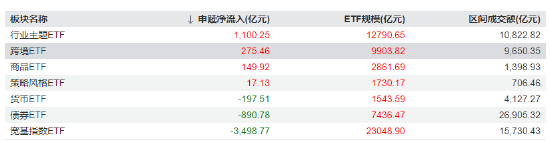
Core Viewpoint - The domestic ETF market has experienced significant capital outflows since the beginning of 2026, primarily driven by large withdrawals from broad-based indices and fixed-income products, while certain thematic and globally-oriented ETFs have attracted capital inflows [1][8]. Overall Market Trends - The total net outflow from the ETF market is approximately 304.6 billion yuan, with broad-based index ETFs accounting for a net outflow of 349.9 billion yuan, representing the majority of the total outflow [2][9]. - Bond ETFs have also seen a net outflow of 89.1 billion yuan, indicating a withdrawal of funds from fixed-income instruments amid market volatility [2][9]. Thematic and Global ETFs - Industry-themed ETFs have emerged as the most attractive category, with a net inflow of 110 billion yuan, particularly in sectors like materials, consumer goods, and pharmaceuticals, which are perceived as defensive and supported by policy [3][10]. - Cross-border ETFs recorded a net inflow of 27.5 billion yuan, reflecting strong demand for overseas assets amid the appreciation of the yuan and pressure on domestic assets [3][10]. - Commodity ETFs also gained 15 billion yuan in net inflows, especially in gold-related products, aligning with the rise in international gold prices and heightened global risk aversion [3][10]. Performance of Broad-based ETFs - Broad-based ETFs are under pressure, with the CSI 300 ETF leading the outflows at 162.5 billion yuan, indicating a phase of capital avoidance from core large-cap assets [5][12]. - The STAR 50 and SSE 50 ETFs also experienced significant outflows of over 30 billion yuan each, suggesting a withdrawal from technology leaders and large-cap blue chips [5][12]. - In contrast, the CSI 2000 index ETF saw a net inflow of 0.0956 billion yuan, indicating a shift towards more flexible small-cap styles during the adjustment period [5][12]. Sector-specific Insights - The semiconductor materials ETF has attracted a notable net inflow of 10.9 billion yuan, likely benefiting from global inflation expectations and specific industry policies [6][13]. - The consumer and pharmaceutical sectors also received slight increases in investment, with inflows of 2.123 billion yuan and 2.037 billion yuan, respectively, reflecting their defensive attributes [6][13].
ETF资金榜 | 港股通互联网ETF 广发(520630):净流入1171.28万元,创近1年新高-20260120
Xin Lang Cai Jing· 2026-01-21 01:55
Group 1 - The Hong Kong Stock Connect Internet ETF, Guangfa (520630.SH), experienced a decline of 0.78% on January 20, 2026, with a trading volume of 30.8275 million yuan [1] - The fund saw a net inflow of 11.7128 million yuan, marking a new high in nearly one year [1] - The fund's latest share count increased by 11.5 million shares, surpassing 220 million shares, while the total fund size exceeded 220 million yuan [1]
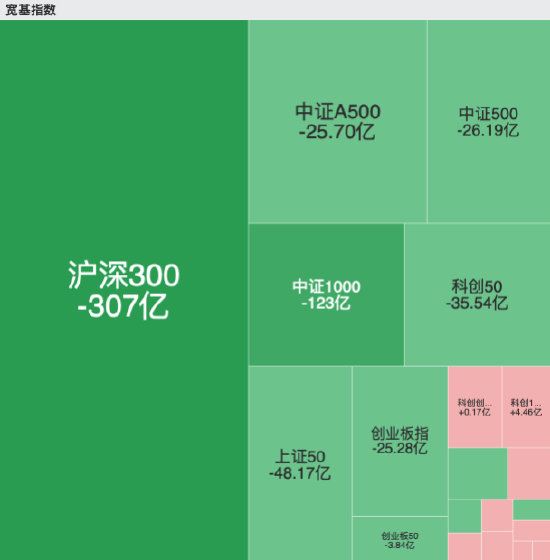
1月19日ETF资金观察:宽基ETF延续流出,沪深300产品净流出超306亿元
Xin Lang Cai Jing· 2026-01-20 03:29
Group 1 - The ETF market experienced significant redemption pressure on January 19, with major broad-based ETFs showing a net outflow of funds, particularly the CSI 300 index ETFs [1][9] - The CSI 300 index ETFs had the most notable single-day net outflow, amounting to -30.694 billion yuan, while the CSI 1000 index ETF also saw a substantial outflow of -12.250 billion yuan [1][9] - Other mainstream broad-based index ETFs, including the SSE 50, STAR 50, and CSI 500, also experienced varying degrees of net outflows ranging from -2.5 billion to -4.8 billion yuan [1][9] Group 2 - Specific products such as the Huatai-PineBridge CSI 300 ETF (510300.SH) had the highest net outflow of -8.982 billion yuan, followed by the Harvest CSI 300 ETF (159919.SZ) and the China Asset Management CSI 300 ETF (510330.SH) with net outflows of -8.428 billion yuan and -7.649 billion yuan, respectively [4][15] - The total net outflow from these four leading CSI 300 ETFs exceeded 30.694 billion yuan [4][15] - Conversely, certain thematic industry ETFs, such as those related to semiconductor materials and specialized chemicals, saw inflows, with the semiconductor materials ETF gaining +1.633 billion yuan and the specialized chemicals ETF gaining +1.595 billion yuan [4][15]
资金流出,超2000亿!
Zhong Guo Zheng Quan Bao· 2026-01-19 12:01
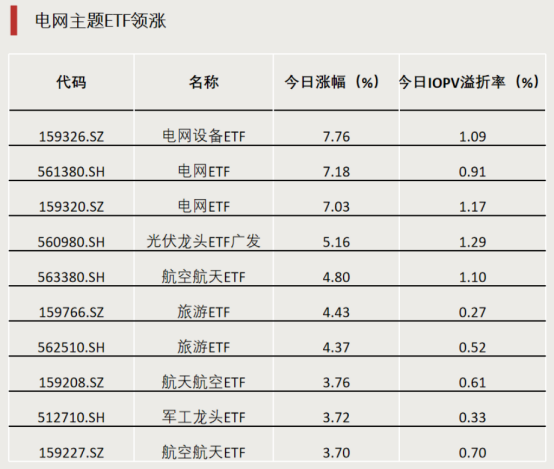
Group 1: ETF Market Overview - The overall ETF market has experienced a net outflow of over 200 billion since January, with a total net outflow of 2,141 billion [9][11] - Last week, various thematic ETFs such as software, non-ferrous metals, media, and satellites attracted significant inflows, while multiple broad-based ETFs faced net outflows totaling 1,572 billion [9][10] Group 2: Electric Grid ETFs Performance - On January 19, the electric grid sector in A-shares saw strong performance, with the electric grid ETF (159320) rising by 7.03% [2][4] - The electric grid ETF has seen continuous accumulation of funds for two weeks since the beginning of the year, with a management fee rate of 0.5%, making it one of the lowest in its category [4] Group 3: Satellite ETFs Insights - The satellite ETF (512630) has gained 17% since the beginning of the year, with an average daily trading volume exceeding 5 billion, indicating strong liquidity [5] - Analysts highlight three main investment values in the satellite sector: strong policy support, expanding demand scenarios, and cost-reducing technological advancements [5] Group 4: Broad-based ETFs Activity - On January 19, several broad-based ETFs, including A500 ETF and CSI 300 ETF, were actively traded, each exceeding a trading volume of 10 billion [7][8] - The trading activity reflects a robust interest in broad-based ETFs despite the overall market's net outflow trend [7] Group 5: Thematic ETFs Inflows - The software ETF (159852) led the inflows with a net inflow of 75.43 billion last week, followed by the non-ferrous metals ETF (512400) with 63.66 billion [10] - The electric grid equipment ETF (159326) also saw significant inflows, indicating strong investor interest in these sectors [10] Group 6: ETF Connectivity Expansion - As of January 19, 54 ETFs listed on the Shanghai Stock Exchange and 44 on the Shenzhen Stock Exchange have been included in the northbound trading scheme, increasing the total number of products from 273 to 364 [11] - The expansion reflects a growing interest in ETF connectivity and investment opportunities across different markets [11]
海外创新产品周报:特朗普媒体科技公司发行ETF-20260106
Shenwan Hongyuan Securities· 2026-01-06 08:41
1. Report Industry Investment Rating No relevant content provided. 2. Core Viewpoints of the Report - In the past week, there were 21 new ETF products issued in the US, with multiple managers launching series of products. The inflow of US ETFs was relatively stable, with domestic stock products' inflow exceeding international stocks again. Gold ETFs had outflows, while biopharmaceutical products performed excellently. In November 2025, the total amount of non - money public funds in the US increased, and the redemption pressure eased. From December 17th to 23rd, the outflow of domestic stock funds narrowed, while hybrid allocation products continued to have outflows and bond products continued to have inflows [1]. 3. Summary According to the Directory 3.1 US ETF Innovation Products: Trump Media & Technology Group Issues ETF - Last week, 21 new products were issued in the US, with multiple managers launching series of products. Tuttle Capital issued an options strategy product based on Magnificent 7, Trump Media & Technology Group issued 5 Truth Social ETFs and plans to issue digital currency - related products in the future. Opal Capital issued a high - concentration ETF and a disciplined US equity ETF. Founder ETF issued another ETF investing in founder - led companies. Innovator issued 4 two - way Buffer products, and Gabelli issued an ETF investing in the sports and live - event industry [6][7][9]. 3.2 US ETF Dynamics 3.2.1 US ETF Funds: Gold ETFs Have Outflows - In the past week, the inflow of US ETFs was relatively stable, with domestic stock products' inflow exceeding international stocks again. Vanguard S&P 500 ETF and State Street S&P 500 had certain inflows, and broad - based products of stocks and bonds were among the top in terms of inflow. Gold and silver ETFs had outflows. The recent fund fluctuations of S&P 500 ETFs remained at a high level, with Vanguard and State Street products having overall inflows and BlackRock's products having outflows [10][12][14]. 3.2.2 US ETF Performance: Biopharmaceutical Products Perform Excellently - In 2025, the US pharmaceutical sector performed well, especially in the biotech field, where many products had涨幅超过 25%, and State Street's products performed the best, with涨幅超过 35% [16]. 3.3 Recent Capital Flows of US General Public Funds - In November 2025, the total amount of non - money public funds in the US was $23.72 trillion, an increase of $0.03 trillion compared to October 2025. The S&P 500 rose 0.13% in November, and the scale of domestic stock products decreased by 0.15%, with the redemption pressure easing. From December 17th to 23rd, the outflow of domestic stock funds narrowed to around $20 billion, while hybrid allocation products continued to have outflows and bond products continued to have inflows [18].
加仓!
中国基金报· 2026-01-05 06:25
Core Viewpoint - On December 31, 2025, stock ETFs saw a net inflow of nearly 4.8 billion yuan, indicating a proactive investment strategy as funds positioned themselves for opportunities in 2026 [2]. Group 1: ETF Inflows - The total scale of all stock ETFs in the market reached 4.76 trillion yuan as of December 31, 2025, with a net inflow of 4.792 billion yuan on that day [4]. - Industry-themed ETFs led the inflows, totaling 5.967 billion yuan, with the semiconductor sector attracting 1.36 billion yuan and the robotics sector 1.09 billion yuan [4]. - Specific ETFs such as the E Fund Robotics ETF saw a net inflow of 320 million yuan, while the Huaxia Fund's robotics ETF exceeded 200 million yuan in inflows [4]. Group 2: Notable Inflows in Broad-based ETFs - The CSI A500 ETF had a net inflow of 2.77 billion yuan, while the Sci-Tech 50 ETF saw 1.12 billion yuan in inflows [5]. - Individual products like the Southern Fund's A500 ETF recorded a net inflow of 1.107 billion yuan, and the Huaxia Fund's A500 ETF also surpassed 1 billion yuan in inflows [5]. Group 3: Outflows from Broad-based ETFs - Broad-based ETFs experienced a significant net outflow of 369 million yuan on December 31, 2025, with a total scale decrease of 24.965 billion yuan [9]. - The top five ETFs with the largest outflows included the SSE 50 ETF with a net outflow of 2.15 billion yuan and the CSI 300 ETF with 1.53 billion yuan [9].

股票型ETF每日交易数据跟踪-20251231
CHINA DRAGON SECURITIES· 2025-12-31 10:04
Group 1: ETF Market Overview - The report highlights the performance of various ETFs, with the Satellite ETF showing a significant increase of 7.72% on the trading day [5][6]. - The top-performing ETFs include the Satellite Industry ETF with a rise of 7.55% and the Satellite ETF from E Fund with a 7.07% increase [5]. - The trading volume for the Satellite ETF reached 38,691.01 thousand yuan, while the Satellite Industry ETF had a trading volume of 50,380.39 thousand yuan [5]. Group 2: Fund Flow Monitoring - The report indicates that the Nonferrous Metals ETF Fund had a net inflow of 270,258.54 thousand yuan on the previous trading day, with a daily increase of 1.23% [8]. - The A500 ETF Leader experienced a slight decline of 0.17% but still had a significant net inflow of 90,435.65 thousand yuan [8]. - The report lists the top ETFs by net inflow, with the Nonferrous Metals ETF leading, followed by the A500 ETF Leader and the CSI 300 ETF [8]. Group 3: Margin Trading Activity - The Securities ETF recorded a financing purchase of 42,272.77 thousand yuan, despite a daily decline of 0.41% [15]. - The report notes that the Sci-Tech Innovation 50 ETF had a financing purchase of 40,667.67 thousand yuan, with a decrease of 1.12% on the trading day [15]. - The margin trading data indicates that the CSI 500 ETF had a financing purchase of 29,028.08 thousand yuan, reflecting a stable interest in this ETF despite market fluctuations [15].
突发!停牌核查了...
Zhong Guo Ji Jin Bao· 2025-12-29 15:21
Core Viewpoint - The stock of Victory Energy has been suspended for review due to a significant price increase of 213.97% over a period of 17 days, which has raised concerns about irrational market speculation and potential risks to investors [1]. Group 1: Company Announcement - Victory Energy announced that its stock will be suspended from trading starting December 30, 2025, for a period not exceeding three trading days to investigate the unusual trading activity [1]. - The company stated that its main business, which involves the procurement, transportation, and sales of liquefied natural gas, has not undergone any significant changes [2]. - The company confirmed that there are no undisclosed major information or changes in its fundamentals, despite the stock's recent price surge [1][2]. Group 2: Market Activity - The stock experienced a cumulative price deviation of over 20% in two consecutive trading days, qualifying it as an abnormal trading situation [1]. - The company indicated that if the stock price continues to rise, it may apply for further suspension from the Shenzhen Stock Exchange [1].