
精细化管理

Search documents
固生堂(02273):EBITDA大增37.3% 成长潜力持续释放
智通财经网· 2025-08-29 08:27
Core Insights - The company reported a significant increase in net profit, reaching 150 million yuan, a year-on-year growth of 41.6% [1] - EBITDA also saw a substantial rise to 270 million yuan, up 37.3% year-on-year, indicating strong operational efficiency and cost control [1] Financial Performance - Revenue for the first half of 2025 was 1.49 billion yuan, reflecting a growth of 9.5% [2] - The growth was driven by the "same city expansion + new city development" strategy, with new branches entering profitability and contributing stable revenue [2] - The number of repeat patients increased by 14.8% due to refined operational tools and AI health assistants, further boosting overall performance [2] Cost Management and Efficiency - The company achieved improved profitability through deep optimization of operational processes and effective cost reduction strategies [1] - The gross profit margin increased to 30.6%, supported by a 209.1% rise in revenue from high-margin self-priced products [2] - Administrative and sales expense ratios decreased, contributing to the high growth in EBITDA [2] Strategic Focus - The company is concentrating resources on core business areas and high-potential regions, reducing investment in smaller, less efficient stores [1] - This strategic focus allows for better allocation of resources, enhancing overall profitability and supporting sustainable growth [2] Future Outlook - With the national push for the development of traditional Chinese medicine, the company is expected to continue its dual-driven approach of high profit growth and quality optimization, creating sustainable value for investors [2]
【私募调研记录】凯丰投资调研温氏股份、三只松鼠等4只个股(附名单)
Zheng Quan Zhi Xing· 2025-08-29 00:08
Group 1: Company Insights - Wens Foodstuff Group reported significant improvement in pig farming costs due to stable production, effective disease control, and increased piglet breeding investment, with a debt-to-asset ratio reduced to 50.6% [1] - Three squirrels are transitioning towards high-end, quality, and differentiated products, achieving a revenue of 5.478 billion yuan and a net profit of 138 million yuan, with offline distribution doubling [2] - Yun Aluminum plans to implement a mid-term dividend of approximately 1.11 billion yuan, enhancing resource acquisition capabilities and maintaining a reasonable inventory level [3] - Giant Network achieved a revenue of 1.662 billion yuan, a year-on-year growth of 16.47%, with a net profit of 777 million yuan, focusing on content supply and exploring overseas markets [4] Group 2: Industry Trends - The food and retail industry is undergoing changes, making it difficult to generate value through homogeneous competition, prompting companies to focus on differentiation and quality [2] - The aluminum industry is seeing a push towards resource acquisition and green aluminum production, with a focus on technology upgrades [3] - The gaming industry is leveraging user-generated content and optimizing game performance to extend product life cycles, with a strong emphasis on user engagement [4]


让“烟火气”不扰民!上海再出措施
Guo Ji Jin Rong Bao· 2025-08-28 12:54
Core Viewpoint - The Shanghai Municipal Government has introduced measures to regulate outdoor seating arrangements, aiming to enhance urban vitality and meet citizen needs while maintaining order in the city [1][2]. Group 1: Regulatory Measures - The newly released measures provide detailed guidelines for outdoor seating, building on previous initiatives to optimize street vendor management [2][3]. - A total of 997 designated outdoor seating points have been established across the city, including 376 outdoor seating areas and 117 specialty markets [2]. - The measures emphasize a balance between urban order and vibrant street life, aiming for "smoky fire without oil smoke, bustling without traffic jams, and being approachable without disturbing residents" [2][3]. Group 2: Safety and Management - The measures stipulate that food preparation is not allowed at outdoor seating; only pre-prepared food can be served, with necessary safety equipment required [4]. - Local management departments are tasked with enhancing public services in designated areas, such as increasing lighting, waste collection, and portable toilets to improve the consumer experience [4]. - A dynamic adjustment mechanism is highlighted, allowing for regular evaluations of outdoor seating arrangements to adapt to urban development and citizen needs [6]. Group 3: Community Involvement - The measures encourage the establishment of self-regulatory organizations to promote cooperative governance and effective supervision of outdoor seating [5]. - Channels for public complaints and feedback are to be established, ensuring timely responses to community concerns [5]. - The initiative aims to create a collaborative environment where local authorities and residents can work together to manage outdoor seating effectively [5][6]. Group 4: Future Outlook - The implementation of these policies is expected to invigorate Shanghai's urban spaces, providing citizens with a richer street life experience in a clean and orderly environment [6]. - The management model developed through these measures may serve as a reference for other cities seeking to enhance urban vibrancy while maintaining order [6].
光大环境(00257):业绩符合预期,中期分红逆势提升
Hua Yuan Zheng Quan· 2025-08-28 08:08
Investment Rating - The investment rating for the company is "Buy" (maintained) [6] Core Views - The company's performance met expectations, with a mid-term dividend increase against the trend [8] - The decline in construction revenue and foreign exchange losses impacted profits, but operational service revenue increased significantly [8] - The company is focusing on refined management, leading to substantial growth in heating supply [8] - The increase in mid-term dividends reflects the company's commitment to enhancing shareholder returns [8] - The potential inclusion of biomass energy utilization in the third batch of CCER is expected to expand profit channels for the company [8] - The company is projected to have a low valuation with high dividend value, maintaining a "Buy" rating [8] Financial Summary - For 2023, the company is expected to generate revenue of 32,495.24 million HKD, with a year-on-year decline of 13.9% [7] - The net profit attributable to shareholders is projected at 4,429.16 million HKD, down 3.8% year-on-year [7] - The earnings per share (EPS) for 2023 is estimated at 0.72 HKD [7] - The company’s return on equity (ROE) is expected to be 9.2% for 2023 [7] - The price-to-earnings (P/E) ratio is projected at 3.52 for 2023 [7] - The company plans to distribute a mid-term dividend of 0.15 HKD per share, an increase from the previous year [8]
百基铁塔安全穿越生态敏感区
Zhong Guo Neng Yuan Wang· 2025-08-28 07:31
8月初的晋北,群山叠翠。8月20日,在位于恒山的500千伏忻州北输变电工程施工现场 上空,一架无人机沿着预设航线巡航,高清镜头实时回传的画面显示塔基周边的土地和植被 状况。"任何对环境的扰动都逃不过无人机的'眼睛',在生态敏感区施工必须毫厘不差。"国 网山西省电力有限公司建设分公司环保水保专责梁亮紧盯着屏幕说道。作为山西电网规划的 重点项目,这项将大同、朔州、忻州、阳泉四市七县(区)串联起来的输变电工程,在生态 敏感区创新实施了电网建设与环境保护协调发展的管理模式。 国网山西电力智慧监理平台在忻州北输变电工程建设中成为助力项目高效运转的"中枢 大脑"。该平台集成了工程质量、安全、环保水保等模块数据,将最小施工作业单元细分为5 部分、26个场景,并生成对应的标准化工卡。"现场监理人员通过智慧监理平台的手机客户 端实时填报工作信息,自动生成工作日志和旁站记录。所有操作痕迹永久保存、不可篡 改。"监理项目部资料员魏建栋介绍,"平台可对班组违章和监理履职行为精准'画像',让考 核更客观、高效。" 忻州北输变电工程施工难度大:新建线路折单长度552.8千米,线路穿越恒山防风固沙 区、五台山生物多样性维护区、太行山水源涵 ...
方大特钢上半年业绩逆势增长
Zheng Quan Ri Bao· 2025-08-27 16:13
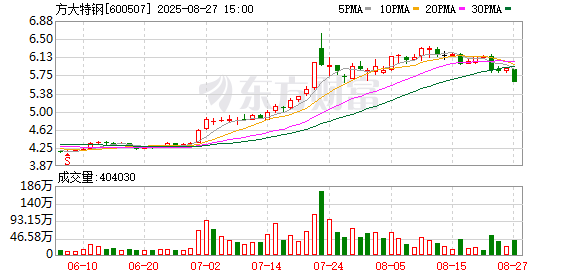
Core Viewpoint - Fangda Special Steel reported a significant net profit increase of 148.75% year-on-year, reaching 405 million yuan in the first half of 2025, despite challenges in the steel industry [2] Group 1: Financial Performance - The company achieved a net profit of 405 million yuan in the first half of 2025, marking a substantial increase of 148.75% compared to the previous year [2] - In the context of the steel industry, which saw a 5.79% decline in revenue for major enterprises, Fangda Special Steel's performance stands out [3] Group 2: Shareholder Confidence - Several institutional investors increased their holdings in Fangda Special Steel, with the controlling shareholder Fangda Steel adding 18.05 million shares, raising its stake by 0.78% [2] - The participation of northbound capital and financial institutions reflects ongoing confidence in the company's strategic direction and growth potential [2] Group 3: Operational Strategy - The company is implementing a "low-cost, differentiated, and specialized" development strategy to navigate market challenges [3] - Fangda Special Steel is focusing on fine management practices, reducing costs, and optimizing product structure to enhance economic benefits [3] Group 4: Energy Efficiency and Sustainability - The company is actively utilizing waste heat and gases from the steel production process for power generation, aiming to improve energy efficiency and reduce carbon emissions [4][6] - Measures such as optimizing energy consumption and enhancing equipment maintenance have led to significant cost savings, including a reduction in diesel costs by 192,400 yuan and a 7.17% decrease in fuel consumption [3] Group 5: Innovation and Development - 2025 is designated as the "Year of Innovation" for Fangda Special Steel, with increased R&D investment and collaboration with partners like Huawei and CATL to drive digital transformation and green development [5][6] - The company is focusing on the development of key materials for new energy vehicles, with some products already in small-scale delivery [6] Group 6: Future Outlook - Fangda Special Steel aims to continue its fine management approach, digital transformation, and green upgrades to solidify its position as an industry benchmark and contribute to high-quality development in the steel sector [6]

世茂服务(873.HK):聚焦核心主业,优化业务结构,提升经营韧性
Ge Long Hui· 2025-08-27 14:03
Core Viewpoint - The company is actively optimizing its business structure by focusing on core operations and adjusting non-core businesses, which includes divesting subsidiaries like Jinsha Tian. These adjustments may have a short-term impact on profits but ultimately enhance the company's ability to respond to market and policy changes [1] Financial Performance - After excluding the impact of subsidiaries like Jinsha Tian, the company's overall revenue still achieved approximately 3% growth [1] - The core property management business maintained steady growth, with revenue exceeding 2.8 billion, reflecting a nearly 3% year-on-year increase [1] Market Expansion - The company achieved significant market expansion, with new contracted area reaching 40.1 million square meters, a year-on-year increase of 126.6% [1] - New annual saturated revenue reached 1 billion, marking a 66.7% year-on-year growth, both figures setting historical highs [1] Operational Efficiency - Nearly 80% of the contracted area comes from third-party clients, indicating a stable operational base and continuous optimization of the revenue structure [1] - Through refined management and digital operations, the company's operational efficiency and cyclical resilience are continuously improving, laying a solid foundation for long-term stable development [1]
恒辉安防:公司秉持精细化管理理念,严格管控销售费用与管理费用
Zheng Quan Ri Bao Wang· 2025-08-27 10:46
Core Viewpoint - The company, Henghui Security (300952), has implemented a refined management approach that has led to a decrease in both sales and management expenses in the first half of the year, enhancing the efficiency of expense utilization [1] Group 1: Financial Management - In the first half of the year, the company strictly controlled sales and management expenses, resulting in a year-on-year decrease in both absolute amounts [1] - The company plans to continue its strict expense management strategy in the second half of the year, focusing sales expenses on "high-output investments" and prioritizing resources for emerging growth markets such as the EU and South America, as well as maintaining relationships with key clients [1] Group 2: Digital Transformation - Management expenses will be reduced through the upgrade of digital office systems (such as ERP/OA system optimization), streamlining approval processes, and minimizing the use of paper materials [1] - The company will also strictly control unnecessary travel and meeting expenses, with expectations of a decrease in both absolute management expenses and expense ratios in the second half of the year [1]

世茂服务发布中期业绩 权益持有人应占溢利851.9万元 新增年化合同金额为9.58亿元
Zhi Tong Cai Jing· 2025-08-27 08:42
Core Viewpoint - Shimao Services (00873) reported strong mid-year results for the six months ending June 30, 2025, showcasing significant growth in contract amounts and management services despite challenging macroeconomic conditions [1][2] Group 1: Financial Performance - Revenue for the first half of 2025 reached 3.62 billion RMB, with a gross profit of 709 million RMB [1] - Profit attributable to equity holders was 8.519 million RMB, with basic earnings per share at 0.003 RMB [1] - Property management services generated 2.812 billion RMB in revenue, reflecting a year-on-year increase of 1.9%, while maintaining stable gross margins [1] Group 2: Market Expansion and Strategy - The company achieved a record high in its market expansion team, with a new annual contract value of 958 million RMB, up 54.6% year-on-year, and a new contracted area of 40.1 million square meters, up 126.6% year-on-year [1] - As of mid-2025, non-residential property projects accounted for 38.4% of the managed area, significantly diversifying the client base [2] - 96.6% of non-residential projects are located in first-tier, new first-tier, and second-tier cities, which are key consumption drivers [2] - The company is expanding its service offerings to include smart energy, space operations, business support, and customized logistics across various property types [2]
新疆天业: 新疆天业股份有限公司2025年半年度报告摘要
Zheng Quan Zhi Xing· 2025-08-27 08:13
Core Viewpoint - The financial performance of Xinjiang Tianye Co., Ltd. for the first half of 2025 shows a decline in net profit and revenue, despite an increase in total profit compared to the previous year [1][3]. Financial Summary - Total assets at the end of the reporting period amounted to CNY 20.77 billion, a 1.17% increase from the previous year [1]. - Net assets attributable to shareholders decreased by 0.45% to CNY 9.28 billion [1]. - Operating revenue for the period was CNY 5.16 billion, down 0.98% year-on-year [1]. - Total profit reached CNY 37.61 million, representing a 37.78% increase from CNY 27.30 million in the previous year [1]. - The net profit attributable to shareholders was a loss of CNY 8.57 million, a significant decline of 228.22% compared to a profit of CNY 6.69 million in the same period last year [1]. - The net profit after deducting non-recurring gains and losses was CNY -31.62 million, a decrease of 55.41% from CNY -20.35 million [1]. - The net cash flow from operating activities was CNY -240.25 million, a decrease of 137.32% from CNY 643.79 million [1]. - The weighted average return on net assets was -0.092%, down 0.1643 percentage points from the previous year [1]. - Basic and diluted earnings per share were both CNY -0.005, a decrease of 228.21% from CNY 0.0039 [1]. Key Operational Insights - The average price of the main product, caustic soda, increased year-on-year, positively impacting gross profit [2]. - However, the average prices of polyvinyl chloride (PVC) resin and its variants saw significant declines, negatively affecting gross profit by CNY 41.35 million [2]. - The average procurement prices of key raw materials such as coal and lime decreased, contributing to a gross profit increase of CNY 25.95 million [2]. - The company implemented refined management and an integrated industrial chain to effectively control manufacturing costs and expenses, resulting in a total profit increase [2].
