隐含波动率

Search documents
大A之外,还有一个资产会持续爆发!
大胡子说房· 2025-10-08 04:32
Core Viewpoint - The article emphasizes the significant rise in gold prices, which have reached a historical high of over $3,800 per ounce, marking a nearly 45% increase this year, outperforming all other major asset classes [1][2]. Market Analysis - The rise in gold prices is attributed to the declining credibility of the US dollar and its assets, particularly due to the perceived loss of independence of the Federal Reserve, influenced by political interventions [1]. - The supply of gold has become tight, with shrinking inventories in London and increased demand from institutional buyers holding futures contracts, leading to a short-term supply crunch [1][2]. Volatility and Market Sentiment - The implied volatility of gold, measured by the SPDR Gold Trust options, is currently at 15%, significantly lower than the 26% observed in April, indicating that the market is not in a state of frenzy and still holds potential for further price increases [2][3]. Future Projections - The upward trend in gold prices is expected to continue until at least November, driven by ongoing buying pressure in the options market and the likelihood of a Federal Reserve rate cut in October [3]. - The potential for a price correction may arise in late November to December, depending on market sentiment and Federal Reserve actions [3][4]. Investment Strategy - The article suggests that despite the current price increases across various assets, there are still explosive opportunities ahead, emphasizing the importance of early positioning in the market [4][5].


黄金期权风险溢价飙升,交易员狂买看涨期权以对冲尾部风险
Jin Shi Shu Ju· 2025-10-06 05:11
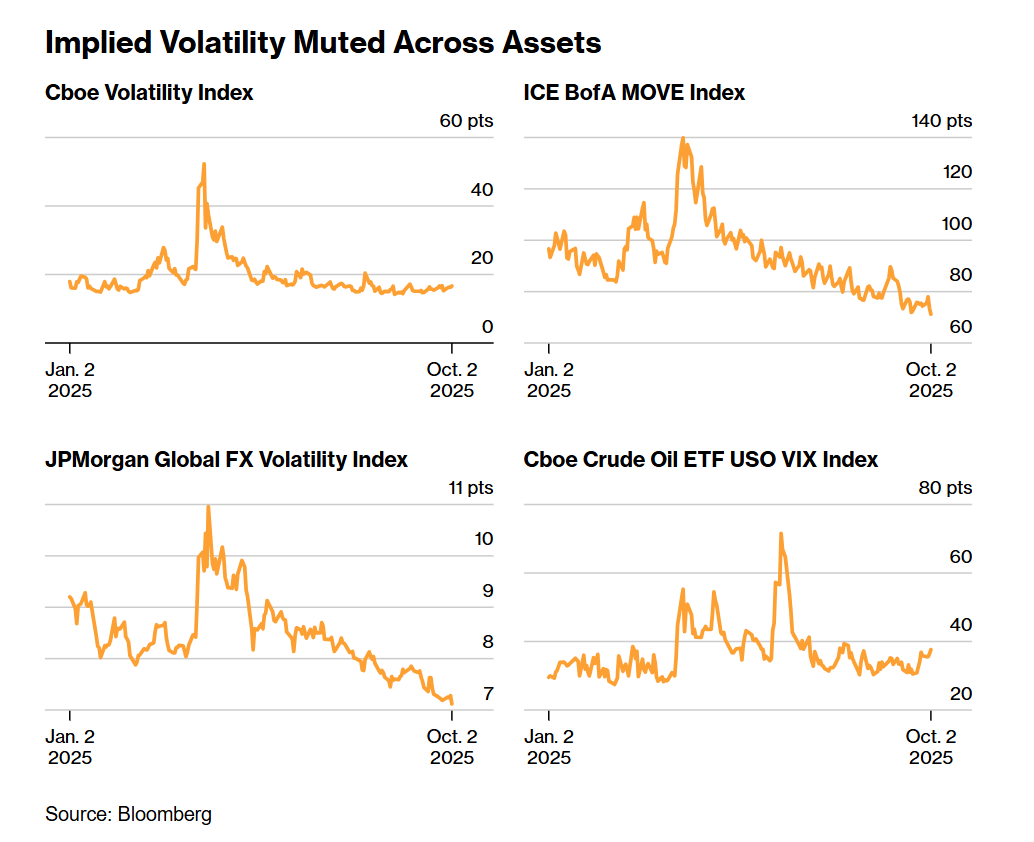
Core Viewpoint - Despite the implied volatility of market benchmark indices remaining stable or declining throughout the year, the risk premium for options across various assets, including stocks and gold, has been rising due to the subdued actual market volatility [1][5]. Group 1: Market Dynamics - The increase in risk premium is attributed to the difference between expected market volatility and actual volatility, driven by various factors such as interest rate expectations affecting gold, supply-demand outlooks limiting oil price fluctuations, and uncertainties surrounding Federal Reserve policies impacting stock market performance [5]. - The S&P 500 index has experienced low correlation among individual stocks, which has suppressed overall volatility, even as earnings season approaches [8][10]. Group 2: Options Market Insights - September saw record trading volumes in options, as investors began to hedge against year-end market movements, leading to heightened expectations of volatility [5]. - Fixed strike volatility has significantly increased, with implied volatility remaining high relative to actual volatility metrics [5][7]. Group 3: Oil Market Analysis - Oil prices have been trapped in a narrow range due to conflicting market expectations of oversupply and geopolitical tensions affecting short-term supply [9]. - The implied volatility of the United States Oil Fund is currently at the 77th percentile of the past year, indicating a high level of risk premium despite limited price movements [9]. Group 4: Gold Market Trends - Gold's implied volatility has been rising, pushing the risk premium for options to a five-year high, primarily due to record-high gold prices and uncertainties surrounding a potential U.S. government shutdown [11][14]. - The fear of missing out (FOMO) among investors has led to a significant increase in option premiums during periods of price surges, although a stabilization in gold prices could lead to a decrease in these premiums [14].
波动率数据日报-20250930
Yong An Qi Huo· 2025-09-30 11:02
Report Summary Core View - The report provides a daily update on volatility data including implied volatility indices, historical volatility, and their spread trends for various financial and commodity options as of September 30, 2025. It also presents the percentile rankings of implied volatility and volatility spread [2]. Details from Different Sections Volatility Index and Spread - Financial option implied volatility indices show the 30 - day implied volatility (IV) trend as of the previous trading day. Commodity option implied volatility indices are calculated by weighting the IV of the two - strike options around the at - the - money option of the main contract, reflecting the IV trend of the main contract. The difference between the IV index and historical volatility (HV) indicates the relative level of IV to HV [2]. Implied Volatility and Historical Volatility Graph - Graphs display the IV, HV, and IV - HV spread for multiple options including 300 Index, 50ETF, 1000 Index, 500ETF, and various commodity options such as silver, gold, soybean meal, corn, etc. [3]. Implied Volatility and Volatility Spread Percentile Rankings - Implied volatility percentile represents the current IV level of a variety in history. A high percentile means the current IV is high, while a low percentile means it is low. The volatility spread is the difference between the implied volatility index and historical volatility. The report shows the percentile rankings of implied volatility and historical volatility for different options like 50ETF, 300 Index, PTA, etc. [4][5]
金属期权策略早报:金属期权-20250930
Wu Kuang Qi Huo· 2025-09-30 02:45
Group 1: Report Overview - Report title: Metal Options Strategy Morning Report [1] - Date: September 30, 2025 [1] Group 2: Core Views - For non - ferrous metals in range - bound oscillations, construct a neutral volatility strategy for option sellers [2] - For the black metals sector with large - amplitude fluctuations, build a short - volatility portfolio strategy [2] - For precious metals with upward breakouts, construct a spot hedging strategy [2] Group 3: Futures Market Overview - For copper (CU2511), the latest price is 83,680, up 1,610 or 1.96%, with a trading volume of 13.85 million lots (down 3.62 million) and open interest of 21.38 million lots (down 1.53 million) [3] - For aluminum (AL2511), the latest price is 20,770, up 65 or 0.31%, trading volume 13.29 million lots (up 1.77 million), and open interest 20.39 million lots (down 0.89 million) [3] - Similar data are provided for other metals including zinc, lead, nickel, etc. [3] Group 4: Option Factor - Volume and Open Interest PCR - For copper options, the volume PCR is 0.27 (up 0.01), and the open - interest PCR is 0.73 (up 0.02) [4] - For aluminum options, the volume PCR is 0.63 (up 0.01), and the open - interest PCR is 0.90 (up 0.05) [4] - Other metals' PCR data are also presented [4] Group 5: Option Factor - Pressure and Support Levels - For copper options, the pressure point is 92,000, and the support point is 82,000 [5] - For aluminum options, the pressure point is 20,800, and the support point is 19,900 [5] - Pressure and support levels for other metals are also given [5] Group 6: Option Factor - Implied Volatility - For copper options, the at - the - money implied volatility is 20.75%, the weighted implied volatility is 27.04% (down 0.59%), and the difference between implied and historical volatility is 6.29% [6] - For aluminum options, the at - the - money implied volatility is 12.19%, the weighted implied volatility is 14.40% (up 0.16%), and the difference is 1.63% [6] - Implied volatility data for other metals are also provided [6] Group 7: Option Strategies for Non - Ferrous Metals Copper Options - Fundamental analysis: Total inventories in three major exchanges decreased by 0.6 million tons. SHFE inventories decreased by 0.7 to 9.9 million tons, LME inventories decreased by 0.3 to 14.4 million tons, and COMEX inventories increased by 0.4 to 29.1 million tons [7] - Market analysis: Shanghai copper showed a bullish high - level consolidation trend [7] - Option factor analysis: Implied volatility is above the historical average, open - interest PCR is around 0.70, pressure point is 92,000, and support point is 80,000 [7] - Strategy suggestions: Construct a bull - spread strategy for call options and a short - volatility option seller portfolio strategy, and a spot long - hedging strategy [7] Other Non - Ferrous Metals - Strategies for aluminum, zinc, lead, nickel, tin, and lithium carbonate options are also provided, including fundamental analysis, market analysis, option factor analysis, and strategy suggestions [9][10][11] Group 8: Option Strategies for Precious Metals Gold Options - Fundamental analysis: Holdings of major gold ETFs increased by 3.79% this month, and total open interest of Shanghai gold and COMEX gold increased [12] - Market analysis: Shanghai gold continued its bullish trend, reaching a new high [12] - Option factor analysis: Implied volatility is around the historical average, open - interest PCR is below 0.80, pressure point is 888, and support point is 800 [12] - Strategy suggestions: Construct a bull - spread strategy for call options, a short - volatility option seller portfolio strategy, and a spot hedging strategy [12] Silver Options - Strategies for silver options are also provided, including fundamental analysis, market analysis, option factor analysis, and strategy suggestions [12] Group 9: Option Strategies for Black Metals Steel and Iron Ore Options - Strategies for rebar, iron ore, ferroalloys, industrial silicon, polysilicon, and glass options are provided, including fundamental analysis, market analysis, option factor analysis, and strategy suggestions [13][14][15]
能源化工期权策略早报:能源化工期权-20250930
Wu Kuang Qi Huo· 2025-09-30 02:32
Group 1: Report Overview - Report title: Energy Chemical Options Strategy Morning Report [2] - Report date: September 30, 2025 [2] - Covered option types: Energy (crude oil, LPG), polyolefins (PP, PVC, plastic, styrene), polyesters (PX, PTA, short - fiber, bottle - chip), alkali chemicals (caustic soda, soda ash), and others (rubber) [3] - Overall strategy: Construct option portfolio strategies mainly as sellers, and use spot hedging or covered strategies to enhance returns [3] Group 2: Underlying Futures Market Overview - Multiple underlying futures are involved, including crude oil, LPG, methanol, etc. For example, the latest price of crude oil (SC2511) is 480, down 14 (-2.87%); LPG (PG2511) is 4,313, up 18 (0.42%) [4] Group 3: Option Factors - Volume and Position PCR - Volume and position PCR are calculated for various options. For instance, the volume PCR of crude oil is 0.59 (-0.07), and the position PCR is 1.07 (-0.02) [5] Group 4: Option Factors - Pressure and Support Levels - Pressure and support levels are provided for different options. For example, the pressure point of crude oil is 570, and the support point is 480 [6] Group 5: Option Factors - Implied Volatility - Implied volatility data is presented for each option. For example, the flat - value implied volatility of crude oil is 44.085, and the weighted implied volatility is 48.59 (4.75) [7] Group 6: Option Strategies and Recommendations Energy - related Options - **Crude oil**: - Fundamental analysis: OPEC+ plans to return 1.66 million barrels per day of production capacity, but the Russia - Ukraine situation causes supply uncertainty. US EIA demand is weak, and the effect of interest - rate cuts needs observation [8] - Market analysis: Since July, it has shown a bearish trend with some rebounds. It is currently in a warming - up market with upper pressure [8] - Option factor research: Implied volatility is at a relatively high level, position PCR is above 1.00, indicating support below [8] - Strategies: Volatility strategy - construct a neutral short - call + short - put option combination; spot long - hedging strategy - construct a long - collar strategy [8] - **LPG**: - Fundamental analysis: PDH device maintenance is stable, but profit is declining. It is expected that capacity utilization will fall below 70% in the peak season [10] - Market analysis: It has shown an oversold - rebound market with upper pressure since July [10] - Option factor research: Implied volatility has dropped to near the average, position PCR is below 0.80, indicating a weak trend [10] - Strategies: Similar to crude oil, construct a neutral short - call + short - put option combination and a long - collar strategy for spot hedging [10] Alcohol - related Options - **Methanol**: - Fundamental analysis: Port and enterprise inventories are decreasing, and pre - holiday downstream stocking has led to inventory reduction [10] - Market analysis: It has shown a weak - rebound market with upper pressure since July [10] - Option factor research: Implied volatility is around the historical average, position PCR is below 0.80, indicating a weak - oscillating trend [10] - Strategies: Volatility strategy - construct a short - biased short - call + short - put option combination; spot long - hedging strategy - construct a long - collar strategy [10] - **Ethylene glycol**: - Fundamental analysis: Port inventory is expected to oscillate at a low level in the short term and turn to a stocking cycle later [11] - Market analysis: It has shown a weak - bearish market with upper pressure since July [11] - Option factor research: Implied volatility is below the average, position PCR is around 0.70, indicating strong bearish power [11] - Strategies: Directional strategy - construct a bear - spread put option combination; volatility strategy - construct a short - volatility strategy; spot long - hedging strategy - hold spot long + buy put option + sell out - of - the - money call option [11] Polyolefin - related Options - **Polypropylene**: - Fundamental analysis: PP inventory pressure is higher than PE. Production and trade inventories are mostly decreasing, but port inventory is increasing [12] - Market analysis: It has shown a weak - bearish market with upper pressure since July [12] - Option factor research: Implied volatility has dropped to near the average, position PCR is around 0.70, indicating a weak trend [12] - Strategies: Spot long - hedging strategy - hold spot long + buy at - the - money put option + sell out - of - the - money call option [12] Rubber - related Options - **Rubber**: - Fundamental analysis: Pre - holiday stocking is over, and buying sentiment has weakened, leading to a decline in rubber prices [13] - Market analysis: It has shown a weak - oscillating market with upper and lower boundaries since July [13] - Option factor research: Implied volatility has dropped to near the average after a sharp rise, position PCR is below 0.60, indicating a weak trend [13] - Strategies: Volatility strategy - construct a short - biased short - call + short - put option combination [13] Polyester - related Options - **PTA**: - Fundamental analysis: Domestic PTA weekly production and capacity utilization are decreasing, and social inventory is also decreasing [14] - Market analysis: It has shown a weak - bearish market with upper pressure since July [14] - Option factor research: Implied volatility is at a relatively high level, position PCR is around 0.70, indicating an oscillating trend [14] - Strategies: Volatility strategy - construct a short - biased short - call + short - put option combination [14] Alkali - related Options - **Caustic soda**: - Fundamental analysis: The caustic soda market is stable with some fluctuations. Some enterprises have device maintenance, and downstream demand is weak [15] - Market analysis: It has shown a downward - oscillating market with upper pressure recently [15] - Option factor research: Implied volatility is at a high level, position PCR is below 0.90, indicating a weak - oscillating trend [15] - Strategies: Directional strategy - construct a bear - spread put option combination; spot long - hedging strategy - construct a long - collar strategy [15] - **Soda ash**: - Fundamental analysis: Factory inventory is decreasing, and inventory available days are also decreasing [15] - Market analysis: It has shown a low - level weak - oscillating market with support below [15] - Option factor research: Implied volatility is at a relatively high historical level, position PCR is below 0.60, indicating strong bearish pressure [15] - Strategies: Volatility strategy - construct a short - volatility combination; spot long - hedging strategy - construct a long - collar strategy [15] Urea - related Options - **Urea**: - Fundamental analysis: Enterprise and port inventories are increasing, indicating an oversupply situation [16] - Market analysis: It has shown a low - level weak - oscillating market since July [16] - Option factor research: Implied volatility is fluctuating around the historical average, position PCR is below 0.60, indicating strong bearish pressure [16] - Strategies: Volatility strategy - construct a short - biased short - call + short - put option combination; spot long - hedging strategy - hold spot long + buy at - the - money put option + sell out - of - the - money call option [16]
波动率数据日报-20250929
Yong An Qi Huo· 2025-09-29 11:23
Group 1: Explanation of Volatility Metrics - Financial option implied volatility index reflects the 30 - day implied volatility (IV) trend as of the previous trading day. Commodity option implied volatility index is obtained by weighting the IV of the upper and lower two - strike options of the at - the - money option of the main contract month, showing the IV change trend of the main contract [2] - The difference between the IV index and historical volatility (HV) indicates the relative level of IV to HV. A larger difference means IV is relatively higher than HV, and a smaller difference means IV is relatively lower [2] Group 2: Volatility Data Visualization - There are charts showing the IV, HV, and IV - HV differences of various financial and commodity options, including 300 - stock index, 50ETF, 1000 - stock index, 500ETF, and many commodity options like silver, gold, soybean meal, etc [3] Group 3: Implied Volatility and Historical Volatility Quantiles - Implied volatility quantiles represent the current IV level of a variety in history. High quantiles mean the current IV is high, and low quantiles mean it is low. The data shows the implied and historical volatility quantiles of different options such as 50ETF, PTA, 300 - stock index, etc [4][5]
大A之外,还有一个资产会持续爆发!
大胡子说房· 2025-09-29 10:35
Core Viewpoint - The article emphasizes the significant rise in gold prices, which have reached a historical high of $3,800 per ounce, reflecting a nearly 45% increase this year, outperforming all other major asset classes [1][2]. Market Analysis - The rise in gold prices is attributed to the declining credibility of the US dollar and its assets, particularly due to the perceived loss of independence of the Federal Reserve, influenced by political interventions [1]. - The supply of gold has become tight, with a decrease in available inventories in London, leading to increased demand for physical gold as institutions prefer to hold it rather than sell futures contracts for profit [1][2]. Volatility and Market Sentiment - The implied volatility of gold, measured by the SPDR Gold Trust options, is currently at 15%, significantly lower than the 26% observed in April, indicating that the market is not in a state of excessive optimism, which could support further price increases [1][2]. Future Outlook - The upward trend in gold prices is expected to continue until at least November, driven by ongoing buying interest in gold options and the potential for a Federal Reserve rate cut in October [3]. - The uncertainty surrounding December's rate cut may lead to a reduction in bullish sentiment, potentially signaling a peak in gold prices [3]. Investment Strategy - The article suggests that despite the current market dynamics, there are still opportunities for explosive growth in various assets, including gold, and emphasizes the importance of early positioning in the market [4][5].

QCP:BTC 回升至 11.2 万美元,关注本周能否突破 11.5 万美元
Xin Lang Cai Jing· 2025-09-29 10:21
Core Insights - QCP's latest analysis indicates that BTC has rebounded to $112,000 and ETH to $4,100 [1] - Despite significant fund outflows from ETFs last Friday, the spot market remains stable, and the quarterly basis recovery has been absorbed by the market [1] - The perpetual contract leverage has re-emerged, with open interest increasing and funding rates turning positive, although implied volatility has continued to decline ahead of this Friday's non-farm payroll data [1] - BTC has seen a cumulative increase of over 3% this month, with the next key resistance level at $115,000 [1]
金属期权策略早报:金属期权-20250929
Wu Kuang Qi Huo· 2025-09-29 02:43
Group 1: General Information - The report is a metal options strategy morning report dated September 29, 2025 [1] - The research team includes Lu Pinxian, Huang Kehan, and Li Renjun [2] - The metal - related sectors are divided into non - ferrous metals, precious metals, and black metals. Options strategies and suggestions are provided for selected varieties in each sector [8] Group 2: Market Overview - The report provides the latest prices, price changes, trading volumes, and open interest of various metal futures contracts, such as copper (CU2511 closed at 81,890 with a - 0.79% change), aluminum (AL2511 at 20,660 with a - 0.55% change), etc. [3] Group 3: Option Factors 3.1 Volume and Open Interest PCR - The volume PCR and open interest PCR of different metal options are presented, which are used to describe the strength of the underlying asset's market and potential turning points. For example, the volume PCR of copper is 0.26 with a - 0.02 change, and the open interest PCR is 0.70 with a 0.01 change [4] 3.2 Pressure and Support Levels - The pressure points, support points, and the corresponding offsets of various metal options are given. For instance, the pressure point of copper is 92,000 with an 8,000 offset, and the support point is 80,000 with a 2,000 offset [5] 3.3 Implied Volatility - The report shows the at - the - money implied volatility, weighted implied volatility, changes in weighted implied volatility, annual average implied volatility, call and put implied volatilities, and the difference between implied and historical volatilities for each metal option. For example, the at - the - money implied volatility of copper is 20.97%, and the weighted implied volatility is 27.63% with a 1.87 change [6] Group 4: Strategy Recommendations 4.1 Non - Ferrous Metals - **Copper**: Build a bull spread strategy for directional gain, a short - volatility option seller strategy for time - value gain, and a spot hedging strategy [7] - **Aluminum/Alumina**: For aluminum, build a short - neutral call + put option combination strategy and a spot collar strategy; for alumina, similar strategies are recommended [9] - **Zinc/Lead**: Build a short - neutral call + put option combination strategy and a spot collar strategy for zinc; similar strategies for lead [9] - **Nickel**: Build a short - bearish call + put option combination strategy and a spot covered - call strategy [10] - **Tin**: Build a short - volatility strategy and a spot collar strategy [10] - **Lithium Carbonate**: Build a short - bearish call + put option combination strategy and a spot hedging strategy [11] 4.2 Precious Metals - **Gold/Silver**: For gold, build a bull spread strategy for directional gain, a short - volatility option seller strategy with a positive delta, and a spot hedging strategy; for silver, similar strategies are recommended [12] 4.3 Black Metals - **Rebar**: Build a short - bearish call + put option combination strategy and a spot covered - call strategy [13] - **Iron Ore**: Build a short - neutral call + put option combination strategy and a spot collar strategy [13] - **Ferroalloys**: For manganese silicon, build a short - volatility strategy; for industrial silicon/polysilicon, build a short - volatility option seller strategy and a spot hedging strategy; for glass, build a short - volatility strategy and a spot collar strategy [13][14][15]
低利率环境下期权结构的选择
Qi Huo Ri Bao Wang· 2025-09-29 02:16
Group 1: Common Option Structures - The three common option structures—Snowball, Phoenix, and Fixed Coupon Notes (FCN)—are essentially barrier options, with specific characteristics regarding cash flow and risk exposure [2][3]. - The classic Snowball structure allows for cash flow only at maturity or upon knock-out, while the Phoenix structure enables monthly cash flow as long as the price is above the knock-in line [2]. - FCN provides fixed coupon payments regardless of price movements during the holding period, making it attractive for conservative investors due to a significantly lower probability of knock-in [2]. Group 2: Profit and Loss Scenarios - In scenarios without knock-in, all three structures yield similar returns, with higher coupon structures being more favorable [3]. - In cases where knock-in occurs but knock-out does not, Snowball and FCN can still yield returns, while Phoenix's cash flow is affected by the knock-in event [3]. - If knock-in occurs and the asset price is below the exercise price at maturity, losses may occur, with Snowball being the most adversely affected due to no cash flow during the holding period [3]. Group 3: Risk and Return Dynamics - The risk-return relationship indicates that Phoenix typically offers lower coupons than Snowball, while FCN generally has the lowest coupon rates [4]. Group 4: Market Timing Considerations - Proper market timing is essential, as no option structure guarantees profit in all market conditions [5]. Group 5: Delta and Volatility Analysis - All three structures maintain a positive Delta, indicating a bullish stance on the underlying asset, and are more suitable for moderate upward or sideways markets [7]. - The expected volatility is positively correlated with coupon rates, as higher volatility increases the likelihood of reaching knock-in conditions [8]. - The structures tend to be short volatility in most scenarios, making high volatility periods favorable for entry [10]. Group 6: Selection of Underlying Assets - The choice of underlying assets significantly impacts the performance of the structured products, with the China Securities 500 Index being identified as a suitable candidate due to its risk-return profile [14][16]. - The analysis of daily return distributions shows that the Hang Seng Tech Index has the lowest probability of extreme negative returns, making it a favorable option [14][15]. Group 7: Historical Backtesting and Timing Strategies - Historical backtesting indicates that FCN can effectively mitigate knock-in losses, making it a lower-risk option compared to Snowball [16]. - Rational timing strategies suggest that selecting more aggressive structures during low-risk periods and conservative structures during higher-risk periods can optimize returns [16]. Group 8: Structural Variations and Adjustments - The flexibility in setting barriers allows for various structural adjustments to balance risk and return, such as eliminating knock-in features or adjusting the knock-out thresholds [19].