
折叠屏手机

Search documents
3个月薪资2万!苹果手机生产旺季,每天上千人进入富士康
第一财经网· 2025-08-19 12:36
Group 1 - Apple is entering the production peak season for its latest iPhone models, with significant recruitment activity at Foxconn factories in Zhengzhou and Shenzhen [1][3] - Foxconn's Zhengzhou facility is experiencing a surge in job seekers, with reports of thousands of applicants daily since late July [3][6] - Hourly wages for workers at Foxconn have increased, with the highest rates reaching 28 yuan per hour in certain departments, reflecting strong production demand [4][6] Group 2 - The upcoming iPhone 17 is generating market anticipation, with rumors suggesting the introduction of a new ultra-thin model [5][8] - Apple is facing sales pressure, as global smartphone shipments declined in Q2, with a slight decrease in Apple's market share [7] - Strategic price adjustments for the iPhone 16 series have been implemented to mitigate sales declines, including significant discounts in various channels [7]



创世纪:上半年归母净利润司比增长47.38%
Ju Chao Zi Xun· 2025-08-19 02:36
Group 1 - The company reported a strong performance in the first half of 2025, with revenue reaching 2.441 billion yuan, a year-on-year increase of 18.44%, and a net profit of 233 million yuan, up 47.38% [2] - The core business of 3C drilling and milling machining centers (drilling and tapping machines) showed significant growth, generating revenue of 896 million yuan, a 34.07% increase year-on-year, solidifying its leading position in the industry [2] - The rapid growth of the drilling and tapping machine business is attributed to four main factors: the surge in demand for AI smartphones and XR devices, increased processing demand from titanium alloy phone frames and the popularity of foldable phones, equipment upgrade needs during the recovery cycle of the consumer electronics industry, and effective market expansion leading to a continuous increase in market share [2] Group 2 - The company achieved a breakthrough in its international strategy, with the Vietnam production base officially commencing operations, resulting in overseas revenue of 161 million yuan, a remarkable increase of 89.45% year-on-year [2] - The establishment of overseas production bases has not only reduced operational costs but also enhanced the company's ability to serve global customers, laying a solid foundation for future international market expansion [2] - The company has increased its R&D investment to 67.6301 million yuan, a year-on-year growth of 49.93%, focusing on developing customized CNC machine tools for emerging fields such as AI hardware and humanoid robots [3] - Continuous technological innovation and market expansion are expected to sustain the growth of product demand, further consolidating the company's leading position in the 3C drilling and tapping machine sector while accelerating overseas expansion and breakthroughs in emerging fields [3]

A股市值突破100万亿元,华为手机出货量重回榜首 | 财经日日评
吴晓波频道· 2025-08-19 00:29
Group 1: A-Share Market Performance - A-share market capitalization surpassed 100 trillion yuan for the first time, reaching a historical high on August 18 [2] - The Shanghai Composite Index hit a nearly ten-year high of 3745.94 points, breaking the previous peak from February 2021 [2] - Major companies like Agricultural Bank and Industrial and Commercial Bank lead the market capitalization rankings, with values of 2.21 trillion yuan and 2.03 trillion yuan respectively [2] Group 2: Smartphone Market Dynamics - Huawei regained the top position in China's smartphone market for the first time in four years, despite a 4% year-on-year decline in overall smartphone shipments [4] - The Chinese smartphone market faced pressure with a total shipment of 68.96 million units in Q2 2025, marking a decline after six consecutive quarters of growth [4][5] - Samsung's market share in the U.S. surged from 23% to 31%, while Apple's share dropped from 56% to 49%, indicating a shift in competitive dynamics [6] Group 3: OpenAI's Financial Moves - OpenAI is seeking to sell approximately $6 billion in equity at a valuation of $500 billion, with plans to invest significantly in AI infrastructure [8][9] - The company aims to challenge traditional giants in various sectors, including search and enterprise software, necessitating substantial funding [9] Group 4: Transformer Supply Challenges - The U.S. faces a 30% shortfall in transformer supply due to increased demand from AI-driven data center upgrades, leading to potential project delays [10][11] - Approximately 80% of transformers will need to be imported, exacerbating supply chain issues and extending delivery times significantly [10] Group 5: Japanese Stock Market Trends - The Nikkei 225 index reached a historical high of 43714.31 points, supported by a weaker yen and positive domestic economic indicators [12] - The Japanese government has implemented policies to boost the stock market, while external trade agreements have reduced uncertainties [12][13] Group 6: Fund Management Performance - Fund companies reported improved performance in H1 2025, with notable revenue and profit growth among major firms [14] - The recovery in the stock market has positively impacted fund management companies, leading to increased investor participation [14][15]

苹果调整产品策略:iPhone 18 基础款推迟至 2027 年
Huan Qiu Wang Zi Xun· 2025-08-18 06:07
Group 1 - Apple plans to adjust its iPhone product line by not releasing the base model "iPhone 18" next year to accommodate the expansion of its product lineup, particularly in anticipation of the upcoming foldable iPhone [1] - The company intends to launch four high-end flagship models in the second half of 2026, including iPhone 18 Air, iPhone 18 Pro, iPhone 18 Pro Max, and the first foldable iPhone 18 Fold [2] - The release of the base model iPhone 18 and iPhone 18e has been postponed to the first half of 2027 [2]

iPhone18 Fold来了,屏幕打“玻尿酸”,彻底消灭折痕,售价1.4万起,值得等吗?
3 6 Ke· 2025-08-14 02:10
Core Viewpoint - The upcoming "iPhone 18 Fold" marks Apple's entry into the foldable smartphone market, generating mixed reactions regarding its naming and features, while highlighting Apple's potential to innovate in software and user experience despite being a latecomer in the foldable segment [1][29]. Design and Features - The iPhone 18 Fold is expected to feature a flip design similar to Samsung's Galaxy Z Fold series, with a dual-screen setup and a release planned for the second half of 2026 [9]. - Apple has reportedly developed a technology to eliminate screen creases, utilizing a mysterious polymer to fill gaps in flexible screens, enhancing the device's aesthetics and functionality [11]. - The device will incorporate a 7.76-inch inner display with a resolution of 2713×1920 and a 5.49-inch outer display, with a thickness of 4.5mm when unfolded [13]. - Innovations in the hinge design aim to reduce stress on the screen, potentially extending its lifespan [16]. Performance and Specifications - The iPhone 18 Fold will be powered by a 2nm A20 chip, outperforming many Android devices, but will feature a dual-camera setup instead of a triple-camera system [17]. - The expected price is around 14,000 yuan, which is approximately 300 USD more than Samsung's Z Fold6, raising questions about its value proposition [19]. Software and Ecosystem - Apple's strength lies in its software ecosystem, which could enhance the user experience on the foldable device, particularly through features like split-screen multitasking and seamless app transitions [20][24]. - The potential for a dual-functionality experience, where the device operates as an iPhone when folded and as an iPad when unfolded, could differentiate it from competitors [27][28]. Market Impact - The introduction of the iPhone 18 Fold signifies Apple's commitment to the foldable market, which may intensify competition and influence consumer expectations [29].

Q2增速领跑!联想摩托罗拉手机稳居海外市场第四 亚太+北美市场成两大增长引擎
Ge Long Hui· 2025-08-10 06:57
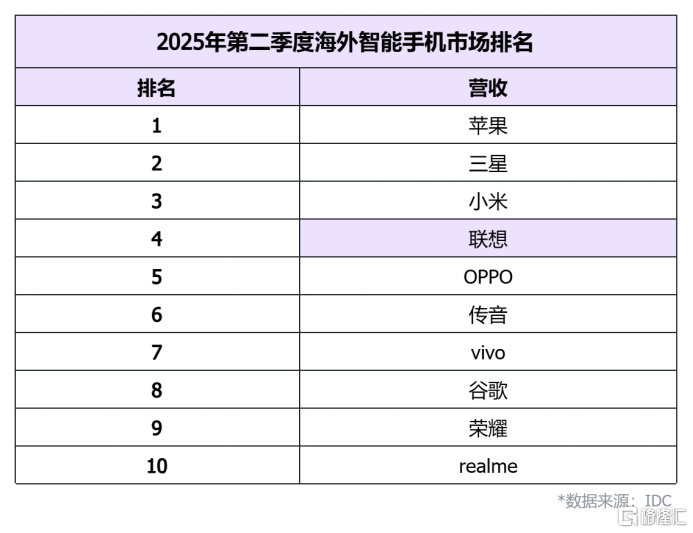
Core Insights - The global smartphone revenue outside of China reached $91.3 billion, marking a 9.2% year-on-year growth, significantly surpassing the previous growth forecast of 1.2% [1] - Lenovo's mobile business showed strong performance in overseas markets, achieving a remarkable 14.6% revenue growth and securing the fourth position globally with a market share of 5.4% [1][2] - Motorola's global revenue share increased to 3.0%, ranking eighth in the market [1] Group 1: Market Performance - Lenovo's revenue growth in the Asia-Pacific emerging markets was 66%, with India showing a robust growth rate of 44% [2] - In North America, Lenovo's revenue reached $1.07 billion, growing 18.2% year-on-year, with a market share of 5.3%, ranking third [3] - Lenovo Motorola's revenue in the global market outside of China grew by 52%, with a shipment increase of 32% [3] Group 2: Financial Highlights - In the fiscal year 2024-25, Motorola's revenue reached 62.6 billion yuan, a 27% increase, marking a historical high since Lenovo's acquisition [4] - The smartphone shipment volume increased by 75% compared to 2020 [4] - Lenovo Motorola's revenue share surpassed OPPO, Transsion, and Google, moving from fifth to fourth place in the global market [4] Group 3: Strategic Outlook - The global smartphone market is expected to continue its trend towards high-end products, with revenue growth anticipated to outpace volume growth in 2025 [4] - The rising interest in generative AI smartphones and foldable devices presents significant growth opportunities for Lenovo Motorola, leveraging its strong foundation in personal smart devices and foldable technology [4]

联想(00992)摩托罗拉手机Q2营收实现双位数增长 稳居海外市场第四
Zhi Tong Cai Jing· 2025-08-10 06:16
Core Insights - The international smartphone market, excluding China, generated total revenue of $91.3 billion, reflecting a year-on-year growth of 9.2%, significantly surpassing the previous growth forecast of 1.2% [1] - Lenovo Group's mobile business performed exceptionally well in overseas markets, achieving a robust revenue growth of 14.6% year-on-year, solidifying its position as the fourth largest player globally with a market share of 5.4% [1][2] - Lenovo's Motorola brand also saw its global revenue share increase to 3.0%, ranking eighth in the market [1] Revenue Growth and Market Position - Lenovo's revenue growth of 14.6% outpaced other top players in the overseas market, where Apple grew by 9.7%, Samsung by 11.3%, and Xiaomi by 3.7%, while OPPO experienced a decline of 1% [2] - The Asia-Pacific emerging markets and North America were identified as key growth drivers for Lenovo, with revenue in the Asia-Pacific region increasing by 66%, and the Indian market alone growing by 44% [2] - In North America, Lenovo's revenue reached $1.07 billion, marking an 18.2% year-on-year increase, with a market share of 5.3%, elevating its rank to third [3] Strategic Advantages - Lenovo's Motorola brand emerged as one of the fastest-growing major brands, benefiting from strong sales in India, steady expansion in the North American prepaid market, and enhanced competitiveness in the mid-range 5G product category [3] - Despite a downturn in the domestic smartphone market in China, Lenovo's Motorola experienced a significant revenue increase of 52% and a shipment growth of 32% [3] - In the fiscal year 2024-25, Motorola's revenue reached 62.6 billion yuan, a 27% increase, marking a historical high since Lenovo's acquisition, with smartphone shipments rising by 75% compared to 2020 [3][4] Future Outlook - Lenovo is expected to continue solidifying its fourth position in the global smartphone market, with double-digit revenue growth reflecting its strategic focus and execution in emerging markets [4] - The global smartphone market is anticipated to maintain a trend towards high-end products, with revenue growth expected to outpace volume growth in 2025 [4] - Lenovo's Motorola is well-positioned to capitalize on opportunities in the personal smart device sector and foldable smartphone market, driven by increasing interest in generative AI (GenAI) devices [4]
蓝思科技股价上涨1.57% 人形机器人业务取得新进展
Jin Rong Jie· 2025-08-06 17:56
Core Viewpoint - The company, Lens Technology, has made significant advancements in its humanoid robot business and is a key supplier in the flexible glass market for foldable smartphones [1] Group 1: Company Performance - As of August 6, 2025, Lens Technology's stock price is 23.24 yuan, reflecting a 1.57% increase from the previous trading day [1] - The trading volume on that day reached 15.05 billion yuan with a total of 651,178 hands traded, showing a volatility of 4.37% [1] Group 2: Business Developments - The company has delivered hundreds of complete humanoid robots to partners such as Zhiyuan Robotics and secured module and structural component shares with leading North American robot clients [1] - In the AI glasses sector, Lens Technology is the assembly partner for all products of Rokid [1] - The company has achieved breakthroughs in the foldable smartphone market, serving as a core global supplier of ultra-thin flexible glass and collaborating closely with multiple international clients on product development and mass production [1]


鹏鼎控股:7月营收达30.02亿元,同比增长稳健
Ju Chao Zi Xun· 2025-08-06 14:16
Core Insights - Pengding Holdings (Shenzhen) Co., Ltd. reported a consolidated revenue of RMB 3.0024 billion for July 2025, showing robust growth compared to the same period last year, highlighting the company's strong competitiveness in the global high-end PCB market [2] Company Overview - As a leading PCB manufacturer globally, Pengding Holdings focuses on high-end products such as HDI, SLP, and substrate-like PCBs, with major clients including Apple, Huawei, and Tesla [2] - The company benefits from the rapid penetration of emerging applications like AI terminals, foldable smartphones, XR devices, and automotive electronics, leading to an optimized order structure and an increase in the proportion of high-end products [2] Industry Trends - The global PCB industry is undergoing structural upgrades, with high-end products characterized by high technical barriers and strong customer loyalty, positioning Pengding Holdings to benefit from the trend of increasing industry concentration [2] - The company places significant emphasis on the development prospects of the AI server sector, with relevant production capacity established in its Huai'an and Thailand parks [2] - Pengding Holdings actively monitors the global AI server market dynamics and plans to adjust its investment and expansion strategies based on market demand and company strategy [2]


蓝思科技:今年公司承接智元机器人全系列多款人形机器人业务
Ju Chao Zi Xun· 2025-08-05 02:24
Group 1: Robotics and Automation - The company has established a joint venture with Zhiyuan Robotics to focus on high-end intelligent manufacturing equipment in the consumer electronics and new energy sectors, providing comprehensive automation solutions [1] - The company has completed a strategic investment in Zhejiang Zhiding Robotics, which specializes in commercial intelligent cleaning robots, aiming for innovation in AI and robotics integration [1] - The company is supplying key components and assembly services to various humanoid robot companies, with confirmed shares in head modules and structural components for North American clients, anticipating large-scale production [1] Group 2: Automotive Business - The company has partnered with over 30 leading automotive enterprises, including major North American clients, covering multiple advanced driving platforms, with a market share of 20.9% in global intelligent automotive interaction systems [2] - The company has achieved breakthroughs in wireless charging modules, domain controllers, and automotive communication modules, expanding its automotive business boundaries [2] Group 3: Mobile Devices - The global shipment of foldable smartphones is expected to grow rapidly, with a compound annual growth rate of over 24%, driving demand for core glass and metal components [2] - The company is a leading global supplier of ultra-thin flexible glass (UTG), benefiting from its deep technical expertise and mature mass production capabilities, capturing significant market share in key components for foldable screens [2] - The company has been actively involved in the design, development, and production of foldable screen products, preparing for large-scale production based on customer needs [3] Group 4: 3D Glass Technology - The demand for 3D glass is expected to grow rapidly, with head brand effects driving market expansion, leading to a significant increase in the value of complex 3D structures [3] - The company has been a pioneer in developing and applying 3D curved glass since 2011, possessing core technologies and mass production experience, positioning itself to benefit from the new wave of 3D glass technology innovation [3]