
绿色能源转型

Search documents
欧洲巨头愁失眠,新疆绿电异军突起,这里藏着中国未来 30 年的财富密钥?
Sou Hu Cai Jing· 2025-09-02 02:29
Group 1 - The core issue in Europe is economic stagnation, with Germany, France, and the UK facing significant challenges due to rising energy prices, persistent inflation, and disrupted supply chains [2] - In contrast, Xinjiang's green electricity industry is experiencing rapid growth, with installed capacity exceeding 100 million kilowatts, accounting for over half of the total power generation capacity [2][3] - Xinjiang has established three large-scale renewable energy bases, significantly contributing to clean energy production [2] Group 2 - The transformation of desert areas into green spaces through solar power projects is notable, with extensive photovoltaic installations improving local ecology [3] - Xinjiang's green electricity is not only thriving locally but also being transmitted to 22 provinces, with over 860 billion kilowatt-hours exported last year, nearly 30% of which came from renewable sources [3][4] - The development of the green electricity sector in Xinjiang is fostering a complete industrial chain, from raw material production to solar panel manufacturing, creating numerous job opportunities and economic benefits [4] Group 3 - The green electricity industry in Xinjiang is attracting investment and industrial migration, particularly in energy-intensive sectors like electrolytic aluminum and silicon-based new materials, due to favorable electricity prices [4] - The potential for green hydrogen production utilizing abundant green electricity resources is being explored, indicating vast future development opportunities for Xinjiang's green electricity sector [5] - Xinjiang's green electricity development is positioned as a key driver for China's economic growth in the next 30 years, especially in the context of global energy transitions [5]

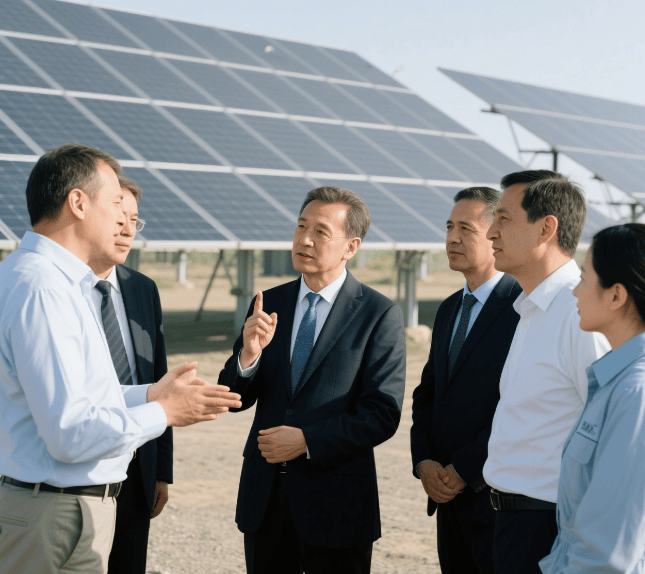
中瑞地方合作对话会在沪举行
Jie Fang Ri Bao· 2025-08-30 02:19
Core Viewpoint - The China-Switzerland Local Cooperation Dialogue held on August 28 in Shanghai celebrates the 75th anniversary of diplomatic relations between China and Switzerland, focusing on sustainable development cooperation [1] Group 1: Event Overview - The dialogue emphasizes topics such as "green energy transition," "AI empowerment," and "smart city governance" to promote mutual learning and collaboration in sustainable development [1] - The event is co-hosted by the Chinese People's Association for Friendship with Foreign Countries and the Swiss-Chinese Association, with support from the Shanghai People's Association for Friendship with Foreign Countries and the Shanghai Academy of Social Sciences [1] - Notable attendees include Yang Wanming, President of the National Association for Friendship with Foreign Countries, and Chen Jing, President of the Shanghai Association for Friendship with Foreign Countries [1]
大唐发电(601991):煤电降本增厚经营业绩 拟推动中期分红
Xin Lang Cai Jing· 2025-08-29 06:31
Core Viewpoint - In the first half of 2025, the company achieved operating revenue of 57.193 billion yuan, a year-on-year decrease of 1.93%, while net profit attributable to shareholders reached 4.579 billion yuan, a year-on-year increase of 47.35% [1][2][3] Financial Performance - The company's operating revenue decreased slightly due to falling electricity prices, while net profit increased significantly due to lower coal prices improving coal power profitability [1][3] - The company reported a weighted return on equity of 11.96%, an increase of 3.94 percentage points year-on-year, and basic earnings per share of 0.21 yuan, up 65.67% year-on-year [2][3] Business Segments - In H1 2025, profits from various business segments were as follows: coal machinery 3.15 billion yuan (+108.5%), gas power 130 million yuan (-62.6%), hydropower 1.21 billion yuan (+17.2%), wind power 1.94 billion yuan (+71.3%), and solar power 400 million yuan (+3.6%) [1][3] - The company’s average on-grid electricity price was 444.48 yuan per megawatt-hour, a decrease of approximately 3.95% year-on-year [4] Cost Management - The company’s financial expense ratio decreased year-on-year due to a reduction in financing costs, with the comprehensive financing cost as of June 2025 being 2.43%, down 20 basis points from the beginning of the year and 54 basis points year-on-year [3][4] Dividend Policy - The company plans to distribute a mid-year dividend of 0.055 yuan per share (before tax), with an estimated total dividend amount of approximately 1.018 billion yuan, resulting in a payout ratio of 26.7% [3] Future Outlook - The company expects net profits attributable to shareholders for 2025 to be 6.083 billion yuan, 6.454 billion yuan for 2026, and 7.091 billion yuan for 2027 [1][6] - The company is actively promoting green energy transformation, with a continuous increase in installed capacity and on-grid electricity from renewable sources [5][6]

迪拜“绿色氢”项目投产逾百吨氢气,助力绿色能源转型
Shang Wu Bu Wang Zhan· 2025-08-27 15:39
Core Insights - The Dubai "green hydrogen" project has produced over 100 tons of green hydrogen since its launch in May 2021, primarily for electricity generation, resulting in over 1.15 gigawatts of green power and a reduction of more than 515 tons of carbon emissions [1][1][1] Group 1: Project Overview - The project is the first in the Middle East and North Africa to produce hydrogen using solar energy, implemented by the Dubai Electricity and Water Authority in collaboration with the 2020 Dubai Expo and Siemens Energy [1][1] - The facility can produce approximately 20 kilograms of green hydrogen per hour, with storage capabilities for up to 12 hours of hydrogen production from solar energy [1][1] Group 2: Applications and Impact - About 11 tons of the produced hydrogen have been utilized in various sectors, including transportation, with hydrogen fuel provided for vehicles at the ENOC future service station in Dubai Expo City [1][1] - The project is designed to serve as a platform for future hydrogen applications and testing across power generation, transportation, and industrial sectors [1][1]
CNOOC(00883) - 2025 Q2 - Earnings Call Transcript
2025-08-27 02:30
Financial Data and Key Indicators Changes - In the first half of 2025, net profit attributable to shareholders reached RMB 69.5 billion, a decrease of 12.8% year on year, primarily due to a 15.1% decline in Brent oil prices [20][10][24] - Oil and gas sales revenue was RMB 171.7 billion, with all-in costs remaining stable at USD 26.94 per barrel, down 2.9% year on year [10][23] - The company maintained a gearing ratio of 8.4%, indicating a healthy financial position, with total assets increasing to RMB 1,119 billion [22][23] Business Line Data and Key Indicators Changes - Net oil and gas production reached 384.6 million BOEs, up 6.1% year on year, with natural gas production rising by 12% [4][14] - The company made five new discoveries and successfully appraised 18 oil and gas structures, with 10 new projects commencing production [4][9] - The interim dividend was set at HKD 0.73 per share, with a payout ratio of 45.5%, marking the second highest in the company's history [5][24] Market Data and Key Indicators Changes - Brent oil prices decreased by 15.1%, impacting overall profitability but the decline in net profit was less severe than the drop in oil prices [20][21] - The company reported strong performance in the domestic natural gas market, with production volume increasing due to new projects in the Bohai region and South China Sea [30][72] Company Strategy and Development Direction - The company aims to enhance oil and gas reserves and production while promoting green energy transition and independent technological innovation [25][64] - There is a commitment to maintaining oil and gas as the core business, with new energy development seen as a supplementary growth area [64][60] - The focus remains on high-quality development and efficiency improvement to ensure sustainable growth [25][44] Management's Comments on Operating Environment and Future Outlook - Management acknowledged the challenges posed by fluctuating oil prices but emphasized the company's resilience and ability to control costs [20][44] - The outlook for oil prices in 2025 is projected to be around USD 65 to USD 70, influenced by various geopolitical factors [46][47] - The company plans to continue investing in technological innovations to drive down costs and improve operational efficiency [40][88] Other Important Information - The company has made significant advancements in technological capabilities, including intelligent drilling and completion initiatives, which have improved operational efficiency [17][88] - The company is actively exploring new energy projects, including offshore wind power and solar energy, while ensuring that these initiatives align with internal investment thresholds [55][60] Q&A Session Summary Question: What are the reasons behind the increase in natural gas production and pricing? - The increase in natural gas production was attributed to additional reserves and production from new projects in the Shanghai and Bozhong areas, with stable pricing due to long-term contracts [30][31] Question: Will the dividend payout ratio improve for the whole year? - The interim dividend payout ratio was set at 45.5%, and while future dividends will be evaluated based on various factors, the company aims to maintain a high-quality development principle [33][34] Question: What are the expectations for cost reduction and efficiency improvement in the second half of the year? - The company plans to continue its low-cost strategy through technological improvements, lean management, and increased production to enhance overall economic benefits [40][42] Question: What are the plans for new energy business development? - The company is focusing on offshore wind power and other renewable energy projects, ensuring that they meet internal investment criteria and contribute to overall sustainability [55][60] Question: What caused the investment loss in the first half of the year? - The investment loss was primarily due to the performance of a joint venture in Argentina, which was recognized in accordance with accounting standards [66][68] Question: What is the outlook for natural gas production growth? - The company anticipates strong growth in natural gas production, supported by ongoing projects and a stable domestic market [70][72]

“中国新能源电池之都”发展正当时
Jin Rong Shi Bao· 2025-08-27 02:29
Core Insights - The article highlights the significant role of new energy vehicles (NEVs) in the global green energy transition, with a particular focus on the importance of batteries, where CATL (Contemporary Amperex Technology Co., Limited) stands out as a key player in the industry [1][2]. Group 1: Company Performance - CATL reported a total revenue of 178.9 billion yuan in the first half of 2025, representing a year-on-year growth of 7.3% [1]. - The net profit attributable to shareholders reached 30.5 billion yuan, showing a substantial year-on-year increase of 33.3% [1]. Group 2: Technological Advancements - CATL has achieved breakthroughs in high energy density, super-fast charging, and battery safety, alleviating consumer concerns regarding electric vehicle range, refueling, and safety [2]. - The company has established a unique R&D closed-loop system that integrates testing data and real vehicle feedback across various stages, including material R&D, product development, engineering design, and smart manufacturing [2]. Group 3: Global Presence and Production Capacity - As of June 2025, CATL has served over 20.43 million vehicles and has sold products to 66 countries and regions [2]. - The company operates 13 battery manufacturing bases globally, including locations in China and Europe, with three of its factories recognized as global "lighthouse factories" by the World Economic Forum [2]. Group 4: Industry Ecosystem and Financial Support - The city of Ningde, where CATL is based, has developed into "China's New Energy Battery Capital," attracting over 80 projects across the entire battery supply chain [3]. - Financial institutions have been guided to support the lithium battery industry in Ningde through innovative credit products, with CATL receiving over 310 billion yuan in comprehensive credit lines from banks, more than doubling since 2019 [3].


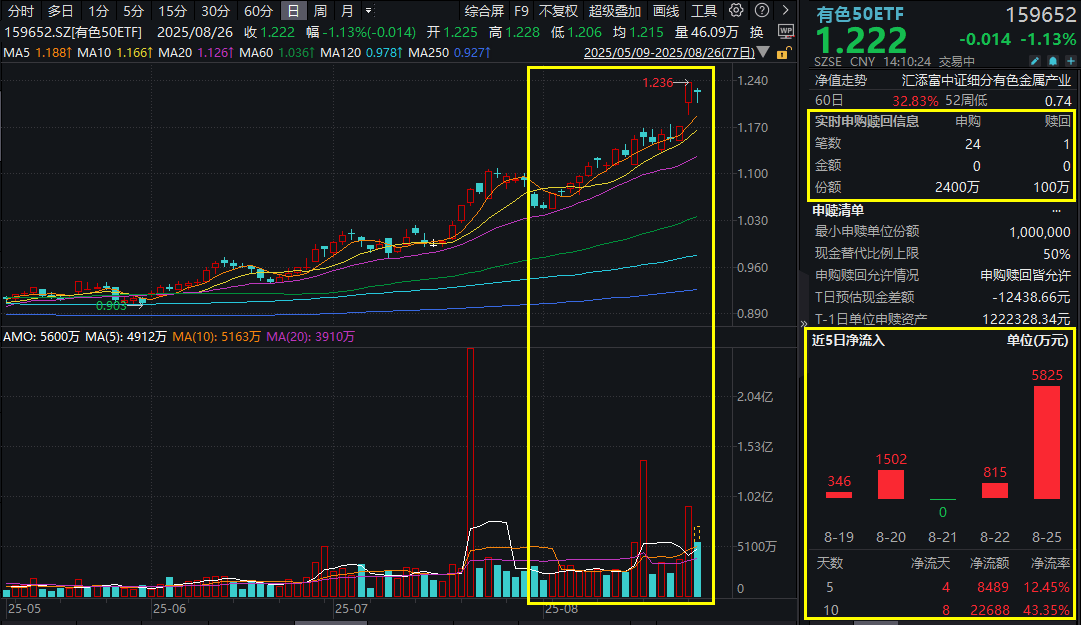
北方稀土跌超5%,“反内卷先锋”有色50ETF(159652)两连阳后首度回调,跌超1%,盘中净流入超2000万元!降息、反内卷双击,有色空间几何?
Sou Hu Cai Jing· 2025-08-26 06:54
Core Viewpoint - The A-share market experienced fluctuations on August 26, with the non-ferrous sector undergoing a pullback, while the Non-Ferrous 50 ETF (159652) saw significant inflows despite a slight decline after a previous surge [1][6]. Market Performance - The Non-Ferrous 50 ETF (159652) recorded a net subscription of 23 million shares during the day, marking its third consecutive day of strong capital inflow [1]. - The component stocks of the Non-Ferrous 50 ETF showed mixed performance, with notable gains from Yun Aluminum Co. and Huaxi Nonferrous, both rising over 4% [3]. Component Stocks Overview - The top ten component stocks of the Non-Ferrous 50 ETF include: - Sanfang Liannong (601899) with a 0.86% increase and a market cap of 35.44 billion - Northern Rare Earth (600111) with a 6.36% decrease and a market cap of 182.38 billion - Other notable stocks include China Aluminum (601600) and Shandong Gold (600547) with increases of 1.24% and 1.85% respectively [4]. Economic Context - Federal Reserve Chairman Jerome Powell highlighted the dual challenges of inflation and a cooling labor market, with a significant drop in job creation in July, indicating increased economic downside risks [5]. - The likelihood of an interest rate cut by the Fed has increased, which is expected to enhance the investment appeal of metals like gold and copper [6]. Investment Insights - The Non-Ferrous 50 ETF (159652) is noted for its high copper content (31%), making it a leading choice in the sector [7]. - The ETF's cumulative return from 2019 to August 10, 2025, reached 140%, despite a 20% decline in valuation PE, indicating that the index's rise is driven by profit growth rather than valuation expansion [11]. - Analysts recommend continued investment in the Non-Ferrous 50 ETF due to its strong positioning in the context of an impending interest rate cut and the ongoing demand for metals driven by green energy transitions and technological advancements [6][11].




紧抓产业发展机遇 嘉实基金旗下两只ETF规模齐创新高
Zheng Quan Ri Bao Wang· 2025-08-26 05:04
Group 1 - The core viewpoint of the articles highlights the strong performance of the technology and rare earth sectors, with significant capital inflow into industry ETFs, indicating investor confidence in high-tech and strategic resource sectors [1][2] - As of August 25, the Jiashi Fund's Science and Technology Chip ETF has surpassed 35 billion yuan, reaching a scale of 35.103 billion yuan, making it the largest in its category, while the Jiashi Rare Earth ETF has exceeded 6.4 billion yuan, standing at 6.436 billion yuan, also leading in its category [1] - Both ETFs have shown a net value increase of over 120% in the past year, reflecting active trading and strong market interest [1] Group 2 - Jiashi Fund has focused on the "super opportunity" investment theme, aligning with industrial trends and national strategic directions, building a product matrix centered around "super ETFs" [2] - The Science and Technology Chip ETF targets domestic semiconductor production, covering industry leaders like SMIC and Haiguang Information, and is closely linked to emerging demands in AI computing and artificial intelligence [2] - The Jiashi Rare Earth ETF focuses on upstream resources for new energy, with top ten weighted stocks including Northern Rare Earth and China Rare Earth, capturing high-end manufacturing upgrade assets in rare earth permanent magnets and military industries [2]
北京卡文新能源汽车注册资本增至13.06亿元,股东名单更新
Ju Chao Zi Xun· 2025-08-25 10:27
| 更新时间(1) | 动态等级 | 动态类型 | 动态内容 | 操作 | | --- | --- | --- | --- | --- | | 2025-08-22 | 利好 | 注册资本增加 | 从"50000万元"增加到"130584.8668万元",增加"80584.8668万元" | - 收藏 | | | | | 新增股东 | | | | | | 新增:海南星辉海纳投资合伙企业(有限合伙)、安鹏绿色(北京)能源产业投资基金(有限合伙)、博 | | | | | | 原怡成(淄博)股权投资合伙企业(有限合伙)、北京市绿色能源和低碳产业投资基金(有限合伙)、武 | | | 2025-08-22 | 揚示 | 股东、主要成员变更 | 汉博原丰成创业投资合伙企业(有限合伙) | 详情 收藏 | | | | | 主要成员变更 | | | | | | 退出:李庆华 | | | | | | 新增:王文健、魏然 | | 同时,公司的股东、主要成员发生变更。新增股东为:海南星辉海纳投资合伙企业(有限合伙)、安鹏绿色(北京)能源产业投资基金(有限合伙)、博原 怡成(淄博)股权投资合伙企业(有限合伙)、北京市绿色能源和低碳产 ...

从黄金替补到领涨主角,白银还能上车吗?
Sou Hu Cai Jing· 2025-08-25 01:30
Group 1 - The global precious metals market has seen a significant rise in 2023, with silver prices reaching a 14-year high of over $39 per ounce, marking a year-to-date increase of 34%, surpassing gold's 29% increase during the same period [1] - Silver's price advantage compared to gold makes it accessible to a broader range of investors, with current silver prices approximately 1/80th of gold prices, allowing for flexible asset allocation among small and medium investors [2] - Retail demand for silver remains strong despite a 15%-20% increase in silver jewelry prices, as consumers find the total cost of smaller silver items still acceptable, leading to a 40% year-on-year increase in sales of silver bars and ingots [2] Group 2 - Silver possesses a unique "industrial + investment" dual attribute, with 56% of global silver demand in 2023 coming from industrial applications, particularly in photovoltaic, electronics, and medical sectors, driven by the rapid growth of the renewable energy industry [3] - The pricing mechanism of silver is influenced by both Federal Reserve monetary policy and global manufacturing PMI indices, creating a dynamic where increased industrial demand can lead to higher prices [3] - Market opinions on investing in silver are divided, with bullish views suggesting that the current gold-silver ratio of approximately 78:1 indicates potential for silver price increases, while cautious perspectives highlight the historical peak in silver futures open interest, suggesting possible short-term corrections [4] Group 3 - Investors in the silver market should clarify their investment goals, whether for short-term trading or long-term allocation, and manage their position sizes carefully, as precious metals should not constitute an overly large portion of their portfolios [5] - Attention should be paid to Federal Reserve policy changes and data from the photovoltaic industry, as silver's price volatility is typically 1.5 to 2 times that of gold, indicating both higher potential returns and greater risks [5]