
南向资金

Search documents
超1.27万亿!南向资金加仓再创历史新高 非银、创新药、科技持续“吸金”
Zhong Guo Ji Jin Bao· 2025-11-06 07:37
Core Insights - Southbound capital has been a significant source of inflow into the Hong Kong stock market, with a cumulative net inflow exceeding 1.27 trillion HKD this year, marking a historical high for annual net inflows [1] - The innovative drug, technology, and non-bank sectors have seen substantial gains, with respective year-to-date increases of 79%, 53%, and 34%, compared to a 26% rise in the Hang Seng Index [1] - The largest Hong Kong innovative drug ETF (513120) received a net inflow of 585 million HKD in a single day, bringing its total size to 23.7 billion HKD [1] Fund Flows - The total net inflow for all ETFs in the market exceeded 3.777 billion HKD, with significant inflows into non-bank financials, innovative drugs, and technology sectors [1] - GF Fund Management led all public institutions with a total net inflow of 1.997 billion HKD across its ETFs, including those focused on A-shares and other sectors [2] - Notable ETFs under GF Fund Management include the innovative drug ETF (515120), low-fee创业板 ETF (159952), and the largest media ETF (512980), each receiving over 100 million HKD in net inflows [2] Market Outlook - Market volatility has increased entering November, with industry experts suggesting that fundamental improvements in 2026 may drive further gains in the Hong Kong stock market [2] - The AI industry is expected to catalyze improvements in net asset return rates (ROE) for sectors represented by the Hang Seng Technology Index, potentially leading to higher market valuations [2] - In terms of asset allocation, while the technology sector remains favorable, innovative drugs, non-bank financials, and certain cyclical assets are also worth attention [2]
机构:预计至2026年底,南向长线资金仍有1.54万亿港元的新增空间
Mei Ri Jing Ji Xin Wen· 2025-11-06 06:47
Group 1 - The Hong Kong stock market showed strong performance on November 6, with the Hang Seng Technology Index rising over 2% in the afternoon, driven by gains in tech stocks, non-ferrous metals, and semiconductor sectors [1] - Southbound capital continued to actively invest in the Hong Kong market, with a net purchase amount of 10.373 billion HKD on November 5, bringing the total for the month to 25.677 billion HKD, and a cumulative net purchase of 1,285.694 billion HKD for the year [1] - According to Guotai Junan's recent report, under a neutral assumption, active public funds are expected to see an inflow of 200 billion HKD next year, with passive public funds also expected to bring in 200 billion HKD, and insurance and private equity funds projected to contribute 400 billion HKD and 300 billion HKD respectively [1] Group 2 - China Merchants Securities forecasts that by the end of 2026, there will be an additional 1.54 trillion HKD of long-term southbound capital, potentially bringing a total of approximately 11 trillion HKD in the next five years [2] - The Hang Seng Technology Index ETF (513180) is currently valued at a P/E ratio of 22.52, which is in the historical low valuation range, being below 73% of its historical valuation periods [2] - The technology sector in Hong Kong is expected to benefit from current trends in AI, with potential foreign capital inflows exceeding expectations due to the backdrop of Federal Reserve interest rate cuts and continued accumulation of southbound funds [2]
招商证券国际:料南向长线资金至明年底增1.54万亿港元 支撑港股“慢牛”行情
Xin Lang Cai Jing· 2025-11-06 04:28
Core Viewpoint - The report from China Merchants Securities International indicates that policies will continue to attract medium to long-term capital to invest in Hong Kong stocks, with an expected additional space of HKD 1.54 trillion by the end of 2026, supporting a "slow bull" market for Hong Kong stocks [1] Group 1: Market Dynamics - The significant increase in Hong Kong stocks this year is primarily due to the continuous inflow of southbound funds from the mainland, with net inflows reaching HKD 1.17 trillion by the end of the third quarter [1] - The trading volume of southbound funds accounted for 23.6% of the total trading volume, with the market value of Hong Kong Stock Connect holdings surpassing HKD 6.3 trillion, representing approximately 12.7% of the total market capitalization of Hong Kong stocks [1] Group 2: Future Outlook - Long-term capital from the mainland is becoming a key driver for the restructuring of liquidity and optimization of the valuation system in the Hong Kong stock market [1] - The report anticipates that improvements in the interconnectivity mechanism, relaxation of QDII restrictions, better tax policies, the listing of quality assets in Hong Kong, and regulatory encouragement for long-term investments will continue to attract medium to long-term capital [1]

刚刚,暴涨超190%!港股,异动!
券商中国· 2025-11-05 13:12
Core Viewpoint - The Hong Kong stock market is experiencing a significant surge in new stock listings, with notable gains observed in the initial trading days of these stocks, indicating a strong investor interest and profitability potential in the market [1][9]. Group 1: New Stock Performance - Wangshan Wangshui-B (02630.HK) is set to list on November 6, with its stock price soaring to 97 HKD per share during the dark trading phase, reflecting an increase of over 190% at one point [1][2]. - The stock closed at 85 HKD per share in the dark trading, marking a 154.72% rise from its offering price of 33.37 HKD per share, potentially yielding a profit of 10,300 HKD per lot (200 shares) for investors [1][3]. - Among the 14 new stocks listed in October, only one experienced a decline on its first trading day, while others saw substantial gains, with Jin Ye International Group achieving a remarkable 330% increase [9]. Group 2: Company Overview - Wangshan Wangshui, established in 2013, is a biopharmaceutical company with nine innovative drug pipelines, including two in commercialization, four in clinical stages, and three in preclinical stages [5]. - The company's core products include LV232, aimed at treating severe depression, and TPN171, a PDE5 inhibitor for erectile dysfunction (ED), with market projections indicating a stable growth in the PDE5 inhibitor market [5][6]. Group 3: Financial Performance - For the fiscal years 2023 and 2024, Wangshan Wangshui reported revenues of 200 million CNY and 11.83 million CNY, with net profits of 64.27 million CNY and a loss of 21.8 million CNY, respectively [7]. - The company attributed its 2024 net loss to a significant decrease in external licensing income, while the first four months of 2025 showed a further loss due to increased administrative expenses related to a new restricted stock plan [7]. Group 4: Market Trends - The Hong Kong stock market has seen a doubling of average daily trading volume to over 32 billion USD compared to the previous year, with 80 IPOs raising over 26 billion USD in the first ten months of the year, leading to a global ranking in IPO fundraising [9][10]. - Continuous inflow of southbound funds, which reached 1.17 trillion HKD by the end of Q3, is significantly enhancing the pricing power of the Hong Kong stock market, with long-term institutional investments expected to support a sustained upward trend [10][11].

南向资金今日净买入103.73亿港元
Zheng Quan Shi Bao Wang· 2025-11-05 09:19
| | 买入成交额(亿港元) | 卖出成交额(亿港元) | 成交净买入(亿港元) | | --- | --- | --- | --- | | 港股通(深) | 221.14 | 151.00 | 70.14 | | 港股通(沪) | 309.16 | 275.57 | 33.59 | | 合计 | 530.30 | 426.57 | 103.73 | 具体看,港股通(沪)买入成交309.16亿港元,卖出成交275.57亿港元,合计成交额584.73亿港元,成 交净买入33.59亿港元;港股通(深)买入成交221.14亿港元,卖出成交151.00亿港元,合计成交372.14 亿港元,成交净买入70.14亿港元。(数据宝) 南向资金今日成交概况 11月5日南向资金全天成交额956.87亿港元,成交净买入103.73亿港元。 证券时报·数据宝统计显示,11月5日恒生指数下跌0.07%,南向资金合计买入成交530.30亿港元,卖出 成交426.57亿港元,合计成交额956.87亿港元,全天成交净买入103.73亿港元,连续11日净买入。 (文章来源:证券时报网) ...
提前近2月,创下年度净流入历史新高!
Mei Ri Jing Ji Xin Wen· 2025-11-05 06:31
Core Insights - As of November 4, cumulative net inflow from southbound funds has exceeded 1.27 trillion HKD, marking a historical high for annual net inflows despite nearly two months remaining until the end of 2025 [1] - The primary source of incremental capital in the Hong Kong stock market this year has been southbound funds, with significant inflows observed since October [1] - The low valuation and high dividend yield of the Hong Kong stock market compared to A-shares are key factors driving this trend, with the dividend yield of the Hong Kong central enterprise dividend ETF at 5.72% and the Hong Kong financial ETF at 4.93%, while A-share ordinary dividend yield is below 4% [1] - For ordinary investors, the trading threshold for southbound investment may pose challenges, making southbound ETFs a viable investment option [1]
调整延续,恒指低开超250点 赛力斯上市破发
Mei Ri Jing Ji Xin Wen· 2025-11-05 02:16
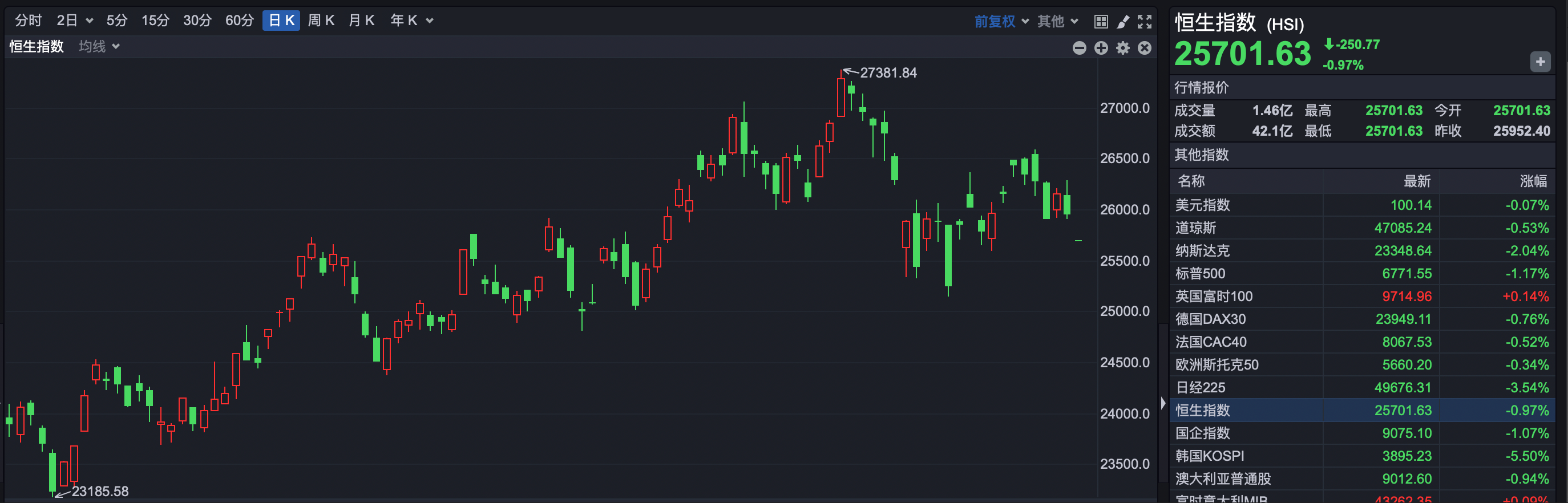
Market Overview - The Hong Kong stock market opened lower today, with the Hang Seng Index down by 250.77 points, or 0.97%, at 25,701.63 points [1] - The Hang Seng Tech Index also opened lower, down 101.75 points, or 1.75%, at 5,716.54 points [2] Impact of US Market - Analysts indicated that the drop in the Hang Seng Index is primarily due to a significant decline in the US stock market the previous night, where the Dow Jones fell by 0.53% and the Nasdaq dropped over 2% [4] New Listings - The new energy vehicle company, Seres (09927.HK), faced a poor market debut, with its stock price falling nearly 10% from the issue price of 131.5 HKD to a low of 118 HKD [4] Sector Performance - The technology sector saw collective declines, with notable drops including Bilibili down over 5%, Kuaishou down over 3%, and Alibaba and Tencent both down over 2% [5] - Gold stocks continued to decline, with Zijin Mining International down over 3% [5] - The lithium battery sector also experienced declines, with Ganfeng Lithium down over 4% [5] Capital Flow Insights - According to CICC, the active performance of Hong Kong stocks this year is closely related to liquidity, driven by international funds seeking asset diversification and domestic funds looking for higher returns through southbound channels [6] - A noteworthy observation is that individual investors have played a significant role in the recent inflow of southbound funds, indicating potential variability in market impact [6] Regulatory Changes - UBS commented on the recent adjustment of the gold value-added tax deduction policy, suggesting it may lead to decreased liquidity in investment gold products and shift some demand towards gold ETFs [6] - The new tax costs in the gold jewelry consumption sector are expected to be largely passed on to consumers, potentially pressuring recent gold consumption demand [6]

南向资金与上市公司回购给力 港股仍有上行空间
Zhong Guo Zheng Quan Bao· 2025-11-04 20:17
Core Insights - Southbound capital has significantly increased its holdings in the Hong Kong stock market, marking it as the largest source of incremental funds this year, with a cumulative net inflow exceeding 1.27 trillion HKD, a historical high [1][4] - The Hong Kong stock market has performed well this year, with the Hang Seng Index and Hang Seng Tech Index rising over 29% and 30% respectively as of November 4 [1][6] - Despite recent market fluctuations, analysts believe that the Hong Kong market is primarily driven by liquidity, with potential for substantial upward movement in the medium to long term [1][7] Southbound Capital Inflows - As of November 4, 2023, southbound capital has recorded a cumulative net inflow of 12,753.21 billion HKD this year, more than double the amount from the same period in 2024, with a single-day record inflow of 358.76 billion HKD on August 15 [1][4] - In 198 trading days this year, there were net inflow days on 166 occasions, accounting for over 80% [1] - Monthly net inflows have consistently exceeded 110 billion HKD in several months, including January through April, July, August, and September [1] Holdings and Sector Preferences - As of November 3, 2023, southbound capital held 5,525.19 billion shares, an increase of 867.34 billion shares since the beginning of 2025, with a market value of 6.29 trillion HKD, up 2.71 trillion HKD [2] - The financial, information technology, and consumer discretionary sectors have the highest holdings, valued at 15,135.25 billion HKD, 13,086.04 billion HKD, and 8,918.34 billion HKD respectively [2] - Major stock holdings include Tencent Holdings over 650 billion HKD, Alibaba-W over 360 billion HKD, and several banks and energy companies exceeding 200 billion HKD [2] Recent Buying Trends - The most significant increases in holdings this year have been in China Construction Bank, Bank of China, and other major banks, with increases of 68.96 billion shares, 52.02 billion shares, and 50.27 billion shares respectively [3] - In the past month, the financial, energy, and communication services sectors saw the highest net buying amounts, with 255.73 billion HKD, 112.20 billion HKD, and 95.67 billion HKD respectively [4] Company Buybacks - As of November 3, 2023, Hong Kong-listed companies have repurchased over 1,460 billion HKD worth of shares, with 239 companies participating in buybacks this year [5] - Tencent Holdings leads in buyback scale with 609.65 billion HKD, followed by HSBC and AIA with 302.57 billion HKD and 176.93 billion HKD respectively [5] - The buyback trend is particularly strong in the technology and financial sectors, with notable increases in consumer companies as well [5] Market Performance and Outlook - The Hong Kong stock market has shown strong performance this year, with all industry sectors experiencing gains, particularly materials, healthcare, and information technology [6] - The Hang Seng Index's rolling P/E ratio has increased from 8.96 to 11.89, indicating a potential for valuation recovery [6] - Analysts suggest that the market may continue to experience fluctuations in the short term but has significant upward potential in the medium to long term due to favorable liquidity conditions and ongoing capital inflows [7]





今日南向资金ETF买入及卖出成交额为15.26亿港元
Zheng Quan Shi Bao· 2025-11-04 16:39
Core Viewpoint - The southbound funds' ETF trading volume today is 1.52% of the total southbound funds trading volume, indicating a decrease in activity compared to the previous day [1]. Group 1: Trading Volume - The total trading volume for southbound funds' ETFs today is 15.26 billion HKD, a decrease of 7.48 billion HKD from the previous day [1]. - The trading volume for the Hong Kong Stock Connect (Shanghai) ETFs is 11.39 billion HKD [1]. - The trading volume for the Hong Kong Stock Connect (Shenzhen) ETFs is 3.86 billion HKD [1].