指数化投资

Search documents
年内上市ETF 317只 同比增超136%
Zheng Quan Ri Bao· 2025-11-12 00:22
Core Insights - The launch of the Xinyi Zhongzheng Financial Technology Theme ETF on November 11 marks a significant milestone, bringing the total number of ETFs listed this year to 317, a year-on-year increase of 136.57% [1] Supply Acceleration - As of November 11, 317 ETFs have been listed this year, with a total scale of 541.174 billion yuan. This is a substantial increase compared to 163 and 156 ETFs listed in 2024 and 2023, respectively [2] - Key drivers for the surge in ETF listings include policy support, upgraded capital allocation needs, industry development trends, and accelerated product innovation [2] - Regulatory improvements, such as the establishment of a fast approval channel for ETFs and the promotion of high-quality index investment, have facilitated rapid product issuance [2] - The growing market demand for ETFs is driven by their transparent strategies, ease of trading, and low fees, making them increasingly popular among investors [2] Active Fund Allocation - ETFs are favored by various funds, including foreign capital and private equity, as an important asset allocation tool [3] - Notable institutional investors in ETFs include foreign banks, brokerages, and private equity firms, indicating a diverse investor base [3] - The participation of long-term capital through ETFs is expected to foster a healthy ecosystem in the A-share market, enhancing market stability and international influence [3] Future Outlook - Over 1,300 ETFs are currently listed, with more expected to enter the market soon, as several public fund institutions have announced upcoming ETF listings [4] - The expansion of ETFs is anticipated to boost the trading activity of underlying assets, thereby enhancing market liquidity [4] - The increase in ETF listings and trading is expected to improve market liquidity and information transparency, leading to more rational pricing and promoting long-term investment philosophies [5]
年内上市ETF317只 同比增超136%
Zheng Quan Ri Bao· 2025-11-11 16:12
Core Insights - The launch of the Xinyi Zhongzheng Financial Technology Theme ETF on November 11 marks a significant milestone, bringing the total number of ETFs listed this year to 317, representing a year-on-year increase of 136.57% [1] Supply Acceleration - As of November 11, 317 ETFs have been listed this year, with a total scale of 541.174 billion yuan. This is a substantial increase compared to 163 and 156 ETFs listed in 2024 and 2023, respectively [2] - Key drivers for the surge in ETF listings include policy support, upgraded capital allocation needs, industry development trends, and accelerated product innovation [2] - Regulatory improvements, such as the establishment of a fast-track approval process for ETFs and the promotion of high-quality index investment development, have facilitated rapid product issuance [2] - The growing market demand for ETFs is driven by their transparent strategies, ease of trading, and low fees, making them increasingly popular among investors [2] Active Fund Allocation - ETFs are favored by various funds, including foreign capital and private equity, as effective tools for asset allocation [3] - Notable institutional investors in ETFs include foreign banks, brokerages, and private equity firms, indicating a diverse investor base [3] - The participation of long-term capital through ETFs is expected to foster a healthy ecosystem in the A-share market, enhancing market stability and international influence [3] Future Outlook - Over 1,300 ETFs are currently listed, with more expected to enter the market soon, as several public fund institutions have announced upcoming ETF listings [4] - The expansion of ETFs is anticipated to boost the trading activity of underlying assets, thereby enhancing market liquidity [4] - The increase in ETF listings and trading is expected to improve market liquidity and information transparency, leading to more rational and effective pricing [5]
多只指数增强产品本周成立,光伏电网领涨:指数化投资周报20251111-20251111
Shenwan Hongyuan Securities· 2025-11-11 11:43
- Multiple index-enhanced products were established this week, including CICC Beizheng 50 Index Enhanced A, Ping An Hang Seng Index Enhanced A, and Guolian CSI Hong Kong Stock Connect Comprehensive Index Enhanced A, adding new members to the index-enhanced ETF category [4][5][8] - Recent fundraising activities include the completion of fundraising for 17 index products, such as CICC CSI All Index Enhanced A and Guotou Ruixin SSE Composite Index Enhanced A, while 23 index products, including Guotou Ruixin Beizheng 50 Constituent Index A and Hua Xia S&P Hong Kong Stock Connect Low Volatility Dividend ETF, began fundraising [8][9][11] - 13 index products were submitted for approval this week, including thematic funds like Dacheng CSI Subdivision Chemical Industry Thematic ETF and Dacheng CSI Battery Thematic ETF, as well as connection funds like Penghua ChiNext New Energy ETF Connection and Guoshou Anbao CSI A500 Low Volatility Dividend ETF Connection [12][13][14]



指数化投资周报:多只指数增强产品本周成立,光伏电网领涨-20251111
Shenwan Hongyuan Securities· 2025-11-11 10:45
- The report primarily focuses on the establishment and fundraising of multiple index-enhanced products, including the recent launch of several index-enhanced ETFs such as CICC Beijing Stock Exchange 50 Index Enhanced A, Ping An Hang Seng Index Enhanced A, and Guolian CSI Hong Kong Stock Connect Composite Index Enhanced A[5] - A total of 20 index-enhanced products were established recently, including notable ones like Changsheng CSI A500 Index Enhanced A, CICC CSI All Index Enhanced A, and Guotou Ruixin Shanghai Composite Index Enhanced A[6][10] - The report highlights the upcoming fundraising for 23 index products, including index-enhanced funds such as Zhongjia Beijing Stock Exchange 50 Constituent Index Enhanced A and Huaxia CSI 800 Index Enhanced A[9][12] - The report also mentions the recent application of 13 index products, with a portion being index-enhanced funds like Huatai-PineBridge CSI A500 Index Enhanced Fund and Shangyin CSI All Index Enhanced Fund[13][14][15]
浙商证券:董事长吴承根到龄退休,钱文海正式接棒;公募港股持仓破1.3万亿元 | 券商基金早参
Mei Ri Jing Ji Xin Wen· 2025-11-11 01:22
Group 1: Management Changes in Securities Firms - Wu Chenggen, the chairman of Zheshang Securities, has retired due to age, and Qian Wenhai has officially taken over as chairman and president, marking a new management cycle for the company [1] - This leadership change may accelerate the implementation of the company's strategy, with market attention on its business integration and innovation capabilities [1] - The governance structure optimization at Zheshang Securities could lead to a reevaluation of management efficiency within the brokerage sector, potentially altering the competitive landscape [1] Group 2: Public Fund Holdings in Hong Kong Stocks - The market value of public funds' holdings in Hong Kong stocks has surpassed 1.3 trillion yuan, with passive funds now accounting for 52.8% of the total, marking a significant shift from active funds [2] - This change indicates a deep transformation in the investment ecosystem of Hong Kong stocks, with a growing preference for low-cost, transparent investment tools like ETFs [2] - The influx of funds into ETFs may increase volatility in key sectors such as technology and consumer goods, while also enhancing overall market liquidity [2] Group 3: New Fund Issuance Trends - A total of 39 new public funds are expected to launch this week, with equity products dominating, comprising over 70% of the new offerings [3] - The average fundraising period for new funds has decreased to less than 17 days, reflecting increased investor interest and willingness to enter the market [3] - The concentration of new equity funds may boost the performance of sectors like brokerage and asset management, as well as high-growth areas such as technology and consumer [3] Group 4: Bond Issuance by Guotai Junan - Guotai Junan's Hong Kong subsidiary successfully issued a zero-coupon exchangeable bond worth approximately 5 billion USD, aimed at refinancing maturing offshore debt [4] - This bond issuance is expected to optimize the company's debt structure and reduce financing costs, providing support for future business expansion [4] - The successful issuance reflects international investors' confidence in Chinese brokerage firms, potentially enhancing market liquidity and overall industry valuation expectations [4]

公募港股持仓破1.3万亿,投资“主力军”悄然更替
2 1 Shi Ji Jing Ji Bao Dao· 2025-11-10 12:45
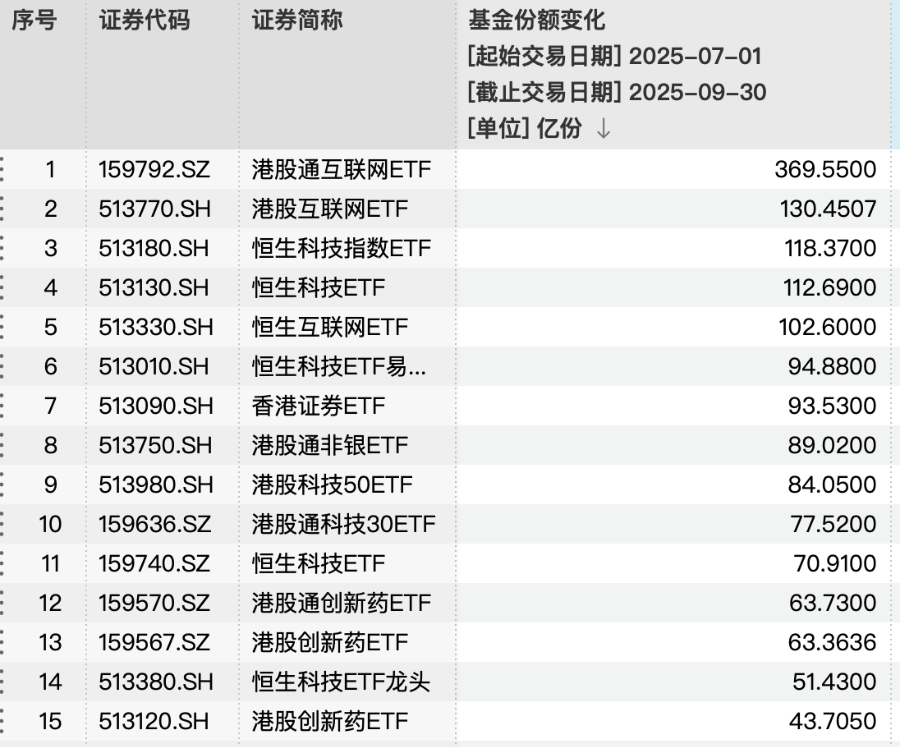
Core Insights - The market value of public funds' holdings in Hong Kong stocks reached 1.33 trillion yuan in Q3 2025, with passive funds surpassing active funds for the first time since 2017 [2][4]. Group 1: Market Trends - The market value of public funds' investments in Hong Kong stocks reached 13,255 billion yuan, with passive funds holding 7,000 billion yuan (52.8%) and active funds holding 6,255 billion yuan (47.2%) [4][5]. - The significant increase in passive fund holdings, which rose by 73% compared to Q2 2025, indicates a growing trend of capital flowing into the Hong Kong market through ETF products [5][6]. Group 2: Fund Performance - The top-performing ETFs in Q3 2025 included the Fuqua Hong Kong Internet ETF, Hua Bao Hong Kong Internet ETF, and Huaxia Hang Seng Technology Index ETF, with substantial increases in fund shares [6][7]. - Active funds showed a preference shift towards sectors like healthcare and materials, while reducing exposure to telecommunications and finance [8]. Group 3: Investment Strategies - Despite market fluctuations, some active fund managers increased their positions in Hong Kong stocks, focusing on technology core assets due to favorable valuations [9]. - The overall trading volume in the Hong Kong market has significantly increased, with average daily turnover reaching 2,579 billion HKD, nearly doubling from the previous year [11].

【广发金工】关注指数成分股调整的投资机会
广发金融工程研究· 2025-11-10 07:41
Core Viewpoint - The article emphasizes the growing recognition of index-based investment strategies among investors, highlighting the potential investment opportunities arising from significant changes in index constituents due to periodic rebalancing of major indices like the SSE 50, CSI 300, and CSI 500 [1][4][5]. Group 1: Index Product Scale Statistics - As of October 31, there are 2,294 passive index funds (ETFs and off-exchange passive index funds) with a total scale of 4.5 trillion yuan, and 437 enhanced index funds with a total scale of 265.3 billion yuan, surpassing the scale of equity mixed funds (2.53 trillion yuan) [2][15]. - The leading indices in terms of product tracking scale include the CSI 300, CSI A500, and CSI 500 [19]. Group 2: Historical Adjustment Effects of Index Constituents - From 2019 to mid-2025, stocks added to the index generally outperformed the index in the two weeks prior to their inclusion, while stocks removed from the index underperformed [22][23]. - The average excess return for stocks added to the index in the two weeks before inclusion is 4.89%, with a success rate of 66.67% [24]. Group 3: Latest Adjustment Impact Estimates - For the expected adjustments in December 2025, the SSE 50 is projected to adjust 4 stocks with an estimated passive buy amount of 5.5 billion yuan, the CSI 300 is expected to adjust 10 stocks with an estimated net buy of 24.5 billion yuan, and the CSI 500 is expected to adjust 50 stocks with an estimated buy of 3.3 billion yuan [30][32].


年度之约,质启新程,财联社首届公募业高质量发展论坛成功举办
财联社· 2025-11-10 06:14
Core Viewpoint - The public fund industry is approaching a significant transformation phase, emphasizing high-quality development and the need for effective service to the real economy, particularly in technology innovation and advanced manufacturing sectors [6][8]. Group 1: Forum Highlights - The forum gathered over 100 executives from regulatory bodies, public funds, and securities asset management firms to discuss key issues such as reform paths, support for the real economy, and investment research upgrades [3][4]. - Five major highlights were presented, including the gathering of top-level wisdom, in-depth discussions on industry pain points, and a focus on actionable insights for building a governance framework that aligns with new regulations [3][4]. - The establishment of the "Public Fund Evergreen Think Tank" aims to provide strategic support for the industry, reflecting a commitment to long-term, investor-centered development [4][33]. Group 2: Regulatory Insights - Regulatory representatives emphasized that the healthy development of the public fund industry relies on proactive actions from the entire ecosystem, especially in the context of the rapid growth of index investment products [5]. - As of September, the ETF market size exceeded 5.62 trillion yuan, ranking first in Asia, indicating a significant shift towards index-based investment strategies [5]. Group 3: Industry Challenges and Solutions - The industry faces challenges such as the disparity between fund profitability and investor returns, necessitating a shift towards a buyer advisory model to enhance investor experience [20][22]. - Key industry leaders discussed the importance of balancing active and passive investment strategies, with a focus on meeting client needs and enhancing competitive advantages [26][31]. Group 4: ETF Market Trends - The global ETF market has surpassed 18 trillion USD, with a notable increase in active ETFs, which are expected to account for 85% of new ETF launches in the U.S. by 2024 [12][14]. - China's ETF market has grown approximately sevenfold since 2019, yet it still represents only 5% of the total stock market capitalization, indicating substantial growth potential [12][14]. Group 5: Future Directions - The establishment of the "Public Fund Evergreen Think Tank" aims to strengthen research capabilities and promote long-term investment and value investment principles within the public fund industry [33][35]. - The industry is encouraged to collaborate and explore high-quality development paths, contributing to the stability and growth of China's capital market [35].


年度之约,质启新程,财联社首届公募业高质量发展论坛成功举办
Xin Lang Cai Jing· 2025-11-10 01:25
Core Insights - The public fund industry is approaching a total scale of 37 trillion yuan, highlighting the need for high-quality development and effective service to the real economy [1][4][6] - The forum emphasized the importance of collaboration among various stakeholders, including regulators, fund companies, and financial institutions, to address industry challenges and promote sustainable growth [1][2][3] Group 1: Forum Highlights - The forum gathered over 80 executives from fund companies and financial institutions, facilitating direct dialogue between policymakers and company decision-makers [1][2] - Key industry pain points discussed included unreasonable performance benchmarks, fund fee reductions, lack of long-term incentive mechanisms, talent retention issues, and compliance shortcomings [1][2] - The forum provided actionable insights on building governance structures that align with new regulations and embedding long-term investment principles within organizations [1][2] Group 2: Regulatory Perspectives - Regulatory representatives expressed expectations for the healthy development of the public fund industry, emphasizing the need for proactive actions within the entire ecosystem [2][3] - The ETF market in China has seen significant growth, with a market size exceeding 5.62 trillion yuan, positioning it as the largest in Asia [2][3] Group 3: Industry Trends - The global ETF market has surpassed 18 trillion USD, with a notable shift towards actively managed ETFs, which are becoming a new growth engine [9][10][12] - China's ETF market has grown approximately sevenfold since 2019, yet it still represents only 5% of the total stock market capitalization, indicating substantial growth potential [10][12] Group 4: Strategic Initiatives - The establishment of the "Evergreen Think Tank" aims to create an open research platform to provide strategic support for the industry [2][31] - The forum highlighted the necessity for the public fund industry to enhance its research capabilities and focus on long-term value investment to align with national economic goals [31][32]

【广发金工】关注指数成分股调整的投资机会
广发金融工程研究· 2025-11-06 00:32
Core Viewpoint - The article emphasizes the growing recognition of index-based investment among investors, highlighting the potential investment opportunities arising from significant changes in index constituents due to the periodic rebalancing of major indices like the SSE 50, CSI 300, and CSI 500 [1][4]. Group 1: Index Fund Growth - The total scale of passive index funds (including ETFs and off-market passive index funds) reached 4.5 trillion yuan as of October 31, with 2,294 funds, while enhanced index funds totaled 265.3 billion yuan, surpassing the scale of equity mixed funds at 2.53 trillion yuan [2][15]. - The total scale of equity ETFs grew from approximately 200 billion yuan in 2014 to 3.72 trillion yuan by October 2025, indicating significant growth [15]. Group 2: Historical Adjustment Effects of Index Constituents - Historical analysis from 2019 to mid-2025 shows that stocks added to indices tend to outperform the index in the two weeks prior to their inclusion, while those removed tend to underperform [2][24]. - The average excess return for stocks added to the index in the two weeks before inclusion was 4.89%, with a success rate of 66.67% [25]. Group 3: Latest Adjustment Impact Estimation - The expected adjustments for December 2025 indicate that the SSE 50 will adjust 4 stocks with an estimated passive buy amount of 5.5 billion yuan, the CSI 300 will adjust 10 stocks with an estimated net buy of 24.5 billion yuan, and the CSI 500 will adjust 50 stocks with an estimated buy of 3.3 billion yuan [3][33].