
硬科技

Search documents
半导体延续强势,硬科技表现活跃!科创50ETF富国(588940)大涨超4%
Mei Ri Jing Ji Xin Wen· 2026-01-21 07:13
Core Viewpoint - The A-share hard technology sector, particularly in GPU, advanced packaging, and semiconductors, has seen significant gains driven by surging global AI demand and substantial improvements in industry fundamentals [1] Group 1: Market Performance - On January 21, the hard technology sector led the A-share market, with the Kweichow Moutai ETF (588940) rising by 4.07% at one point and closing with a gain of 3.15% [1] - Among the index constituents, Longxin Zhongke reached a daily limit increase of 20% [1] Group 2: Industry Drivers - The core drivers of the current semiconductor industry strength include a global explosion in AI demand and tangible improvements in industry fundamentals [1] - By 2025, the global semiconductor industry is expected to experience structural growth, with increased capacity utilization and rising revenue, particularly in mid-to-high-end products [1] Group 3: Market Dynamics - The semiconductor industry's inventory cycle has entered a healthy state, combined with an AI innovation cycle, suggesting the sector may experience a "Davis Double Play" [1] - Domestic manufacturers are steadily increasing their market share due to dual drivers of policy support and market demand [1] Group 4: Investment Opportunities - The Kweichow Moutai ETF (588940) closely tracks the Shanghai Stock Exchange Science and Technology Innovation Board 50 Index, focusing on leading companies in semiconductors, AI, and high-end manufacturing [1] - The semiconductor sector has a high weight in this ETF, which is expected to benefit significantly from the current semiconductor boom, providing an accessible investment option for external investors through the Kweichow Moutai ETF Connect (Class A 023055/Class C 023056) [1]
百亿级科创ETF诠释宽基配置价值,科创100ETF(588220)鹏华规模稳居同类第一
Cai Fu Zai Xian· 2026-01-21 05:03
一方面,该基金的规模持续攀升,自2025年末的90亿跃升至当前的113亿,半月净流入超23亿元,且自 2023年9月上市以来,日均成交额为4.83亿元,构建起"规模-流动性-资金流入"的良性循环。另一方面, 该基金近一年净值增长率75.05%,成为投资者一键布局硬科技宽基、分享国家创新发展红利的核心载 体(数据来源:wind)。 在指数化投资加速普及的今天,宽基正成为机构与个人投资者跟上市场行情的首选工具。Wind数据显 示,截至2026年1月19日,全市场科创板相关ETF产品已达157只,但其中仅有6只权益类ETF规模突破 百亿元大关,几乎全部集中于科创50、科创创业50和科创100等宽基指数。其中,科创100ETF鹏华 (588220)尤为亮眼——作为唯一一只追踪上证科创板100指数的百亿级产品,其最新规模已达113.94亿 元,稳居同类第一。 来到当下,在指数化投资迈向高质量发展的新阶段,宽基ETF凭借分散风险、覆盖全面、费率优惠等优 势,已成为不少资金长期配置的"压舱石"。而在硬科技这一关乎国家未来的核心赛道上,科创100ETF 鹏华(588220)以其百亿规模、旗舰定位、系统支撑与战略契合度,正成为 ...
对话六位投资大佬:2026年,他们打算这样花钱
Xin Lang Cai Jing· 2026-01-21 04:39
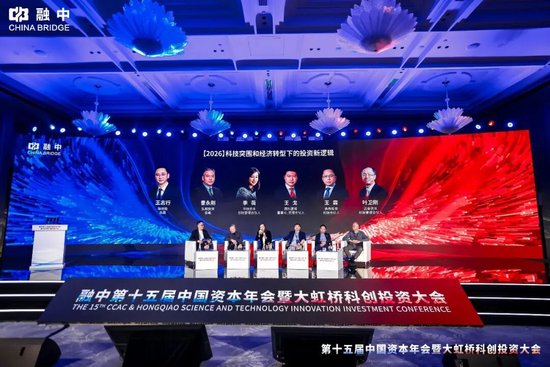
Core Insights - The equity investment industry is entering a "refinement period" characterized by a return to cognition and capability reshaping, with long-term capital expanding and patient capital becoming a core force supporting technological innovation [3][41] - Investment institutions are focusing on hard technology and strategic emerging industries, deepening their layouts and uncovering value [3][41] - The conference aims to create an efficient ecosystem that integrates investors and enterprises, promoting the full-chain integration of the investment industry [3][41] Group 1: Institutional Positioning and Core Advantages - The forum features prominent figures from leading investment institutions, emphasizing their long-term commitment and sensitivity to cyclical and structural changes [5][42] - 弘毅投资 has shifted its focus to early-stage technology investments, aligning with national policies and industry trends, while also managing a significant real estate investment business [7][8] - 华映资本 has a strong emphasis on early-stage investments, with over 80% of its investments concentrated in this phase, particularly in AI and related fields [10][11] Group 2: Investment Strategies and Opportunities - Investment strategies for 2026 will focus on AI, biomedicine, and gene technology, with a recognition of the need for a forward-looking perspective on how AI will reshape industries [19][20] - The importance of early-stage investments is highlighted, with institutions planning to deepen their engagement in sectors like semiconductors and artificial intelligence [15][22] - 鼎晖投资 emphasizes a dual structure of traditional PE and VGC, focusing on both acquisition investments and innovative growth funds in hard technology sectors [13][14] Group 3: Balancing Policy Guidance and Investment Returns - The concept of "patient capital" is discussed, with a distinction between "active patience" and "passive patience," emphasizing the need for a proactive approach to long-term investments [32][36] - The balance between policy direction and market logic is crucial, with a focus on finding projects that align with both government strategies and market demands [33][34] - The need for a diversified capital structure to support long-term investments in hard technology is emphasized, highlighting the role of various capital sources [32][33]

百余家A股公司,去年净利或翻倍!
证券时报· 2026-01-21 04:25
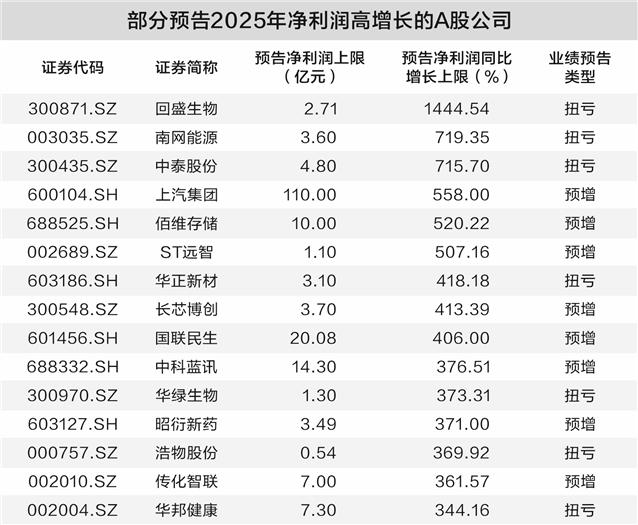
Core Viewpoint - The A-share market is experiencing a peak in earnings forecasts, with over 500 companies disclosing their 2025 earnings predictions, highlighting strong growth in technology sectors driven by AI, while other sectors like photovoltaic and pig farming face challenges [3][5]. Group 1: Earnings Forecasts - As of January 20, 2025, 525 A-share companies have disclosed earnings forecasts, with approximately 200 expecting growth and over 100 predicting net profit increases exceeding 100% [5]. - Companies like Huisheng Biological and Nanfang Energy are expected to see significant profit increases, with Huisheng predicting a net profit of 2.35 billion to 2.71 billion yuan, representing a year-on-year growth of 1265.93% to 1444.54% [6][7]. Group 2: High-Growth Companies - Notable companies with high growth forecasts include Zijin Mining, which anticipates a net profit of 51 billion to 52 billion yuan, a year-on-year increase of approximately 59% to 62% [8]. - Other companies like Bawei Storage and Shenghong Technology are also expected to report substantial profit increases, with Bawei predicting a net profit of 8.5 billion to 10 billion yuan, reflecting a growth of 427.19% to 520.22% [11][12]. Group 3: Sector Performance - The technology sector, particularly "hard tech," is showing strong profitability due to the expanding demand for AI infrastructure and related products [10]. - The storage sector is entering a "super cycle," benefiting from the demand for massive data storage and high-speed access, leading to significant revenue growth for companies like Bawei Storage [11]. Group 4: Challenges in Certain Industries - The photovoltaic industry is facing significant challenges, with companies like Tongwei Co. predicting a net loss of 9 billion to 10 billion yuan due to market oversupply and rising raw material prices [15][16]. - The pig farming sector is also under pressure, with leading companies like Muyuan Foods forecasting declines in earnings due to falling pig prices, despite an increase in sales volume [16].

港股科技ETF(513020)盘中涨超0.5%,优质科技企业赴港节奏有望延续
Mei Ri Jing Ji Xin Wen· 2026-01-21 03:03
Group 1 - The core viewpoint is that the Hong Kong stock market is gathering leading H-share semiconductor companies, and the recent stable performance of domestic GPU, large model, and hard technology companies post-listing is expected to continue attracting quality tech enterprises to Hong Kong, providing ongoing incremental targets for the Hong Kong tech sector [1] - Investment strategies suggest that due to strict regulations and cooling sentiment in the A-share market, Hong Kong tech heavyweight stocks are likely to benefit from the upcoming AI product release window, with "northbound capital" potentially becoming more active in seeking advantageous assets in Hong Kong, indicating that Hong Kong stocks may outperform A-shares in the short term [1] - Leading tech companies in Hong Kong are accelerating the integration of AI with their business ecosystems, such as Alibaba advancing productization in core scenarios like e-commerce and transportation using its Qianwen platform, and Tencent enriching AI applications through its WeChat ecosystem [1] Group 2 - The Hong Kong Stock Connect Technology Index is overweight in sectors like new energy vehicles, innovative pharmaceuticals, and semiconductors compared to the Hang Seng Technology Index, showing a cumulative return of 224.25% from the base date at the end of 2014 to the end of 2025, significantly outperforming the Hang Seng Technology Index, which has a return of 83.87% [2] - The Hong Kong Stock Connect Technology Index has consistently outperformed similar indices, including the Hang Seng Internet Technology Index and the Hang Seng Healthcare Index, indicating its strong performance in the long term [2]
龙芯中科封板,科创50ETF涨超3%,冲击前期高点
Mei Ri Jing Ji Xin Wen· 2026-01-21 02:15
Market Performance - The A-share market showed signs of recovery in the early session, with all three major indices rising: the Shanghai Composite Index increased by 0.17%, the Shenzhen Component Index rose by 0.54%, and the ChiNext Index climbed by 1.15% [1] - The Kweichow Moutai ETF (588000) surged by 3.46%, with the latest price at 1.614 yuan, and the intraday trading volume reached 2.121 billion yuan, resulting in a turnover rate of 2.67% [1] Semiconductor Sector - The semiconductor sector experienced a significant rally, with notable stocks such as Longxin Technology hitting the limit up, Haiguang Information rising by 14.07%, Lanke Technology increasing by 6.80%, Zhongwei Company up by 3.97%, and SMIC gaining 3.04% [1] - The domestic semiconductor equipment sector is witnessing dual catalysts: the successful launch of the first high-energy hydrogen ion implanter developed by China National Nuclear Corporation, breaking foreign monopolies in key semiconductor manufacturing processes, and TSMC's financial report indicating a projected 35% increase in net profit by Q4 2025 and a gross margin of 62% [1] Industry Outlook - The dual catalysts are expected to accelerate the localization of domestic equipment, combined with AI-driven technological upgrades and capacity expansion, suggesting that the industry may enter a "golden period" of expansion cycles and technological breakthroughs [1] - The Kweichow Moutai ETF (588000) tracks the Sci-Tech 50 Index, which has a 70.35% allocation in the electronics sector, aligning well with the current development trends in artificial intelligence and robotics [1] - The ETF also covers multiple sub-sectors, including semiconductors, medical devices, software development, and photovoltaic equipment, indicating a high content of hard technology, and investors optimistic about the long-term development prospects of China's hard technology are encouraged to continue monitoring [1]




百余家A股公司,去年净利或翻倍!
Zheng Quan Shi Bao Wang· 2026-01-21 00:56
Core Viewpoint - The A-share market is experiencing a peak in earnings forecasts, with over 500 companies disclosing their 2025 performance predictions, highlighting strong growth in technology sectors driven by AI, while other sectors face challenges due to market fluctuations and supply-demand adjustments [1][2]. Group 1: Earnings Forecasts - As of January 20, 2025, 525 A-share companies have disclosed earnings forecasts, with approximately 200 companies expecting growth, and over 100 companies predicting net profit increases exceeding 100% [2]. - The highest expected net profit growth is from Huisheng Biological, with a forecasted net profit of 235 million to 271 million yuan, representing a year-on-year increase of 1265.93% to 1444.54% [3][4]. Group 2: Sector Performance - The technology sector, particularly "hard technology," is showing significant profit growth due to the expanding demand for AI infrastructure and computing power, benefiting upstream and downstream enterprises [6]. - Companies like Bawei Storage are expected to see substantial profit increases, with a forecasted net profit of 850 million to 1 billion yuan, reflecting a year-on-year growth of 427.19% to 520.22% [6]. - The PCB leader Shenghong Technology anticipates a net profit of 4.16 billion to 4.56 billion yuan, a significant increase of 260.35% to 295% compared to the previous year [7]. Group 3: Commodity Price Impact - The performance of companies in the commodity sector is varied, with precious metals, industrial metals, and chemicals experiencing strong price increases, positively impacting earnings [7]. - Tianqi Materials expects a maximum net profit growth of 230.63% due to rising lithium hexafluorophosphate prices, while North Rare Earth anticipates a 134.60% increase driven by rising rare earth product prices [7].




百余家A股公司,去年净利或翻倍
Zheng Quan Shi Bao· 2026-01-21 00:40
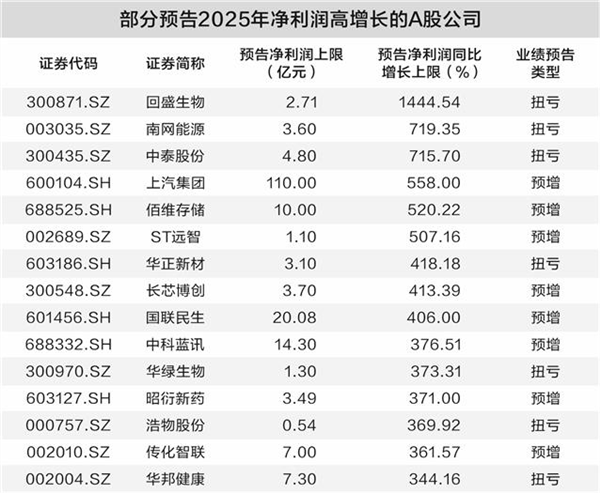
Core Viewpoint - The A-share market is experiencing a peak in earnings forecasts, with over 500 companies disclosing their 2025 performance predictions, highlighting strong growth in technology sectors driven by AI, while other sectors like photovoltaics and pig farming face challenges [1][2]. Group 1: Earnings Forecasts - As of January 20, 2025, 525 A-share companies have disclosed earnings forecasts, with around 200 expecting growth and over 100 projecting net profit increases exceeding 100% [2]. - The highest projected net profit increase is from Huisheng Biological, with an expected profit of 235 million to 271 million yuan, representing a year-on-year growth of 1265.93% to 1444.54% [3][4]. Group 2: Sector Performance - The technology sector, particularly "hard technology," is showing strong profitability, driven by the demand for AI infrastructure and data storage, with companies like Baiwei Storage expecting a net profit of 850 million to 1 billion yuan, a growth of 427.19% to 520.22% [6]. - Zijin Mining, a leading mining company, forecasts a net profit of 51 billion to 52 billion yuan, an increase of approximately 189 billion to 199 billion yuan, reflecting a growth rate of 59% to 62% [4][5]. Group 3: Challenges in Certain Industries - The photovoltaic industry is facing significant challenges, with companies like Tongwei Co. predicting a net loss of 9 billion to 10 billion yuan due to market fluctuations and rising raw material prices [8][9]. - In the pig farming sector, companies such as Muyuan Foods and Wens Foodstuffs are forecasting declines in performance, with some expecting losses due to falling pig prices and increased operational costs [9].


深圳办公楼租赁市场显韧性
Zheng Quan Ri Bao Wang· 2026-01-20 12:46
Core Insights - The Shenzhen Grade A office market is undergoing structural adjustments in 2025, characterized by "overall pressure and structural differentiation" due to high levels of new supply and a transformation in corporate leasing demand [1][2] Group 1: Market Dynamics - New demand is increasingly concentrated in high-value, high-growth sectors such as consumer electronics, smart manufacturing, and professional services related to brand expansion [1][2] - The market is expected to see a peak in supply in 2025, with 15 new projects adding nearly 1.16 million square meters, the highest level in three years [2] - Major new supply is concentrated in key sub-markets: Qianhai (approximately 35%), Bao'an Center (approximately 21%), and Houhai (approximately 21%), with over half being self-built headquarters [2] Group 2: Tenant Strategies - Shenzhen tenants are optimizing real estate strategies through flexible leasing arrangements and strict cost control, with lease renewals and cost-driven relocations being dominant strategies [1][2] - Lease restructuring transactions are increasing, with most renewals involving adjustments to key terms such as rental levels and leasing scale [1] Group 3: Future Outlook - In 2026, the market is expected to see over 1.5 million square meters of new supply, with structural supply-demand contradictions likely to persist, leading to continued high competition and pressure on rental prices [3] - Tenants will focus more on the operational support effectiveness of office spaces while landlords will need to enhance flexibility in leasing terms and service capabilities to maintain stable cash flow and sustainable occupancy rates [3]
科创板“全景图”科创综指发布一周年 引导中长期资金配置作用日益凸显
Zhong Guo Jing Ying Bao· 2026-01-20 11:41
Core Insights - The Sci-Tech Innovation Board Composite Index (Sci-Tech Index) has been operational for one year as of January 20, 2026, and has shown stable performance since its launch on January 20, 2025 [1] - The Sci-Tech Index serves as a comprehensive representation of the Sci-Tech Board market, covering over 570 samples and more than 90% of the market capitalization, indicating its strong representativeness and investability [1] - As of January 15, 2026, the Sci-Tech Index has achieved a cumulative increase of 65.44% since its launch, significantly outperforming major A-share market indices [1] Industry Developments - The product ecosystem related to the Sci-Tech Index has been increasingly完善, with 78 index funds established by December 31, 2025, totaling nearly 27.5 billion yuan [2] - The introduction of the Sci-Tech Index has enhanced the broad index system of the Sci-Tech Board, providing a more comprehensive observation dimension and investment targets, thereby supporting the development of a modern industrial system and high-level technological self-reliance in China [2] - The continuous inflow of medium- to long-term funds through products related to the Sci-Tech Index is expected to further enhance the attractiveness and influence of the Sci-Tech Board as a hub for "hard technology" enterprises in China [2]