
碳市场

Search documents
刚刚,利好来了
中国基金报· 2025-08-25 11:00
Core Viewpoint - The article discusses the release of a significant document by the Central Committee of the Communist Party of China and the State Council, titled "Opinions on Promoting Green and Low-Carbon Transition and Strengthening National Carbon Market Construction," which outlines the framework for China's carbon market development and its role in addressing climate change and promoting economic transformation [1][12]. Summary by Sections 1. Overall Requirements - The carbon market is identified as a crucial policy tool for addressing climate change and facilitating a comprehensive green transition in economic and social development. The main goals include achieving basic coverage of major industrial sectors by 2027 and establishing a robust carbon trading market by 2030 [15][12]. 2. Accelerating the Construction of the National Carbon Emission Trading Market - The coverage of the national carbon emission trading market will be expanded based on industry development, pollution reduction contributions, data quality, and carbon emission characteristics [16]. - A transparent carbon emission quota management system will be established, with a focus on balancing supply and demand in the market [17]. - Guidance and supervision will be strengthened for pilot carbon trading markets to ensure they contribute to regional green and low-carbon transitions [18]. 3. Actively Developing the National Voluntary Greenhouse Gas Reduction Trading Market - A comprehensive methodology system will be established to support voluntary reduction projects, ensuring effective management from project development to verification [18]. - Encouragement for various entities, including government and enterprises, to utilize certified voluntary reduction credits to offset emissions [18]. 4. Enhancing Market Vitality - Financial institutions will be supported in developing green financial products related to carbon emissions, including carbon pledges and repurchase policies [19]. - The introduction of new trading participants, including individuals, will be facilitated in the voluntary reduction trading market [19]. 5. Strengthening Carbon Market Capacity Building - A management system that aligns with the development stages of the national carbon market will be established, enhancing supervision and operational efficiency [21]. - The carbon emission accounting and reporting management will be improved, with a focus on accurate measurement and verification of emissions [21]. 6. Strengthening Organizational Implementation Support - Local governments are urged to enhance leadership and policy support for carbon market construction, ensuring effective management of emission quotas and data quality [23]. - Legal frameworks will be developed to support carbon market operations, including regulations for voluntary reduction trading [24].


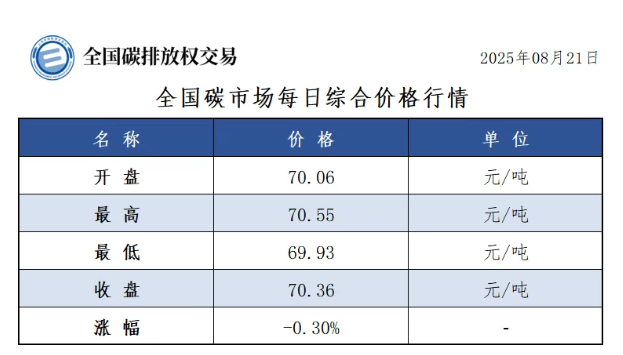
8月21日全国碳市场综合价格收盘价70.36元/吨,较前一日下跌0.30%
Xin Hua Cai Jing· 2025-08-21 08:53
Core Insights - The national carbon market's comprehensive price today opened at 70.06 yuan/ton, with a closing price of 70.36 yuan/ton, reflecting a decrease of 0.30% from the previous day [1][2]. Price Summary - Opening price: 70.06 yuan/ton [2] - Highest price: 70.55 yuan/ton [2] - Lowest price: 69.93 yuan/ton [2] - Closing price: 70.36 yuan/ton [1][2] - Price change: -0.30% [1][2] Trading Volume and Revenue - Total trading volume for the day: 501,896 tons [3] - Total transaction value for the day: 34,933,361.65 yuan [3] - Agreement trading volume: 398,264 tons with a value of 27,930,947.41 yuan [2] - Bulk agreement trading volume: 103,632 tons with a value of 7,002,414.24 yuan [2] Cumulative Data - Cumulative trading volume as of August 21, 2025: 689,579,228 tons [5] - Cumulative transaction value as of August 21, 2025: 47,412,553,223.48 yuan [5] - Cumulative trading volume from January 1 to August 21, 2025: 59,310,564 tons with a transaction value of 4,379,826,119.97 yuan [4]
钢铁行业绿色转型之路如何越走越宽?
Zhong Guo Chan Ye Jing Ji Xin Xi Wang· 2025-08-19 22:23
Group 1 - The steel industry is currently in a period of reduction and deep transformation, facing structural contradictions such as excess low-end products and insufficient high-end products, with significant room for improvement in energy conservation and carbon reduction levels [1] - As of July this year, 197 steel companies have completed ultra-low emission modifications, with 600 million tons of crude steel capacity achieving full-process ultra-low emission modifications, and 350 million tons undergoing key project modifications, accounting for over 80% of the national total capacity [1][2] - The Ministry of Ecology and Environment emphasizes the need for a flexible and sustainable management system to ensure fair competition among enterprises under unified rules, allowing those with significant emission reductions to benefit [2][3] Group 2 - The steel industry was officially included in the national carbon market in March this year, but faces challenges such as weak data foundations, insufficient carbon emission management capabilities, and balancing emission reductions with growth [2][3] - Recommendations for the steel industry include enhancing carbon market capabilities, establishing dedicated carbon management institutions, and improving data quality to ensure accurate emissions accounting [3][4] - The industry is encouraged to actively participate in the voluntary emission reduction market to effectively lower compliance costs and scientifically allocate carbon assets [3][4] Group 3 - The transition to ultra-low emissions is seen as a new starting point for green development, with the need for differentiated policies to support compliant enterprises and penalties for those failing to meet emission reduction targets [4][5] - The steel industry is urged to maintain strategic determination, increase technological innovation, and explore more low-carbon and zero-carbon technology pathways [4][5] - Key focus areas for the industry include achieving high-quality ultra-low emissions, promoting extreme energy efficiency projects, and advancing low-carbon transformation efforts [5]
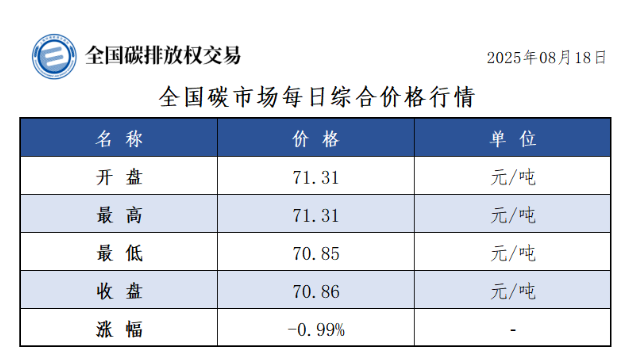
8月18日全国碳市场综合价格收盘价70.86元/吨
Xin Hua Cai Jing· 2025-08-18 09:37
Core Points - The national carbon market opened at a price of 71.31 yuan per ton, with a closing price of 70.86 yuan per ton, reflecting a decrease of 0.99% from the previous day [1][2] - The total trading volume of carbon emission allowances today was 390,844 tons, with a total transaction value of 27,932,689.60 yuan [3][5] - Cumulative trading volume of carbon emission allowances in the national carbon market reached 687,745,739 tons, with a cumulative transaction value of 47,283,681,347.74 yuan as of August 18, 2025 [5] Trading Data - Today's trading included 90,844 tons in listed agreement transactions, amounting to 6,452,689.60 yuan, and 300,000 tons in bulk agreement transactions, totaling 21,480,000.00 yuan [2] - The highest price recorded today was 71.31 yuan per ton, while the lowest was 70.85 yuan per ton [1][2] - The trading data for various annual carbon emission allowances showed fluctuations, with some allowances experiencing price changes of up to -2.21% [4]
促进碳市场全面深化改革!绿色燃料为汽车业增添新动能
Zhong Guo Qi Che Bao Wang· 2025-08-14 09:44
Core Viewpoint - The development of new energy vehicles (NEVs) is a crucial part of China's efforts to achieve carbon peak and carbon neutrality goals, with Shanghai's carbon market reform providing a favorable environment for this growth [2][3]. Industry Opportunities - The carbon market reform is expected to create more opportunities and benefits for the development of NEVs [3]. - The automotive industry in Shanghai is projected to produce 1.808 million vehicles in 2024, with NEV production reaching 1.225 million, resulting in a penetration rate of nearly 68% [4]. - Shanghai has established a "4+N" automotive industrial service cluster, enhancing the automotive value chain and promoting a collaborative development model that integrates people, production, and cities [4]. Transition to Sustainable Development - Shanghai aims to transition from automotive manufacturing to industrial services, building a globally influential sustainable automotive ecosystem [5]. - The carbon market is driving the automotive industry to adopt measures to reduce carbon footprints, with companies facing increased costs if they exceed carbon emission quotas [6]. Technological Diversification - NEVs are seen as key to reducing carbon emissions in the transportation sector, with a growing consensus on their importance [7]. - While battery electric vehicles dominate the market, challenges such as reduced range in cold weather and charging infrastructure strain exist, prompting exploration of diversified technology routes [7][10]. - Methanol vehicles fill a gap in the NEV market, offering advantages such as wide availability of feedstock and ongoing technological improvements [8]. Policy and Infrastructure Challenges - Despite the rapid growth of NEVs, challenges remain in infrastructure development and standardization, with a significant gap in the number of methanol and hydrogen refueling stations compared to electric charging stations [10]. - Experts suggest that to maximize the low-carbon advantages of hydrogen fuel vehicles, the construction of green hydrogen production capacity should be accelerated [10][11]. Recommendations for Industry Development - The establishment of a "technology route adaptive subsidy" mechanism is recommended to provide differentiated subsidies based on regional conditions [10]. - Encouraging the formation of technology alliances among companies can help overcome key technological challenges and enhance innovation capabilities [11]. - A flexible R&D system that combines core technology independence with diverse application scenarios is advised for automotive companies [11].

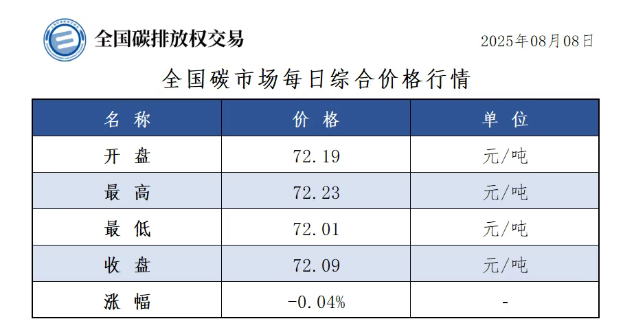
8月8日全国碳市场综合价格收盘价72.09元/吨,较前一日下跌0.04%
Xin Hua Cai Jing· 2025-08-08 09:08
Market Overview - The national carbon market opened at a price of 72.19 yuan/ton, with a highest price of 72.23 yuan/ton, a lowest price of 72.01 yuan/ton, and a closing price of 72.09 yuan/ton, reflecting a decrease of 0.04% compared to the previous day [1][2]. Trading Volume and Revenue - The total trading volume for the day was 369,079 tons, with a total transaction value of 26,975,942 yuan [3]. - The agreement trading volume was 269,079 tons, generating a transaction value of 19,675,942 yuan, while the bulk agreement trading volume was 100,000 tons, with a transaction value of 7,300,000 yuan [2]. Cumulative Data - From January 1 to August 8, 2025, the total carbon emission quota trading volume reached 54,054,578 tons, with a cumulative transaction value of 4,016,195,389.14 yuan [4]. - As of August 8, 2025, the cumulative trading volume in the national carbon market was 684,323,242 tons, with a total transaction value of 47,048,922,492.65 yuan [4].
北京绿金院:可持续议题动态与趋势观察报告(2024年)
Sou Hu Cai Jing· 2025-08-06 07:11
在政策层面,国际组织和各国持续推进相关政策。国际标准化组织发布《全球环境、社会和治理(ESG)实施原则》,欧盟通过《企业可持续发展尽职调查 指令》等强化ESG信息披露,美国SEC出台气候披露新规,中国发布《关于加快经济社会发展全面绿色转型的意见》等政策,完善绿色转型制度体系,主流 评级机构也更新了ESG评分模型。 重点议题方面,极端天气频发加剧气候风险,各国加强气候适应能力建设,企业需重视气候风险识别与管理;国际气候相关贸易政策兴起,欧盟碳边境调节 机制进入过渡期,英国将实施碳边境调节机制,碳足迹要求融入贸易政策;全球碳市场建设加快,中国重启全国温室气体自愿减排交易市场,巴西、新加坡 等推进碳市场立法,高质量碳信用成为关注焦点;转型规划在全球受重视,实体企业和金融机构积极制定并实施转型战略;生物多样性保护受关注,国际社 会推进"30×30"目标,各国出台保护政策,企业将生物多样性纳入ESG框架;循环经济成为应对资源环境挑战的关键,欧盟、中国等出台政策推动废弃物循 环利用,企业探索可持续商业模式;供应链安全和负责任采购重要性凸显,关键矿产资源争夺加剧,食品安全事件推动供应链透明度提升;人工智能在带来 积极影响的 ...

贵州茅台MSCI ESG评级升至A级|ESG热搜榜
2 1 Shi Ji Jing Ji Bao Dao· 2025-08-05 12:16
当"反内卷"遇上ESG,谁在绿色赛道上领跑? 2025年8月16日,由南方财经全媒体集团指导、21世纪经济报道主办的第三届21世纪"活力·ESG"创新论 坛将在上海隆重举办!今年最终入围案例将被纳入《21世纪"活力·ESG"实践案例集锦(2025)》,于 本次论坛上公布。 本次论坛还将围绕能源发展、绿色消费展开两场深度思辨,看传统能源企业如何通 过数字化改造提升能效,新能源企业如何应对技术路线不确定性,"链主"企业如何带动供应链上的企业 进行绿色转型升级。 洞见ESG七月刊:全国碳市场开启四周年 2025年7月,全国碳排放权交易市场启动运行4周年。市场累计成交金额超460亿元,钢铁、水泥、铝冶 炼行业正式纳入,全国温室气体自愿减排交易市场也于今年启动交易,首批核证自愿减排量(CCER) 正式签发。作为我国应对气候变化的市场机制,碳市场下一步如何发展? 贵州茅台(600519):MSCI ESG评级升至A级 7月31日,贵州茅台在MSCI的ESG评级已升为A级别,ESG总评排名白酒行业首位。贵州茅台也是唯一 获得A级的中国白酒企业,其余酒企评级依次为水井坊BBB级,泸州老窖、洋河股份、山西汾酒为BB 级、古井贡 ...

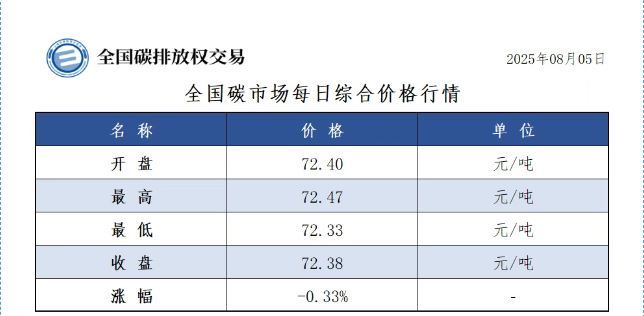
8月5日全国碳市场综合价格收盘价72.38元/吨,较前一日下跌0.33%
Xin Hua Cai Jing· 2025-08-05 08:59
Core Points - The national carbon market opened at a price of 72.40 yuan per ton, with a closing price of 72.38 yuan per ton, reflecting a decrease of 0.33% from the previous day [1][2] - The total trading volume of carbon emission allowances today reached 1,021,368 tons, with a total transaction value of approximately 67.70 million yuan [3] - As of August 5, 2025, the cumulative trading volume of carbon emission allowances in the national carbon market has reached 682,378,841 tons, with a total transaction value of approximately 46.91 billion yuan [5] Daily Trading Summary - The daily trading volume for listed agreement transactions was 124,246 tons, with a transaction value of approximately 9.12 million yuan; the bulk agreement trading volume was 897,122 tons, with a transaction value of approximately 58.57 million yuan [2] - The highest price recorded today was 72.47 yuan per ton, while the lowest was 72.33 yuan per ton [1][2] Annual Trading Data - From January 1 to August 5, 2025, the total trading volume of carbon emission allowances was 52,110,177 tons, with a total transaction value of approximately 3.88 billion yuan [4]
华塑控股(000509.SZ):未开展稳定币相关业务
Ge Long Hui· 2025-08-05 06:43
格隆汇8月5日丨华塑控股(000509.SZ)在互动平台表示,公司通过全资子公司湖北碳索空间科技有限公 司开展甲烷等温室气体的监测和排放治理相关业务,并通过已落地的自有碳治理业务项目推进CCER的 开发和交易,截至目前公司减排项目暂未实现碳市场交易。公司未开展稳定币相关业务。 ...
