
AI技术应用

Search documents
出海人力资源专题论坛圆满落幕!AI赋能全球用工,加速出海组织跃迁
Zhong Guo Chan Ye Jing Ji Xin Xi Wang· 2025-08-18 10:41
Group 1 - The forum focused on the theme "AI-driven and Organizational Leap," addressing key issues such as compliance in global employment, organizational construction, and the application of AI technology in the context of globalization [2][3] - The president and CEO of Yonyou Xinfu Society emphasized the need for Chinese enterprises to reconstruct their human resource management systems to adapt to global challenges and opportunities [3] - The forum featured various industry leaders and experts who shared practical insights and strategies for Chinese companies looking to expand internationally [2][4][10] Group 2 - The first speaker, Liu Minlian from Xiandao Technology, shared practical experiences in local employment management, tax risk response, and cultural integration for companies entering overseas markets [4] - Liu highlighted the importance of standardized management, localized empowerment, and cost control, suggesting the use of global HR service providers to manage regional affairs efficiently [4] - The session on global talent deployment discussed the core pain points in expatriate management, with insights from a global 500 company HRD on the need for clear distinctions between short-term business trips and long-term assignments [5] Group 3 - The AI product launch showcased Yonyou Xinfu Society's capabilities in addressing human resource challenges faced by companies going global, emphasizing the importance of a resilient HR system [7][8] - The TalentSeek AI recruitment tool was introduced, which claims to enhance efficiency by over six times and reduce costs to below 5% of traditional methods, connecting over 1 billion talent resources globally [8] - The insurance segment discussed the importance of customized insurance solutions for overseas employees, addressing various risks faced by companies operating internationally [9] Group 4 - A panel discussion included experts from seven renowned HR service providers across five continents, sharing strategies and insights on global employment practices and compliance policies [10][11] - The forum concluded with a commitment from Yonyou Xinfu Society to continue enhancing global HR services, leveraging digital technology to support Chinese enterprises in achieving organizational leaps and talent breakthroughs [12]
2025(第十九届)中国品牌节 南航获华谱奖等多项荣誉文
Zhong Guo Min Hang Wang· 2025-08-17 04:07
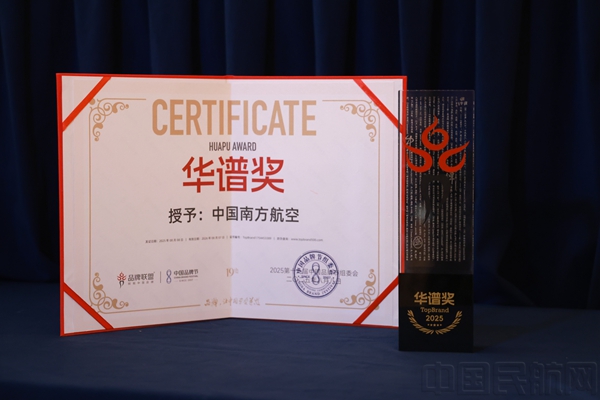
Group 1 - The 2025 (19th) China Brand Festival was held in Shenzhen from August 7 to 11, focusing on "AI and Going Global" [1] - China Southern Airlines (CSA) won multiple honors at the festival, including the "Top Brand 2025 China Brand Festival Huapu Award" [1] - The Huapu Award represents the highest honor for China's independent brands, with 25 brands selected from 40 nominees based on online voting [1] Group 2 - CSA was also included in the "Top Brand 2025 World Brand 500," alongside notable companies like Microsoft, Nvidia, Tencent, and Huawei [1] - The "Top Brand 2025 World Brand 500" list, first published in 2022, evaluates brands based on a mature brand value assessment model, covering nearly 40,000 global brands [1] - CSA Media was recognized in the "Top Brand 2025 China Innovation Brand 500," which assesses innovation capabilities of over 15,000 outstanding brands in China [1] Group 3 - The "Top Brand 2025 China Brand Festival Jinpu Award" was awarded to the "Southern Airlines" magazine, which evaluates brands based on industry position, purchasing power, consumer influence, and social responsibility [2] - The 40th anniversary forum of "Southern Airlines" magazine was held during the festival, discussing the role of aviation media in brand communication and the application of AI technology in global brand dissemination [2][4]


尚德机构2025Q2营收与利润双增长,实现规模化盈利1.27亿元
Xin Hua Wang· 2025-08-15 06:48
Core Insights - The company, Shangde Institution, reported strong financial performance for Q2 2025, with revenue of 5.39 billion yuan, a year-on-year increase of 9.5%, and a net profit of 1.27 billion yuan, up 54% [1][2][3] - The adult education industry is undergoing significant structural changes, with a shift from traditional growth models to a focus on refined operations, cost optimization, and technology-driven strategies [2][3] Financial Performance - For the first half of 2025, Shangde achieved revenue of 10.27 billion yuan and a net profit of 2.02 billion yuan [1] - The net profit margin improved from 16.7% in the previous year to 23.5% in Q2 2025 [2] Operational Efficiency - The company has optimized its operational system over the years, focusing on three core areas: market investment, teaching research, and organizational management [3] - AI technology has been a key driver of operational efficiency, with applications in various areas such as sales, teaching, and administrative tasks [4][5] AI Integration - The implementation of AI tools has significantly improved sales efficiency, with over a 50% increase in operational efficiency and a 30% rise in the number of students served per salesperson [4] - In teaching, AI has automated over 70% of assignment grading, increasing speed by more than eight times and achieving a 95% accuracy rate [4] Strategic Transformation - The adult education market in China is projected to grow to 1.04 trillion yuan by 2027, with a compound annual growth rate of 12.6% [5] - Shangde has shifted its course structure from a "demand-driven" model to a "diversified-driven" model, covering a wide age range from 20 to 75 years [6] New Growth Engines - The interest education segment has become a significant growth driver, with non-degree business revenue accounting for 78% of total revenue in Q2 2025 [6] - The company has successfully targeted the silver-haired demographic, with over one million paid users, primarily retired individuals aged 50 to 75 [6][7] User Engagement and Retention - The company has developed a three-part service model for silver-haired users, focusing on content, social interaction, and companionship, leading to an 80% course completion rate and over 60% repurchase rate [7] - Shangde's approach emphasizes user outcomes, creating a sustainable cash flow structure and a strong competitive barrier against price wars [8]

传媒板块2025Q2基金持仓分析:持仓比例环比回升,游戏、广告营销板块关注度高
Zhongyuan Securities· 2025-08-14 11:19
Investment Rating - The report maintains a "Market Perform" rating for the media industry, indicating that the industry is expected to perform in line with the broader market over the next six months [2][38]. Core Insights - The media sector's fund holdings have shown a quarter-on-quarter increase, with a notable focus on the gaming and advertising sectors, which are currently favored by institutional investors [7][36]. - The total market value of public funds' holdings in media stocks reached 36.341 billion yuan in Q2 2025, reflecting a quarter-on-quarter increase of 9.613 billion yuan, or 35.97% [11][36]. - The gaming sector accounted for 21.503 billion yuan, representing 59.17% of the total media holdings, with a quarter-on-quarter increase of 10.36 percentage points [12][36]. - The advertising sector also saw an increase, with a market value of 10.033 billion yuan, making up 27.61% of the total, up by 1.48 percentage points [12][36]. - The report highlights a significant concentration in the top ten media stocks, which accounted for 85.35% of the total media holdings, indicating a high concentration of investments in leading companies [21][36]. Summary by Sections Fund Holdings Analysis - The media sector's fund holding ratio has increased, reaching approximately 1.40%, the highest level since Q3 2023, despite still being slightly below the standard allocation [11][36]. - The top three sub-sectors in terms of fund holdings are gaming, advertising, and film and television, with gaming showing the highest allocation and growth [12][19]. Investment Recommendations - The report suggests continued focus on the gaming sector, particularly in light of potential policy improvements, new game product supply, and the application of AI technology, which may enhance valuation [36]. - It also recommends attention to high-dividend stocks in the publishing sector and leading companies in the media space [36]. Changes in Top Holdings - The top ten media stocks by fund holdings in Q2 2025 include companies like 分众传媒 (Fenzhong Media) and 恺英网络 (Kaiying Network), with significant increases in their market values compared to Q1 2025 [28][29]. - Notably, companies such as 芒果超媒 (Mango Super Media) and 昆仑万维 (Kunlun Wanwei) have exited the top ten holdings, while ST 华通 (ST Huatong) and 吉比特 (Jibite) have entered [25][26].






海南出台地方性法规促进民营经济发展
Zhong Guo Xin Wen Wang· 2025-08-14 09:27
Core Viewpoint - The "Regulations on Promoting the Development of the Private Economy in Hainan Free Trade Port" (referred to as "Regulations") is the first local legislation on private economic development following the promulgation of the "People's Republic of China Private Economy Promotion Law," providing legal support for private enterprises in Hainan to seize opportunities and respond to challenges in the context of trade liberalization [1] Group 1: Legislative Innovations - The Regulations adopt a "small incision" legislative approach, focusing on key issues in private economic development and emphasizing the principle of competitive neutrality as the core of the legislative drafting process [1] - The Regulations address issues such as fair competition, investment financing, technological innovation, service guarantees, rights protection, and weaknesses in the development of the private economy, offering practical measures based on practical experience [2] Group 2: Fair Competition and Policy Support - The Regulations stipulate equal access to various production factors and public service resources, prohibiting the establishment of entry barriers and restrictions on private economic organizations in public resource transactions [2] - The Regulations support private economic organizations in participating in the development of four leading industries and key project construction, ensuring equal enjoyment of tax incentives and other benefits under Hainan Free Trade Port policies [2] Group 3: Financial Support Measures - The Regulations include multiple financial support measures, promoting equal treatment of all types of enterprises by financial institutions and enhancing financing convenience for private economic organizations [3] - The "Haiyidai" system is introduced as a unified service system for policy implementation, aiming to streamline data reporting and enhance intelligent matching and service capabilities [3]
买方投顾转型中的财富规划实践:匡正、李斌、杨辉共探破局之道
Morningstar晨星· 2025-08-14 01:05
Core Viewpoints - The wealth management industry is undergoing a significant transformation from a product-driven model to a service-driven model, necessitating a balance between global standards and local client needs through talent development and technological investment [1][8][9] Group 1: Wealth Management Transformation - The Chinese wealth management industry is shifting from a focus on individual products to a broader emphasis on asset allocation, with investors increasingly sensitive to short-term gains and losses [8] - Institutions are encouraged to invest in technology and talent to enhance their capabilities in global asset allocation, family office services, and retirement planning, thereby establishing long-term competitiveness in the Chinese market [8] - Different financial institutions are exploring unique strategies to navigate the opportunities and challenges presented by the transition from "sell-side sales" to "buy-side advisory" [2][8] Group 2: Unique Advantages of Brokerage Firms - Brokerage firms possess distinct advantages in wealth management, including a client base with a higher tolerance for risk and volatility, allowing for more comprehensive wealth planning strategies [8] - The experience of advisory teams in managing risk and volatility is noted, although there is a need to enhance capabilities in asset allocation [8] - The symbiotic relationships between brokerages and asset managers (public and private) facilitate a deeper understanding of management strategies, enabling better client service [8] Group 3: Internet Platforms and Data Utilization - Internet platforms are leveraging their vast user base and data advantages to provide personalized wealth management services, addressing the challenge of delivering tailored services to a large audience [9] - The implementation of KYC (Know Your Customer) and KYP (Know Your Portfolio) processes is crucial for creating accurate user profiles and reducing decision-making difficulties for investors [9] - The transition from a product-centric sales model to an account-centered asset allocation advisory model is emphasized, with a focus on enhancing the user experience through simplicity, safety, and enjoyment [9] Group 4: System and Team Development - The establishment of a TAMP (Turnkey Asset Management Platform) model is highlighted as a means to integrate research, data analysis, and advisory tools, enhancing the support for financial advisors [11] - The importance of a feedback mechanism between research teams and client needs is stressed to ensure alignment in service delivery and product offerings [11] - The goal for financial advisors is to evolve into long-term financial partners for clients, supported by effective AI tools to enhance service quality [13] Group 5: Focus Areas for Brokerages - Brokerages are advised to focus on three key areas: developing ETF-based intelligent trading and allocation tools, embracing AI technology to improve service efficiency, and evolving account systems to support comprehensive wealth management [13] - The relationship between sales and advisory roles is viewed as a gradual transition, with a structured growth path for professionals to develop from sales to specialized advisory capabilities [13]

完美世界上半年业绩提振增长 预计实现归母净利润4.8-5.2亿元
Quan Jing Wang· 2025-08-13 05:51
Core Viewpoint - Perfect World is entering a growth phase, with significant improvements in its financial performance, particularly in the gaming and film sectors, driven by strategic adjustments and operational efficiencies [1][2][4] Financial Performance - The company expects a net profit attributable to shareholders of 480-520 million yuan for the first half of 2025, with a non-GAAP net profit of 290-330 million yuan, marking a substantial turnaround from a loss of 235 million yuan in the same period last year [1] - The gaming segment is projected to contribute a net profit of 480-520 million yuan, with a non-GAAP net profit of 320-360 million yuan, showcasing a successful recovery [1][2] Business Strategy - Perfect World is leveraging a dual-engine strategy of "gaming + film," which has proven resilient and effective in driving growth [1][4] - The company has optimized its organizational structure and management efficiency, leading to improved operational quality and cost control [2] Product Development - The company is actively developing new games, with the supernatural urban open-world RPG "Yihuan" recently undergoing testing in both domestic and overseas markets, receiving positive feedback [2] - Perfect World is focusing on high-quality content production in its film segment, with several successful releases in 2025, including "Thousand Blossoms Blooming" and "Only This Jianghu Dream" [3] E-sports and Events - The e-sports business is expanding, with a focus on high-quality and frequent event operations, contributing to steady revenue growth [3] - The upcoming CS Asia Invitational (CAC 2025) is expected to enhance the company's e-sports ecosystem and drive further growth in related sectors [3] Technological Investment - The company continues to invest in game engine technology, artificial intelligence, and cloud computing to enhance its technical capabilities [4] - Perfect World is exploring innovative applications of AI in game development and content generation, improving research and development efficiency and product quality [4]

阅文集团(00772) - 2025 Q2 - 业绩电话会
2025-08-12 13:00
Financial Data and Key Metrics Changes - Total revenue for the first half of 2025 was RMB 3.2 billion, a decrease from RMB 4.2 billion in 2024 [23] - Online business revenues increased by 2.3% to RMB 2 billion, driven by growth in self-owned platform products [23][24] - Net profit attributable to shareholders increased by 68.5% to RMB 850 million, while non-IFRS net profit decreased to RMB 508 million from RMB 702 million in 2024 [29] Business Line Data and Key Metrics Changes - Revenue from self-owned platform products increased by 3.1% to RMB 1.7 billion, while revenues from Tencent channels decreased by 25.6% to RMB 97 million [24] - Revenue from IT operations decreased by 46.4% to RMB 1.2 billion, primarily due to a lack of new TV series or film releases [26][27] - The IT merchandise business generated GMV of RMB 488 million, nearing last year's total of RMB 500 million [16][27] Market Data and Key Metrics Changes - The average monthly active users (MAUs) decreased to 141.3 million from 176 million in 2024, with a decline in MAUs from Tencent channels [25] - Average monthly paying users (MPUs) grew by 4.5% to 9.2 million, reflecting growth in membership users [26] Company Strategy and Development Direction - The company aims to capitalize on the rapid growth of China's IP industry, focusing on premium IP, short dramas, and physical merchandise [7][9] - Plans to enhance the IP commercialization strategy by expanding product categories and improving distribution channels [16][39] - Commitment to integrating AI across business lines to enhance content creation and user engagement [19][62] Management's Comments on Operating Environment and Future Outlook - Management highlighted the explosive growth of China's IP industry and the company's unique position to leverage this trend [7][9] - The focus will be on enhancing the emotional connection between IP and users, as well as exploring new technologies like AI and VR [46][62] - The company anticipates strong growth momentum driven by diverse content types and consumption patterns [20][21] Other Important Information - The company introduced an AI-powered knowledge base for online literature, significantly increasing interactions between writers and AI [19][62] - Revenue from AI-translated works on the international reading platform grew by 38% year over year, accounting for over 35% of total novel revenue [20][62] Q&A Session Summary Question: Progress of IP merchandise business and future development priorities - Management discussed the successful IP merchandise initiatives, including events like the King's Avatar tournament and plans for customized merchandise [33][35][40] Question: Top priorities and KPIs for classic IPs - Management emphasized the importance of releasing new content and enhancing merchandise offerings for classic IPs to maintain their popularity [42][45] Question: Commercialization potential of top IPs - Management expressed confidence in the commercialization potential of IPs, highlighting the need to adapt to evolving user demands [48][53] Question: Content pipeline for Newcastle Media - Management outlined the upcoming content releases, including six drama series and a movie project scheduled for the second half of the year [59][61] Question: Deployment of AI technologies - Management provided insights into the integration of AI in content creation, enhancing efficiency and user engagement [62]
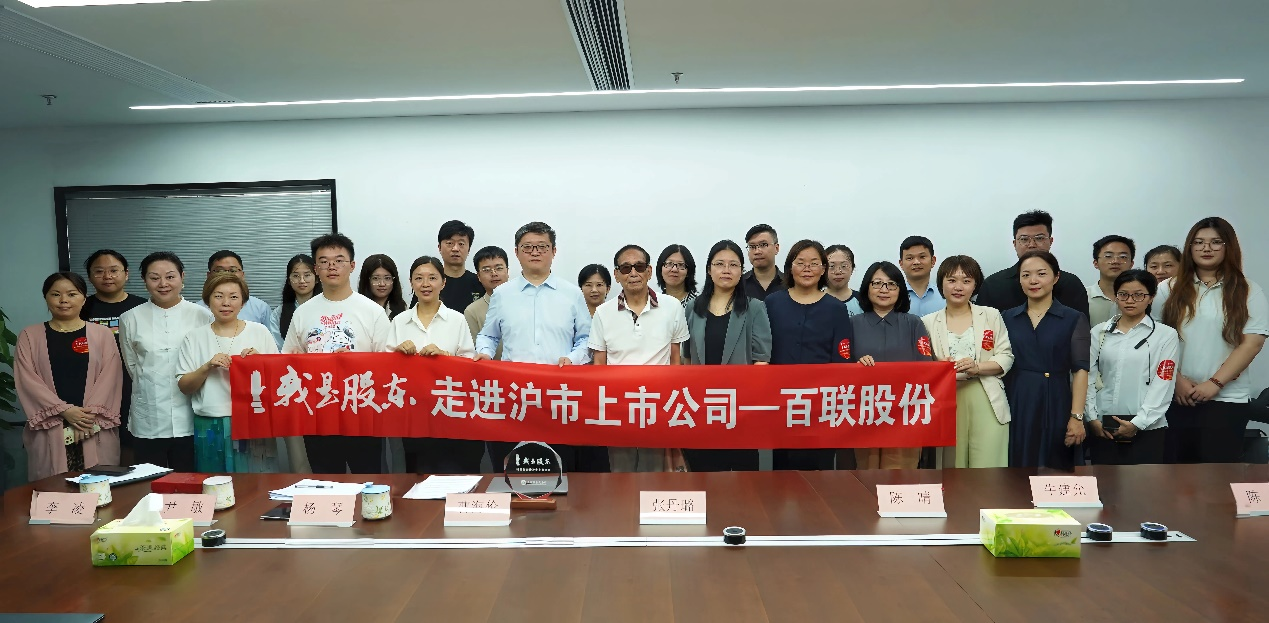
湘财证券走进百联股份:引领次元文化新消费,共筑商业生态新势能
Quan Jing Wang· 2025-08-12 09:53
Core Viewpoint - The event "I am a Shareholder - Walking into Bailian Group and Walking with High Quality" aimed to enhance investors' understanding of the investment value of listed companies in Shanghai, particularly highlighting Bailian Group's recent development highlights amidst the new consumption wave [3][4]. Company Overview - Bailian Group is a landmark enterprise in Shanghai's commerce, with a rich history that includes the success of four major companies and a diversified business layout following multiple mergers and reorganizations [3]. - The company operates various retail formats, including department stores, large supermarkets, and chain specialty stores, showcasing its strong resource integration capabilities [3]. Market Insights - Bailian Group has demonstrated keen market insight by capturing the potential of the ACG (Anime, Comic, and Games) culture among young consumers, successfully transforming it into commercial value through innovative marketing strategies and experiential consumption [4]. - The company has pioneered the outlet model in China, continuously innovating to enhance the shopping experience by integrating traditional culture with modern commerce [4]. Digital Transformation and Innovation - Bailian Group is actively pursuing digital transformation and scenario-based consumption, with successful projects like the First Department Store Commercial Center and Bailian TX Huaihai, as well as new outlet projects near Chengdu Panda Base [4]. - The company has implemented AI technology extensively in B2B applications for data analysis and decision-making efficiency, and in B2C applications for member systems and product development [5][6]. Industry Trends - The retail industry is a crucial part of the national economy, contributing significantly to GDP, but it faces challenges such as declining foot traffic and average transaction value, particularly in the luxury goods sector [5]. - The rise of Generation Z, which constitutes 20% of the population and accounts for 40% of consumption, is driving a shift towards personalized services and immersive experiences in retail [5]. Event Impact - The successful hosting of the event provided investors with a deeper understanding of Bailian Group's strategic layout, innovative measures, and future development prospects, while also emphasizing the company's commitment to investor relations management and high-quality development [6].

2025中国智慧化工园区建设发展大会召开
Zhong Guo Hua Gong Bao· 2025-08-12 00:54
Core Insights - The current number of smart chemical parks in China accounts for only 6.4% of the total recognized chemical parks, indicating a significant gap in smart construction levels between eastern and western regions [1][2] - There are notable issues in the smart construction of chemical parks, including a focus on construction over application, and a need for enhanced functionalities in predictive analysis, decision-making, centralized control, and optimization [1] Group 1: Current State of Smart Chemical Parks - The number of recognized smart chemical parks is only 6.4% of the total, with uneven distribution and varying levels of smart construction [1] - A few parks, such as those in Ningbo and Nanjing, have achieved precise control in areas like intelligent management and pollution source tracking, but overall smart construction still lags behind industry development needs [1] Group 2: Challenges and Recommendations - Challenges include insufficient top-level design, weak industrial internet support, functional deficiencies in business systems, and a lack of digital foundation at the enterprise level [2] - Recommendations include benchmarking against world-class standards, implementing a smart construction project for chemical parks, and exploring more application scenarios based on actual production and operational conditions [1][2] Group 3: Future Directions - The industry is transitioning from data visualization to analytical capabilities, with a need for deeper integration of information technology and industrial operations [2] - The goal is to create a world-class model of a smart chemical park that is safe, efficient, green, and collaborative [2]