AI芯片

Search documents
CoWoS产能支撑,摩根大通再次上调TPU预期:今明两年出货量有望达370、500万颗
Hua Er Jie Jian Wen· 2026-01-07 12:50
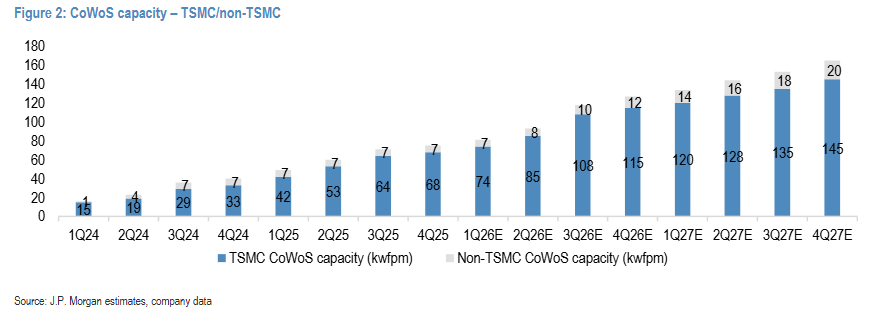
Core Viewpoint - Morgan Stanley has raised its forecast for Google's TPU chip shipments for 2026 and 2027, expecting shipments to reach 3.7 million and 5 million units respectively, driven by TSMC's expanding CoWoS packaging capacity and strong market demand [1][3]. Group 1: Capacity Forecast Adjustments - Morgan Stanley has increased its CoWoS capacity forecasts for 2026 and 2027 by 8% and 13% respectively, reflecting TSMC's new capacity construction in the second half of 2026 and 2027 [1][3]. - TSMC's CoWoS capacity is expected to reach 115,000 wafers per month by the end of 2026, with external suppliers providing an additional 12,000 to 15,000 wafers per month [1][3]. Group 2: Demand Drivers - The increase in capacity is primarily driven by rising demand from the ASIC supply chain [1][3]. - The main shipments for 2026-2027 will come from TPU v7 (Ironwood) and v8 series (Broadcom's AX version and MediaTek's X version) [3]. Group 3: Company-Specific Insights - NVIDIA's CoWoS allocation for 2026 remains at 700,000 wafers, with slight adjustments in product mix due to HBM4 readiness issues [4]. - AMD's CoWoS forecast remains unchanged at 90,000 and 120,000 wafers for 2026 and 2027, respectively, with potential delays in the MI450 project [4]. - AWS's Trainium project has seen a slight reduction in expected shipments for 2026, now projected at 2.1 million units [5]. Group 4: Outsourcing Trends - The outsourcing ratio for packaging has increased, benefiting equipment suppliers [6][7]. - TSMC will focus on key GPU and AI ASIC projects, leaving smaller projects to packaging houses like ASE and Amkor [7]. - Equipment suppliers are expected to see a year-on-year increase in demand for CoWoS, with new capacity projected to grow by 40,000 to 50,000 wafers per month [7].


三星无折痕折叠屏OLED面板亮相CES;江淮汽车公布多模态飞行汽车专利,可降低噪音和能耗丨智能制造日报
创业邦· 2026-01-07 03:22
Group 1 - Jianghuai Automobile Group has announced a patent for a multi-modal flying car that can reduce noise and energy consumption, featuring foldable wings and vertical lift fans for flight control [2] - AMD's CEO revealed at CES that the next-generation AI chip MI455 GPU, built on 2nm and 3nm processes, is expected to enhance AI performance by 1000 times within four years [2] - Star River Power plans to launch the "Ceres-1 Sea Launch (Remote 7)" commercial rocket soon, with the mission code named "Wanghai Tide" [2] - Samsung showcased a crease-free foldable OLED panel at CES 2026, which may be used in the upcoming Galaxy Z Fold8 and potentially in Apple's first foldable iPhone, promising a seamless display experience [2]

存储芯片板块领涨,半导体设备ETF广发(560780)盘中涨近5%,近3日涨超14%!标的指数半导体设备材料权重占比超80%!
Xin Lang Cai Jing· 2026-01-07 02:35
Group 1: Market Dynamics - The A-share storage chip sector opened strong on January 7, 2026, with stocks like Purun Co. hitting a 20% limit up, reaching a historical high, while others like Hengshuo Co., Jucheng Co., Jiangbolong, and Xiangnong Chip Innovation rose over 10% [1] - AMD showcased its MI455 GPU chip at CES, claiming significant performance improvements, while SK Hynix presented its 48GB 16-layer HBM4, the next generation of high-bandwidth memory [1] - Following NVIDIA CEO Jensen Huang's emphasis on memory and storage demand at CES, U.S. semiconductor stocks saw a continued rise, with reports indicating Samsung and Hynix proposed a 60%-70% price increase for DRAM in Q1 compared to Q4 of the previous year [1] Group 2: Domestic Developments - The domestic DRAM industry is making significant progress, with Changxin Storage's IPO on the Sci-Tech Innovation Board accepted, aiming to raise 29.5 billion yuan for technology upgrades and forward-looking research [2] - Aijian Securities believes this financing will accelerate the transition of Changxin's process platform to higher generations and promote the overall development of the domestic storage industry [2] - Despite the global DRAM market being dominated by Korean and American manufacturers, domestic firms have made breakthroughs in mainstream product lines, with Changxin launching JEDEC-certified DDR5 and LPDDR5X memory products [2] Group 3: Semiconductor Materials and Domestic Production - The domestic semiconductor materials localization process is accelerating, driven by high-performance computing and advanced packaging, increasing demand for key materials like CMP polishing materials and photoresists [2] - Although the overall localization rate of semiconductor materials in China remains low—less than 15% for wafer manufacturing materials and below 30% for packaging materials—there have been breakthroughs in multiple areas supported by policies and industry collaboration [2] - As AI chips, HBM, and Chiplet technologies become more prevalent, demand for high-end electronic resins and low dielectric constant materials is expected to grow, providing opportunities for domestic companies to increase their market share through technological iterations [2] Group 4: ETF Performance - As of January 7, 2026, the CSI Semiconductor Materials and Equipment Theme Index surged by 5.36%, with the semiconductor equipment ETF Guangfa (560780) rising by 4.98%, marking a three-day consecutive increase [3] - The top ten weighted stocks accounted for 65.08% of the index, with significant gains from stocks like Anji Technology (up 14.37%), Chip Source Micro (up 13.21%), and Nanda Optoelectronics (up 12.35%) [3] - The latest scale of the semiconductor equipment ETF Guangfa reached 1.6 billion yuan, a new high in nearly a month, with a notable increase of 690 million shares over the past six months [3]
【点金互动易】商业航天+AI芯片,提供全面的卫星载荷产品,开展了多次NTN技术试验验证并取得突破,这家公司自研DPU、CPU芯片等产品
财联社· 2026-01-07 00:31
Group 1 - The article emphasizes the investment value of significant events, industry chain companies, and key policy interpretations, providing timely information for market impact analysis [1] - The company is engaged in commercial aerospace and AI chips, offering comprehensive satellite payload products and has conducted multiple NTN technology trials with breakthroughs, including self-developed DPU and CPU chips [1] - The company is also focused on solid-state batteries, with a production line expected to be completed in the second half of the year, projecting a year-on-year net profit increase of over 127% for 2025, and its lithium battery products include electrolyte, lithium hexafluorophosphate, and LiFSI [1]

【公告全知道】商业航天+人形机器人+低空经济+军工+新能源车!公司商业航天火箭结构件业务已形成正式的合同订单
财联社· 2026-01-06 15:32
Group 1 - The article highlights significant announcements in the stock market, including "suspensions and resumption of trading, shareholding changes, investment wins, acquisitions, performance reports, unlocks, and high transfers" [1] - A company involved in commercial aerospace has established formal contract orders for rocket structural components, with major clients including Blue Arrow Aerospace, and has received small batch sample orders from clients like Zhiyuan Robotics [1] - Another company is focused on brain-computer interfaces, humanoid robots, multimodal AI, autonomous driving, AI chips, and cloud computing, and is optimizing its brain model while developing its own brain-computer interface system, having partnered with Leju Robotics to deliver a small number of robots equipped with the large model [1] - A company has signed a second fully automated OCS (Optical Switch) packaging production line order, indicating its involvement in commercial aerospace, chips, and CPO, with partnerships including Nvidia and Huawei HiSilicon [1]

全球第四、国内第一,上海集成电路产业发展“成绩单”出炉
Xin Lang Cai Jing· 2026-01-06 12:16
Core Insights - Shanghai's integrated circuit industry achieved a revenue scale of 391.2 billion yuan from January to November 2025, marking a year-on-year growth of 23.72%, with an expected annual scale exceeding 460 billion yuan, reflecting a growth of 24% [1] - Shanghai ranks fourth globally and first domestically in the latest Global Integrated Circuit Industry Comprehensive Competitiveness Ranking by the World Semiconductor Association [1] Group 1 - Shanghai has actively implemented national strategic deployments, designating integrated circuits as one of the three key industries for development, resulting in a complete industrial chain, advanced technology, and a concentration of talent and enterprises [1] - The city has established a robust integrated circuit industry chain system, nurturing leading enterprises across various segments, including chip design, manufacturing, packaging, and testing, with 35 companies listed on the Sci-Tech Innovation Board, the highest in the country [1] - The chip design and manufacturing sectors continue to lead domestically, with advanced packaging and high-end equipment materials making significant progress [1] Group 2 - Shanghai has gathered over 1,200 integrated circuit companies, accounting for approximately 40% of national talent and nearly 50% of industry innovation resources, supported by systematic development policies [2] - The city has developed a spatial layout for the industry, including five specialized industrial parks for integrated circuit design and smart sensors, enhancing the business environment and increasing support for talent, finance, and industry policies [2] - Over the past five years, Shanghai has fostered a domestic AI chip strategy, supporting multiple technological routes, with notable companies in the GPU chip sector, including two listed and one soon to be listed [2]
英特尔CES发布关键AI PC芯片:18A工艺首秀+性能提升60%,公司将迎“战略转折点”
Hua Er Jie Jian Wen· 2026-01-06 08:40
Core Insights - Intel officially launched its AI PC chip series based on the 18A process technology at CES, marking a significant milestone in the company's manufacturing revival and technological leadership [1] - The new Intel Core Ultra Series 3 processors, the first products based on the Panther Lake architecture, will be available for pre-order on January 7 and globally launched on January 27 [1] - The performance of the new chips is reported to be up to 60% higher than the previous Lunar Lake Series 2 [1] Group 1: Technological Advancements - The 18A process technology integrates two key innovations, including the introduction of "full surround gate" technology for improved transistor switching control, which is crucial for reducing overall power consumption [2] - Intel has developed independent small chips for graphics processing that can be integrated with other functional chips using advanced packaging technology, allowing for more flexible and high-performance processor solutions [2] - A handheld gaming device platform based on the Panther Lake architecture is expected to be launched in 2025, with specific partners and product details to be announced later this year [2] Group 2: Strategic Business Moves - The market performance of the new products is critical for Intel's strategy to become a major global foundry, competing against TSMC and Samsung in the foundry industry [3] - Intel has outsourced some advanced process production to TSMC, indicating recognition of TSMC's current technological capabilities, while also attempting to bring high-end chip manufacturing back in-house [3] - Recent support from the U.S. government and significant investments from companies like Nvidia and SoftBank have contributed to a rebound in Intel's stock price [3] Group 3: Competitive Landscape - AMD is set to deliver a keynote at CES, where CEO Lisa Su is expected to unveil a new generation of PC chips aimed at AI computing and graphics processing [4] - AMD has announced a long-term partnership with OpenAI for the next-generation MI400 chip, which is projected to generate billions in revenue over the coming years [4] - Nvidia's CEO Jensen Huang revealed that the next generation of Nvidia chips has entered full-scale production, achieving five times the computational performance of previous models for large language models and generative AI applications [5]

AMD推出下一代新品,4年内AI芯片性能有望提升1000倍
第一财经· 2026-01-06 04:04
Core Viewpoint - AMD is advancing its AI chip technology with the introduction of the next-generation MI455 GPU, which utilizes 2nm and 3nm manufacturing processes and advanced packaging, featuring HBM4 memory [1] Group 1: Next-Generation AI Chips - The MI455 GPU will be integrated with the EPYC CPU, and the next-generation AI rack, Helios, will include 72 GPUs, enabling the construction of large AI clusters by connecting thousands of Helios racks [1] - The MI500 series chips are also under development and will adopt the 2nm process [2] - With the launch of the MI500 series in 2027, AMD aims to enhance AI performance chips by 1000 times over the next four years [3]

小鹏汽车-W涨近4% 2026款小鹏P7将于本周五登陆欧洲市场
Zhi Tong Cai Jing· 2026-01-06 03:34
消息面上,1月5日,小鹏汽车-W宣布,2026款小鹏P7+车型已在奥地利格拉茨工厂顺利完成试装,目前 中奥团队正协同推进后续研发与生产流程,全力保障高质量交付。据介绍,该工厂拥有百年制造积淀和 超过300万辆整车量产经验,是全球最大且唯一生产梅赛德斯-奔驰G级车型的制造商。 小鹏汽车-W(09868)涨近4%,截至发稿,涨3.85%,报79.6港元,成交额5.58亿港元。 据悉,作为小鹏汽车首款面向全球发布的车型,新款小鹏P7+采用全球统一的生产与安全标准,将于 2026年1月8日在中国上市,并于1月9日在欧洲上市。日前,2026款小鹏P7+和小鹏G7相继亮相,新车定 档1月8日正式上市。两款新车均将推出增程动力车型,并将升级第二代VLA辅助驾驶大模型和三颗图 灵AI芯片,算力达到2250TOPS,硬件支持更高级别的辅助驾驶能力。 ...
AI芯片景气度爆棚!科创半导体ETF(588170)劲升4%,规模最大的芯片ETF(159995)两日涨6%
Ge Long Hui A P P· 2026-01-06 02:31
Group 1 - The semiconductor sector has seen significant gains at the beginning of the year, with semiconductor equipment stocks reaching new highs, including a 4.17% increase in the Sci-Tech Semiconductor ETF and a 1.71% rise in the Chip ETF [1][2] - ASML, a major player in semiconductor equipment, has increased by over 5%, reaching a historic market capitalization, while TSMC has also risen over 3%, achieving a market value of $1.7 trillion [2] - Samsung Electronics and SK Hynix plan to raise server DRAM prices by 60% to 70% in Q1 of this year, indicating a tightening supply and demand situation in the semiconductor market [3] - TSMC's 2nm process technology has commenced mass production as scheduled, with initial capacity expected to reach 35,000 wafers per month, projected to increase to 140,000 wafers per month by the end of the year, surpassing previous market estimates [3] - NVIDIA showcased its new AI platform Rubin at CES, featuring six new chips with five times the inference computing power of the previous generation, now in full production [3] Group 2 - The Sci-Tech Semiconductor ETF (588170) focuses on domestic semiconductor replacement equipment and materials, rising by 4.17%, with key components including companies like Zhongwei Company and Huahai Qingke [4] - The largest chip industry ETF in the market, the Chip ETF (159995), has increased by 1.71%, with a total scale reaching 26.222 billion yuan, covering the entire semiconductor industry chain and including leading stocks like SMIC and Cambrian [4]