
绿色化

Search documents
慧谷新材创业板IPO获注册
Sou Hu Cai Jing· 2025-12-31 09:44
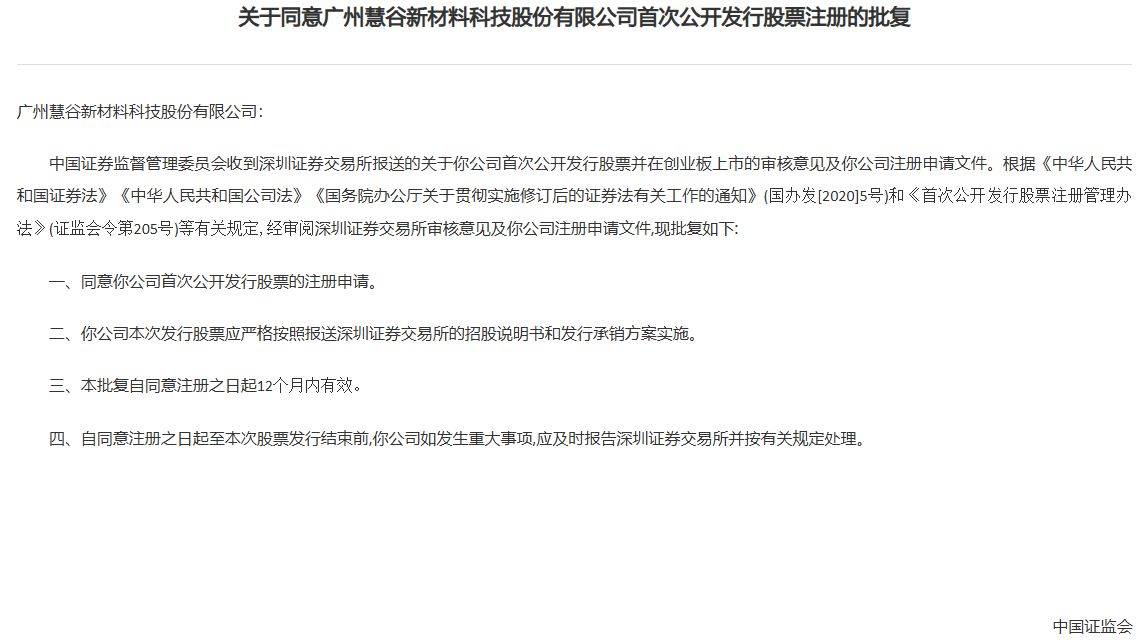
Group 1 - The China Securities Regulatory Commission approved the initial public offering registration of Guangzhou Huigu New Materials Technology Co., Ltd. on December 26, 2025 [1] - Huigu New Materials focuses on polymer materials and aims to become a global leader in functional material technology innovation, with a business model centered around the research, production, and sales of functional resins and coatings [4] - The company has developed a diverse range of coating materials with properties such as optical control, electrical conductivity, thermal conductivity, mechanical enhancement, and corrosion resistance, targeting applications in home appliances, packaging, new energy, and electronics [4] Group 2 - The global functional coatings market is expected to grow at a compound annual growth rate (CAGR) of 5.3%, with the automotive and construction industries being the largest application markets [4] - Despite industry growth, there are significant technical challenges in achieving large-scale industrial applications of advanced coatings, such as superhydrophobic coatings, which face issues like durability and environmental concerns [5] - Chinese companies, including Huigu New Materials, have made significant strides in high-end markets, achieving over 60% market share in energy-saving coatings for heat exchangers and over 30% in metal packaging coatings [5] Group 3 - The domestic industry faces challenges in moving up the value chain, including insufficient foundational research and original innovation, high costs, and the need for improved intelligent research systems [6] - The future of the functional coatings industry in China lies in pursuing "green" and "high-end" development, focusing on sustainable products and advancing upstream in the supply chain [6]


华锡有色:2026年计划投资约16.67亿元
Xin Lang Cai Jing· 2025-12-31 09:22
Core Viewpoint - The company plans to invest approximately 1.667 billion yuan in 2026, focusing on enhancing resource control, safety, environmental management, and product quality [1] Investment Plan - The planned investment includes 1.204 billion yuan for new projects and 463 million yuan for ongoing projects [1] - The implementation of the 2026 investment plan is expected to strengthen the company's resource management capabilities [1] Strategic Goals - The investment aims to improve mine safety and environmental management, as well as advance the level of intelligence and sustainability in mining operations [1] - The company seeks to enhance product quality and promote strong, supplementary, and extended supply chains to achieve high-quality and sustainable development [1]

业绩再创新高 | 解码潍柴雷沃守护大国粮安的新答卷
Sou Hu Wang· 2025-12-31 02:25
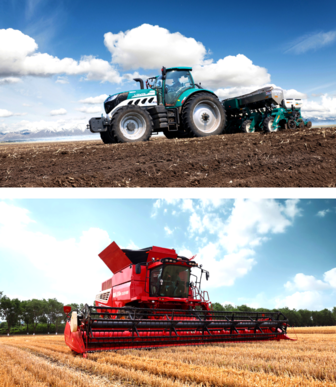
Core Insights - The core message of the news is that Weichai Lovol Smart Agriculture is set to achieve a revenue of 18 billion yuan by 2025, showcasing resilience and growth in the agricultural machinery industry despite global market fluctuations and rising agricultural production demands [1] Group 1: Innovation and Technology - The company emphasizes the importance of agricultural technology and equipment support as a guiding principle for innovation and industry development [2] - During the 14th Five-Year Plan, Weichai Lovol Smart Agriculture is building a global technology innovation system integrating resources from China, Europe, and Japan, focusing on high-end agricultural machinery core technologies [4] - The company has made significant technological advancements, including the mass production of 240 and 340 horsepower CVT tractors, breaking free from external dependencies in core transmission technology [6] Group 2: Manufacturing and Quality - The company is committed to promoting high-end, intelligent, and green development in manufacturing, aligning with national strategic directions [7] - A new smart factory for high-horsepower tractors, the largest and most technologically advanced in China's agricultural machinery history, has been established, showcasing advanced technologies like industrial internet and AI [10] Group 3: Digital Services and Solutions - Weichai Lovol Smart Agriculture is launching China's first AI model for smart agriculture in 2025, providing a comprehensive digital service system for the entire agricultural cycle [12] Group 4: Industry Ecosystem and Collaboration - The company is enhancing the resilience and autonomy of the agricultural machinery supply chain, acting as a leading enterprise in the industry [13] - Through the "R&D Community" initiative, the company collaborates with global suppliers and research institutions to tackle key technologies in agricultural machinery [15] Group 5: Global Expansion - Weichai Lovol Smart Agriculture is expanding its overseas market presence, with expected overseas revenue surpassing 2.5 billion yuan by 2025, reflecting significant growth [16][17] - The company is developing adaptive products for various global markets, establishing a comprehensive network for R&D, manufacturing, marketing, and services [19]
工业实力大幅跨越 产业能级显著提升
Guang Xi Ri Bao· 2025-12-31 02:19
Group 1 - The core viewpoint of the news is that Guangxi has made significant progress in its industrial economy since the implementation of the "14th Five-Year Plan," establishing itself as a key driver for high-quality economic development [1][2][3] - The total industrial output value is expected to reach 2.7 trillion yuan this year, with a growth of 900 billion yuan over five years, and the industrial added value is projected to exceed 800 billion yuan, representing an increase of over 50% compared to 2020 [1] - The proportion of industrial added value in GDP has surpassed 27%, an increase of nearly 4 percentage points over five years, while industrial tax revenue has risen to 44.4%, up 11 percentage points in the same period [1] Group 2 - The industrial structure has been optimized, with ten pillar industries now established, including non-ferrous metals, steel, and food, with the non-ferrous metals industry expected to exceed 450 billion yuan this year [2] - Emerging industries are growing rapidly, with strategic emerging industries accounting for 23% of the industrial added value, an increase of 7 percentage points over five years, and new product output contributing over 50% to industrial growth [2] - The pace of digital and green transformation has accelerated, with over 5,000 enterprises implementing digital upgrades and 105 national-level green factories established in the past five years [2] Group 3 - The number of large-scale industrial enterprises has increased from 6,500 at the end of 2020 to nearly 11,000, ranking second in the western region and 13th nationwide [3] - The total number of industrial enterprises has grown from 73,000 at the end of 2020 to 120,000, with an average annual increase of about 10,000 [3] - Guangxi aims to focus on ten modern pillar industries during the "15th Five-Year Plan," including non-ferrous metals, advanced steel materials, and artificial intelligence, to build a modern industrial system that reflects its unique characteristics and advantages [3]
以旧换新实施细则出台 2026年补贴范围有这些“新升级”
Yang Shi Xin Wen· 2025-12-31 02:06
Core Viewpoint - The new policy on consumer goods trade-in and upgrade, effective from January 1, 2026, aims to enhance the subsidy framework for key consumer products such as automobiles, home appliances, and digital devices, promoting green and intelligent consumption [1][2]. Group 1: Subsidy Details - The policy specifies that for automobiles, a fixed percentage of the new car sales price will be subsidized for scrapping and replacing old vehicles [1]. - For home appliances and digital products, consumers will receive a subsidy of 15% of the final sales price after discounts, with a cap of 1,500 yuan for home appliances and 500 yuan for digital products [2]. - The subsidy for scrapping old cars includes 12% for purchasing eligible new energy vehicles, with a maximum of 20,000 yuan, and 10% for fuel vehicles, capped at 15,000 yuan [5]. Group 2: Local Autonomy and Support - The new policy grants local governments more autonomy to develop additional subsidy measures tailored to local consumer needs, enhancing the effectiveness of the trade-in program [3]. - Local authorities can allocate matching funds for trade-in subsidies, allowing for customized implementation based on regional characteristics [3]. Group 3: Support for Offline Retail and Rural Areas - The policy emphasizes support for offline retail, aiming to boost local consumption and enhance the shopping experience [4][6]. - It expands the coverage of subsidies to rural areas by increasing the number of eligible online and offline retailers, ensuring that rural residents can access the benefits of the trade-in program [4][6]. - The initiative encourages various retail formats to reach remote areas, enhancing service networks and consumer engagement in these regions [6].
科技引领聚合力 全链共赢启新程
Jing Ji Ri Bao· 2025-12-30 22:12
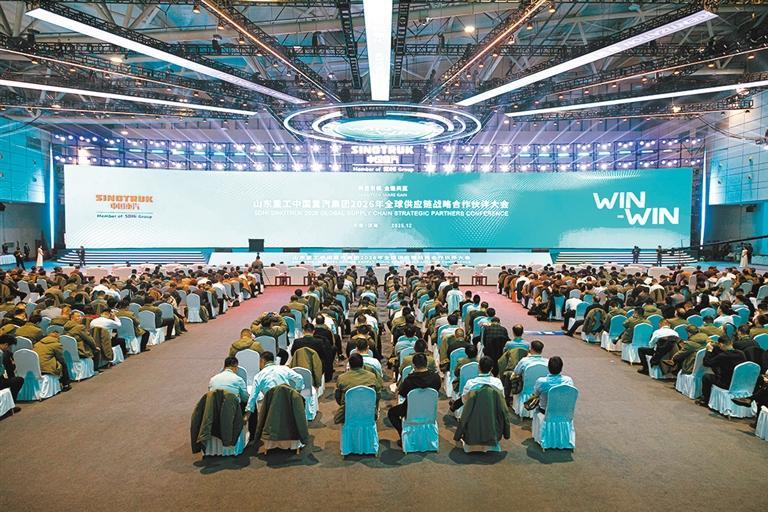
Core Insights - The 2026 Global Supply Chain Strategic Partnership Conference of Shandong Heavy Industry China National Heavy Duty Truck Group was held in Jinan, recognizing outstanding partners for their contributions [2][3] - The conference showcased record participation with over 4,200 partners, emphasizing collaboration and future development plans [3] Financial Performance - In 2025, the commercial vehicle industry faced intense competition, with expected revenue growth of 17% year-on-year and vehicle sales projected to exceed 450,000 units, a 25% increase [4] - Heavy truck sales reached a historic high of over 300,000 units, maintaining a leading position in China's heavy truck industry for four consecutive years [4] - Domestic heavy truck sales are expected to reach 150,000 units, a 33% increase, while light truck sales are projected at 120,000 units, up 29% [4] - Export performance also improved, with heavy truck exports exceeding 150,000 units, an 11% increase, and light truck exports rising by 161% [4] Competitive Advantages - The company leverages five core advantages: industrial chain synergy, comprehensive product development, strong marketing capabilities, quality control, and diversified international operations [5] - Continuous investment in R&D and the adoption of advanced European technologies have enabled the company to achieve self-controlled core technologies [5] - The company has established a global marketing team of over 2,600 professionals and a comprehensive service network, enhancing its market responsiveness [5] Strategic Transformations - The company is committed to six strategic transformations: green, digital, service-oriented, international, diversified, and high-end [7] - In the green transformation, the company has developed key technologies for new energy vehicles and is promoting innovative business models [8] - The digital transformation focuses on intelligent driving and data integration to enhance operational efficiency [8] Future Goals - The company aims to achieve a revenue of over 400 billion yuan and vehicle sales of 800,000 units by 2030, marking a critical strategic opportunity for high-quality development [14] - In 2026, the company plans to invest over 3.4 billion yuan in R&D to support product development and competitiveness [13] Community Engagement - The public open day event attracted over 10,000 participants, showcasing the company's product range and fostering community connections [10] - The company emphasizes the importance of high-quality party building to drive business success and enhance employee engagement [11][12]

天原股份顺应高端化转型趋势 拟投15亿元新建年产10万吨钛白粉项目
Zheng Quan Shi Bao Wang· 2025-12-30 14:11
Group 1 - The core announcement from Tianyuan Co., Ltd. is the plan to expand production capacity by constructing a new 100,000-ton chlorination titanium dioxide project, with a total investment of 1.483 billion yuan and a construction period of 24 months [1] - The project aims to align with the industry's trend towards green and high-end transformation, enhancing the company's competitiveness in the titanium dioxide market and increasing the proportion of new industries in its portfolio [1] - In addition to the titanium dioxide project, Tianyuan is also advancing other projects, including a 100,000-ton lithium iron phosphate cathode material project and ongoing construction of the Tiancheng lithium battery project [2] Group 2 - Tianyuan's subsidiary, Vietnam Tianxiang New Materials Technology Co., Ltd., will cease production and operations starting January 1, 2026, due to ongoing losses attributed to external factors such as tariffs and rapid capacity expansion in Vietnam [3] - The financial performance of Vietnam Tianxiang has been poor, with reported revenues of 28.86 million yuan in 2024 and 72.50 million yuan in the first three quarters of 2025, alongside net losses of -16.91 million yuan and -10.61 million yuan respectively [3] - The decision to halt operations is aimed at protecting shareholder interests and is not expected to impact the main business of Tianyuan [3]

无人机产业洞察:在战略机遇与供应链风险中重塑全球竞争力
Da Gong Guo Ji· 2025-12-30 12:45
Investment Rating - The report does not explicitly provide an investment rating for the drone industry Core Insights - The Chinese drone industry has become a strategic emerging industry driven by national strategy, with a leading global market size and a complete industrial chain, transitioning from "manufacturing-led" to "technology-driven and ecosystem construction" [1] - The industry faces multiple challenges, including reliance on imported core technologies, long commercial return cycles, and international compliance and geopolitical risks, with future development focusing on intelligence, greening, airspace digitization, and market diversification [1] Strategic Positioning and Policy Support - The drone industry has rapidly developed under coordinated policy design, airspace management reform, and infrastructure construction, establishing a solid foundation for the large-scale application of the low-altitude economy [2] - The industry is defined as unmanned aerial vehicles operating in low-altitude airspace, which is recognized as a core carrier of the low-altitude economy [2] - A comprehensive policy framework has been established, including mandatory national standards and regulations to support the industry's standardized development [3][4] Market Size and Import-Export Patterns - The global drone market is projected to grow from USD 35.28 billion in 2024 to USD 67.64 billion by 2029, with a compound annual growth rate (CAGR) of 13.90% [5] - The Chinese civil drone market is expected to reach approximately CNY 146.8 billion in 2024, with a forecasted market size exceeding CNY 400 billion by 2030, reflecting a CAGR of 18.3% from 2024 to 2030 [5] - China remains the world's largest drone manufacturer and exporter, with significant growth in both export volume and value [6][7] Industry Chain Structure and Layout - The Chinese drone industry has established a complete industrial chain from upstream core components to midstream manufacturing and downstream application services, showcasing global competitiveness [11] - The upstream sector includes critical components such as flight control systems and sensors, with a high reliance on imports for advanced technologies [13] - The midstream focuses on the research and production of consumer, industrial, and military drones, with leading companies dominating various segments [14] - The downstream application services cover logistics, agriculture, power inspection, and emergency rescue, with significant market shares held by key players [14] Core Challenges and Future Development Trends - The industry faces challenges such as reliance on imported high-end components, high commercialization costs in industrial applications, and complex certification processes [16] - Future trends indicate a shift towards intelligent, autonomous, and green technologies, with eVTOLs emerging as a new avenue for urban air mobility [17][18] - The integration of low-altitude economy and digital infrastructure is expected to enhance operational efficiency and regulatory compliance [18]


巨亏之下的钢铁行业,不断停产、减人,钢铁工人未来何去何从?
Sou Hu Cai Jing· 2025-12-30 12:18
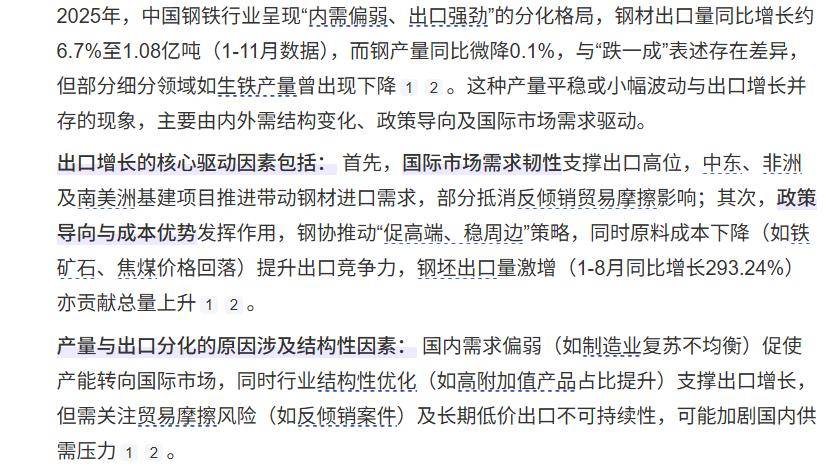
Core Viewpoint - The article highlights the paradox of declining domestic steel production in China alongside a surge in steel exports, reflecting the ongoing transformation of China's economic structure and changes in global trade dynamics [1]. Group 1: Domestic Production and Export Trends - In November, China's crude steel production fell by 10.9% year-on-year, marking a significant decline not seen in recent years, indicating low production enthusiasm among steel mills [2][4]. - Conversely, steel exports reached 8.06 million tons in November, an increase of 8.4% compared to the same month last year, marking the seventh consecutive month of year-on-year growth [2][4]. - The disparity between falling domestic production and rising exports suggests that excess capacity is being redirected to international markets due to weak domestic demand, particularly from the real estate and infrastructure sectors [4][6]. Group 2: Global Market Dynamics - The global crude steel production in November was 147.8 million tons, a decrease of 4.6% year-on-year, with the decline primarily attributed to China; excluding China, production in other regions increased by 2.6% [8]. - Emerging markets like India, Turkey, and Vietnam are experiencing rising steel production, indicating a shift in global demand dynamics as China's cooling demand significantly impacts overall global statistics [8][10]. Group 3: European Market Response - Europe is responding to the supply pressure from China with protective measures, including the implementation of a carbon border adjustment mechanism (CBAM) and potential cuts to steel import quotas by up to 50% [10][12]. - These policies have already widened the price gap between locally produced and imported steel, with the price difference reaching approximately $370 per ton, driven more by policy than by genuine demand [12][14]. Group 4: Future Outlook and Industry Transformation - The World Steel Association predicts a slight global steel demand growth of 1.3% by 2025, primarily driven by regions like India and ASEAN, while China's demand is expected to continue its slight contraction [16]. - China's steel industry is undergoing structural reforms aimed at high-end, intelligent, and green development, with major companies investing in low-carbon technologies and high-performance steel production [22][24]. - New demand drivers are emerging in sectors such as renewable energy and high-end manufacturing, which are partially offsetting the decline in traditional construction steel demand, necessitating agility in responding to downstream industry upgrades [24].
张掖全链赋能让“好菜”卖“好价”
Xin Lang Cai Jing· 2025-12-30 09:45
Core Insights - The article emphasizes the transformation of the vegetable industry in Zhangye from "growing well" to "selling well" and "building a strong brand" to enhance market competitiveness and support rural revitalization [1] Group 1: Industry Development - The city has established 20 vegetable production towns with over 10,000 acres and 150 specialized villages with over 1,000 acres, creating a production base for the Guangdong-Hong Kong-Macao region with a planting area of 110,000 acres [2] - The total vegetable planting area in the city remains stable at 1,004,000 acres, with an annual output of 3.94 million tons, solidifying its position as a core vegetable production area in the country [2] - The city has been recognized in various national vegetable industry maps, indicating the continuous emergence of industrial cluster effects [2] Group 2: Organic Agriculture - The city has implemented a plan to accelerate the construction of organic agricultural bases, with an investment of 2.5 million yuan to create five demonstration organic vegetable bases [2] - Currently, there are 24 organic vegetable bases established, with a certified area of 29,400 acres, leading the province in both area and product certification [2] Group 3: Supply Chain Integration - The city has built 42 intensive seedling bases and nurtured 10 enterprises with an annual seedling capacity of over 30 million, achieving a total annual intensive seedling output of 1.8 billion [3] - Support has been provided to 610 vegetable planting, logistics, and marketing cooperatives, enhancing the overall development level of the entire industry chain [3] Group 4: Technological Innovation - The city has established 26 experimental demonstration sites in collaboration with research institutions, introducing 331 excellent varieties and 34 new technologies for vegetable cultivation [4] - The establishment of technology service teams has facilitated regular training and guidance, enhancing production safety and efficiency [4] Group 5: Brand Development - The city focuses on building the "Golden Zhangye Organic Vegetables" brand, enhancing its core competitiveness and market recognition [5] - A total of 81 vegetable products have been certified as green, organic, or geographical indication products, with several products included in regional public brand directories [5]