
产学研融合

Search documents
政府引导企业选聘高校“科技副总”:一场人才选拔的突围
2 1 Shi Ji Jing Ji Bao Dao· 2025-08-06 08:17
Core Viewpoint - The introduction of the "Technology Vice President" role in Shaanxi Province aims to facilitate the market-oriented flow of technological resources, addressing the disconnect between academia and industry, and enhancing innovation through direct involvement of research talents in corporate decision-making [1][3]. Group 1: Policy Implementation - Shaanxi's policy allows enterprises to recruit "Technology Vice Presidents" from universities and research institutions, promoting innovation and addressing key technological challenges [1][4]. - The policy establishes a three-party agreement framework that allows research personnel to retain their university positions while serving as corporate executives, thus resolving systemic barriers to talent mobility [3][5]. - A KPI evaluation system will be created to quantify contributions in research and development, guiding resources towards industry needs [3]. Group 2: Historical Context and Expansion - The "Technology Vice President" initiative originated in Jiangsu in 2013 and has since been adopted by over 20 provinces, focusing on breaking down barriers for research personnel to work in enterprises [5][6]. - Other provinces, such as Zhejiang and Henan, have developed their own action plans and frameworks to enhance the flow of intellectual capital and establish clear responsibilities and rights [6][7]. Group 3: Impact on Innovation - The policy has shown significant results in various regions, facilitating collaboration between university professors and enterprises, leading to the resolution of technical challenges and the filing of patents [8][9]. - Successful case studies include projects that have received provincial awards and significant cost reductions through technological advancements, demonstrating the effectiveness of the "Technology Vice President" role in driving innovation [9]. Group 4: Challenges and Future Directions - Despite progress, challenges remain in aligning market demands with research capabilities, as well as in establishing stable partnerships between academia and industry [10].
美锦能源:公司高度重视产学研融合发展
Zheng Quan Ri Bao Wang· 2025-08-05 14:12
证券日报网讯美锦能源(000723)8月5日在互动平台回答投资者提问时表示,公司高度重视产学研融合 发展,与部分高校及科研机构保持积极沟通,未来将结合产业发展实际,进一步探索合作机会,持续提 升自主研发能力。 ...

上海出台多条措施强化企业基础研究 推动科技创新与产业深度融合
Huan Qiu Wang· 2025-08-05 06:05
Group 1 - The core viewpoint of the article is the introduction of measures by Shanghai to enhance enterprise participation in basic research, aiming to strengthen the integration of basic research, technological innovation, and industrial application [1] - The "Explorer Program" encourages qualified enterprises to increase investment in basic research, offering a one-time financial subsidy of up to 10 million yuan per year for companies with strong technological innovation capabilities and high basic R&D investment [3] - Shanghai's basic research investment accounts for 11% of the total R&D expenditure, which is higher than the national average but still has room for improvement compared to international innovation center goals [3][4] Group 2 - The measures broaden funding sources by encouraging enterprises to establish or donate to basic research public welfare funds, with a 50% matching support for related projects [4] - The Shanghai Qiyuan State-owned Assets Innovation Source Public Welfare Fund, established by 16 state-owned enterprises, focuses on cutting-edge fields such as quantum technology and brain science, supporting youth talent and innovative projects [4] - Collaboration between universities and enterprises is emphasized, with nearly 20% of Shanghai's university technology funding coming from enterprise contributions, and nearly a thousand joint research platforms established [4]


“科创家”汇聚科创板 产学研融合创新加速孵化新质生产力
Zheng Quan Ri Bao Zhi Sheng· 2025-08-04 08:38
Core Insights - The Science and Technology Innovation Board (STAR Market) has fostered an environment for innovation and entrepreneurship over the past six years, attracting high-level scientific talent and facilitating the transformation of innovative advantages into industrial and national competitive advantages [1][2] Group 1: Talent and Innovation - Over 60% of STAR Market companies have founding teams composed of scientists, engineers, or industry experts, with nearly 40% establishing partnerships with universities and research institutions [1] - A significant number of STAR Market companies are led by individuals with academic backgrounds, including 75 companies with leaders who have experience as university professors or doctoral advisors [2][4] - More than 30% of STAR Market company leaders have overseas study experiences, particularly in the fields of biomedicine and integrated circuits, where this figure rises to 50% [3] Group 2: Industry Collaboration - STAR Market companies have achieved over 1,100 collaborative projects that have led to the industrialization of research outcomes in the past three years [1][6] - Approximately 80% of STAR Market companies engage in industry-academia-research collaborations, with over 70% partnering with 985/211 universities or Chinese Academy of Sciences research institutions [6] - The collaboration has resulted in over 4000 projects, with more than 1300 receiving national or provincial-level funding, and 1100 projects achieving industrialization [6] Group 3: Intellectual Property and R&D - STAR Market companies have collectively generated over 120,000 invention patents, with more than 20,000 new patents filed in 2024 alone [7] - The STAR Market has implemented adaptive equity incentive systems to attract and retain talent, with over 70% of companies utilizing these tools, covering more than 140,000 core business and technical personnel [7] - The total number of R&D personnel in STAR Market companies exceeds 240,000, accounting for nearly 30% of the total workforce [7]

“科创家”会聚科创板 产学研融合加速孵化新质生产力
Zheng Quan Shi Bao Wang· 2025-08-04 08:24
Core Insights - The Sci-Tech Innovation Board (STAR Market) has completed six years, focusing on institutional innovation and ecological development to foster a conducive environment for scientists and high-level tech talent [1][9] - Over 60% of STAR Market companies have founding teams composed of scientists, engineers, or industry experts, with nearly 40% collaborating with universities and research institutions [1][2] Group 1: Talent and Innovation - The STAR Market features a distinct characteristic of scientist-led entrepreneurship, with over 60% of companies having founders from scientific backgrounds [2][3] - A significant number of companies are led by individuals with academic experience, including 75 companies having leaders with professor or doctoral advisor roles [3][4] - Approximately 110 STAR Market company leaders graduated from China's C9 universities, contributing to the industry's clustering advantage [4][5] Group 2: Industry Collaboration - The STAR Market companies have a high rate of collaboration with academic institutions, with over 80% engaging in partnerships for research and development [6][7] - More than 70% of companies collaborate with 985/211 universities or Chinese Academy of Sciences for R&D, and over 40% engage in joint talent cultivation [6][7] - The number of collaborative projects with universities and research institutions has exceeded 4,000 in the past three years, with over 1,100 projects achieving commercialization [7][8] Group 3: Intellectual Property and R&D - STAR Market companies have collectively generated over 120,000 invention patents, with more than 20,000 new patents filed in 2024 alone [8] - The board has implemented a flexible equity incentive system, with over 70% of companies utilizing it to attract and retain talent [9] - The total number of R&D personnel in STAR Market companies has surpassed 240,000, accounting for nearly 30% of the total workforce [9]
“航天宝”保丰收,中国太保产险汕尾中支产学研融合结硕果
Nan Fang Nong Cun Bao· 2025-08-01 07:01
Core Viewpoint - The collaboration between China Pacific Insurance (CPIC) and South China Agricultural University has led to the successful application of the "Aerospace Treasure" microbial agent technology, significantly enhancing agricultural productivity and disease resistance in Shantou, contributing to rural revitalization efforts [3][5][29]. Group 1: Agricultural Innovations - The "Aerospace Treasure" technology has resulted in an average increase of 100 pounds per mu for vegetables, a 75% effectiveness in controlling rice sheath blight, and a notable increase in lychee fruiting rates, along with a 10%-15% increase in oil orange yields [2][10]. - The core of the "Aerospace Treasure" technology is derived from space-induced Bacillus cereus PS04, which enhances photosynthesis, improves germination and fruit-setting rates, and ultimately increases crop yields [13][15][17]. Group 2: Collaboration and Impact - The partnership between CPIC and South China Agricultural University is recognized as a successful model for integrating academic research with local economic development, demonstrating the effectiveness of the "prevention-first" approach in agricultural insurance [21][22]. - The successful implementation of the "Aerospace Treasure" technology in Shantou serves as a valuable experience for building an integrated service system of "insurance, prevention, and compensation," aiming to enhance disaster prevention and reduction capabilities for farmers [28][30].


山东移动携手产业合作伙伴联合发布作物育种大模型
Qi Lu Wan Bao· 2025-08-01 01:35
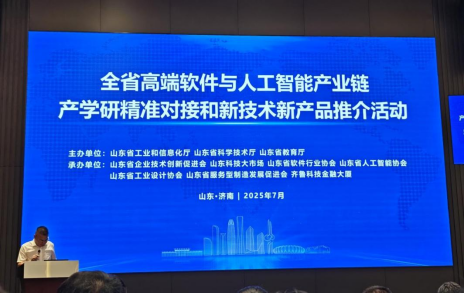
近日,在山东省工业和信息化厅、教育厅、科学技术厅联合主办的"高端软件与人工智能产业链产学研 精准对接和新技术新产品推介活动"上,潍坊现代农业山东省实验室、北京大学现代农业研究院、山东 移动潍坊分公司、中移齐鲁创新研究院四方联合,正式发布育种大模型(BreedGPT)。该模型的发 布,标志着我国作物育种科研与产业应用在智能化、精准化方向上迈出关键一步。 BreedGPT旨在解决传统育种痛点,推动从"经验育种"向"精准设计育种"的实质性跨越。该模型依托中 国移动研究院"AI For Science (AI4S)"科学装置的强大算力支持,以及中移齐鲁创新研究院自主构建 的"AI+"技术平台,深度融合先进的大模型技术与农业育种专业知识体系,构建了覆盖科研智能问答、 基因深度解析、高效文献检索、智能科研辅助四大核心场景的全链条育种智能平台。其目标是提升育种 科研效率,加速优良品种选育进程,为我国农业高质量发展和粮食安全提供关键技术支撑。 BreedGPT的核心能力与显著优势体现在以下几个方面: 智能化的科研辅助。BreedGPT创新性地将文献理解模型与生物学知识库相结合,并运用大模型智能体 技术。用户通过输入关键词,即 ...
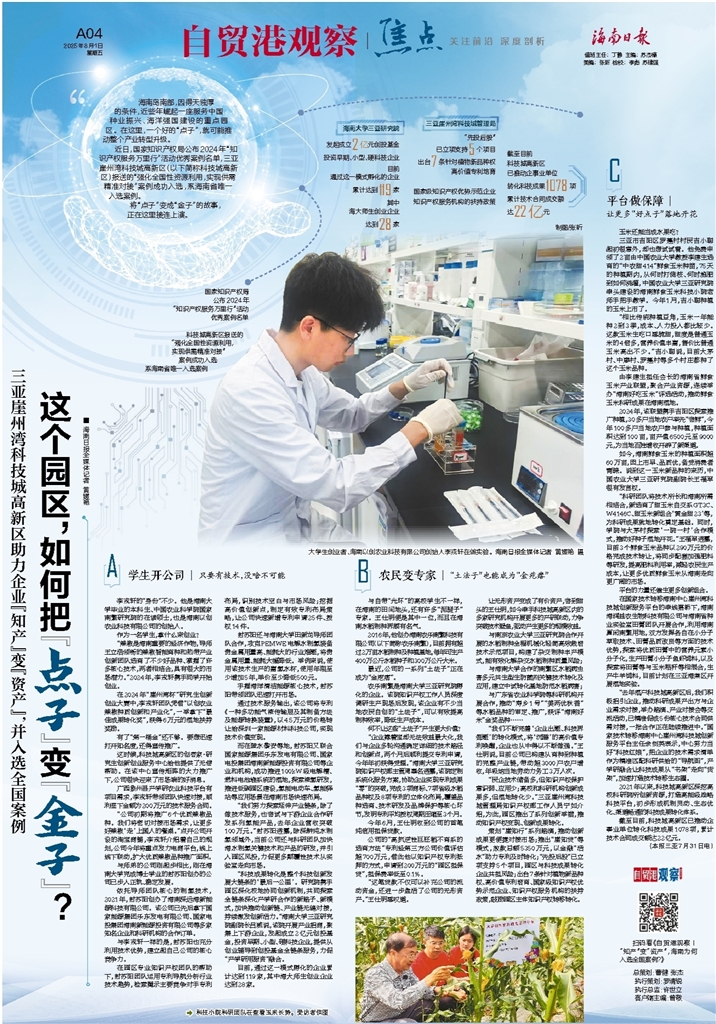
三亚崖州湾科技城高新区助力企业“知产”变“资产”
Hai Nan Ri Bao· 2025-08-01 01:29
Core Viewpoint - The Sanya Yazhou Bay Science and Technology City High-tech Zone has been recognized for its successful transformation of intellectual property into assets, showcasing a model for resource utilization and precise supply-demand matching in the agricultural and marine sectors of China [5][6]. Group 1: Intellectual Property and Innovation - The Sanya Yazhou Bay Science and Technology City High-tech Zone was the only case from Hainan Province selected in the National Intellectual Property Administration's 2024 "Intellectual Property Service Journey" activity [5][6]. - The zone has successfully incubated 119 enterprises, including 28 founded by students and faculty from Hainan University [15]. - The zone's initiatives have led to the submission of multiple patents and trademarks, significantly reducing the average authorization period for invention patents to three months [18]. Group 2: Entrepreneurial Success Stories - Li Rongxuan, a graduate student, founded a company focusing on innovative chili pepper breeding, securing a technology service contract worth 2 million yuan [10][9]. - Feng Suyang, a PhD graduate, established a company specializing in hydrogen energy technology, achieving over 1 million yuan in revenue and filing 25 new patent applications [11][13]. - Wang Shiming, a farmer, transformed traditional farming methods into valuable intellectual property, securing a loan of 2 million yuan against his patents, which were valued at over 7 million yuan [19][20]. Group 3: Agricultural Innovations - The introduction of sweet corn varieties has led to increased income for local farmers, with planting areas expanding to over 60,000 acres [22][23]. - The Sanya Yazhou Bay Science and Technology City has facilitated partnerships between agricultural companies and research institutions, resulting in the development of new agricultural products and technologies [24]. - The zone has successfully facilitated the conversion of 1,078 technology achievements into practical applications, with a total transaction value of 2.2 billion yuan [25].
聚合力、谋新篇,政企研共绘茂南罗非鱼产业发展蓝图
Nan Fang Nong Cun Bao· 2025-07-31 13:33
Core Viewpoint - The article discusses the development blueprint for the tilapia industry in Maonan District, Maoming City, emphasizing collaboration among government, enterprises, and research institutions to enhance the industry's quality and competitiveness [2][5][6]. Group 1: Industry Development and Planning - The Maonan District Tilapia Association held its third general meeting, where a new leadership team was elected, and a development plan for the tilapia industry was released [2][5][12]. - The "Maoming City Maonan District Tilapia Industry Development Plan (2025-2030)" aims to achieve a tilapia production of 120,000 tons and an industry chain output value exceeding 12.5 billion yuan by 2030 [24][25]. - The plan focuses on core strategies such as "industry foundation, cultural soul, digital empowerment, capital operation, and cooperative prosperity" [23][24]. Group 2: Collaboration and Innovation - The Maonan District Tilapia Association signed a cooperation agreement with the Freshwater Fisheries Research Center of the Chinese Academy of Fishery Sciences to establish a tilapia germplasm innovation platform [19][20]. - The association aims to enhance industry standards, quality supervision, and promote the "China Tilapia Capital" brand through self-regulation and cooperation among enterprises [28][30]. Group 3: Current Industry Status - The tilapia industry in Maonan has a cultivation area of 48,600 acres, producing over 1.3 billion fry annually, with an annual output value exceeding 2 billion yuan [35][36]. - The region has established a complete industry chain, from fry production to processing, with a processing capacity exceeding 600,000 tons annually [47][48]. Group 4: Financial and Technological Support - The industry has received 32 utility model patents and established a full-process traceability platform in collaboration with Southern University of Science and Technology [52][53]. - Financial support measures include a loan issuance of 664 million yuan and the establishment of a comprehensive financial service center to alleviate financing difficulties for enterprises [54][55]. Group 5: Policy and Market Integration - The tilapia industry was selected as a national modern agricultural industrial park in 2025, integrating into the Pearl River Delta consumer market through the "Zhanmao Cooperation" mechanism [56][57]. - The industry supports over 5,000 farmers and more than 15,000 people, contributing to rural revitalization as a pillar industry [58].
博士团队突破芯片温控技术在汉创业 企业上半年订单突破两千万元
Chang Jiang Ri Bao· 2025-07-30 01:56
在千亿级产业集群——光电子信息产业基地光电产业圈的核心区,武汉中旗光电科技有限公司(以 下简称中旗光电)的会议室里,创始人顾勇刚和技术骨干就核心产品晶圆卡盘的又一次技术升级开展讨 论。与此同时,在光谷腹地的一处车间,一块块晶圆卡盘正从生产线上顺利下线。 在温度控制体系中,晶圆卡盘处于核心地位,堪称"皇冠顶上的明珠"。 工程师周华健介绍,传统调温高温多使用电加热丝,加热时间需35分钟。传统调温低温使用冷媒或 液氮,变温时间也需35分钟。现在,公司产品突破时长,既可加热也可制冷,5分钟内完成变温,价格 上较传统产品下降2/3,具有极大的市场优势。 "突破半导体级温控技术壁垒,才能推动实现全产业链国产化替代。"顾勇刚斩钉截铁地说道。 正在武汉大学攻读集成电路科学与工程专业博士的顾勇刚,已经拥有5家公司,覆盖半导体制造、 激光医疗、生物科技等行业。今年,是中旗光电成立的第十年。瞄准核心技术攻坚十年,企业已成为行 业龙头京东方、歌尔的供货商。 参加大赛,团队收获远超"一座奖杯" 在刚刚举行的第四届武汉大学生"英雄杯"创新创业大赛中,智能制造赛道的顾勇刚团队从837个参 赛项目中脱颖而出,以"基于高精度半导体温度控制技术 ...
