
消费者权益保护

Search documents
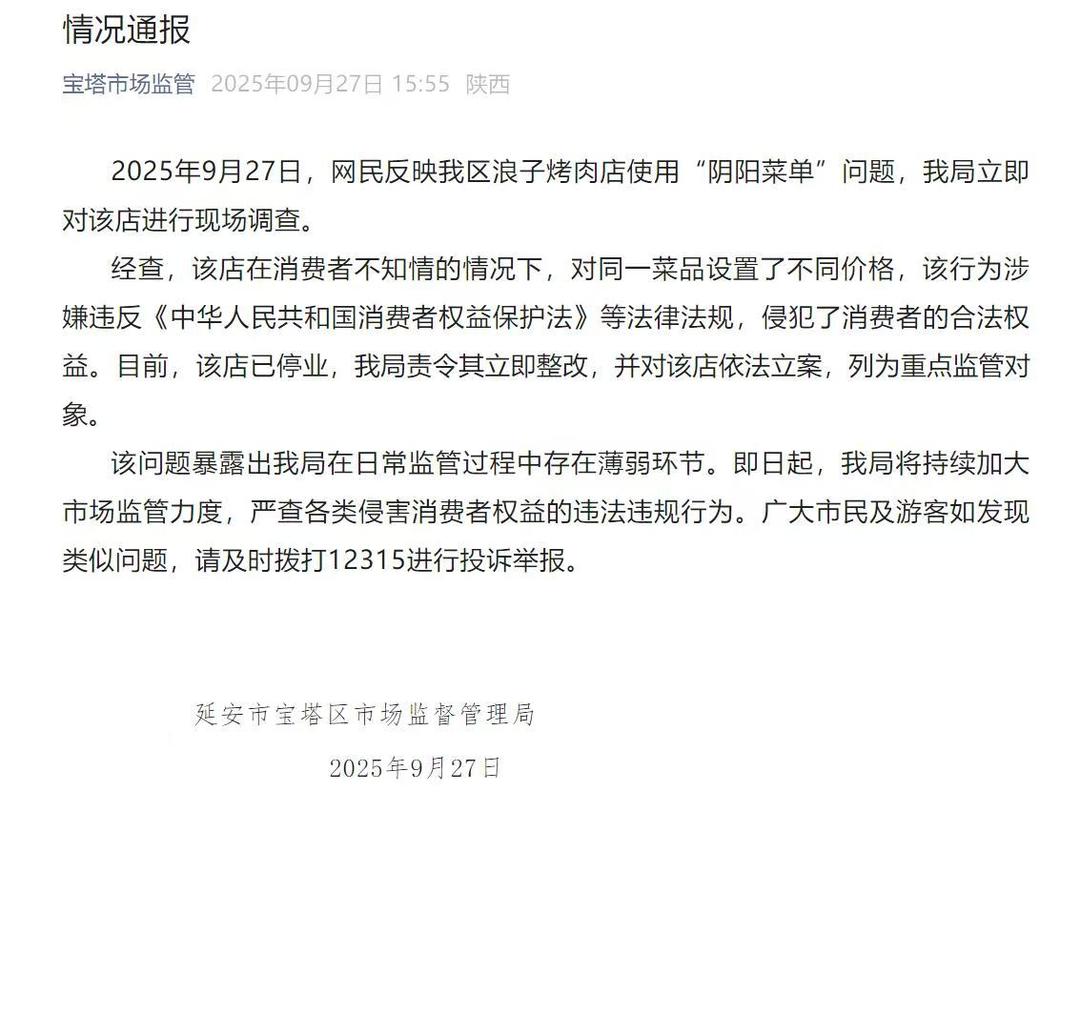
被曝对外地人用“阴阳菜单”,延安市监局:依法立案,饭店已停业
Qi Lu Wan Bao Wang· 2025-09-27 10:08
Core Points - A restaurant in Yan'an, Shaanxi Province, has been accused of using a "dual-price menu" that charges local customers and tourists different prices for the same meal, with a discrepancy of 59 yuan [1] - The local market supervision bureau has initiated an investigation into the restaurant's pricing practices, which allegedly violate consumer rights laws [1] - The restaurant has been ordered to cease operations and rectify its pricing strategy, and it has been placed under heightened regulatory scrutiny [1] Company Summary - The restaurant involved is located in a tourist area and has been reported to offer discounts to regular customers, which may contribute to the pricing disparity [1] - The local authorities have confirmed that the restaurant's practice of setting different prices for the same dish without consumer knowledge is a violation of the Consumer Rights Protection Law [1] - The restaurant has been temporarily closed as part of the investigation and is now a focus of regulatory actions [1] Industry Summary - The incident highlights potential issues within the restaurant industry regarding pricing transparency and consumer rights [1] - Regulatory bodies are actively monitoring and addressing unfair pricing practices in the food service sector, indicating a stricter enforcement of consumer protection laws [1] - The case may prompt broader discussions and potential reforms in pricing strategies among restaurants, especially those in tourist-heavy areas [1]

选择权岂能被“锁住”!江苏省消保委:航司盈利创新不应损害消费者权益
Yang Zi Wan Bao Wang· 2025-09-26 12:05
Core Viewpoint - The recent discussions around "paid seat selection" in the airline industry have raised concerns about consumer rights and the legality of such practices, with experts suggesting that these practices may violate consumer protection laws [1][2][4]. Group 1: Lack of Transparency - Airlines have not publicly disclosed the standards for their "seat locking" rules, including the basis for calculating the locking ratio, dynamic adjustment mechanisms, and specific fees or points required for seat selection [2][3]. - This lack of transparency infringes on consumers' right to know the true conditions of the services they purchase, as stipulated by the Consumer Rights Protection Law [2]. Group 2: Increased Locking Proportions - Reports indicate that the proportion of locked seats has increased significantly, particularly on popular routes, with a shift from locking only special seats to including more desirable seats in the economy class [2][3]. - This practice limits consumers' choices, as airlines are reserving premium seats for paid selection while offering only less desirable options for free [2]. Group 3: Questionable Justification for Fees - The rationale behind charging for seat selection is under scrutiny, as consumers traditionally expect that the purchase of a ticket includes the right to a seat [3][4]. - The pricing of seat selection within the same class varies without a clear basis, suggesting that the fee structure is more about maximizing profits rather than reflecting service costs [3]. Group 4: Consumer Rights Violations - The practice of charging for seat selection is seen as a violation of consumers' rights to know and choose, contradicting the airlines' responsibilities as public service providers [4]. - Recommendations include airlines adhering to safety protocols for special seats, standardizing their operational practices, and increasing transparency regarding seat locking rules and fees [4].
Amazon settles with FTC over 'deceptive' Prime signups
Yahoo Finance· 2025-09-25 16:10
Core Viewpoint - Amazon has agreed to a $2.5 billion settlement with the Federal Trade Commission (FTC) over allegations of deceptive practices related to its Prime subscription service, affecting nearly 40 million customers [1][2]. Settlement Details - The settlement includes a $1 billion civil penalty and $1.5 billion in consumer refunds, marking the second-largest restitution amount ever obtained by the FTC [2][3]. - The FTC described the settlement as a "record-breaking, monumental win" for consumers facing deceptive subscription practices [3]. Allegations and Customer Experience - The FTC's lawsuit, filed two years ago, accused Amazon of creating a "labyrinthine" cancellation process that deterred customers from canceling their Prime subscriptions [3]. - Customers were reportedly required to navigate a complex cancellation process involving four pages, six clicks, and fifteen options, with warnings about missing deals to discourage cancellations [3]. Changes in Policies - Following the FTC's actions, Amazon has revised its cancellation policies, introducing a standalone cancellation page that clearly outlines options for pausing or ending memberships [4]. - The settlement mandates that Amazon provide a clear button for customers to decline Prime, eliminating misleading options such as "No, I don't want Free Shipping" [4]. - An independent third-party supervisor will be appointed to monitor Amazon's compliance with the settlement terms [4]. Subscriber Insights - Amazon's Prime subscriber base is estimated to exceed 200 million, with Prime customers generally spending more than non-subscribers, making them more valuable to the company [5]. - This lawsuit is distinct from the FTC's ongoing antitrust case against Amazon, which is scheduled for trial in 2027 [5].

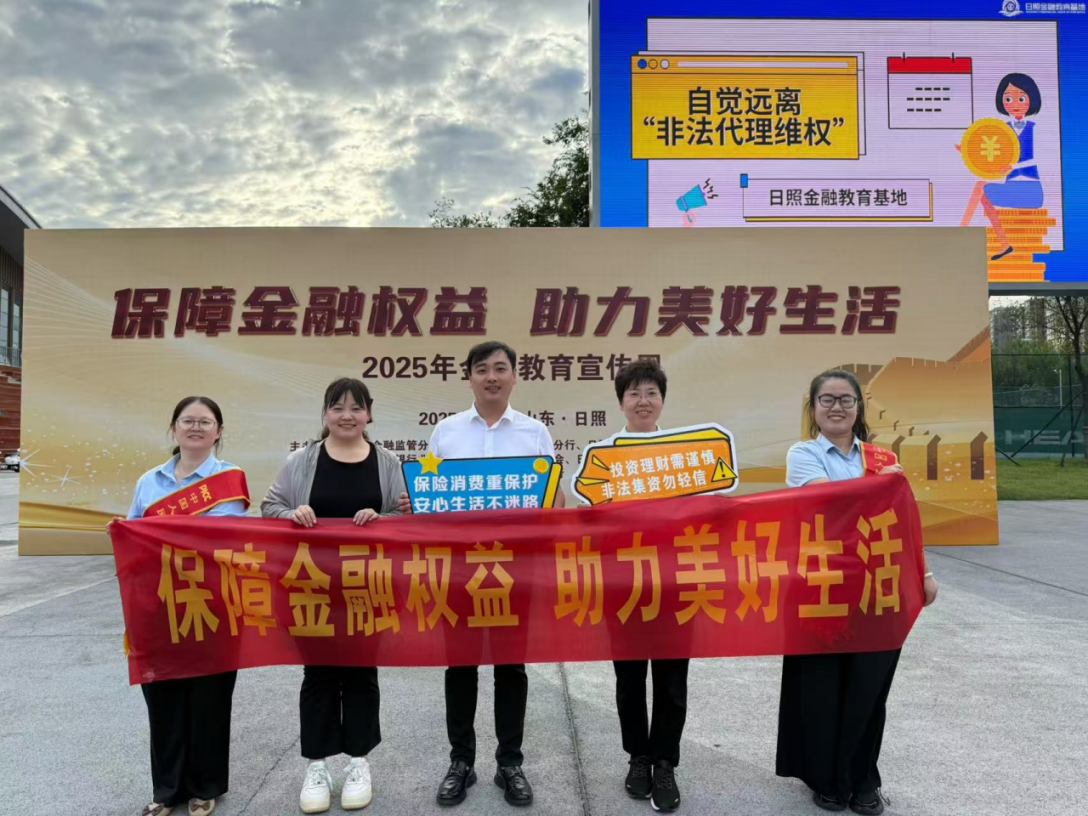
人保寿险日照中支积极投身金融教育宣传周 多维发力守护消费者权益
Qi Lu Wan Bao· 2025-09-25 11:28
Core Viewpoint - The company actively participates in financial education initiatives to protect consumer rights and enhance public trust in the financial industry [1][3][5] Group 1: Consumer Education and Protection - The company focuses on consumer needs by promoting knowledge about financial products and risk awareness, helping consumers make informed choices and avoid fraud [3][6] - A new campaign emphasizes the core content of the Anti-Money Laundering Law, enhancing consumers' awareness of their rights and responsibilities [3][6] Group 2: Infrastructure and Outreach - The company is establishing a permanent educational presence by creating consumer protection information zones in bank branches, enhancing the delivery of financial knowledge [5][6] - Outdoor promotional activities are being conducted to bring financial knowledge directly to communities, utilizing various traditional and innovative methods [6] Group 3: Targeted Education Initiatives - Special educational programs are designed for vulnerable groups, such as the elderly and youth, to promote awareness of financial risks and responsible consumption [6] - Internal training programs are being implemented to raise awareness among employees about consumer rights protection [6] Group 4: Commitment to Continuous Improvement - The company is committed to a people-centered development approach, aiming to enhance consumer satisfaction and contribute positively to the financial industry's growth [6]
守初心 强服务 筑防线
Jin Rong Shi Bao· 2025-09-25 02:49
Core Viewpoint - Trust companies are increasingly focusing on consumer rights protection through various educational activities and initiatives, recognizing it as a fundamental mission rather than an additional responsibility [1][2]. Group 1: Consumer Rights Protection Initiatives - Trust companies have been actively engaging in consumer rights protection activities, such as the "Financial Consumer Rights Protection Education Month" and "Financial Education Promotion Week" [1]. - The unique institutional advantages and service models of trust companies have positioned them as significant players in wealth management for residents [1]. - To maintain competitiveness, trust companies must integrate consumer rights protection throughout their business processes, transforming institutional advantages into effective services [1]. Group 2: Innovative Approaches to Consumer Education - There is a need to move beyond traditional methods and develop engaging consumer protection plans that resonate with the public [2]. - Utilizing platforms like video accounts and Douyin, trust companies can create relatable content, such as skits and animations, to address common consumer issues like false advertising [2]. - Establishing a standardized information disclosure system is essential, presenting key product information clearly to consumers [2]. Group 3: Complaint Handling and Risk Management - An efficient complaint handling and feedback mechanism is crucial for addressing consumer concerns and preventing potential risks [2]. - Trust companies should continuously improve their risk prevention and dispute resolution mechanisms, ensuring that consumer disputes are resolved quickly and effectively [2][3]. - Integrating consumer rights protection into every aspect of product design and risk management is vital for building trust and becoming a reliable "wealth guardian" for consumers [3].
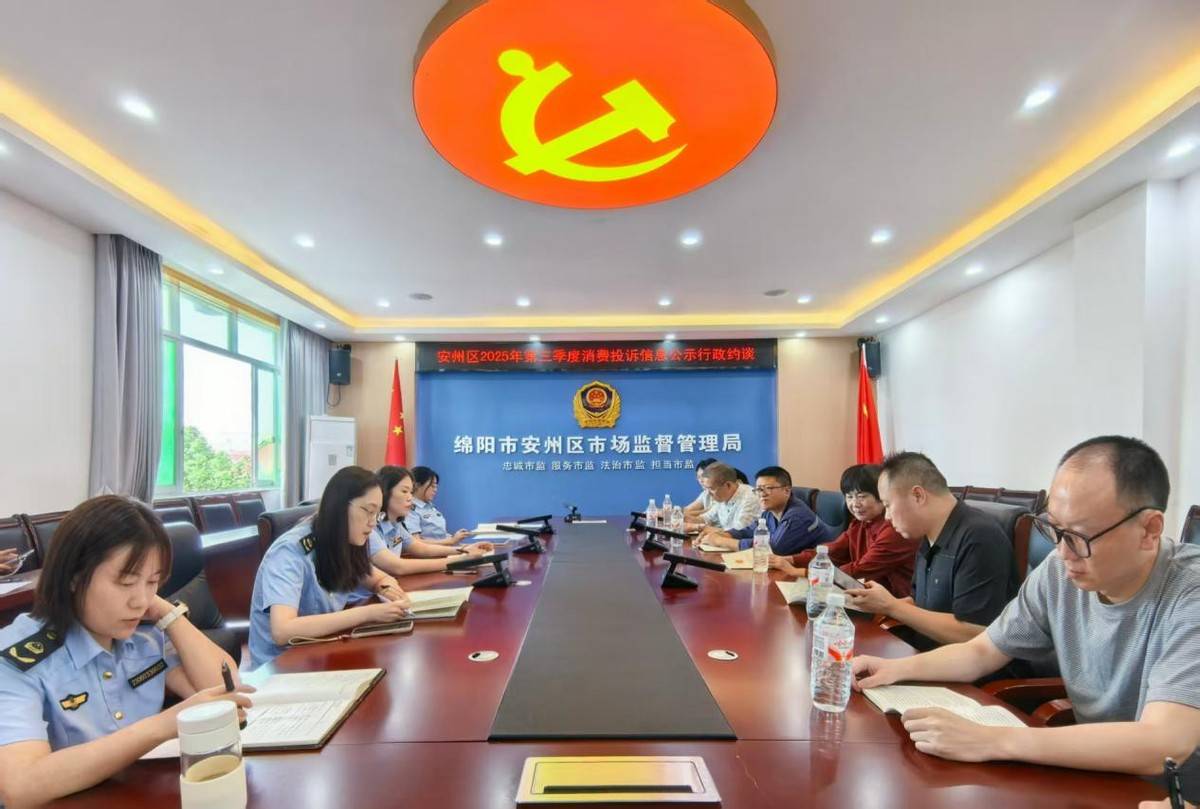
安州区市场监管局约谈8家重点企业 筑牢消费维权防线
Sou Hu Cai Jing· 2025-09-25 02:34
Core Points - The Sichuan Mianyang Anzhou District Market Supervision Bureau conducted administrative interviews with eight key enterprises to address consumer complaints and enhance consumer rights protection [1][3][4] - The focus of the interviews included critical areas such as medical devices, product quality, and pricing, which are closely related to public welfare [3][4] - The initiative aims to optimize the consumption environment and improve enterprises' awareness of consumer rights protection [4] Group 1 - The administrative interviews were guided by consumer complaint information and aimed at improving the local consumption environment [4] - Legal training was provided to enterprise leaders on compliance in medical devices, quality control in cosmetics, accurate use of measuring instruments, and transparent pricing [3] - Enterprises were urged to enhance their internal consumer complaint management systems and treat complaint information as a key tool for identifying operational risks [3][4] Group 2 - The training emphasized the importance of enterprises' responsibilities in consumer rights protection and the need for effective communication with consumers [3][4] - The Anzhou District Market Supervision Bureau plans to continue promoting consumer rights protection and improve the social governance mechanism for consumer rights [4] - The ultimate goal is to create a safe, fair, and trustworthy business and consumption environment, enhancing the public's sense of gain, happiness, and security [4]
金秋九月果飘香,神州万里好丰景。
Zhong Guo Shi Pin Wang· 2025-09-24 09:32
Core Viewpoint - The establishment of the "Chinese Farmers' Harvest Festival" in 2018 marks a significant recognition of farmers' contributions over 5,000 years, celebrating agricultural abundance and improving farmers' livelihoods [1] Group 1: Background and Context - The "Chinese Farmers' Harvest Festival" was established to honor farmers and their rights, reflecting a commitment to agricultural prosperity and consumer protection [1] - The article highlights the role of market regulatory authorities in safeguarding farmers' rights since their inception in 1978 [1] Group 2: Case Study of Tomato Seed Dispute - In 2008, a significant dispute arose involving tomato seeds purchased by farmers, leading to complaints about the seeds not matching the descriptions provided [2][3] - The dispute affected hundreds of farmers across multiple regions, involving over 500 acres of farmland [3] - The local consumer association and market regulatory authorities worked collaboratively to resolve the issue, ultimately compensating farmers a total of 751,880 yuan [2][3] Group 3: Resolution Process - The resolution involved a detailed investigation, evidence collection, and negotiations, resulting in an agreed compensation of 1,500 yuan per acre [3] - The regulatory authorities emphasized the importance of the Consumer Rights Protection Law, which played a crucial role in holding the seed supplier accountable [3] - The compensation was distributed in phases, with transparency in the process, leading to positive feedback from the affected farmers [3]
如何为消费者提供“负责任的服务”
Jin Rong Shi Bao· 2025-09-24 02:41
Core Viewpoint - The increasing reliance of consumers on consumer finance tools highlights the importance of consumer rights protection and responsible financial services within the industry [1] Group 1: Regulatory Framework - A robust institutional framework is deemed the "first line of defense" for consumer rights protection in the consumer finance sector [1] - Recent policy updates, including the revised "Management Measures for Consumer Finance Companies," have introduced specific chapters on "Consumer Rights Protection" and "Management of Cooperative Institutions" [1] - The new "Regulatory Rating Measures for Consumer Finance Companies" assigns a weight of 15% to "Consumer Rights Protection," second only to "Risk Management" at 25% [1] Group 2: Company Initiatives - Some consumer finance companies have recognized the importance of institutional development and are taking proactive measures [2] - Harbin Consumer Finance has established a comprehensive consumer protection mechanism, achieving significant results in system construction and operational efficiency [2] - Zhongyou Consumer Finance has formed a specialized committee for consumer rights protection at the board and executive levels, integrating consumer protection principles into its corporate culture and management processes [2] Group 3: Performance Assessment - Several consumer finance companies have innovated their assessment mechanisms by incorporating consumer complaint rates and satisfaction metrics into employee performance evaluations, linking them to compensation and promotions [2] - This approach has effectively enhanced employee awareness and execution of consumer rights protection responsibilities [2] Group 4: Consumer Loan Matching - Properly matching loans to suitable customers is crucial for consumer rights protection [3] - The industry recognizes that consumer finance should not excessively target lower-income segments without boundaries, emphasizing the importance of both institutional and consumer debt limits [3] - Financial technology should be leveraged to analyze consumer needs accurately, improving the precision of credit approvals and reducing issues like "multiple loans" and excessive credit [3]
聚焦多元场景 践行金融为民——山东中行金融知识宣教新实践
Qi Lu Wan Bao· 2025-09-24 00:33
Group 1 - The core idea of the article is that the Shandong Branch of Bank of China is actively promoting financial education and consumer rights protection through a series of innovative activities during the "Financial Education Promotion Week" [1][3][5] - The bank has organized 480 "Financial Education Pioneer Teams" to deliver financial knowledge to various communities, including fishing villages, urban business districts, and schools, emphasizing the theme of "protecting financial rights and supporting a better life" [1][3][5] - Specific activities include financial education initiatives in port cities like Rizhao, Yantai, and Weihai, focusing on core industries such as port logistics and marine equipment manufacturing, providing credit support and supply chain financial policy interpretations [3][5] Group 2 - The "Financial Education Promotion Week" also targets fishing villages, with initiatives like the "Fishing Village Promotion Team" that addresses the specific financial needs of fishermen, teaching them about savings and investment strategies [5][6] - In addition to fishing villages, the bank has engaged in various community outreach efforts, including performances and interactive financial education events in commercial areas, enhancing public awareness of financial knowledge [7][9] - The bank has collaborated with local regulatory bodies to conduct anti-fraud campaigns, using relatable language and local dialects to effectively communicate with diverse audiences, particularly in rural areas [9][11] Group 3 - The bank has integrated financial education with the back-to-school season, launching initiatives like the "First Lesson of the School Year" to educate students on financial safety and fraud prevention [12][13] - Collaborative efforts with local media have been established to enhance financial literacy through real case analyses, increasing public vigilance and confidence in financial institutions [15] - The ongoing commitment of the bank to financial education aims to continuously enrich the methods of outreach and expand communication channels, ensuring that financial education is accessible and impactful [15]

金融知识进万家 山东中行掀起金融教育宣传热潮
Zhong Guo Jin Rong Xin Xi Wang· 2025-09-23 11:52
Core Viewpoint - The Shandong Branch of Bank of China is actively promoting consumer rights protection and financial education through a series of initiatives, emphasizing the importance of safeguarding financial rights and enhancing the quality of life for consumers [1] Group 1: Financial Education Initiatives - The Shandong Branch has launched a "September Concentrated Education and Promotion Week" with 480 financial education teams engaging in various local activities to promote financial literacy [1] - Activities are tailored to local characteristics, with a focus on port cities like Rizhao, Yantai, and Weihai, addressing specific industry needs such as logistics and marine economy [2] - The bank is conducting targeted financial education in fishing villages, teaching fishermen about savings and investment strategies to protect their earnings [2] Group 2: Community Engagement and Collaboration - Local branches are encouraged to collaborate with regulatory bodies to host financial education events, enhancing community engagement through performances and interactive sessions [3] - The bank is utilizing a "grid-based" approach to reach various commercial areas, educating the public on common scams and promoting rational investment concepts [3] - In rural areas, the bank is using local dialects and informal settings to deliver anti-fraud education, making financial literacy accessible to all [4] Group 3: Innovative Outreach Methods - The bank is integrating financial education with the back-to-school season, launching initiatives like the "First Lesson of School" to educate students on financial safety and fraud prevention [5] - Collaborations with local media have been established to broadcast financial education programs, enhancing public awareness and trust in financial institutions [6] - The bank aims to continuously improve its outreach methods, ensuring that financial education is impactful and resonates with the community [6]