高端化战略

Search documents
日妆四巨头上半年:海外市场难守,高端牌频出
Bei Jing Shang Bao· 2025-08-11 14:34
Group 1 - The core viewpoint of the articles highlights the mixed performance of Japan's four major cosmetics companies—Shiseido, Kao, POLA, and Kose—in their financial results for the first half of 2025, with varying sales growth and profitability trends [2][3][4] - Kao and Kose reported sales growth, with Kao's sales increasing by 2.7% to 809 billion yen and Kose's sales rising by 0.9% to 160.5 billion yen, while Shiseido and POLA experienced sales declines of 7.6% and 0.7%, respectively [3][4] - Kose was noted as the only company among the four to see a decline in operating profit, which fell by 17.7% to 113 billion yen, while Kao, Shiseido, and POLA reported increases in operating profit [3][4] Group 2 - The domestic Japanese market has been a crucial pillar for the performance of these companies, with Kose's sales in Japan growing by 6% and Kao attributing its growth to competitive product launches [4][6] - In contrast, the overseas markets have shown weakness, with Kose's North American sales declining by 8.6% and sales in China dropping by 3.4% [4][5] - The nuclear wastewater incident has been identified as a significant factor affecting the international market presence of Japanese cosmetics brands, leading to consumer resistance and declining sales [5][6] Group 3 - To address the challenges in overseas markets, the companies are focusing on high-end strategies, with plans to enhance their global presence and product offerings [6][7] - Shiseido's sales in Japan account for about 30% of its total sales, while Kose and POLA have over 50% of their sales from the domestic market, indicating limited growth potential in Japan [6][7] - The high-end market has become increasingly competitive, with global brands emphasizing their premium attributes, necessitating Japanese brands to invest in research and development to remain relevant [8][9]

小米手机欧洲份额超苹果,股价却创近两月新低
Guan Cha Zhe Wang· 2025-08-07 09:13
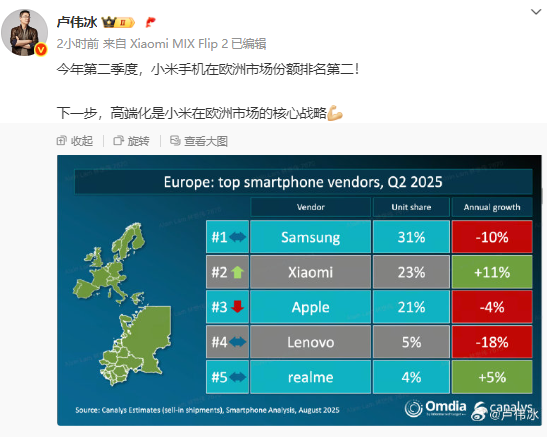
Group 1: Market Position and Performance - Xiaomi ranked second in the European smartphone market with a 23% market share in Q2 2025, following Samsung at 31% and ahead of Apple at 21% [1][2] - Xiaomi's annual growth rate in Europe was 11%, contrasting with Samsung's decline of 10% and Apple's decline of 4% [2] - Globally, Xiaomi maintained a stable shipment volume of 42.4 million units, achieving a 15% market share in Q2 2025, with a year-on-year growth rate of 0% [3] Group 2: Financial Outlook and Adjustments - Xiaomi's total revenue for Q2 2025 is projected at 112.6 billion RMB, slightly below market expectations, while adjusted net profit is expected to be 10.2 billion RMB, in line with market expectations [3][4] - Due to a downward revision in smartphone gross margin forecasts, Daiwa Securities lowered Xiaomi's earnings per share estimates for 2025 to 2027 by 2% to 7% and adjusted the target price from 78 HKD to 72 HKD [4] Group 3: Electric Vehicle Business - Xiaomi's electric vehicle deliveries are expected to reach 82,000 units in Q2 2025, with an average selling price of 242,000 RMB and an improved gross margin of 25% [4] - The company is set to launch its second factory by the end of September, which is anticipated to enhance production capacity [4]

高端化战略成效凸显 珍酒李渡实现高质量增长
Jin Rong Jie· 2025-08-06 07:58
Core Insights - The company, Zhenjiu Lidu Group, reported a significant revenue growth of 28%-32% for the first half of 2025, reaching a range of 5.8-6 billion yuan, with net profit increasing by 35%-40% to exceed 1.5 billion yuan, outperforming the industry average growth of 8.3% [1][2] - The flagship product, the "Zhen Thirty" series, accounted for 45% of revenue, driving the company's growth [1][2] - The company has successfully implemented a "gradient product matrix" covering price ranges from 800 to 3000 yuan, positioning itself well for the upcoming peak consumption seasons [1] Performance Growth Engines - The high-end product mix continues to perform well, with the "Zhen Thirty" series revenue share increasing by 9 percentage points to 45%, and the collectible version priced at 2999 yuan seeing a doubling in sales [2] - The "gradient product" strategy has established a three-tier product structure, effectively covering the thousand-yuan price range, while the release of 100,000 tons of high-quality base liquor has improved product quality and raised the gross margin of high-end products to 82.3% [2] - The "Master Workshop" limited customization service has attracted a high repurchase rate of 67% among high-net-worth clients [2] Digital Channel Efficiency - The inventory turnover days for distributors decreased from 45 to 33 days, with a terminal sales rate of 83%, outperforming the industry average by 10 percentage points [3] - The investment of 280 million yuan in the "Cloud Store 2.0" intelligent system has enabled real-time monitoring of terminal data and dynamic replenishment [3] - The company has increased its group purchase channel share to 38%, with an average order value of 280,000 yuan, supported by marketing initiatives such as sponsoring golf events [3] Lean Management Enhancing Profitability - The "Smart Brewing Project" has reduced steam energy consumption by 15%, saving over 60 million yuan annually [4] - The implementation of a "cooperative + contract farming" model at the Zunyi sorghum planting base has lowered raw material cost share from 21% to 18.5% [4] - Supply chain optimization has led to a 1.8 percentage point decrease in overall expense ratio, pushing the net profit margin to a historical high of 25.2% [4] Strategic Positioning in Industry Changes - Amid a 8% decline in white liquor production over the past three years, the company has achieved counter-cyclical growth through a "dual brand + multiple aroma" strategy, focusing on high-end business markets and cultural liquor segments [5] - An additional investment of 360 million yuan in wine tourism integration will establish a "brewing heritage park + sealed wine cellar" complex, expected to attract 500,000 visitors annually and generate 120 million yuan in derivative sales [5] - The company has received 240 million yuan in matching funds from local government, aligning with Guizhou's "ecologicalization of the liquor industry" policy [5] Market Recognition and Development Outlook - Following the earnings forecast, CITIC Securities raised the target price to 42 HKD, noting that the company's high-end strategy is progressing 12 months ahead of expectations [6] - The current price-to-earnings ratio stands at 28 times, lower than Moutai's 35 times but higher than the industry average of 20 times, indicating market recognition of the company's growth potential [6] - The management has committed to allocating 5% of revenue for aging liquor reserves to support the goal of reaching 10 billion yuan in revenue by 2026 [6]
卢伟冰宣布小米欧洲市场份额第二,将发力高端化
Xin Lang Ke Ji· 2025-08-06 07:52
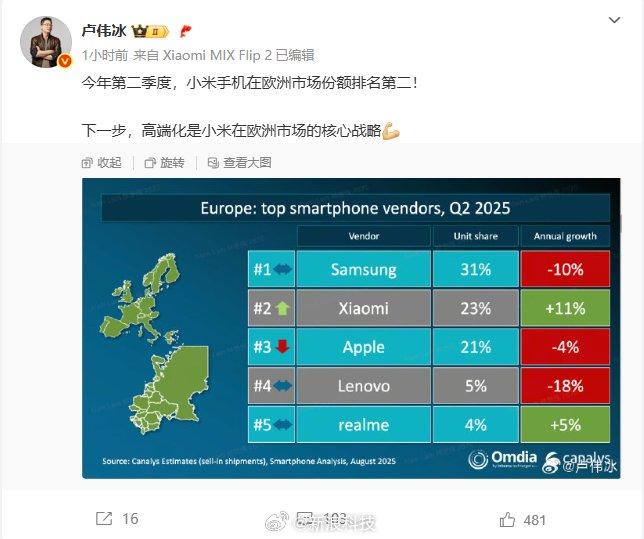
【#卢伟冰回应小米手机欧洲第二#】市场调研机构canalys的最新数据显示,2025年第二季度,小米手机 在欧洲市场份额排名第二。三星排名第一,苹果、联想、真我分列三至五名。小米集团总裁,手机部总 裁,小米品牌总经理@卢伟冰 在微博上转发相关数据并表示:"下一步,高端化是小米在欧洲市场的核 心战略。" ...

小米欧洲市场份额23%排名第二,超越苹果
Bei Ke Cai Jing· 2025-08-06 07:52
从全球市场整体来看,小米也依然稳居行业前三,国产第一。第二季度拿下全球15%的市场份额,距离 苹果的16%只有一步之遥。目前三星、苹果、小米三巨头的格局已经十分稳定,其他厂商都有较大差 距。(财经网科技) 同时,小米也是前三中唯一保持增长的品牌,与苹果、三星两大全球巨头展开激烈竞争。值得一提的 是,榜单上第四第五分别是联想和realme,都是国产品牌。 【#小米手机欧洲市场份额排名第二#】#小米二季度欧洲市场份额超苹果# 8月6日,卢伟冰今天发文 称,小米手机在欧洲市场份额排名第二,下一步,高端化是小米在欧洲市场的核心战略。从他晒出的 Canalys调研数据来看,小米2025年二季度在欧洲市场增长11%,拿下23%的市场份额,超越苹果。 ...

卢伟冰:小米手机在欧洲市场份额排名第二,高端化将是核心战略
Xin Lang Ke Ji· 2025-08-06 06:58
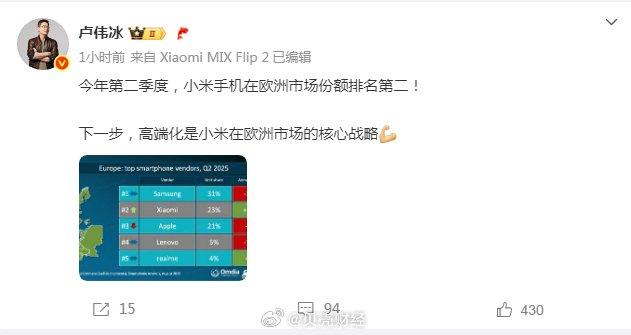
小米集团手机部总裁,小米品牌总经理卢伟冰8月5日发文称,小米手机在欧洲市场份额排名第二,下一 步,高端化是小米在欧洲市场的核心战略。 他晒出的数据显示,小米2025年二季度在欧洲市场增长11%,拿下23%的市场份额。苹果第二季度在欧 洲市场下降4%,市场份额被小米反超,排名第三。 排名第一的是三星,占据31%的市场份额。联想和realme分列四五位,市场份额分别为5%和4%。 责任编辑:王翔 ...
百威亚太(01876.HK)非即饮破局,高端布局成效可期
Xin Lang Cai Jing· 2025-08-05 09:07
Core Viewpoint - Budweiser APAC is shifting its strategic focus towards non-drink channels, demonstrating operational resilience and long-term growth potential despite market challenges in the first half of 2025 [1] Financial Performance - In the first half of 2025, Budweiser APAC reported revenue of $3.136 billion, a decrease of 5.6% year-on-year, but achieved a 0.5% year-on-year increase in revenue per hectoliter due to diversified brand matrix and refined revenue management in the eastern region [1] - As of the end of the first half of 2025, the company had a net cash reserve of $2.4 billion, indicating a robust asset-liability structure [1] Strategic Focus - The company aims to enhance its market share in non-drink channels, leveraging its distribution network to expand the presence of high-end and super high-end products [2] - Budweiser APAC's CEO emphasized the importance of focusing on controllable factors, including continued investment in flagship brands and accelerating the expansion of non-drink channels [1][3] Market Trends - The non-drink channel is steadily increasing its share of overall sales and revenue, contributing to an improvement in EBITDA profit margins [1] - The non-drink channel currently accounts for approximately 60% of the total industry scale in the Chinese market, with significant growth potential as consumer disposable income rises [1] Regional Performance - Budweiser APAC's operations in India are experiencing strong growth, with double-digit increases in sales and revenue for high-end and super high-end product lines [3] - The company's performance in South Korea is outperforming industry averages in both drink and non-drink channels, benefiting from effective revenue management measures [3] Collaboration and Innovation - The company is actively developing new primary and secondary distributors to expand its sales network and is collaborating with distributors to invest in expanding the non-drink sales team [2] - Budweiser APAC is focusing on product innovation and packaging design to enhance consumer drinking experiences [3]

中国市场拖累明显 百威亚太上半年净利润缩水24.4%
Xi Niu Cai Jing· 2025-08-05 08:00
Core Insights - Budweiser APAC reported a disappointing half-year performance with a 5.6% year-on-year revenue decline to $3.136 billion and a significant 24.4% drop in net profit to $409 million [3] - The Chinese market was the primary factor dragging down performance, with sales decreasing by 8.2% and revenue falling by 9.5%, underperforming the industry average [3] - The company attributed the poor performance in China to regional layout and channel structure issues, heavily relying on coastal regions like Guangdong and Fujian, where dining and nightlife consumption slowed in Q2 [3] Company Strategy - Budweiser APAC is accelerating its transition to non-drinking channels, which currently account for only 50% of its Chinese business, below the industry average of 60% [3] - The company is also pushing a premiumization strategy, although short-term challenges in the drinking channel are expected to persist [3] - New CEO Cheng Yanjun emphasized continued investment in flagship brands, cost structure optimization, and expanding the digital platform BEES to enhance business efficiency [4] Market Context - The overall Chinese beer industry is undergoing structural adjustments, with intensified competition in the premium segment and a shift in consumption scenarios from traditional nightlife and dining to home and online [4] - Competitors like Heineken are gaining momentum in the high-end market through partnerships, leaving Budweiser in a relatively passive position [4] - The stock price of Budweiser APAC fell nearly 6% on the day of the earnings report, with a cumulative decline of over 40% for the year [4]
开出人均700的臻选店,海底捞还想向上一跃?
Hua Er Jie Jian Wen· 2025-08-05 06:34
Core Insights - Haidilao is shifting its strategy from a focus on lower-tier markets to targeting high-end dining experiences with the launch of its "Zhenxuan" stores, which feature luxurious ingredients and a significantly higher average spending per customer [1][2][3] - The average spending at Haidilao has dropped to 97.5 yuan in 2024, returning to levels seen eight years ago, prompting the company to explore high-end market opportunities [1][3][4] - The emergence of the "Zhenxuan" stores reflects a broader trend in the high-end dining market, where consumers are increasingly valuing experience and quality over price [4][5] Company Strategy - Haidilao is implementing a franchise model for the first time in its 30-year history to accelerate expansion and address stagnant store growth, while also launching multiple new brands under the "Red Pomegranate Plan" to penetrate various market segments [2][3] - The company aims to balance its offerings by catering to both budget-conscious consumers and those seeking premium dining experiences, thereby enhancing its market coverage [2][3] Market Trends - The high-end hot pot market in China is projected to grow significantly, with the market size expected to reach 741 billion yuan in 2024 and 805 billion yuan in 2025, indicating a shift towards quality dining experiences [3][4] - New consumer behaviors are emerging, with younger generations prioritizing dining experiences that offer emotional value and a sense of occasion, which could benefit Haidilao's high-end offerings [5][6] Challenges - Haidilao faces challenges in changing consumer perceptions, as its established brand identity as a "national hot pot" may hinder acceptance of its new high-end positioning [6][7] - Operational costs associated with high-quality ingredients and service may impact profitability, and the frequency of visits to high-end restaurants is typically lower than that of casual dining, raising concerns about sustaining operations [6][7] - The high-end dining market is geographically limited, primarily concentrated in first-tier and new first-tier cities, which may restrict the scalability of Haidilao's new store format [6][7]

华润啤酒转让资产8年关停36家酒厂 侯孝海卸任“啤+白”双轮驱动模式
Chang Jiang Shang Bao· 2025-08-04 01:52
Core Viewpoint - China Resources Beer is undergoing significant asset disposals, including the transfer of several brewery facilities, which raises concerns about its dual business model of beer and liquor facing challenges in the current market environment [2][4][12]. Group 1: Asset Disposals - China Resources Beer is planning to transfer assets from its Snow Beer factories located in Zhumadian, Shantou, and Dazhou, as part of a broader strategy to optimize its production capacity [4]. - The company has reduced its number of factories from 98 in 2016 to 62 by the end of 2024, indicating a net closure of 36 factories over eight years [2][4]. - The decision to dispose of these factories is attributed to their smaller production capacities and outdated equipment, as the company aims to eliminate inefficient production and adjust its capacity layout [4][11]. Group 2: Financial Performance - In 2024, China Resources Beer experienced a rare decline in both revenue and net profit, with total revenue of 38.635 billion yuan, down 0.76% year-on-year, and net profit of 4.739 billion yuan, down 8.03% [15][16]. - The beer sales volume was approximately 10.8774 million kiloliters, reflecting a year-on-year decrease of about 2.5%, while the liquor business generated revenue of 2.149 billion yuan, growing only 4% [15][16]. Group 3: Leadership and Strategic Challenges - The leadership of Hou Xiaohai, who has been pivotal in the company's growth and strategic direction, will transition as he steps down as chairman in June 2025 [2][16]. - The dual business model of "beer + liquor" initiated by Hou has not yielded significant results in the liquor segment, with the liquor business facing challenges in achieving growth targets [12][14][16]. - The liquor segment's performance has been disappointing, with significant revenue declines in subsidiaries like Jinzhongzi and Jingzhi, raising questions about the sustainability of the dual business strategy [14][15][16].