AI芯片

Search documents
百度李彦宏的第二家上市公司来了!
Xin Lang Cai Jing· 2026-01-04 13:26
Core Viewpoint - Baidu's subsidiary Kunlun Chip has submitted a confidential application for a mainboard listing on the Hong Kong Stock Exchange, which is expected to enhance its market image and allow for independent financing while remaining a part of Baidu's ecosystem [2][28]. Group 1: Listing Announcement and Market Reaction - On January 2, 2026, Baidu announced the submission of Kunlun Chip's listing application, which led to a 9.35% increase in Baidu's stock price, closing at HKD 143.8 per share, with a total market capitalization of HKD 395.5 billion [3][29]. - The announcement followed a series of market rumors about the potential spin-off, which had already caused Baidu's stock to rise by over 5% in early December 2025 [5][31]. Group 2: Company Background and Financials - Kunlun Chip, established in 2021, has evolved from supporting Baidu's internal AI needs to offering a full-stack product line, including chips, servers, and software platforms, with its latest chip, P800, designed for large-scale AI clusters [8][34]. - The company has secured significant contracts, including a major order from China Mobile, and is projected to exceed RMB 10 billion in revenue in 2024, with estimates suggesting revenues could soar to RMB 83 billion by 2026 [11][39]. Group 3: Valuation and Investment Landscape - Despite its strong revenue growth, Kunlun Chip's valuation stands at RMB 21 billion, significantly lower than competitors in the AI chip sector, which often reach valuations in the hundreds of billions [14][40]. - The company has attracted a diverse group of investors, including IDG Capital and BYD, with a total of 44 shareholders, indicating a strategic partnership approach rather than a simple financial investment [17][43]. Group 4: Competitive Landscape and Challenges - The AI chip market is increasingly competitive, with success hinging on building a robust ecosystem rather than just technical specifications. Companies like Nvidia and Huawei have established strong ecosystems that provide them with a competitive edge [19][45]. - Kunlun Chip's focus on cost reduction and replacement rather than market creation may limit its perceived growth potential, affecting its market valuation compared to peers [22][48].


分拆昆仑芯赴港上市,百度美股飙升15%
Huan Qiu Lao Hu Cai Jing· 2026-01-04 12:43
Group 1 - Baidu Group announced that Kunlun Chip submitted a listing application to the Hong Kong Stock Exchange on January 1, with the split expected to maintain Kunlun Chip as a subsidiary of Baidu Group [1] - The split aims to better reflect Kunlun Chip's value, as the company is deemed large enough to seek a listing status [1] - If successful, Kunlun Chip's valuation increase will directly impact Baidu's long-term equity investment value, potentially leading to a revaluation of Baidu's overall market value [1] Group 2 - Following the announcement, Baidu Group's stock price rose over 9% in Hong Kong, with a total market capitalization reaching HKD 395.5 billion, while its US stock also saw a significant increase of 15% [2] - Kunlun Chip, originally part of Baidu's internal smart chip and architecture department, is a supplier of AI computing chips and related integrated hardware and software systems, covering data centers, cloud computing, and autonomous driving [2] - Since starting its independent financing process in 2021, Kunlun Chip has completed seven rounds of financing, with the latest round in July 2025, achieving a post-investment valuation of CNY 21 billion [2] Group 3 - Kunlun Chip has released and mass-produced three generations of products, including K100/K200, R200 series, and P800, with plans to launch new products annually for the next five years [2] - In the 2024 Chinese GPU market, Kunlun Chip ranks third, with Nvidia holding 70% market share and Huawei's Ascend at 23% [2]
2026开局 | 港股GPU第一股上市首日涨超100%
Sou Hu Cai Jing· 2026-01-04 10:27
Core Insights - Wall Street's first GPU stock, Birun Technology, listed on the Hong Kong Stock Exchange on January 2, opening at HKD 35.7 per share, an increase of 82.14% from the issue price of HKD 19.6, and reaching a peak of HKD 42.88, with a market capitalization exceeding HKD 90 billion [2] Company Overview - Birun Technology is a major AI chip manufacturer in China, raising approximately HKD 5.375 billion from the global offering of about 285 million H-shares, with funds allocated for R&D of intelligent computing solutions, commercialization, working capital, and general corporate purposes [4] - Despite continuous revenue growth over the past three years, Birun Technology remains in a loss position, with revenues of CNY 499,000, CNY 62.03 million, and CNY 337 million from 2022 to 2024, and corresponding losses of CNY 1.474 billion, CNY 1.744 billion, and CNY 1.538 billion, totaling CNY 4.75 billion in cumulative losses [4] - In the first half of 2025, the company reported revenue of CNY 58.903 million and a loss of CNY 1.6 billion [4] R&D Expenditure - The company's R&D spending has been significantly high relative to its annual revenue, totaling CNY 2.73 billion from 2022 to 2024, with R&D expenditure accounting for 245.5% of annual revenue in 2024 [4] Market Position - The market share of domestic GPU manufacturers, including Birun Technology, remains low compared to overseas giants, with Nvidia and Huawei HiSilicon commanding 94.4% of the Chinese intelligent computing chip market by revenue in 2024 [5] - Birun Technology holds a market share of 0.16% in the Chinese intelligent computing chip market and 0.2% in the general GPU market for 2024, with expectations to reach 0.19% in the intelligent computing chip market by 2025 [5] - The Chinese intelligent computing chip market is expected to see its share from domestic companies rise from approximately 20% in 2024 to about 60% by 2029, indicating potential growth opportunities for Birun Technology and other players [5]

百度分拆昆仑芯IPO上市:参股昆仑芯的A股上市公司或受益(附表格)
Xin Lang Cai Jing· 2026-01-04 09:54
Core Viewpoint - Baidu's subsidiary Kunlun Chip has submitted an application for an independent IPO on the Hong Kong Stock Exchange, leading to significant stock price increases for Baidu [1][2][17]. Group 1: IPO Announcement and Market Reaction - On January 2, 2026, Baidu announced the plan to spin off Kunlun Chip, resulting in a 9.35% increase in Baidu's Hong Kong stock price and a 15.03% increase in its NASDAQ stock price, both reaching two-year highs [1][2][17]. - The IPO process for Kunlun Chip is seen as a strategic move to enhance its market valuation and attract investors focused on AI computing chips and related systems [4][16]. Group 2: Business and Financial Background - Kunlun Chip, a leading AI computing chip supplier, was established from Baidu's smart chip division, with its self-developed chip projects dating back to 2011 [4][16]. - The company completed its first round of financing in April 2021, achieving a valuation of approximately 13 billion yuan (about 1.9 billion USD) [4][16]. - By 2025, Kunlun Chip had completed multiple financing rounds, attracting investments from major firms like BYD and CITIC Capital [4][16]. Group 3: Product Development and Market Position - Kunlun Chip has secured significant contracts, including a 1 billion yuan deal with China Mobile for AI computing devices, achieving a leading market share in several procurement categories [5][18]. - The company plans to launch new products annually over the next five years, with the Kunlun M100 and M300 chips set for release in 2026 and 2027, respectively [5][18]. - IDC reported that Kunlun Chip's shipment volume reached 69,000 units, significantly surpassing competitors like Cambricon [6][18]. Group 4: Industry Context and Competitive Landscape - The IPO of Kunlun Chip is part of a broader trend of domestic semiconductor companies entering the capital market, with several other firms like Moore Threads and Muxi also recently listed [20][21]. - The Chinese AI chip market is undergoing a significant transformation, moving towards a model of "multiple strong coexistence and scene segmentation," with Kunlun Chip positioned as a foundational player in AI computing [21][22]. Group 5: Valuation and Investment Implications - Goldman Sachs estimates that if Kunlun Chip achieves a valuation similar to Cambricon's (40x sales), Baidu's 59% stake could be valued at 22 billion USD, representing 45% of Baidu's current market capitalization [9][22]. - Companies holding stakes in Kunlun Chip, such as Chuling Information and Zhongxin Group, are expected to benefit from this IPO, with potential upward price elasticity in their stocks [10][23].
每经品牌100指数2025年报收1145点,成分股百度集团2026年“首秀”大涨9%
Sou Hu Cai Jing· 2026-01-04 07:34
Group 1: Market Overview - The A-share market ended 2025 with all major indices in the green, supported by multiple favorable factors such as the "15th Five-Year Plan" industrial guidance and loose overseas liquidity [1][3] - The "Everyday Brand 100 Index" achieved a 15.21% annual increase in 2025, closing at 1145.49 points, marking two consecutive years of gains [2][3] Group 2: Baidu Group Performance - Baidu Group's stock surged by 9.35% on January 2, 2026, with a weekly increase of 20.33%, following the announcement of its subsidiary Kunlun Chip's application for a Hong Kong IPO [4][5] - The Kunlun Chip, focused on AI chip development, is expected to enhance Baidu's asset value significantly if it achieves a high valuation upon listing [5] Group 3: AI Cloud and Smart Driving Growth - Baidu's AI cloud revenue grew by 21% year-on-year in Q3 2025, with AI infrastructure revenue increasing by 33% and AI accelerator infrastructure subscription revenue soaring by 128% [7][8] - The company's "萝卜快跑" (Roborun) service saw a significant increase in order volume, exceeding 310,000 orders in Q3 2025, reflecting a more than 200% year-on-year growth [6][8] Group 4: Economic Environment and Policy Support - The domestic economic environment showed resilience in exports, while the CPI continued to recover, although consumer and investment indicators remained weak [3] - The Central Economic Work Conference emphasized expanding domestic demand and fostering new growth drivers as key tasks for 2026, aiming for a strong start to the "15th Five-Year Plan" [3]

刚刚!一家秘密申请港交所IPO上市!百度AI芯片龙头昆仑芯,A1表格已提交!不声不响递表!
Xin Lang Cai Jing· 2026-01-04 06:37
Core Viewpoint - Kunlun Core, an AI chip company under Baidu, has quietly submitted a listing application to the Hong Kong Stock Exchange on January 1, 2026, in a "confidential manner" to protect its business secrets and choose the best timing for public disclosure [2][12][22]. Group 1: Listing Process - The company has initiated a "secret submission" process, allowing it to submit all application materials to the exchange while keeping the content confidential from the public [3][17]. - This approach helps protect sensitive information such as financial data and client lists, which is crucial in the competitive AI chip industry [19][66]. - The company can control the timing of its public appearance based on market conditions and the progress of the review process [4][20]. Group 2: Reasons for Spin-off - Baidu aims to unlock the value of Kunlun Core by allowing it to operate as an independent entity, making its potential more visible to the market [5][74]. - The spin-off is expected to attract specialized investors focused on semiconductor technology, which may not be interested in Baidu's traditional internet advertising business [6][75]. - Kunlun Core will benefit from having its own financing platform, enhancing its brand recognition and operational focus [7][76]. Group 3: Shareholder Support - Kunlun Core boasts a prestigious shareholder list, including national funds and top venture capital firms, indicating strong backing and confidence in its future [8][34]. - Notable investors include IDG Capital, Junlian Capital, and BYD, which suggest potential collaborations in the automotive AI chip sector [9][10][89]. - Following its latest financing round, Kunlun Core's valuation has reached approximately 21 billion RMB [11][90]. Group 4: Market Reaction - Following the announcement, Baidu's stock price surged over 8%, reflecting positive market sentiment regarding the spin-off [12][28]. - Investment banks estimate that Baidu's 59% stake in Kunlun Core could be valued at tens of billions to over a hundred billion USD, highlighting the market's recognition of Baidu's undervalued hard tech assets [12][28]. Group 5: Current Status and Future Outlook - The application has been submitted, and the review process by the Hong Kong Stock Exchange has begun, marking a significant step in the listing journey [14][80]. - The company has transitioned from a limited liability company to a joint-stock company, a critical legal step for the listing process [43][94]. - Future steps include multiple rounds of inquiries from the exchange, followed by the public release of the prospectus and the eventual listing [25][81].
DeepSeek上新mHC,R2还远吗?
Tai Mei Ti A P P· 2026-01-04 06:05
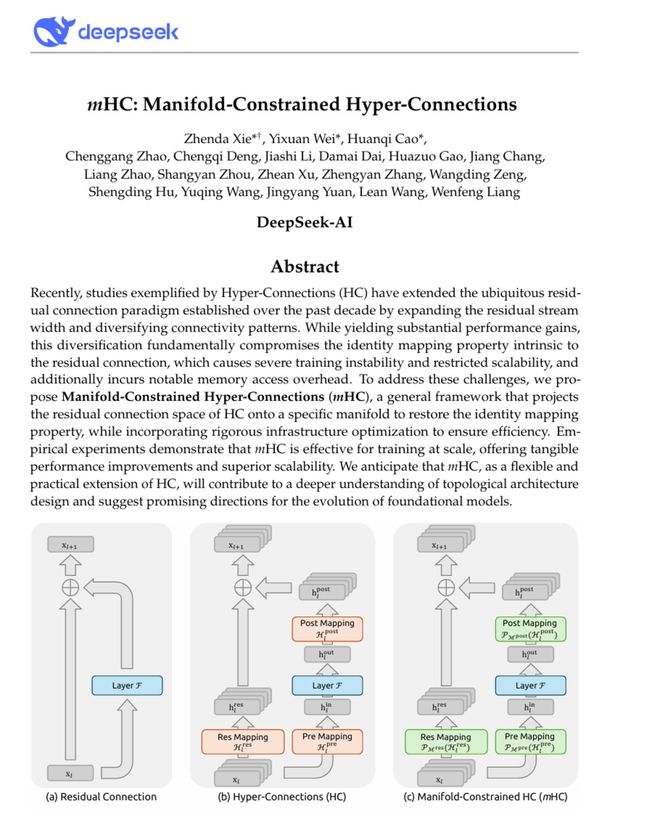
Core Insights - DeepSeek has introduced a new neural network architecture optimization called mHC (Manifold-Constrained Hyper-Connections), which is expected to significantly impact the AI industry, including large models and chips [1][5][9] Group 1: mHC Architecture - The mHC architecture builds on the Hyper-Connections (HC) framework released by the Byte Bean team in November 2024, aiming to replace the nearly decade-old ResNet architecture [5] - mHC introduces a Manifold-Constrained approach using the Sinkhorn-Knopp algorithm to stabilize signal propagation during training, addressing issues of signal explosion and instability in large model training [5][6] - In training demonstrations with 27 billion parameters, mHC maintained a signal amplification of only 1.6 times, while HC experienced a catastrophic failure with a 3000 times amplification [6][8] Group 2: Performance and Efficiency - mHC shows a significant reduction in training loss and improved performance on challenging tasks, with over 2% enhancement in reasoning and reading comprehension benchmarks compared to traditional architectures [6][8] - The additional training time overhead for mHC, even with a fourfold expansion of residual channels, is only 6.7%, indicating a focus on cost-effectiveness and efficiency [8] Group 3: Industry Impact and Reactions - The release of mHC has sparked high discussion levels among researchers and industry professionals, with expectations of a paradigm shift in large model architectures by 2026 [9][10] - Competitors are already responding, with new architectures like Deep Delta Learning emerging shortly after mHC's announcement, indicating a potential chain reaction in AI architecture development [9][10] - Analysts predict that DeepSeek may make significant announcements around the Lunar New Year, potentially unveiling the long-awaited R2 model or a faster universal model V4 [10] Group 4: Compatibility and Market Dynamics - mHC's architecture is primarily designed for NVIDIA's supernode links, raising concerns about compatibility with domestic chips, which may require enhanced adaptation efforts [11] - As U.S. AI chip manufacturers gradually exit the Chinese market due to geopolitical factors, domestic chipmakers are accelerating their development and ecosystem building to adapt to DeepSeek's models [12]

百度拆芯上市引爆港股!科技股狂冲4%,商业航天12%暴涨?
Sou Hu Cai Jing· 2026-01-04 05:50
Core Viewpoint - The recent surge in Hong Kong's stock market, particularly in technology and commercial aerospace sectors, is primarily driven by Baidu's announcement regarding the IPO of its AI chip subsidiary, Kunlun Chip, which has sparked a broader market rally due to favorable policies, industry trends, and capital inflow [1][2][3]. Group 1: Baidu's Announcement and Market Impact - Baidu announced on January 2 that its AI chip subsidiary, Kunlun Chip, submitted a listing application to the Hong Kong Stock Exchange, with a valuation of 21 billion yuan and Baidu holding nearly 60% [2]. - Kunlun Chip is projected to have a shipment volume of 69,000 units in 2024, significantly outperforming competitors, and has secured a major order from China Mobile worth over 1 billion yuan [2]. - Analysts predict Kunlun Chip's revenue could grow from 1.3 billion yuan in 2026 to 8.3 billion yuan, representing a sixfold increase, which has contributed to Baidu's stock price surge [2]. Group 2: Technology Sector Rally - The announcement from Baidu acted as a catalyst, leading to a 4% increase in the Hang Seng Technology Index, reaching a recent high of 5,736.44 points [3]. - Major tech companies such as Alibaba, Tencent, and NetEase also saw significant stock price increases, with Baidu's market capitalization reaching 386.7 billion HKD [3]. - The semiconductor industry's positive outlook, driven by global demand for AI computing power, has further supported the rally, with companies like Huahong Semiconductor and SMIC experiencing notable stock price increases [3]. Group 3: Commercial Aerospace Sector Surge - The commercial aerospace sector experienced a remarkable 12% increase, with trading volume exceeding 1.152 billion HKD, and leading companies like Asia Pacific Satellite seeing stock price increases of over 30% [4]. - Baidu's collaboration with China's aerospace sector, including partnerships in AI for lunar exploration, has positioned it as a significant player in the commercial aerospace industry [4]. - Key factors driving this sector's growth include government policies promoting the aerospace industry and a global revaluation of space companies, such as SpaceX's upcoming IPO [4]. Group 4: Underlying Factors of the Market Surge - The market rally is attributed to multiple factors, including significant capital inflow, with over 16 billion HKD net inflow from southbound funds since December 2025 [5]. - The offshore RMB's appreciation against the USD has increased the attractiveness of RMB-denominated assets, leading to foreign investment in Chinese tech stocks [5]. - Supportive government policies, including subsidies for equipment upgrades and favorable regulations for the AI chip and commercial aerospace sectors, have provided a clear direction for industry growth [5].

李彦宏,分拆210亿芯片独角兽
创业邦· 2026-01-04 03:48
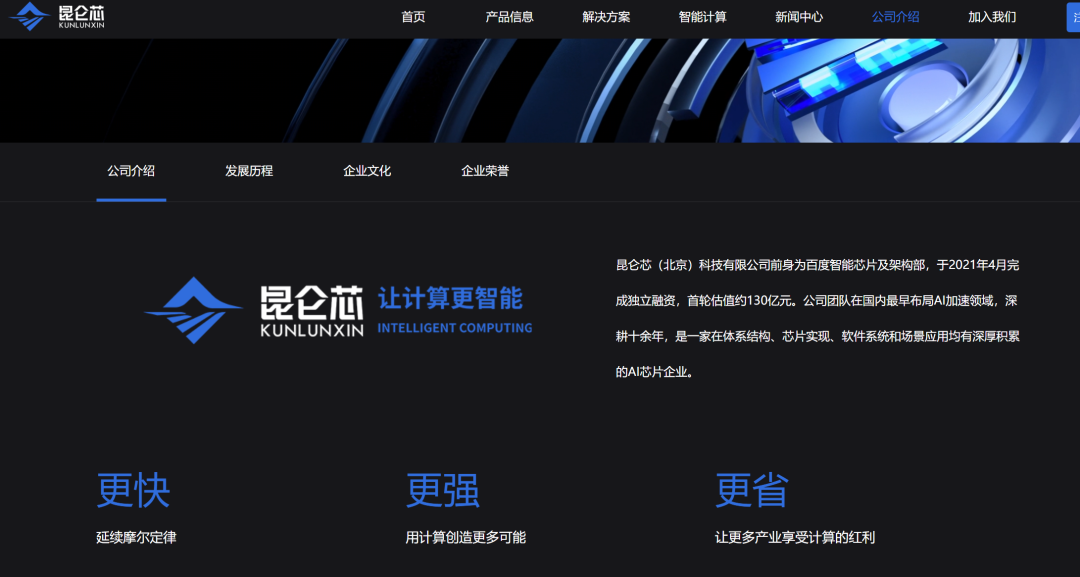
Core Viewpoint - Baidu's Kunlun Chip is set to go public, reflecting its growing importance in the AI chip market and aligning with the company's broader AI strategy [5][6][9]. Group 1: IPO and Market Position - Kunlun Chip has submitted a confidential application for listing on the Hong Kong Stock Exchange, with plans to potentially expedite its IPO timeline to early 2027 [5][6]. - The company has achieved a post-financing valuation of 21 billion yuan (approximately 3 billion USD) as of July 2025 [8]. - Following the IPO announcement, Baidu's stock surged by 15%, pushing its market capitalization above 50 billion USD [22]. Group 2: Strategic Importance of Kunlun Chip - The separation of Kunlun Chip is expected to enhance its image among clients and partners, facilitate direct access to capital markets, and improve management focus [19]. - The chip is positioned as a key player in the domestic AI landscape, especially as the demand for local chip solutions increases due to external supply chain disruptions [17][15]. - Kunlun Chip is projected to generate over 1 billion yuan (approximately 150 million USD) in revenue in 2024, with expectations to reach 5 billion yuan (approximately 750 million USD) in 2025 [18]. Group 3: Technological Advancements - Kunlun Chip has developed the P800 series, designed specifically for large model training, and is capable of supporting extensive AI workloads [40][38]. - The company aims to expand its cluster scale to one million cards by 2030, indicating a strong commitment to enhancing its technological capabilities [32]. - The P800 chip has been successfully utilized in various applications, including a significant project with China Mobile, showcasing its competitive edge in the market [41]. Group 4: Leadership and Management - The leadership of Kunlun Chip has been entrusted to Ouyang Jian, who has been pivotal in driving the company's growth and commercialization efforts since its independence [36][34]. - The company has undergone rapid iterations and product launches, with a focus on meeting market demands and enhancing its technological offerings [37].
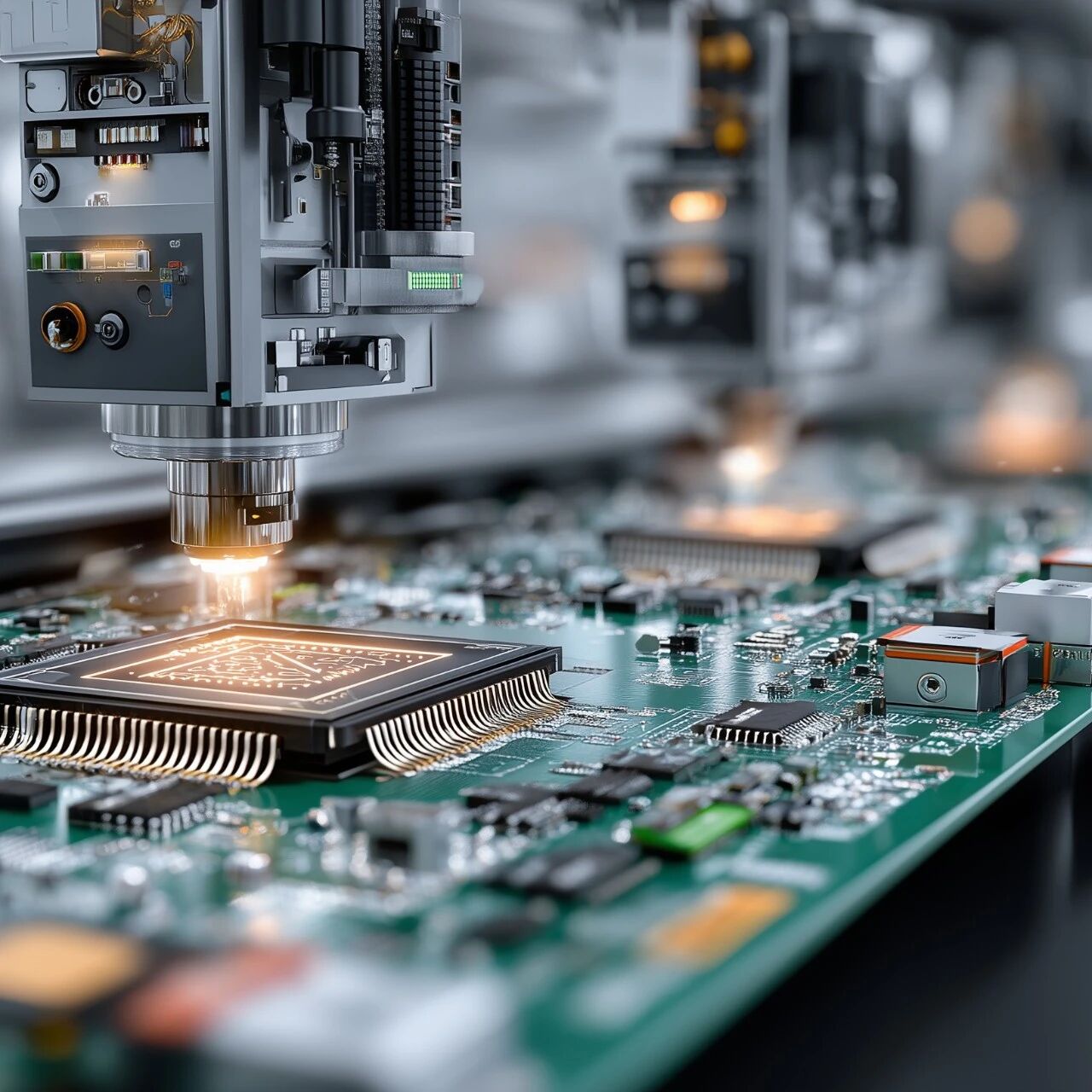
百度昆仑芯秘密赴港IPO,四年时间估值上涨61.5%
Sou Hu Cai Jing· 2026-01-04 03:28
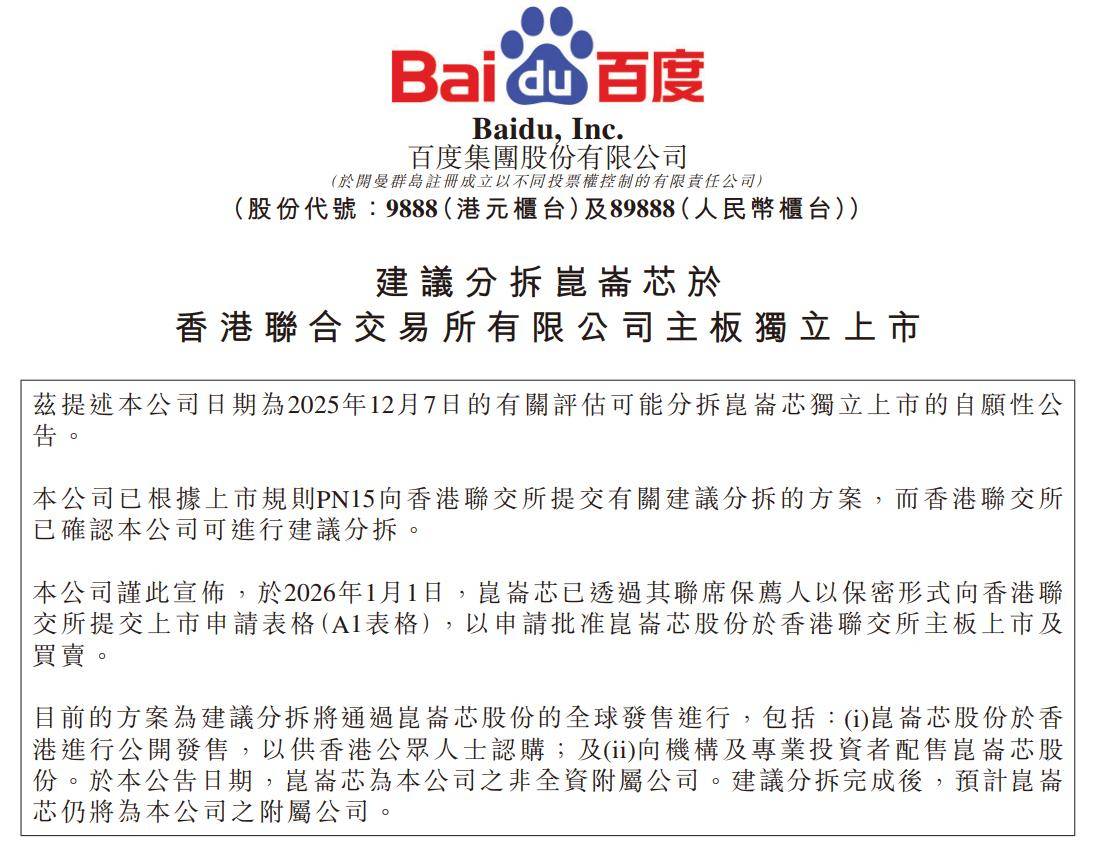
Core Viewpoint - Baidu Group announced the submission of a listing application for Kunlun Core to the Hong Kong Stock Exchange, aiming for a spin-off that will enhance operational and financial transparency, allowing investors to better assess Kunlun Core's performance and potential [2]. Group 1: Spin-off Details - Kunlun Core, a non-wholly owned subsidiary of Baidu, plans to conduct a global offering that includes a public offering in Hong Kong and a placement to institutional and professional investors [2]. - The spin-off is expected to maintain Kunlun Core as a subsidiary of Baidu post-listing, benefiting both companies [2]. Group 2: Business and Financial Implications - The spin-off will allow for a clearer reflection of Kunlun Core's value based on its strengths, attracting investors focused on AI computing chips and related hardware and software systems [2]. - Kunlun Core's business model is distinct from Baidu's more diversified operations, which is anticipated to enhance its market image and negotiation power with clients and suppliers [2]. - The company aims to independently access equity and debt capital markets in the future, improving financial resource allocation for Baidu [2]. Group 3: Financial Performance and Projections - Kunlun Core's valuation increased by 61.5% over four years, reaching approximately 29.7 billion USD after a recent funding round [3][4]. - The company reported revenues of 2 billion RMB with a net loss of 200 million RMB for 2024, with expectations to break even in 2025 with revenues exceeding 3.5 billion RMB [4]. - Morgan Stanley forecasts that Kunlun Core's revenue will surge to 8.3 billion RMB in 2026, representing a sixfold increase [4].