
红利策略

Search documents
螺丝钉指数地图来啦:指数到底如何分类|2025年9月
银行螺丝钉· 2025-09-16 04:01
Core Viewpoint - The article introduces a comprehensive index map that includes various commonly used stock indices, their codes, selection rules, industry distribution, average and median market capitalization of constituent stocks, and the number of constituent stocks, which will be regularly updated for easy reference [1][2]. Group 1: Types of Indices - The index map includes several categories of stock indices: broad-based indices, strategy indices, industry indices, thematic indices, and overseas indices [4][8]. Group 2: Broad-based Indices - Examples of broad-based indices include: - CSI 300 (000300.SH) with an average market cap of 206.67 billion and 300 constituent stocks [5]. - CSI 500 (000905.SH) with an average market cap of 32.77 billion and 500 constituent stocks [5]. - CSI 800 (000906.SH) with an average market cap of 97.98 billion and 800 constituent stocks [5]. - CSI 1000 (000852.SH) with an average market cap of 14.42 billion and 1000 constituent stocks [5]. - CSI 2000 (932000.CSI) with an average market cap of 5.93 billion and 2000 constituent stocks [5]. Group 3: Strategy Indices - Strategy indices include: - CSI Dividend (000922.CSI) reflecting high dividend yield companies with an average market cap of 193.25 billion and 100 constituent stocks [6]. - Shanghai Dividend (000015.SH) with an average market cap of 275.17 billion and 50 constituent stocks [6]. - Shenzhen Dividend (399324.SZ) with an average market cap of 105.30 billion and 40 constituent stocks [6]. Group 4: Industry Indices - Industry indices are designed to reflect specific sectors, such as: - CSI Consumer (000932.SH) focusing on major consumer industry stocks with an average market cap of 125.14 billion and 40 constituent stocks [7]. - CSI Medical (000933.SH) which includes companies related to the pharmaceutical industry [7]. Group 5: Thematic Indices - Thematic indices are tailored to specific investment themes, such as: - CSI Innovation (399989.SZ) which selects companies involved in innovative drug development [7]. - CSI Green Energy focusing on companies in the renewable energy sector [7].


逾600家公司披露未来三年分红规划
Zheng Quan Shi Bao· 2025-09-15 18:34
Group 1 - The technology sector, represented by TMT indices, has seen significant growth, with indices in communication, electronics, and media rising over 30% as of September 15 [1] - In contrast, the dividend sector has underperformed, with the CSI Dividend Index declining over 1% this year [1] - Long-term effectiveness of dividend strategies remains intact, with low valuation and high dividend yields attracting long-term capital [1] Group 2 - Companies with high dividend potential are gaining attention, with over 600 companies disclosing shareholder return plans for 2025-2027 [2] - Jianghe Group plans to distribute at least 80% of its net profit or a minimum of 0.45 yuan per share in cash dividends during 2025-2027 [2] - Huaihe Energy aims to distribute no less than 75% of its net profit or a minimum of 0.19 yuan per share in cash dividends during the same period [2] Group 3 - China Shenhua and Mindray Medical are tied for third place, each planning to distribute at least 65% of their net profit in cash dividends from 2025 to 2027 [3] - Other companies like Guodian Power, Zhongfu Industrial, and Wantong Expressway also have dividend rates of at least 60% [3] - Historical data shows that these companies have strong dividend records, with cumulative dividends exceeding 100% of net profits in the last three years for some [3] Group 4 - Institutions predict earnings per share for high dividend companies, with Sichuan Road and Bridge expected to have a dividend yield exceeding 6% based on a 60% payout ratio [4] - Zhongfu Industrial is also projected to have a dividend yield over 5% based on similar calculations [4] - A total of 25 stocks are forecasted to have dividend yields exceeding 2%, with an average annual increase of nearly 11%, outperforming the CSI Dividend Index [4]





我在红利躲牛市?怎么破?
雪球· 2025-09-15 13:01
Core Viewpoint - The article discusses the contrasting performance of dividend stocks and technology sectors in the current market, highlighting the significant gains in technology indices while dividend indices lag behind, raising questions about the role of dividend strategies in investment portfolios [5][12]. Group 1: Performance Comparison - Since the beginning of the year, technology indices such as the Sci-Tech Innovation Index and the ChiNext Index have seen increases of 43.66% and 42.73%, respectively, while the dividend index has only risen by 3.50% [5]. - The article presents a performance comparison of dividend indices against major indices from February 18, 2021, to September 14, 2024, showing that dividend indices outperformed most major indices during downtrends but struggled during market recoveries [11][12]. - The dividend low volatility index achieved a return of 81.39% since 2021, outperforming many other indices during the downtrend period [11]. Group 2: Long-term Value of Dividend Strategies - The article emphasizes that dividend indices have a long-term effective strategy, having been adjusted to a "dividend yield weighted" rule since 2013, which favors stable, cash-rich companies [14]. - Since 2005, the annualized return of the CSCI Dividend Total Return Index has been approximately 12.7%, significantly outperforming the CSI 300's 9.1% [15]. - Dividend indices serve a defensive role in investment portfolios, providing stability and cash flow during market downturns, which is essential for maintaining investor confidence [16][18]. Group 3: Strategic Positioning of Dividend Stocks - Investors are advised to recognize the defensive and cash flow characteristics of dividend indices rather than expecting them to perform like growth stocks during bull markets [21]. - A balanced portfolio strategy combining dividend indices with growth indices can achieve a better risk-return profile, as dividend stocks provide stability while growth stocks offer potential for higher returns [22]. - Maintaining a long-term perspective and emotional discipline is crucial for investors, as short-term underperformance of dividend stocks should not lead to panic or strategy changes [23].

601886,承诺分红王!三年分红率不低于80%,预测股息率超6%
Zheng Quan Shi Bao Wang· 2025-09-15 10:37
Core Viewpoint - The article discusses the potential of companies with high dividend yields and the effectiveness of dividend strategies in attracting long-term investments, despite the recent underperformance of dividend stocks compared to growth stocks in the TMT sector [1][2]. Group 1: High Dividend Companies - Over 600 companies have disclosed their shareholder return plans for 2025-2027, with Jianghe Group leading with a proposed cash distribution of at least 80% of its net profit or a minimum of 0.45 CNY per share [2]. - Huaihe Energy ranks second, planning to distribute at least 75% of its net profit and a minimum of 0.19 CNY per share [2]. - China Shenhua and Mindray Medical are tied for third, each proposing a minimum cash distribution of 65% of their net profits during the same period [2]. Group 2: Historical Performance and Dividend Records - Companies like China Shenhua, Wuhu Highway, and Mindray Medical have shown strong historical dividend records, with cumulative dividends exceeding 100% of net profits over the past three years [4]. - Jianghe Group's minimum dividend of 0.45 CNY per share results in a dividend yield exceeding 6%, while Huaihe Energy and Guodian Power have yields of 5.49% and over 4%, respectively [4]. Group 3: Future Dividend Predictions - Predictions for future dividends based on consensus earnings estimates indicate that Sichuan Road and Bridge could yield a dividend rate of 6.36% based on a projected earnings per share of 0.92 CNY and a 60% payout ratio [5]. - Other companies like Zhongfu Industrial and Wuhu Highway are also expected to have dividend yields exceeding 5% and 4%, respectively [5]. - A total of 25 stocks are predicted to have dividend yields over 2%, with an average price increase of nearly 11% this year, significantly outperforming the CSI Dividend Index [5].
宁银理财姚爽:含权理财的绝对回报之道
Jing Ji Guan Cha Wang· 2025-09-15 07:15
Core Insights - The article highlights the increasing popularity of wealth management products with equity investments, particularly those with a 20%-45% allocation to equity assets, as the stock market reaches new highs [1][2] - The investment philosophy of the equity investment manager at Ningyin Wealth Management emphasizes three principles: focusing on win rates, balanced diversification, and left-side trading [1][2][3] - The performance of various wealth management products managed by the company has been strong, with notable annualized returns, such as 8.5% for a mixed fund since its inception and 10.6% for a Hong Kong stock strategy product [1][2] Investment Strategy - The investment range for wealth management products is broader than that of public funds, allowing for more diverse asset allocation and risk management strategies [2] - The absolute return assessment model used by wealth management firms helps managers focus on the quality of listed companies and balanced asset allocation rather than short-term market trends [2][3] - The "left-side trading" principle is crucial in investment decisions, where the manager evaluates the growth prospects of equity assets before making buy or sell decisions [3] Market Trends - The article notes a shift in the dividend strategy landscape, with a focus on three categories: stable dividend stocks, cyclical dividend stocks, and individual stock exploration [4][5] - The stable dividend stocks provide consistent returns but may see a decline in yield as prices rise, while cyclical stocks are expected to benefit from economic recovery and increased cash flow [4] - The new policy allowing wealth management products to participate directly in IPOs and private placements is seen as a significant advantage, enhancing potential returns [6] Performance Metrics - The performance of the wealth management products has been commendable, with specific products achieving annualized returns of 6.8% since their inception [5] - The focus on maintaining a favorable ratio of annualized absolute return to maximum drawdown is emphasized as a key metric for attracting investors [3][5] - The company is committed to continuously optimizing asset allocation strategies based on market conditions to ensure sustained, robust returns for investors [3][6]
月月分红机制启动!中证红利质量ETF(159209)、港股红利低波ETF(520550)今日分红除息
Sou Hu Cai Jing· 2025-09-15 02:45
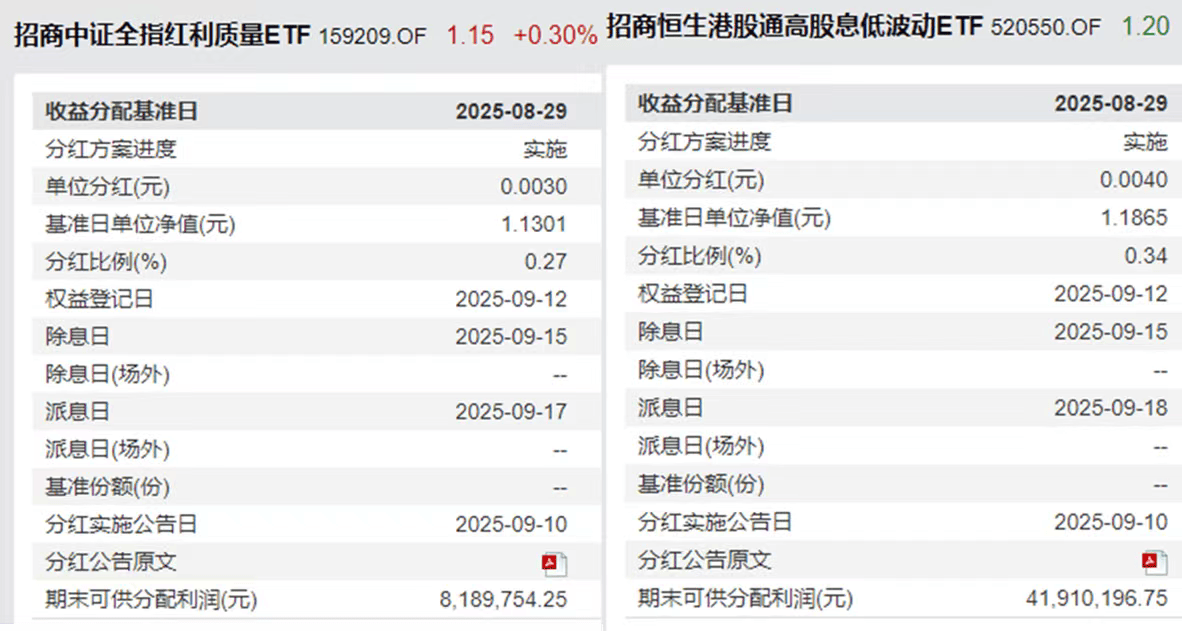
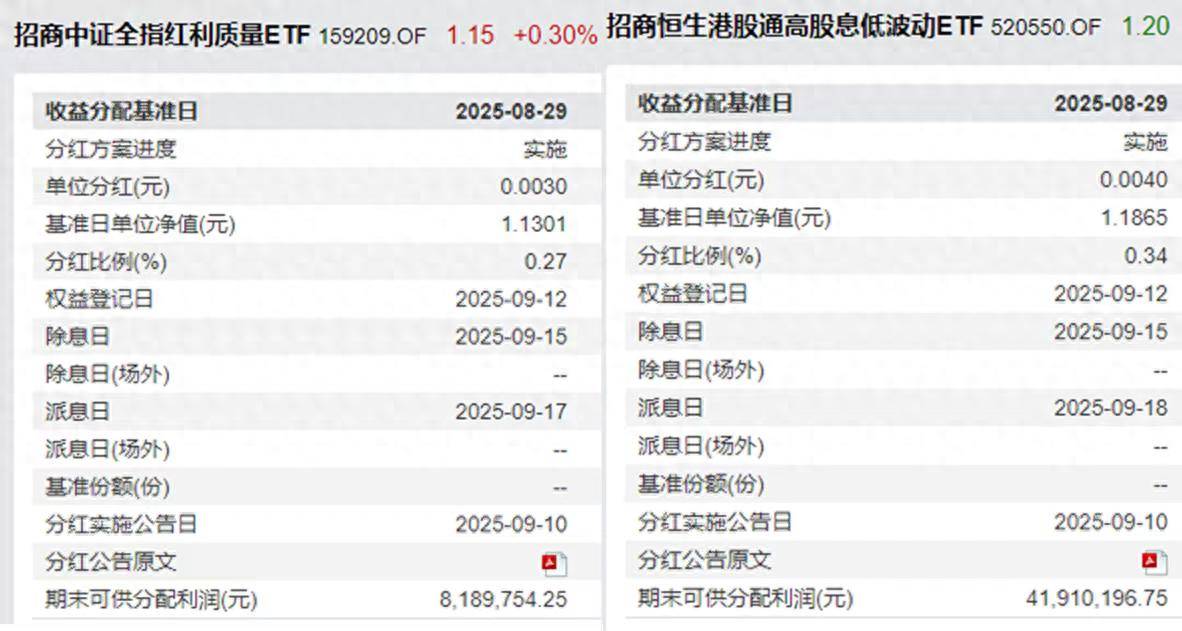
Core Viewpoint - The news highlights the dividend distribution plans for two ETFs, indicating their respective strategies and market positioning, which cater to different investor preferences. Group 1: Dividend Distribution Details - The China Securities Dividend Quality ETF (159209) will distribute a cash dividend of 0.0030 yuan per fund share, marking its third dividend distribution of the year [1] - The Hong Kong Stock Dividend Low Volatility ETF (520550) will distribute a cash dividend of 0.0040 yuan per fund share, representing its fifth dividend distribution of the year, with both ETFs achieving a dividend ratio of 0.3% [1] - The profit available for distribution at the end of the period for the China Securities Dividend Quality ETF is 8,189,754.25 yuan [1] Group 2: Product Strategy and Market Positioning - The 159209 ETF employs a "high dividend + high profitability quality" strategy, focusing on quality companies in growth sectors such as consumer and pharmaceuticals, balancing defensive and growth potential [2] - The 520550 ETF tracks the Hong Kong high dividend low volatility index, concentrating on defensive sectors like finance and public utilities, with the current index dividend yield exceeding 6%, highlighting its deep value and anti-volatility attributes [2] - Market perspectives suggest that these two products represent the two main directions of dividend strategies, providing differentiated tools for investors [2] - The associated linked funds (Class A 024029/Class C 024030) are now open for subscription and redemption, facilitating off-market allocation [2] - Investors are advised to choose based on their risk preferences: aggressive investors may focus on the China Securities Dividend Quality ETF, while conservative investors may prefer the Hong Kong Stock Dividend Low Volatility ETF; a "barbell strategy" can also be employed for dynamic balancing of value and growth exposure [2]
今日分红除息!月月评估分红的中证红利质量ETF(159209)、港股红利低波ETF(520550)同步分红进行时
Sou Hu Cai Jing· 2025-09-15 02:16
Group 1 - The core viewpoint of the news highlights the implementation of a dividend distribution plan, with a unit dividend of 0.0030 yuan and a dividend ratio of 0.27% based on a net asset value of 1.1301 yuan as of the distribution benchmark date of August 29, 2025 [1] - The announcement of the dividend implementation is set for September 10, 2025, with the record date for rights being September 12, 2025, and the payment date on September 17, 2025 [1] - The total distributable profit at the end of the period is reported to be 8,189,754.25 yuan [1] Group 2 - Market analysis indicates that the current dividend distribution coincides with the growing recognition of the investment value of dividend assets [2] - The two products represent mainstream dividend strategy directions: the CSI Dividend Quality ETF focuses on "high dividend + high profitability quality," particularly in consumer and pharmaceutical sectors, with a historical dividend yield of 3%-5% and robust ROE levels [2] - The Hong Kong Dividend Low Volatility ETF follows a "deep value" strategy, tracking the Hang Seng High Dividend Low Volatility Index, with a current dividend yield exceeding 6%, benefiting from undervaluation in the Hong Kong market and supportive state-owned enterprise dividend policies [2] - Investors are advised to dynamically capture investment opportunities in dividend assets based on their risk preferences, with aggressive investors focusing on the CSI Dividend Quality ETF and conservative investors leaning towards the Hong Kong Dividend Low Volatility ETF [2] - A "barbell strategy" is suggested for portfolio construction, allowing for a balanced allocation between the two product types with periodic rebalancing to achieve a more stable risk-return profile [2]
银行业周报(20250901-20250907):1H25商业银行资产质量表现如何?-20250907
Huachuang Securities· 2025-09-07 12:45
Investment Rating - The report maintains a "Recommended" investment rating for the banking sector, expecting the sector index to outperform the benchmark index by over 5% in the next 3-6 months [4][24]. Core Insights - The overall asset quality of commercial banks has improved in the first half of 2025, with a slight decrease in the non-performing loan (NPL) ratio to 1.49% [7][8]. - Retail loan asset quality remains under pressure, particularly in specific areas such as credit cards and personal business loans, due to ongoing economic recovery challenges [8]. - The report emphasizes the importance of long-term capital inflows and public fund reforms, suggesting that banks with high dividend yields and solid asset quality present good investment opportunities [8][9]. Summary by Sections Corporate Sector - The corporate lending sector shows improved asset quality, driven by government policies aimed at stabilizing growth, with a focus on high-tech manufacturing and key policy-supported areas [3]. - The NPL ratio in the corporate real estate sector has increased by 10 basis points to 3.59%, but the peak risk exposure phase is considered to have passed [3][8]. Retail Sector - Retail loan quality is closely linked to employment, income expectations, and consumer confidence, with the NPL ratio for mortgages, credit cards, and consumer loans showing increases of 10bp, 9bp, and 6bp respectively [8]. - The report highlights that the recovery of household balance sheets may take longer, impacting the retail loan sector's performance [8]. Investment Recommendations - The report suggests a diversified investment strategy focusing on state-owned banks and robust regional banks with high provisioning coverage, such as China Merchants Bank and CITIC Bank [8][9]. - It also recommends attention to undervalued joint-stock banks with potential for return on equity (ROE) improvement, specifically mentioning浦发银行 (Shanghai Pudong Development Bank) [8]. Performance Metrics - The banking sector's absolute performance over the past month is reported at 5.0%, with a 17.3% increase over six months and 17.7% over twelve months [5]. - The report provides earnings per share (EPS) and price-to-earnings (PE) ratios for key banks, indicating a positive outlook for banks like 宁波银行 (Ningbo Bank) and 招商银行 (China Merchants Bank) [10].



现金流ETF(159399)吸金超亿元,市场震荡背景下的压舱石之选
Mei Ri Jing Ji Xin Wen· 2025-09-05 05:59
Group 1 - The market is experiencing significant volatility, with cash flow ETF (159399) attracting over 100 million yuan in inflows during a market pullback, highlighting the value of dividend strategies as a defensive allocation [1] - Historical data indicates that dividend strategies have strong anti-drawdown properties, with the FTSE cash flow index outperforming the market during significant downturns [2] - The cash flow ETF (159399) utilizes free cash flow as a stock selection factor, closely tracking the FTSE China A-share free cash flow focus index, excluding financial and real estate sectors, and selecting the top 50 stocks with the highest free cash flow rates [2] Group 2 - The cash flow index focuses on large and mid-cap stocks, exhibiting strong defensive attributes and potentially higher dividend yields to withstand market fluctuations [3] - The cash flow ETF (159399) has consistently paid dividends for six consecutive months since its launch, with the latest evaluation as of the end of August [4]
平安中证A500红利低波动ETF正式上市 波动市场中的资产配置新选择
Quan Jing Wang· 2025-09-05 02:40
Core Viewpoint - The A-share market is experiencing significant growth, with indices reaching new highs, while investors are increasingly seeking stable investment options amidst heightened market volatility [1]. Group 1: Product Overview - The Ping An Asset Management's Ping An CSI A500 Dividend Low Volatility ETF (code: 561680) was officially launched on September 5, providing a strategy tool that balances high dividends and risk control [1]. - The fund tracks the CSI A500 Dividend Low Volatility Index, which selects 50 stocks with high dividend yields and low volatility from leading companies across various sectors, making it a quality choice for asset allocation in the current market environment [1][3]. - The fund's establishment scale reached 803 million yuan, indicating strong investor recognition [1]. Group 2: Index Performance - Since 2015, the annualized return of the A500 Dividend Low Volatility Index has reached 10.81%, outperforming traditional dividend indices by at least 1% in long-term annualized returns [2]. - The index has demonstrated lower volatility and smaller maximum drawdowns, winning against three mainstream dividend indices in five out of the last ten years, showcasing its defensive attributes during economic downturns [2]. Group 3: Advantages of the Index - The A500 Dividend Low Volatility Index has several advantages over traditional dividend indices, including a stronger risk resistance due to the selection of leading stocks with robust profitability [3]. - The index maintains a balanced industry allocation, covering 21 primary industries, thus avoiding excessive concentration in traditional sectors like banking and transportation [3]. - It aligns well with the current economic transformation trends by overweighting core assets in new productive forces, supporting sustainable performance and dividend distribution [3]. Group 4: Investor Suitability - The index is suitable for conservative investors affected by bank wealth management products, who favor high dividend yields while avoiding high volatility in A-shares [6]. - It appeals to investors seeking stable returns to hedge against inflation, particularly those unfamiliar with equity index investments [7]. - Investors who have experienced account drawdowns in volatile markets but wish to continue investing in core A-share assets may consider transitioning from single broad-based index investments to broad strategy index investments [7]. - Institutional funds, such as insurance and annuity accounts, can also utilize the A500 Dividend Low Volatility Index to optimize asset allocation and enhance portfolio performance during market fluctuations [7]. Group 5: Market Implications - The launch of the Ping An CSI A500 Dividend Low Volatility ETF signifies a shift towards "refined selection" in domestic dividend strategy ETFs, providing investors with a pathway that balances high dividends and risk control [8].