
3D打印

Search documents
巨头联手进入,这一产业新生态有望开启丨每日研选
Shang Hai Zheng Quan Bao· 2025-12-10 00:46
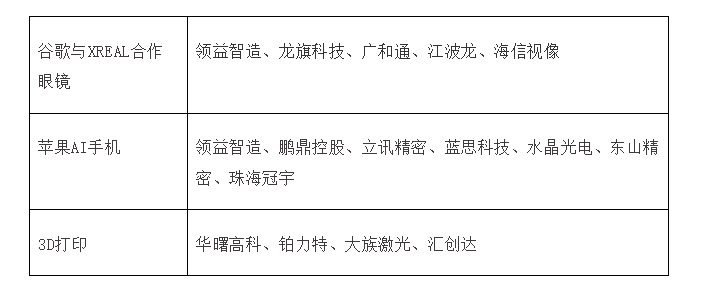
在技术创新与需求修复的共振下,消费电子板块正显现新的活跃信号。近日,谷歌与国内企业共同推出 全球首款Android XR平台的AI智能眼镜,或再次催化该板块。国内哪些产业链企业有望从中受益?请 看机构最新研判。 全年来看,消费电子板块在1-2月上涨,4月受美国加征关税影响有较大幅度回调,6-7月逐步进入上涨 趋势,8-9月加速上涨,10月以来高位震荡。估值方面,目前消费电子板块PE-TTM约38倍,相对电子行 业其他板块仍处于偏低状态,为后续行情演绎留出空间。 从基本面看,2025年以来消费电子复苏趋势持续巩固,技术创新成为板块景气度抬升的重要驱动力。一 方面,折叠屏手机新品密集发布,带动相关零部件需求回暖;另一方面,人工智能技术快速迭代,AI 基础设施需求维持高景气,同时,AI在终端侧的加速落地推动端侧硬件升级,端侧SoC、散热材料等零 部件赛道景气度高企。 与此同时,近期百度、阿里夸克相继发布眼镜产品后,理想汽车也正式发布其第一代AI眼镜理想 Livis。机构认为,此前的AI眼镜多为支付、导航、影音等手机生态的延伸,而此次Livis的发布为AI眼 镜的发展开辟了和手机厂商、互联网公司等不同的新路径,车机联 ...

家联科技跌1.95%,成交额3722.72万元,今日主力净流入-150.96万
Xin Lang Cai Jing· 2025-12-09 09:32
可降解塑料+3D打印+跨境电商+人民币贬值受益+一带一路 1、宁波家联科技股份有限公司的主营业务是塑料制品、生物全降解制品及植物纤维制品的研发、生产 与销售。公司的主要产品是塑料制品、生物全降解制品、植物纤维制品、纸制品及其他。 塑料制品、 生物全降解制品及植物纤维制品的研发、生产与销售。 2、2025年6月17日互动易,公司专注于PLA材料的研发与应用,并在消费级FDM材料及制品领域提前 布局并产业化。目前,公司暂未与泡泡玛特开展合作。公司生产的3D打印耗材具备广泛的应用前景, 可覆盖工业设计、教育、玩具手办、医疗等多个领域,其技术特性能够为潮流玩具制作等场景提供材料 支持。 3、根据2022年12月9日互动易,公司为全球塑料餐饮具制造行业的领先企业,公司产品销售以外销为 主,外销区域主要分布在北美洲、欧洲及大洋洲等发达国家和地区,公司目前的主要海外客户为海内外 知名大型商超以及连锁餐饮企业,2021年公司外销占比达70.47%。同时公司也开拓了跨境电商平台的 线上市场对产品进行境外推广和销售。 来源:新浪证券-红岸工作室 12月9日,家联科技跌1.95%,成交额3722.72万元,换手率1.30%,总市值 ...
南风股份(300004.SZ):子公司3D打印服务业务正与航空航天等领域相关客户进行送样、业务洽谈中
Ge Long Hui· 2025-12-09 06:52
格隆汇12月9日丨南风股份(300004.SZ)在互动平台表示,子公司3D打印服务业务正与航空航天等领域相 关客户进行送样、业务洽谈中。 ...

消费级3D打印厂商Snapmaker快造科技完成C+轮融资
机器人圈· 2025-12-08 10:13
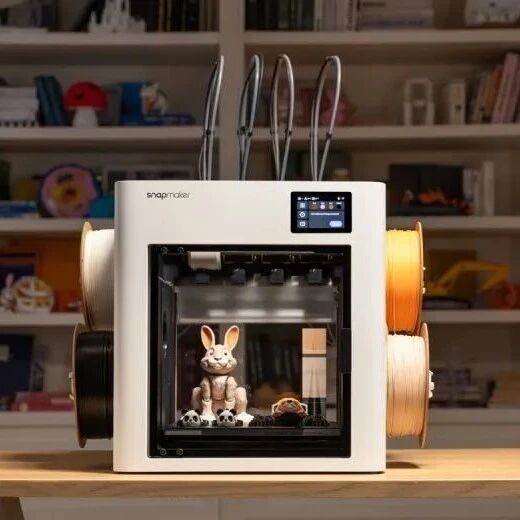
文章来 源:南极熊3D打印 近日, 消费级3D打印厂商 深圳快造科技有限公司 (以下简称:Snapmaker快造科技) 完成C+轮融资,融资 金额未透露,投资方为南山战新投、顺为资本、同创伟业,本轮融资将用于加强产品研发、拓展全球市场 及完善服务体系。Snapmaker快造科技是一家集研发、生产和销售桌面级多功能3D打印机的科技公司,致 力于降低快速原型工艺的使用门槛,为用户带 来极致的使用体验。 在短短一年时间之内,Snapmaker已经完成了四次融资,虽然都属于B轮,但也足见资本的追捧热度 之高。之所以Snapmaker如此受到资本的厚爱,与今年他们发布的一款新产品U1有很大的关系,这款 四打印头的多色智能桌面3D打印机目前处于一机难求的状态。 快造科技(Snapmaker)在众筹平台Kickstarter上创下新纪录。其新款U1 3D打印机的众筹项目已从 全球20,643名支持者处募集到20,577,877美元(约合1.47亿人民币),成为该平台历史上募资金额 最高的3D打印机项目。 Snapmaker U1最主要的就是解决了多色打印过程中的材料浪费问题,以前单打印头的多色3D打印 机,在切换不同颜色耗 ...
万得凯涨1.01%,成交额1430.94万元,近5日主力净流入-201.04万
Xin Lang Cai Jing· 2025-12-08 07:59
来源:新浪证券-红岸工作室 12月8日,万得凯涨1.01%,成交额1430.94万元,换手率1.94%,总市值29.09亿元。 (免责声明:分析内容来源于互联网,不构成投资建议,请投资者根据不同行情独立判断) 资金分析 异动分析 共同富裕示范区+人民币贬值受益+专精特新+智能家居+3D打印 1、公司位于浙江省台州市玉环市龙溪镇东港村渔业,从事水暖器材的设计、开发、生产、销售。 2、根据2024年年报,公司海外营收占比为82.39%,受益于人民币贬值。 3、专精特新"小巨人"企业是全国中小企业评定工作中最高等级、最具权威的荣誉称号,是指专注于细 分市场、创新能力强、市场占有率高、掌握关键核心技术、质量效益优的排头兵企业,对于提升中小企 业自身的竞争力,以及提升产业链、供应链稳定性和竞争力具有重大意义。公司已入选工信部国家级专 精特新小巨人企业名单。 4、浙江万得凯流体设备科技股份有限公司主营业务为水暖器材、阀门、管件、建筑金属配件、智能家 居及环保节能控制系统等相关产品的研发、制造、销售与服务。 5、2024年7月3日互动易:公司3D打印业务主要是为航天航空客户提供非金属打印产品,目前尚处于研 发送样阶段,还未 ...
南风股份(300004) - 300004南风股份投资者关系管理信息20251205
2025-12-08 07:20
Group 1: Company Performance and Challenges - The company's Q3 performance experienced a year-on-year decline due to project delays affecting revenue recognition, with varying product supply structures impacting gross margins [2][3] - The company aims to enhance its core competitiveness by actively participating in bidding for ventilation equipment projects and increasing R&D efforts [2][3] Group 2: Future Business Development - The strategic plan focuses on the ventilation and air treatment industry, accelerating new product development and expanding production capacity while maintaining a leading position in niche markets [3] - The company has established an overseas marketing department to expand into Southeast Asia and other international markets, following a dual strategy of "sailing out" and "self-sailing" [3] Group 3: Product Applications and Innovations - Ventilation equipment is crucial for safety and comfort, with potential applications in controlled nuclear fusion projects, depending on specific project requirements [4] - The 3D printing service is progressing well, offering customized solutions for various materials and industries, although it is not expected to significantly impact the company's current financial performance [6][7] Group 4: Incentives and Financing - Currently, there are no plans for equity incentives; the company will consider such plans based on strategic needs and market conditions in the future [5] - As of now, there is no financing requirement for the 3D printing business, but the company may explore refinancing options to expand operations as market demand evolves [6][7]
信创ETF(159537)涨超2.5%,半导体需求增长提振行业预期
Mei Ri Jing Ji Xin Wen· 2025-12-08 06:10
Group 1 - The core viewpoint is that 3D printing is accelerating its penetration in the consumer electronics sector, with applications in foldable device hinges and watch/mobile phone frames expected to mark a new era [1] - The global semiconductor market is projected to exceed $200 billion for the first time in Q3 2025, with a quarter-on-quarter growth of 15.8%, marking the highest growth rate since 2009 [1] - AI training and inference cost reductions are driving application prosperity, with significant potential in edge AI, particularly through devices like headphones and glasses [1] Group 2 - The next three years will see "advanced process expansion" as a key focus for self-controlled development, with CoWoS and HBM positioning themselves to capitalize on AI industry trends [1] - Storage prices are rebounding from their lows, and the utilization rate in packaging and testing is gradually increasing, benefiting from the advanced packaging demand driven by AI chips [1] - The 信创 ETF (159537) tracks the 国证信创指数 (CN5075), which selects listed companies in the semiconductor, software development, and computer equipment sectors to reflect the overall performance of the information technology innovation theme [1]
家联科技涨2.10%,成交额4863.00万元,近5日主力净流入-1679.87万
Xin Lang Cai Jing· 2025-12-05 10:26
Core Viewpoint - Ningbo Jialian Technology Co., Ltd. is experiencing growth in its stock price and market activity, driven by its focus on biodegradable plastics, 3D printing, and cross-border e-commerce, benefiting from the depreciation of the RMB and the Belt and Road Initiative [1][2]. Company Overview - Ningbo Jialian Technology specializes in the research, production, and sales of plastic products, biodegradable products, and plant fiber products, with a revenue composition of 84.41% from plastic products, 14.25% from biodegradable products, and 1.34% from other sources [7]. - The company was established on August 7, 2009, and went public on December 9, 2021 [7]. Financial Performance - For the period from January to September 2025, the company achieved a revenue of 1.865 billion yuan, representing a year-on-year growth of 8.25%. However, the net profit attributable to the parent company was a loss of 73.8145 million yuan, a decrease of 209.95% year-on-year [8]. - As of September 30, 2025, the company had a total of 6,828 shareholders, an increase of 15.61% from the previous period, with an average of 20,195 circulating shares per person, down by 11.47% [8]. Market Position and Strategy - The company is a leading player in the global plastic dining utensils manufacturing industry, with 70.47% of its sales coming from exports in 2021, primarily to developed regions such as North America, Europe, and Oceania [2][3]. - The company has also expanded its online market presence through cross-border e-commerce platforms [2]. Production Capacity and Expansion - The company has established a significant overseas production capacity in Thailand, which includes production lines for 3D printing materials, plastic dining utensils, home products, and plant fiber products, with these lines gradually entering production [3]. Stock Market Activity - On December 5, the company's stock rose by 2.10%, with a trading volume of 48.63 million yuan and a turnover rate of 1.70%, leading to a total market capitalization of 4.075 billion yuan [1].
3D打印,从制造到智造的跨越丨热门赛道
创业邦· 2025-12-05 00:16
Industry Overview - 3D printing is a technology that constructs physical objects layer by layer based on digital 3D models, utilizing materials such as metal powders, photopolymers, and engineering plastics [5] - The manufacturing paradigm is shifting from large-scale standardized production to agile manufacturing that supports complex structures and small-batch customization, with 3D printing being a representative technology of "digital manufacturing" [6] - 3D printing offers unique value in various fields, including aerospace, healthcare, and automotive, providing solutions for personalized customization and lightweight structural design [6][7] Advantages and Limitations - 3D printing has a material utilization rate exceeding 90%, significantly reducing waste compared to traditional subtractive manufacturing methods, which can waste up to 90% of raw materials [7] - The technology allows for the creation of complex lightweight structures that are difficult to achieve with traditional methods, which is particularly beneficial in aerospace for fuel savings and performance enhancement [12] - Despite its advantages, 3D printing faces limitations in material variety and production speed, and it is not intended to completely replace traditional manufacturing methods but rather to complement them [7] Industry Chain - The 3D printing industry chain consists of upstream materials and core components, midstream equipment manufacturing and services, and downstream applications across various industries [12][13] - Upstream, the core technologies are concentrated in materials, key hardware, and software, with titanium alloys being the most used material in China, accounting for 20.2% of raw material usage [12] - Midstream, industrial-grade equipment is developed for high-end needs, while consumer-grade devices cater to personal creators and small businesses, with China being the largest market for consumer-grade devices [13] Market Trends and Financing - The 3D printing market is expected to exceed 100 billion yuan by 2027, transitioning from prototype manufacturing to direct manufacturing of core functional parts [14] - Financing events in the 3D printing sector peaked at 72 in 2021 but declined to 53 in 2023, indicating a market adjustment and a shift from speculative hype to practical applications [14] Key Companies - Shenzhen Intelligent Pie Technology Co., Ltd. focuses on consumer-grade 3D printing equipment and has achieved significant sales, with revenue expected to exceed 2.5 billion yuan in 2025 [17][18] - Suzhou Xidimo 3D Printing Technology Co., Ltd. specializes in metal 3D printing and has developed large-scale SLM equipment, maintaining a leading position in the industry [21][22] - Divergent Technologies, Inc. utilizes AI-driven digital manufacturing systems for the automotive and aerospace sectors, achieving significant revenue growth and securing substantial financing for expansion [26][29] Recent Developments - Meta has launched a new imaging model that enhances 3D model generation from 2D images, showcasing advancements in AI and 3D printing technology [31][32] - A major 3D printing factory is being established in Shenzhen, which will become the largest in the world, marking a significant step for China in smart manufacturing [33] - Apple has revealed details about its use of 3D printing in Apple Watch production, highlighting material savings and environmental benefits [35]

2025 年隐形正畸品牌推荐:国产突围与进口标杆,分层市场精选指南
Tou Bao Yan Jiu Yuan· 2025-12-04 12:44
Investment Rating - The report indicates a positive investment outlook for the invisible orthodontics industry in China, projecting a compound annual growth rate (CAGR) of 13.9% from 2024 to 2030, with the market size expected to grow from 145 billion yuan in 2024 to 316 billion yuan by 2030 [8][9]. Core Insights - The invisible orthodontics market in China is characterized by a large patient population suffering from malocclusion, with a higher prevalence of complex cases compared to Western countries. The market is currently dominated by two major players, Angelalign and Invisalign, while local brands are emerging [5][6]. - The industry is experiencing rapid growth driven by technological advancements, increased consumer awareness, and a shift towards personalized treatment options. The competition is intensifying, but the overall market is expected to maintain a high growth trajectory [5][6][9]. Market Background - The invisible orthodontics industry in China has evolved over the past 20 years, transitioning from technology introduction to local innovation. Key milestones include the establishment of the first 3D printing production line for invisible aligners in 2007 and the introduction of regulatory frameworks to standardize the market [6][7]. - The demand for invisible orthodontics is significantly increasing due to rising aesthetic standards and the preference for less visible treatment options among consumers [5][8]. Market Status - The market size for invisible orthodontics in China is projected to reach 145 billion yuan in 2024, with a CAGR of 13.9% expected until 2030. The demand is driven by a high prevalence of malocclusion and the advantages of invisible aligners over traditional braces [8][9]. - The supply side is seeing advancements in materials technology, particularly in the development of heat-pressed film materials that enhance the performance of aligners [10]. Market Competition - The competitive landscape is marked by a "dual oligopoly" structure, with Angelalign and Invisalign leading the market. These companies leverage continuous technological innovation and extensive clinical data to build competitive advantages [16][17]. - The report identifies ten recommended brands in the market, highlighting their unique strengths and market positioning, such as Angelalign's extensive clinical database and Invisalign's patented technology [18][19][20]. Development Trends - The report outlines several key trends shaping the future of the invisible orthodontics industry, including enhanced control capabilities, increased predictability through AI and big data, reduced chairside time due to smart manufacturing, and expanded application flexibility through digital integration [31][32][33][34].
