
AI产业

Search documents
跨境支付破局成功,美元被动放水,人民币升值藏关键底气
Sou Hu Cai Jing· 2025-11-23 23:41
Core Viewpoint - The appreciation of the Renminbi (RMB) against the US dollar is not a short-term trend but a reflection of China's growing economic strength and the shift in the global currency landscape [1][21]. Group 1: RMB Strength - The recent rise of the RMB against the USD is attributed to years of underlying strength, particularly in cross-border payments, which have reduced reliance on Western systems [4][10]. - The Cross-Border Interbank Payment System (CIPS) now has 187 direct participants and 1,559 indirect participants, with 63.7% being foreign entities, covering 122 countries and regions [6]. - The "Multilateral Central Bank Digital Currency Bridge" project utilizes blockchain for real-time cross-border payment settlements, bypassing SWIFT, with 164 transactions completed in 2022, totaling over 150 million yuan [8]. Group 2: USD Weakness - The USD is facing challenges due to high fiscal pressures and rising interest payments, leading to a situation where the Federal Reserve is forced into quantitative easing rather than tightening [15][19]. - The reliance on debt financing for AI industry growth poses risks, as tightening monetary policy could lead to increased financing costs and potential valuation collapses [17]. - The historical over-reliance on printing money without supporting the real economy has led to a decline in the USD's credibility and strength [19]. Group 3: Future Trends - The RMB's appreciation is expected to continue over the next 6 to 12 months, signaling important implications for personal finance and asset allocation [21][26]. - The shift from a USD-dominated currency system to a more diversified one is underway, with the RMB's rise aligning with this trend [24][26]. - Individuals are encouraged to pay attention to RMB-denominated assets, as their attractiveness is likely to increase with the currency's appreciation [26].

铝&氧化铝产业链周度报告-20251123
Guo Tai Jun An Qi Huo· 2025-11-23 11:54
Report Industry Investment Rating The provided content does not mention the report industry investment rating. Core Viewpoints of the Report - The macro - risk appetite in the aluminum market is under pressure, but in the medium - term, the growth potential of aluminum due to AI - related energy and storage demand is still worthy of attention. However, there are also negative factors such as Indonesia's over - expected electrolytic aluminum production and pessimistic photovoltaic demand. In the short - term, the end - of - year destocking of aluminum depends on photovoltaic production and imports [3]. - The fundamental pressure of alumina remains unresolved. The rigid production supply puts pressure on prices, and the price may continue to be under pressure in the short - term [4]. Summary by Relevant Catalogs Aluminum - **Macro and Medium - term Outlook**: The macro risk appetite is under pressure, and the AI narrative bubble is deflating. In the medium - term, the demand for aluminum in the energy and storage sectors related to AI is expected, but there are negative factors like Indonesia's over - expected electrolytic aluminum production and pessimistic photovoltaic demand. In the short - term, the end - year destocking depends on photovoltaic production and imports [3]. - **Short - term Micro - supply and Demand**: The destocking at the end of the year depends on the year - on - year decline in photovoltaic production in late November and December and the reduction in aluminum ingot imports under processing trade. The aluminum ingot social inventory decreased by 0.1 million tons to 61.3 million tons this week [3]. - **Downstream Demand**: The downstream demand is relatively resilient but not strong. The total weekly output of aluminum plate, strip, and foil decreased, and the aluminum profile construction continued to decline slightly. The aluminum rod processing fee increased [3]. Alumina - **Fundamentals**: The fundamental pressure remains unresolved. The rigid production supply puts pressure on prices, and the price may continue to be under pressure in the short - term. The total inventory continued to increase this week [4]. - **Spot and Futures**: The spot price is relatively stable, but if the futures price continues to fall, the spot price may follow. The current spot inventory of futures - cash traders is low, and they are waiting for the right time to sell [4]. - **Inventory**: The total inventory of alumina continued to increase, with the factory inventory decreasing, the electrolytic aluminum factory's alumina inventory increasing slightly, the port inventory decreasing, and the platform/in - transit inventory increasing slightly [43]. Transaction - related (Spread, Volume, and Open Interest) - **Term Spread**: This week, the A00 spot premium/discount was differentiated, and the alumina spot premium strengthened. The average SMM A00 aluminum premium remained at 0 yuan/ton, while the average SMM A00 aluminum (Foshan) premium increased from - 145 yuan/ton to - 115 yuan/ton. The premium of Shandong alumina to the current month increased from - 43 yuan/ton to 41 yuan/ton, and that of Henan alumina increased from 42 yuan/ton to 131 yuan/ton [10]. - **Monthly Spread**: The monthly spread of SHFE aluminum fluctuated slightly [11]. - **Volume and Open Interest**: The open interest of the SHFE aluminum main contract decreased significantly, and the trading volume decreased slightly. The open interest of the alumina main contract increased slightly and is at a historical high, while the trading volume decreased slightly [13]. - **Open Interest - to - Inventory Ratio**: The open interest - to - inventory ratio of SHFE aluminum decreased, and that of alumina continued to decline and is at a historical low [18]. Inventory (Bauxite, Alumina, Electrolytic Aluminum, and Processed Products) Bauxite - **Port Inventory**: As of November 21, the port inventory of imported bauxite decreased by 49.87 million tons week - on - week, and the port inventory days remained basically the same [23]. - **Enterprise Inventory**: As of October, the bauxite inventory of 43 sample enterprises increased by 67 million tons month - on - month, and the inventory days in the alumina factory increased [28]. - **Port Shipment and Floating Inventory**: As of November 21, the weekly shipment volume from Guinea and Australia ports decreased, and the floating inventory in Guinea increased while that in Australia decreased [29]. - **Out - port and In - port Volume**: As of November 14, the out - port volume from Australian ports decreased, while that from Guinean ports increased. The in - port volume increased significantly [34]. Alumina - **Total Inventory**: The total inventory of alumina continued to increase, with the factory inventory decreasing, the electrolytic aluminum factory's alumina inventory increasing slightly, the port inventory decreasing, and the platform/in - transit inventory increasing slightly [43]. Electrolytic Aluminum - **Seasonal Pattern and Current Inventory**: According to the seasonal pattern, the domestic electrolytic aluminum social inventory usually reaches its peak in the fifth or sixth week after the holiday and then enters a destocking cycle. As of November 20, the social inventory of aluminum ingots decreased by 0.1 million tons to 61.3 million tons [51]. Processed Products - **Aluminum Rod**: The spot inventory and factory inventory of aluminum rods showed a differentiated trend this week [57]. - **Aluminum Profile and Plate, Strip, and Foil**: As of October, the finished - product inventory ratio of SMM aluminum profiles decreased slightly, and the raw - material inventory ratio increased slightly. For SMM aluminum plate, strip, and foil, the finished - product inventory ratio increased slightly, and the raw - material inventory ratio decreased slightly [60]. Production (Output, Capacity, and Operating Rate) Bauxite - **Domestic Supply**: The domestic bauxite supply is mainly stable. In October, the SMM - caliber domestic bauxite output decreased slightly. Imported bauxite is an important factor driving the growth of the total supply. By province, the bauxite output in Shanxi showed different trends in different calibers, and the output in Henan decreased while that in Guangxi increased [65]. Alumina - **Capacity Utilization and Output**: The capacity utilization rate of alumina remained basically stable. As of November 21, the total operating capacity of alumina in the country was 96.6 billion tons, with a weekly increase of 0.6 billion tons. The domestic metallurgical - grade alumina output was 1.845 billion tons this week, an increase of 0.002 billion tons from last week, remaining at a high level in recent years. The short - term supply of alumina remains loose [70]. Electrolytic Aluminum - **Operating Capacity and Output**: As of October, the operating capacity of electrolytic aluminum remained at a high level, and the capacity utilization rate was high due to profit recovery. As of November 20, the weekly output of electrolytic aluminum was 0.8547 billion tons, an increase of 0.0003 billion tons from last week, remaining at a six - year high. During the peak consumption season, the proportion of molten aluminum increased, and the ingot casting volume is expected to decrease [73]. Downstream Processing - **Output**: The output of recycled aluminum rods decreased by 500 tons this week. The output of aluminum rods increased by 0.31 million tons, and the output of aluminum plate, strip, and foil decreased by 0.14 million tons [76]. - **Operating Rate**: The operating rate of domestic aluminum downstream leading enterprises remained unchanged. The operating rate of aluminum plate and strip increased slightly, while that of aluminum foil decreased. The operating rate of aluminum profiles decreased slightly, and that of aluminum cables increased slightly. The operating rates of recycled and primary aluminum alloys remained unchanged [77]. Profit Alumina - **Overall and Provincial Profits**: The profit of alumina decreased slightly this week. The profit of metallurgical - grade alumina was 135.4 yuan/ton. By province, the profits in Shandong, Shanxi, and Henan remained stable, and the profit in Guangxi was better due to relatively firm cost [83]. Electrolytic Aluminum - **Profit Level and Uncertainties**: The profit of electrolytic aluminum remains at a high level, but the complex global macro - economic situation, overseas geopolitical conflicts, and changing trade policies have increased uncertainties and affected market expectations [95]. Downstream Processing - **Aluminum Rod Processing Fee and Profit**: The aluminum rod processing fee increased by 170 yuan/ton this week, but the downstream processing profit remains at a low level [96]. Consumption Import and Export Profit and Loss - **Import**: The import profit and loss of alumina and SHFE aluminum narrowed [105]. - **Export**: In October 2025, the export of un - wrought aluminum and aluminum products decreased by 1.7 million tons month - on - month. The export demand for aluminum products is blocked by trade policy adjustments, and the export profit and loss of aluminum processed products is differentiated [107]. Apparent Demand - **Consumption Volume**: The commercial housing transaction area decreased, and the automobile production increased month - on - month [115].
摩根资产管理:短期波动可能为中长期布局提供机会
Sou Hu Cai Jing· 2025-11-22 10:46
Group 1 - The recent adjustment in A-shares is attributed to a combination of internal and external factors, with external factors acting as a trigger rather than the main issue of the A-share market [1] - Concerns over external liquidity have intensified, particularly due to the cautious stance of Federal Reserve officials regarding a potential rate cut in December, leading to a rapid decline in expectations for such a cut and putting pressure on risk-sensitive tech stocks [1] - There is a market divergence regarding the AI industry, as investors express concerns about the sustainability of capital expenditures and eventual returns from US AI giants, despite their strong earnings, which has led to a global decline in the AI hardware sector [1] Group 2 - From a mid-term perspective, the A-share market possesses independent logic, and the overall market trend has not fundamentally changed, with China's AI industry still in its early development phase and not facing the same excessive capital expenditure issues as the US [2] - Future investment opportunities may include undervalued quality companies in the tech sector, industries with policy support and improving fundamentals (such as photovoltaics and chemicals), and non-cyclical assets with strong defensive characteristics (such as banks and coal) [2]
美股从惊喜变惊吓,原因何在?
Sou Hu Cai Jing· 2025-11-21 08:12
Core Viewpoint - The U.S. stock market experienced a dramatic reversal on November 20, 2025, influenced by Nvidia's strong earnings report and subsequent investor concerns about tech stock valuations and interest rate expectations [1][4][15]. Group 1: Market Performance - The Nasdaq index opened high, rising 2.18% to a peak of 23,147.33 points, but ultimately closed down 2.15%, a drop of 486.18 points, ending at 22,087.05 points [1]. - The Dow Jones Industrial Average and S&P 500 exhibited similar single-day movements, reflecting overall market sentiment [3]. - The VIX index, a measure of market volatility, surged 11.67% to 26.42 points, marking a 32.10% increase over the past five days [3]. Group 2: Factors Influencing Market Reversal - Concerns over tech stock valuations arose after Nvidia's third-quarter revenue and profit exceeded expectations, leading to fears that the positive news was fully priced in and that growth may have peaked [6]. - The release of mixed U.S. non-farm payroll data showed an increase of 119,000 jobs, significantly above the forecast of 52,000, but the unemployment rate rose to 4.4%, higher than the expected 4.3% [7]. - The market's expectations for interest rate cuts diminished, with the probability of a 25 basis point cut in December dropping from 50.1% to 35.5% [7]. Group 3: Impact on Tech Stocks - The decline in interest rate expectations negatively affected tech stocks reliant on cheap capital, leading to significant sell-offs, including Oracle's stock, which fell 6.58% [9]. - Concerns about private credit risks and potential asset valuation vulnerabilities in the financial system contributed to a broader market sell-off [10]. - Bitcoin prices continued to decline, further correlating with tech stock performance, as leveraged trading in Bitcoin exacerbated selling pressure on high-valuation tech stocks [11]. Group 4: Trading Dynamics - Programmatic trading strategies, particularly from CTA funds, amplified market volatility as they triggered further sell-offs when market thresholds were breached [12]. - The options market, particularly zero-day-to-expiration options, played a role in exacerbating market movements, as market makers adjusted positions to hedge risks, leading to concentrated selling pressure [13]. - The "iron condor" strategy in options trading was identified as a factor suppressing market rebounds, as it required market makers to sell stocks to manage risk exposure [13]. Group 5: Future Outlook - The uncertainty surrounding Federal Reserve monetary policy and reduced investor interest in high-risk assets suggest that global markets, particularly U.S. stocks, may continue to face downward pressure [15]. - This environment may present opportunities for long-term investors to identify value amidst market volatility [15].

创业板50ETF(159949)连续5个交易日获得资金净流入 机构:AI产业仍处发展早期,回调或是布局良机
Xin Lang Ji Jin· 2025-11-21 07:55
Core Viewpoint - The market experienced a significant downturn on November 21, with major indices declining, particularly the ChiNext Index which fell over 4% [1] Group 1: Market Performance - The ChiNext 50 ETF (159949) closed at 1.384 CNY, down 3.89% with a turnover rate of 9.89% and a trading volume of 2.429 billion CNY [1][2] - The ETF has seen a net inflow of 489 million CNY over the past five trading days, indicating positive investor sentiment despite the market decline [2][3] Group 2: ETF Details - As of November 20, 2025, the ChiNext 50 ETF has a total circulation scale of 25.25 billion CNY, leading among similar ETFs [2][3] - The top ten holdings of the ChiNext 50 ETF include leading companies such as CATL, Zhongji Xuchuang, and Dongfang Caifu, reflecting a focus on high-growth sectors [3] Group 3: AI Industry Insights - NVIDIA reported a quarterly revenue of 57 billion USD, a 62% year-over-year increase, and projected next quarter revenue to reach 65 billion USD, addressing concerns about AI asset price bubbles [4] - Analysts suggest that the AI industry is still in its early development stage, with significant long-term growth potential despite current high valuations [5] Group 4: Investment Strategies - The ChiNext 50 ETF (159949) is recommended as an efficient investment tool for those optimistic about the long-term growth of China's technology sector [5] - Investors are advised to consider dollar-cost averaging strategies to mitigate short-term volatility risks while monitoring the performance of index constituent stocks [5]







资金持续借助权益类ETF入市
Shang Hai Zheng Quan Bao· 2025-11-20 07:43
Group 1: Market Trends - Continuous inflow of funds into equity ETFs, with over 20 billion yuan entering in the first three trading days of the week and a total net subscription of 542.32 billion yuan since November 1 [1][2] - Specific sector ETFs, such as the Southern Growth Enterprise Board AI ETF and Guotai Junan ETF, have seen significant net subscriptions of 32.52 billion yuan and 21.4 billion yuan respectively [2] - Hong Kong-themed ETFs also attracted substantial inflows, with several exceeding 30 billion yuan in net subscriptions [2] Group 2: Bond Fund Dynamics - In stark contrast, bond funds have faced large-scale redemptions, with over 15 bond funds experiencing significant withdrawals in November [4] - Major bond funds, including Tianhong Fund and Yuanxin Yongfeng Fund, have raised their net asset value precision due to large redemptions [4] - The issuance of new bond funds has been sluggish, indicating a decline in attractiveness for pure bond funds amid poor market performance [4] Group 3: Future Market Opportunities - The market is currently experiencing a rebalancing phase, with funds rotating between sectors, particularly moving towards defensive sectors like finance and public utilities [5] - The AI industry is still in its early development stage, with potential for growth as large models improve, leading to a positive cycle of capital investment and revenue [6] - In the Hong Kong market, high-dividend stocks are becoming increasingly attractive, especially with the potential for a new round of interest rate cuts in the US, supporting valuations in this sector [6]
供不应求?中芯国际承接了大量存储急单
Shang Hai Zheng Quan Bao· 2025-11-18 12:26
Group 1 - The storage chip sector in A-shares has strengthened, with companies like Shikong Technology and Purun Co., Ltd. seeing significant price increases, driven by Samsung's continued price hikes for storage chips [1] - SMIC reported a tight supply of mobile storage chips, with a capacity utilization rate of 95.8% in Q3, indicating a supply-demand imbalance [2][4] - The storage market is experiencing price pressures, with manufacturers facing challenges in securing supply while maintaining competitive pricing for end products [2][4] Group 2 - The industry outlook for the first half of next year is cautious, although there is potential for optimism as the year progresses [3] - A 5% fluctuation in supply can lead to significant price volatility in the storage market, with current supply gaps expected to maintain high price levels [4] - SMIC has observed a clear demand for inventory replenishment, with clients actively increasing stock levels despite uncertainties in future supply [5][6]


进口格局生变!碳酸锂期货逼近10万元大关,锂电板块飙涨引爆市场
Hua Xia Shi Bao· 2025-11-18 10:49
Core Viewpoint - The recent surge in lithium carbonate futures prices is driven by strong downstream demand and a persistent supply shortage, leading to significant price increases in both futures and spot markets [2][3][4]. Group 1: Lithium Carbonate Futures Performance - On November 17, the main lithium carbonate futures contract opened at 87,700 yuan/ton and reached a limit price of 95,200 yuan/ton, closing with a 9% increase [2]. - Since November, the main contract price has risen nearly 17%, with further increases observed on November 18, reaching 96,920 yuan/ton [2]. - The continuous reduction in social inventory, which has decreased by 22,000 tons over 13 weeks, is a key factor behind the strong performance of lithium carbonate prices [2][4]. Group 2: Impact on Lithium Battery Sector - The rise in lithium carbonate prices has led to a collective surge in the lithium battery sector, with companies like Shengxin Lithium Energy and Rongjie Co. hitting their daily price limits [3]. - The spot market for high-quality lithium carbonate saw prices ranging from 90,500 to 90,900 yuan/ton, reflecting a 3,600 yuan increase from the previous trading day [3]. - The demand for lithium carbonate is expected to grow significantly, with predictions of a 30% increase in demand by 2026, reaching 1.9 million tons [4]. Group 3: Supply and Demand Dynamics - Domestic lithium carbonate production has remained stable, while demand has increased by 4% to 115,000 tons in November [4]. - The import structure for lithium ore is changing, with significant increases in imports from Australia and South Africa, indicating a shift in sourcing strategies [6]. - The total lithium carbonate consumption in November has exceeded 135,000 tons, marking a year-on-year growth of over 40% [7][8]. Group 4: Market Sentiment and Future Outlook - Market sentiment has been bolstered by positive forecasts from industry leaders, suggesting a balanced supply-demand scenario in the near future [4]. - The increase in futures positions indicates growing market interest, with a recent rise of approximately 72,000 contracts in the past week [5]. - Long-term projections suggest that lithium carbonate prices will continue to rise, driven by sustained demand and potential supply constraints [9][10].

港股速报|恒指失守26000点 恒生科技指数创近两个月新低 半导体股逆势走强
Mei Ri Jing Ji Xin Wen· 2025-11-18 10:46
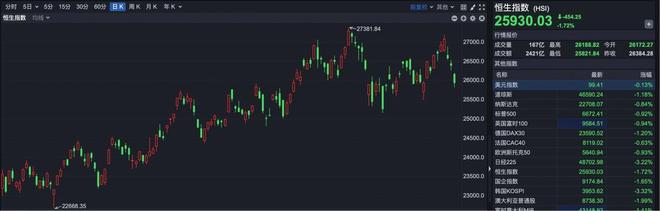
Market Overview - The Hong Kong stock market experienced a decline for the third consecutive day, with the Hang Seng Index closing below 26,000 points at 25,930.03, down 454.25 points, a decrease of 1.72% [1] - The Hang Seng Tech Index reached a new closing low since September 5, ending at 5,645.73, down 111.15 points, a drop of 1.93% [3] Sector Performance - Major sectors fell across the board, with technology stocks experiencing significant declines. Lenovo Group (00992.HK) dropped over 4%, Kuaishou-W (01024.HK) fell over 3%, and Tencent Holdings (00700.HK) and Xiaomi Group-W (01810.HK) both decreased by over 2% [5] - Gold stocks also saw declines, with Lingbao Gold (03330.HK) down over 8%. Lithium battery stocks continued to weaken, with Ganfeng Lithium (01772.HK) and Tianqi Lithium (09696.HK) both falling over 6%. Automotive stocks were broadly down, with Xpeng Motors-W (09868.HK) dropping over 10% [5] - Notably, the semiconductor sector was the only one to rise against the trend, with Huahong Semiconductor (01347.HK) up over 3%, Hongguang Semiconductor (06908.HK) rising over 2%, and SMIC (00981.HK) increasing over 1% [5] Capital Flow - As of the market close, southbound funds recorded a net purchase of over 7.4 billion HKD in Hong Kong stocks [6] Market Outlook - Most institutions believe that the Hong Kong market lacks clear direction in the short term due to a lack of new macroeconomic stimuli and a cooling expectation of interest rate cuts by the Federal Reserve, leading to reduced market risk appetite [7] - However,招商证券国际 indicates that the foundation for a market turnaround is being established, driven by breakthroughs in China's AI industry, improved policy transmission efficiency, and expectations for future growth stabilization policies [7] - Huatai Securities notes that liquidity pressure in the Hong Kong market may persist until the end of the year, with a slowdown in the inflow of southbound funds, but marginal improvement in liquidity is expected after December, potentially leading to a spring rally in early next year [7]
20cm速递|国务院力推AIDC新场景!储能迎政策需求双驱动,创业板新能源ETF华夏(159368)昨日净流入3743万居首
Mei Ri Jing Ji Xin Wen· 2025-11-18 06:48
Core Viewpoint - The A-share market continues to show weakness, with the ChiNext New Energy ETF experiencing a decline, while the storage industry is poised for growth driven by policy support and market demand [1][2]. Group 1: Market Performance - The A-share indices continued to decline in the afternoon session, with the ChiNext New Energy ETF (159368) falling over 4% [1]. - The ChiNext New Energy ETF (159368) saw a net inflow of 37.43 million yuan yesterday, leading comparable funds, with its share surpassing 480 million [1]. - The trading volume of the ChiNext New Energy ETF (159368) exceeded 60.7 million, ranking first among similar products [1]. Group 2: Policy and Industry Outlook - The State Council issued an implementation opinion to accelerate the cultivation of new scenarios and promote large-scale applications, focusing on the demand for new productive forces [1]. - The stability and greening of energy supply for Artificial Intelligence Data Centers (AIDC) are increasingly important, with storage technology being a key support [1]. - CITIC Securities predicts a high prosperity development period for the storage industry, driven by both policy and market factors, particularly in the context of power shortages in the U.S. due to AIDC integration and manufacturing return [1]. Group 3: Company and Product Details - The ChiNext New Energy ETF (159368) is the largest ETF tracking the ChiNext New Energy Index, covering various sectors including batteries and photovoltaics [2]. - The ETF has the highest elasticity, with a potential increase of up to 20%, and the lowest fee rate, with a total management and custody fee of only 0.2% [2]. - As of October 31, 2025, the ETF's scale reached 829 million yuan, with an average daily trading volume of 90.05 million over the past month, and it contains 59% storage and 32% solid-state battery components [2].