中国版平准基金

Search documents
图说|2025年资本市场大事记
Xin Hua Cai Jing· 2025-12-29 04:57
Group 1 - The core viewpoint of the article highlights the significant improvements in investor confidence and expectations in the A-share market, with total market capitalization exceeding 100 trillion yuan in 2025, and a growing preference for hard technology assets [1][9]. Group 2 - In January, a plan was introduced to promote the entry of medium- and long-term funds into the market, aiming to enhance the investment ratio and stability of commercial insurance funds in A-shares, optimize the investment management mechanisms of national social security and basic pension funds, and increase the scale and proportion of equity funds [2]. Group 3 - The government work report for 2025 emphasizes the development of new productive forces and the integration of technological and industrial innovation, with the China Securities Regulatory Commission (CSRC) deepening reforms in the Sci-Tech Innovation Board, Growth Enterprise Market, and Beijing Stock Exchange to enhance the inclusiveness and adaptability of the system [3]. Group 4 - On April 8, the Central Huijin Investment Company reaffirmed its role as a stabilizing force in the capital market, akin to a "stabilization fund," with the People's Bank of China supporting it in increasing stock market index fund holdings and providing sufficient re-lending support when necessary [4]. Group 5 - On May 7, the CSRC issued an action plan to promote the high-quality development of public funds, proposing 25 specific measures to shift the industry focus from "scale" to "returns" by optimizing the fee structure of actively managed equity funds and strengthening the alignment of interests between fund companies and investors [5]. Group 6 - On May 16, the CSRC announced modifications to the major asset restructuring management measures, introducing a phased payment mechanism for restructuring shares, a simplified review process for restructuring, and clarifying lock-up period requirements for mergers, leading to a significant increase in mergers and acquisitions activity, with 279 major restructurings recorded in A-shares by the end of the reporting period, nearly doubling from the previous year [6]. Group 7 - On June 18, the CSRC implemented reforms to enhance the inclusiveness and adaptability of the Sci-Tech Innovation Board, including the establishment of a growth tier, pilot introduction of experienced institutional investors, and the resumption of the fifth set of standards for listing unprofitable companies [8]. Group 8 - By August, the total market capitalization of A-shares surpassed 100 trillion yuan, with a notable structural change in the market, as various medium- and long-term funds collectively held approximately 21.4 trillion yuan of A-share circulating market value, reflecting a 32% increase compared to the end of the 13th Five-Year Plan [10]. Group 9 - On October 27, the CSRC released an optimization plan for the Qualified Foreign Institutional Investor (QFII) system, proposing 11 measures across six areas to enhance access management, facilitate investment operations, expand investment scope, clarify policy expectations, and enrich service support [11]. Group 10 - On October 28, the Shanghai Composite Index broke the 4000-point mark for the first time in over a decade, driven by factors such as the release of DeepSeek-R1, renewed recognition of Chinese companies' technological innovation capabilities, a low-interest-rate environment, and global capital reallocation [12].


今日视点:多路资金协力巩固资本市场向好生态
Zheng Quan Ri Bao· 2025-08-21 23:21
Core Viewpoint - The A-share market is experiencing a strong upward trend, supported by various funding sources, which enhances the resilience of China's capital market and solidifies its positive ecosystem [1]. Group 1: Market Performance - Major indices in the A-share market have shown significant gains this year, with the Shanghai Composite Index, Shenzhen Component Index, and ChiNext Index rising by 12.51%, 14.45%, and 21.19% respectively [1]. - The trading volume in the Shanghai and Shenzhen markets has frequently surpassed 2 trillion yuan, indicating robust market activity [1]. Group 2: Funding Sources - The China version of the stabilization fund has played a crucial role in the long-term health of the capital market, with the Central Huijin Investment's actions providing liquidity and strong policy signals to stabilize the market [1]. - As of June 30, 2023, the balance of insurance funds invested in stocks increased by 640.6 billion yuan, a growth of 26.4% compared to the end of last year, reflecting effective policy measures to encourage long-term capital inflow [2]. - Retail investors have significantly increased their participation, with a 36.88% year-on-year rise in new A-share accounts in the first seven months of the year, contributing to market liquidity and activity [3]. Group 3: Foreign Investment - There has been a noticeable increase in foreign capital inflow into the A-share market, with the average daily trading volume of northbound funds reaching 202.4 billion yuan in July, a 36.3% increase from June [4]. - The influx of foreign capital is expected to optimize the investor structure in the capital market and promote valuation reassessment, driven by China's stable macroeconomic outlook and deepening market openness [4]. Group 4: Future Outlook - The collaborative efforts of diverse funding sources are a result of institutional innovation, policy support, economic transformation, and global capital restructuring, indicating a positive trend for the A-share market [4]. - The current upward logic of the A-share market remains intact, supported by structural economic upgrades, declining risk-free returns, and improved regulations, paving the way for a new phase of high-quality development characterized by stability and long-term returns [4].
多路资金协力巩固资本市场向好生态
Zheng Quan Ri Bao· 2025-08-21 16:19
Group 1 - The A-share market has shown strong performance, with major indices like the Shanghai Composite Index, Shenzhen Component Index, and ChiNext Index rising by 12.51%, 14.45%, and 21.19% respectively year-to-date as of August 21 [1] - The increase in market activity is supported by various funding sources working together, enhancing the resilience of China's capital market in the long term [1] Group 2 - The Chinese version of the stabilization fund, led by the Central Huijin Investment, has played a crucial role in maintaining the long-term health of the capital market by injecting liquidity and providing strong policy signals [2] - The Central Huijin's actions, such as increasing holdings in stock index funds, have been significant in promoting market recovery and stabilizing abnormal fluctuations [2] Group 3 - There has been a steady inflow of medium to long-term funds into the market, with insurance capital's stock investment balance increasing by 640.6 billion yuan, a growth of 26.4% compared to the end of last year [3] - Recent policy measures have facilitated the entry of long-term capital, which is expected to enhance market resilience and resource allocation efficiency [3] Group 4 - Retail investors have significantly increased their participation in the market, with new A-share accounts rising by 36.88% year-on-year in the first seven months of the year [4] - The active involvement of retail investors contributes to the liquidity and vibrancy of the capital market [4] Group 5 - Foreign capital has been increasingly flowing into A-shares, with the average daily trading volume of northbound funds reaching 202.4 billion yuan in July, a 36.3% increase from June [5] - The influx of foreign investment is expected to optimize the investor structure in the capital market and drive valuation reassessment [5] - The combination of economic stability, deepening market openness, and the emergence of globally competitive companies will further attract foreign capital, promoting high-quality development of the capital market [5]
★A股主要股指"含科量"提升 更有效表征企业转型升级
Shang Hai Zheng Quan Bao· 2025-07-03 01:56
Group 1 - The core viewpoint of the news is the recent adjustments in index sample stocks by major exchanges, which aim to enhance the representation and investment value of indices, particularly in the context of increasing long-term capital inflows into the market [1][2] - The adjustments have led to a significant increase in the scale of ETFs linked to major indices, with an estimated total scale of approximately 1.7 trillion yuan by April 2025, representing a nearly fourfold increase since the end of 2021 [1] - The adjustments are expected to optimize index representation, trigger structural capital flows, and potentially have a positive impact on the stock prices of newly included stocks, especially those in mainstream indices [1][3] Group 2 - The recent index adjustments have increased the weight of technology stocks, reflecting a trend towards high-tech and advanced manufacturing in listed companies [2] - The adjustments in the CSI 300 index included an increase of 2 technology stocks, raising its weight by 0.18%, while the CSI 500 index saw an increase of 12 technology stocks, raising its weight by 1.82% [2] - The adjustments are likely to enhance the investment value of the North Exchange's indices, aligning with its focus on specialized and innovative companies [2][3] Group 3 - The selection criteria for index adjustments typically emphasize market capitalization and liquidity, with newly included stocks often experiencing increased buying pressure post-adjustment [3] - The recent adjustment of the CSI 300 index involved the removal of stocks from sectors like power equipment and construction materials, while adding stocks from banking, artificial intelligence, and military sectors, consistent with the current market style [3] - Historical data indicates that index adjustments lead to positive price impacts for included stocks, particularly in larger indices where passive trading can significantly influence stock prices [3][4] Group 4 - The adjustments by international index providers like MSCI are also noteworthy, with recent changes including the addition of five A-shares to the MSCI China Index, which saw immediate price increases for the newly included stocks [4]

财经早报:多家金融机构看好银行股配置价值 医药生物重回券商金股推荐度第一
Xin Lang Zheng Quan· 2025-06-04 00:04
Group 1 - Insurance capital is increasing its market presence with an additional 50 billion yuan, indicating a positive outlook for the A-share market [4] - Major insurance firms are launching private equity funds, such as the 300 billion yuan target fund by Taiping Insurance, focusing on state-owned enterprise reforms and modern industrial systems [4] - The overall trend shows insurance institutions are actively exploring equity investments, particularly in sectors closely related to their main business, such as healthcare and renewable energy [4] Group 2 - The U.S. government has temporarily suspended "reciprocal tariffs" for 90 days, urging countries to submit their best trade negotiation proposals [3] - The EU expressed regret over the U.S. decision to increase tariffs on steel and aluminum, which adds to economic uncertainty between the U.S. and Europe [3] - Ongoing negotiations between the U.S. and EU aim to accelerate discussions on trade agreements [3] Group 3 - The June stock recommendations from 42 brokerage firms show a significant increase in the pharmaceutical and biotechnology sectors, which have regained the top recommendation position after three years [8] - The report indicates a notable rise in recommended stocks from Hong Kong, with 332 stocks receiving a total of 457 recommendations [8] - The decline in the retail sector's recommendation is attributed to renewed trade tensions and previous significant price increases [8] Group 4 - New energy vehicle companies, including Xiaomi, NIO, and Xpeng, are approaching profitability, supported by their systematic capabilities [9] - Xiaomi's automotive business is expected to become profitable in the third or fourth quarter of this year, ahead of Tesla's timeline [9] - The company has invested significantly in autonomous driving technology, with a total budget of 3.5 billion yuan for research and development [9] Group 5 - The introduction of the "Regulations on Government Data Sharing" aims to enhance the efficiency and security of government data sharing, marking a new phase in data management [6] - The regulations will facilitate the flow of data from higher to lower government levels, promoting better governance and service delivery [6] - Experts believe that effective data sharing will be a crucial driver for high-quality economic and social development [6] Group 6 - The banking sector has seen a rise in stock prices, with 20 banks experiencing over a 10% increase in share prices this year [7] - Qingdao Bank has the highest increase at 35.31%, followed by Chongqing Rural Commercial Bank and Chongqing Bank with increases of 32.14% and 24.79% respectively [7] - Analysts suggest that the decline in market interest rates has made bank stocks attractive due to their stable dividend yields [7]

中央汇金调仓动向曝光 “中国版平准基金”持续稳市稳信心
Zheng Quan Ri Bao Zhi Sheng· 2025-05-06 16:10
Core Viewpoint - Central Huijin Investment Co., Ltd. plays a stabilizing role in the capital market by holding significant stakes in large banks and financial institutions, as well as broad-based ETFs, and has recently increased its investments to support market stability [1][5]. Group 1: Investment Actions - In Q1 2025, Central Huijin held shares in 152 listed companies with a total market value of 3.02 trillion yuan, primarily concentrated in the financial sector [2]. - Central Huijin has newly entered the top ten shareholders of Huatai Securities, holding 96.1452 million shares, which represents 1.32% of the circulating A-shares, with a market value of 1.59 billion yuan [2]. - The company has significantly increased its holdings in various ETFs, including E Fund CSI 300 ETF and Huatai-PineBridge CSI 300 ETF, with total increases of 5.02 billion shares and 3.63 billion shares respectively [3]. Group 2: Market Stability Role - Central Huijin's investment strategy is characterized by long investment cycles, providing confidence to the market during periods of volatility [3]. - The company is seen as a crucial force in maintaining market stability, directly injecting funds into the market and supporting expectations [3]. - The establishment of a "Chinese version of a stabilizing fund" is viewed as essential for stabilizing the capital market and enhancing investor confidence [5][6]. Group 3: Future Directions - There is a call for Central Huijin to increase its market entry scale and improve the operational mechanisms of the stabilizing fund to better stabilize investor expectations and confidence [6]. - Recommendations include establishing a clear funding source and dynamic adjustment of fund size, along with enhancing regulatory mechanisms for transparency and accountability [6].
重要预告 明日上午9时!央行、证监会等将出席!A50直线拉升
Zheng Quan Shi Bao Wang· 2025-05-06 11:08
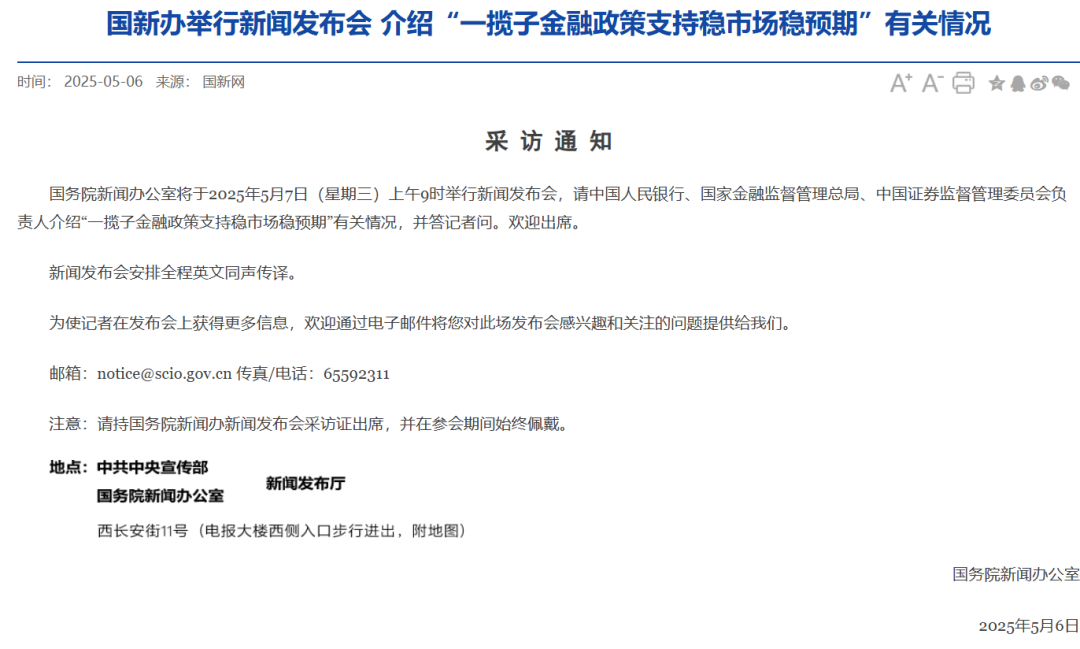
Group 1 - The State Council Information Office will hold a press conference on May 7, 2025, to introduce a "package of financial policies to support market stability and expectations" [1][2][6] - Officials from the People's Bank of China, the National Financial Regulatory Administration, and the China Securities Regulatory Commission will present information and answer questions [1][2][6] - The press conference will feature simultaneous English interpretation [3][7] Group 2 - Journalists are encouraged to submit questions of interest via email prior to the press conference [4][8] - The press conference will take place at the Central Propaganda Department's press hall, located at 11 Xichangan Street [5][10] Group 3 - Following the announcement, the FTSE China A50 index futures surged over 0.5% [10] - On the first trading day after the May Day holiday, the A-shares market saw significant gains, with the Shanghai Composite Index rising over 1% [10][15] - The government has shown a commitment to stabilizing the stock market and promoting healthy development in the real estate sector [15][16]
重要预告,明日上午9时!央行、证监会等将出席!A50直线拉升
证券时报· 2025-05-06 10:52
Core Viewpoint - The Chinese government is taking proactive measures to stabilize the financial market and maintain investor confidence through a series of financial policies and regulatory actions [1][5][6]. Group 1: Government Actions and Policies - A press conference will be held on May 7, 2025, to discuss a "package of financial policies to support market stability and expectations" [1]. - The State Council, led by Premier Li Qiang, emphasized the need to stabilize the stock market and promote the healthy development of the real estate market [5]. - Since April, various ministries have been actively implementing measures to maintain capital market stability, reflecting a strong commitment to ensuring smooth market operations [6]. Group 2: Market Reactions - Following the announcement of government measures, the FTSE China A50 index futures surged over 0.5% [3]. - On the first trading day after the holiday, the A-shares market saw a broad increase, with the Shanghai Composite Index rising over 1% and returning above 3,300 points [4]. - The Hong Kong stock market also experienced gains, with the Hang Seng Index rising over 1% and net inflows from southbound funds exceeding 13 billion HKD [4]. Group 3: Regulatory Focus - The China Securities Regulatory Commission (CSRC) is focusing on risk prevention, strong regulation, and promoting high-quality development within the capital market [7]. - Key initiatives include enhancing the awareness and capability of listed companies to return value to investors and supporting the issuance of shares by high-quality, unprofitable technology companies [7].

政策预期点燃市场信心,500质量成长ETF(560500)盘中飘红
Xin Lang Cai Jing· 2025-04-30 05:24
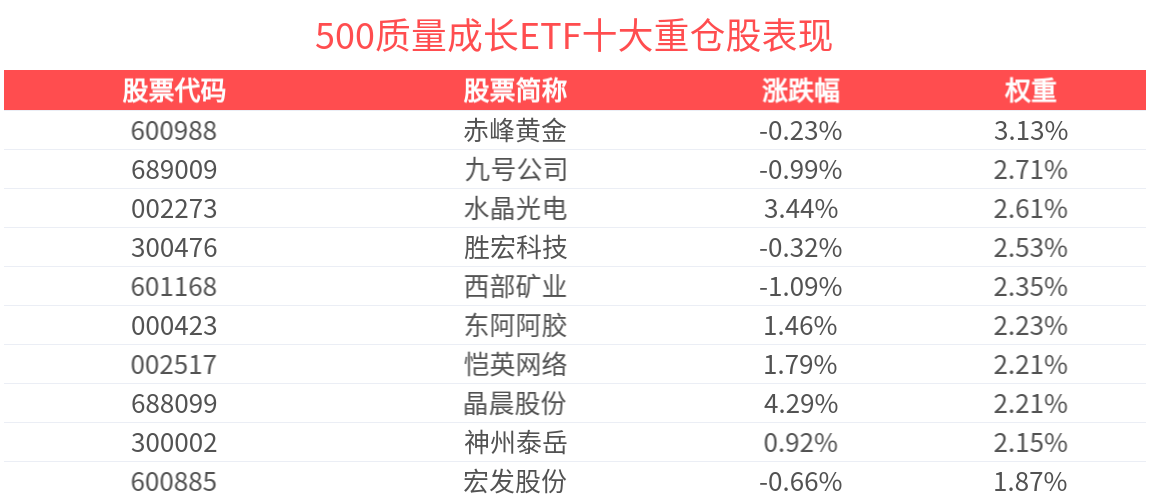
Group 1 - The China Securities 500 Quality Growth Index (930939) has shown a slight increase of 0.22% as of April 30, 2025, with notable gains in constituent stocks such as Amlogic (688099) up 4.29% and Anker Innovations (300866) up 3.80% [1] - The 500 Quality Growth ETF (560500) has also risen by 0.22%, with the latest price reported at 0.92 yuan, and a significant increase in shares by 5 million this month, ranking it in the top third among comparable funds [1] - Huaxi Securities highlights the role of the Chinese version of the stabilization fund in supporting the A-share market, emphasizing a higher positioning for "stabilizing and activating the stock market" compared to previous times [1] Group 2 - The 500 Quality Growth ETF closely tracks the China Securities 500 Quality Growth Index, which selects 100 companies with high profitability, sustainable earnings, and strong cash flow from the broader 500 Index [2] - As of March 31, 2025, the top ten weighted stocks in the index include Chifeng Jilong Gold Mining (600988) and Ninebot (689009), with the top ten stocks accounting for a total weight of 24.26% [2]



最新!“国家队”动向曝光!
券商中国· 2025-04-22 08:52
Core Viewpoint - The recent fund quarterly reports reveal significant increases in holdings of major ETFs by the "national team," particularly by the Central Huijin Investment Ltd, which has injected over 200 billion yuan into several ETFs, indicating a strong commitment to stabilizing the capital market [2][12]. Group 1: National Team's ETF Purchases - The Central Huijin Investment Ltd has notably increased its holdings in several large-scale ETFs, including the Huatai-PB CSI 300 ETF, which now exceeds 300 billion yuan in size, with an increase of 363 million units in Q1 2024 [4][5]. - Other ETFs such as the Huaxia CSI 300 ETF, Harvest CSI 300 ETF, and E Fund CSI 300 ETF also saw significant increases in holdings, with respective increases of 157 million, 117 million, and 502 million units [6]. - By the end of 2024, the total amount held by the Central Huijin Investment Ltd in ETFs surpassed 1 trillion yuan, reflecting its role as a stabilizing force in the market [12]. Group 2: Market Impact and Future Outlook - The "national team" has been actively involved in the stock ETF market since early 2023, with a notable public announcement of continued purchases aimed at maintaining market stability [8][10]. - In April 2024, the net inflow into stock ETFs reached a historical high, with a total of 1,117.8 billion yuan, largely attributed to the "national team" investments, providing crucial support for the A-share market [13]. - Fund managers express optimism about A-share investment opportunities, highlighting potential structural opportunities and the importance of policy continuity in the second quarter of 2024 [15].