长钱长投

Search documents
华安基金:险资长周期考核明确,“长钱长投”迎制度突破
Xin Lang Ji Jin· 2025-07-15 08:51
Market Overview and Key Insights - The Hong Kong dividend sector continued to rise last week, outperforming the broader market, with the Hang Seng China Central State-Owned Enterprises Dividend Total Return Index increasing by 1.74%, compared to a 0.93% rise in the Hang Seng Index and a 0.62% rise in the Hang Seng Tech Index [1] - Foreign capital inflow expanded, with net inflow into Hong Kong stocks reaching $1.023 billion, up from $916 million the previous week, while southbound funds saw a net inflow of HKD 26.4 billion [1] Insurance Capital and Long-term Investment - Recent regulatory changes encourage insurance funds to adopt a long-term investment strategy, shifting the assessment of net asset return rates from a 3-year and annual indicator to a combination of annual, 3-year, and 5-year indicators with respective weights of 30%, 50%, and 20% [1] - Insurance capital is expected to become a significant source of incremental funds in the stock market, with a requirement for state-owned large insurance companies to invest 30% of new premiums in A-shares, potentially adding thousands of millions in long-term capital annually [2] Dividend Strategy and Valuation - The dividend yield of the Hang Seng China Central State-Owned Enterprises Dividend Index is 5.86%, compared to 4.82% for the CSI Dividend Index, with a price-to-book (PB) ratio of 0.64 and a price-to-earnings (PE) ratio of 6.96 [2] - The total return index has achieved a cumulative return of 123% since early 2021, outperforming the Hang Seng Total Return Index by 118% [2] ETF Overview - The Huaan Hong Kong Stock Connect Central State-Owned Enterprises Dividend ETF (513920) tracks the Hang Seng China Central State-Owned Enterprises Dividend Index and is the first ETF in the market with the combined attributes of Hong Kong stocks, central state-owned enterprises, and dividends [3] Fund Performance - The net asset value of the Huaan Hong Kong Stock Connect Central State-Owned Enterprises Dividend ETF is 7.66 billion [4] - Key holdings include China COSCO Shipping (4.6% weight, 12.9% dividend yield), Orient Overseas International (4.4% weight, 11.3% dividend yield), and New China Life Insurance (3.9% weight, 6.4% dividend yield) [5]

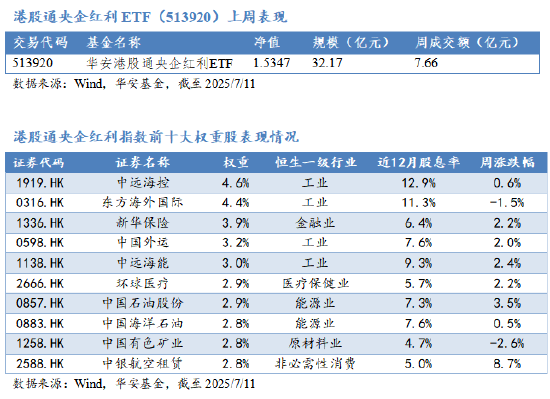
长钱何以长投?资管掌门人如是说
Shang Hai Zheng Quan Bao· 2025-07-14 18:29
Core Viewpoint - The recent initiatives by the Ministry of Finance and other regulatory bodies aim to guide insurance funds towards long-term and stable investments, enhancing the performance evaluation system for state-owned commercial insurance companies, which is seen as a crucial step for stabilizing the capital market [6][9]. Group 1: Insurance Funds and Capital Market - Insurance funds are characterized as long-term and patient capital, making them naturally suitable for long-term investment needs in the capital market [8][9]. - As of the end of the first quarter, the balance of funds utilized by insurance companies reached 34.93 trillion yuan, indicating a significant potential for long-term investments [8]. - China Life Asset Management, as a major player, aims to reshape the value investment paradigm in the capital market by increasing equity investment proportions and providing stable long-term funding [7][9]. Group 2: Long-term Investment Initiatives - The "Honghu Fund," initiated by China Life and Xinhua Insurance, is a pilot fund with a total scale of 50 billion yuan, focusing on long-term investments in companies with strong competitive advantages [9]. - The push for long-term investment reform is a key focus for regulatory bodies, with China Life Asset Management being one of the first participants in this initiative [9][10]. Group 3: Challenges and Opportunities - The insurance sector faces challenges such as the need for improved risk management tools and a shift from short-term to long-term investment strategies [11][13]. - There is a call for enhancing the investment capabilities of insurance funds, particularly in navigating complex global capital markets and optimizing investment frameworks [13][15]. - The low interest rate environment and insufficient supply of quality assets highlight the necessity for insurance funds to increase their equity asset allocation [15][16]. Group 4: Bank Wealth Management - Bank wealth management is increasingly entering the capital market, with institutions like Everbright Wealth Management leading the way in equity investments [17][18]. - As of June, the proportion of equity products in Everbright's wealth management offerings exceeded 7%, reflecting a significant increase in equity asset allocation [19]. - The shift towards equity investment is seen as a necessary response to the limitations of fixed-income assets in a low-interest-rate environment [20][21]. Group 5: Regulatory and Structural Adjustments - There is a need for regulatory adjustments to support long-term investments, including optimizing accounting standards and enhancing the matching mechanism between client risk profiles and asset styles [30][31]. - The establishment of a multi-dimensional evaluation system for long-term investments is essential to support investment teams in maintaining a focus on fundamental research during market fluctuations [30][31].

10万亿元长钱来了!险资长周期考核再“松绑”
Hua Xia Shi Bao· 2025-07-14 12:39
财政部近期连续出台重磅政策,力促保险资金立足长期、投向资本市场。7月11日发布的《关于引导保 险资金长期稳健投资 进一步加强国有商业保险公司长周期考核的通知》(下称"新规"),将国有商业 保险公司两大核心绩效指标——净资产收益率与资本保值增值率的考核权重向三年及五年长周期指标大 幅倾斜,合计占比高达70%。 这并非孤立的政策调整,而是一系列引导"长钱"入市组合拳的关键一环。从2023年首次引入三年期考 核,到2024年初《推动中长期资金入市工作的实施方案》明确要求大型险企每年新增保费的30%投向A 股,再到此次将考核周期实质性延长至五年,监管层引导险资践行长期价值投资、优化资本市场结构的 决心清晰可见。 本报(chinatimes.net.cn)记者吴敏 北京报道 "财政部此次改革将五年期考核权重由原先的大约50%提升至70%,显著弱化了对保险公司短期财务收 益的关注,释放出强烈的政策信号,即支持长期投资、价值投资、稳定投资。"北京大学应用经济学博 士后、教授朱俊生在接受《华夏时报》记者采访时表示,未来2-3年内,险资在A股的配置比例有望从 当前约11%左右稳步上升至15%甚至更高,配置结构也将由"防御型"为 ...



入市重点投向,长钱长投制度优化……多家险资巨头发声
天天基金网· 2025-07-14 05:52
Core Viewpoint - The article emphasizes the necessity and feasibility of increasing equity asset allocation by insurance funds, highlighting the importance of value investing and long-term investment strategies in the current macroeconomic environment [2][3]. Group 1: Investment Strategy - Insurance funds should return to the essence of value investing, focusing on acquiring assets at reasonable prices to achieve long-term growth and returns [3]. - Key investment strategies include prioritizing stable holdings in FVOCI stocks, strategic stakes in companies, and long-term partnerships [3][4]. - The selection criteria for investment targets should include long-term competitiveness, sustainable profitability, operational stability, and shareholder return capabilities [4]. Group 2: Focus Areas for Investment - Key investment opportunities identified include new productive forces, new economy sectors, high-dividend assets, and overseas expansion of manufacturing and consumer brands [5][6]. - The technology growth sector, particularly in AI and robotics, is highlighted as a significant area for long-term investment [5]. - Traditional industries with stable earnings and reasonable valuations are also seen as viable investment options [5][6]. Group 3: Market Environment and Recommendations - The article discusses the need for a conducive environment for long-term capital investment, suggesting improvements in the regulatory framework and market mechanisms [8][9]. - Recommendations include enhancing market infrastructure, optimizing IPO and refinancing policies, and improving investor protection mechanisms [8][9]. - The article advocates for differentiated capital measurement and the introduction of counter-cyclical adjustment factors to encourage long-term investments by insurance funds [9].

长周期考核,化解长投顾虑!险资渐成“托底”主力军!
Sou Hu Cai Jing· 2025-07-14 01:48
Group 1 - The Ministry of Finance has issued a notice to guide insurance funds towards long-term stable investments, emphasizing a three-year long-cycle assessment mechanism with increased weight on net asset return and capital preservation metrics [1] - The long-cycle assessment aims to reduce anxiety over short-term performance fluctuations, encouraging insurance funds to focus on long-term investments, which historically yield higher returns [2] - The recent surge in insurance capital's stake acquisitions, nearly 40 instances, reflects a response to regulatory calls for insurance capital to act as patient capital and a stabilizing force in the market [3] Group 2 - The current low interest rate environment is driving insurance companies to seek high-dividend stocks as a strategy to mitigate risks associated with interest rate and fee losses [3] - The shift towards long-term investment strategies is indicative of a broader market and policy transformation, influenced by factors such as low interest rates and the need to boost capital markets [4] - The global landscape is undergoing significant changes, necessitating a supportive environment for long-term investments to counteract rising uncertainties and market volatility [5]
中证报头版:险资锚定“长钱长投”入市路线图
news flash· 2025-07-13 22:41
Core Insights - The article emphasizes the increasing alignment of insurance capital with "long money and long investment" strategies in the market [1] - It highlights the acceleration of insurance funds entering the market as a result of supportive policies and growing allocation needs [1] Group 1: Policy and Market Dynamics - Continuous policy collaboration has led to a significant shift of insurance funds towards patient, strategic, and long-term capital [1] - Insurance capital is becoming a crucial institutional investor in the capital market, enhancing its interaction with the market [1] Group 2: Investment Strategies - The focus on "long money and long investment" is driving the introduction of new policies aimed at increasing the scale, expanding channels, and improving assessments of insurance capital [1] - Insurance funds are building a solid foundation of quality core assets to withstand market cycles, thereby enriching the long-term liquidity of the capital market [1] Group 3: Market Interaction - A more stable allocation of equity assets by insurance capital is fostering a healthy interaction with the capital market [1] - This interaction is seen as a way to provide sustainable liquidity for the healthy operation of the capital market [1]
险资锚定“长钱长投”入市路线图
Zhong Guo Zheng Quan Bao· 2025-07-13 20:52
Group 1 - The core viewpoint of the article emphasizes the ongoing push for long-term investment by insurance funds, supported by favorable policies and a focus on stable capital allocation [1][2] - The Ministry of Finance has issued a notice to enhance the long-term assessment of state-owned commercial insurance companies, adjusting the evaluation metrics to include longer periods, which encourages a more stable investment approach [1][2] - The establishment of a long-cycle assessment mechanism reduces the constraints on the market value fluctuations of insurance fund holdings, promoting a more stable investment behavior [2][3] Group 2 - Insurance funds are increasingly focusing on equity investments due to the low interest rate environment, seeking growth opportunities beyond fixed-income assets [3] - The recent establishment of private equity funds, such as the Honghu Fund, represents a significant step in the long-term investment pilot program, with a total approved scale exceeding 200 billion yuan [3][4] - The investment strategy of these funds is primarily directed towards large-cap stocks with stable governance and good liquidity, aligning with the principles of long-term capital investment [5]

政策“组合拳”协同发力险资“长钱长投”打开空间
Shang Hai Zheng Quan Bao· 2025-07-13 19:46
Group 1 - The core viewpoint of the articles highlights the acceleration of insurance capital's entry into the market, driven by a series of supportive policies aimed at promoting long-term investments [1][2][4] - Insurance capital has made 19 equity stakes in listed companies this year, which is consistent with the total from the previous year, indicating a stable investment trend [2][4] - The implementation of policies such as increasing the proportion of equity asset allocation and expanding long-term investment pilot programs has provided more opportunities for insurance capital to invest [2][4][5] Group 2 - A total of 1,720 billion yuan has been approved for long-term investment pilot funds, with many insurance companies actively participating in these initiatives [2][4] - The financial regulatory authority has raised the equity asset allocation limits for insurance companies, potentially increasing their investment capacity by approximately 500 billion yuan [5] - The recent adjustments in risk factors for insurance stock investments are expected to lower the capital requirements, allowing more funds to be allocated to the stock market [5][7] Group 3 - The introduction of a long-term assessment mechanism for state-owned insurance companies aims to encourage a shift from short-term to long-term investment strategies [6][8] - There is a growing interest among smaller insurance companies to participate in long-term stock investment trials, indicating a broader industry trend towards long-term capital deployment [3][4] - Industry experts suggest further optimization of solvency requirements and risk factor assessments to enhance the effectiveness of insurance capital in the market [7][8]

每经热评︱险资长期考核指标落地 “长钱长投”培育更多耐心资本
Mei Ri Jing Ji Xin Wen· 2025-07-13 12:57
每经评论员 杜恒峰 7月11日,财政部发布《关于引导保险资金长期稳健投资 进一步加强国有商业保险公司长周期考核的通 知》(以下简称《通知》),对国有商业保险公司经营效益类绩效评价指标作出重大调整,核心内容有 二:其一,将净资产收益率考核由"当年度指标+3年周期指标"调整为"当年度指标+3年周期指标+5年周 期指标",三者权重分别为30%、50%和20%;其二,把资本保值增值率指标从"当年度指标"调整为"当 年度指标+3年周期指标+5年周期指标",权重同样为30%、50%和20%。 首先,被考核对象对投资的考量将以3年作为最小周期。这是因为3年周期指标的权重最高,达到50%, 而且较高的3年期收益率能为5年期考核奠定良好基础。在此情况下,被考核对象追求短期业绩的热情会 大幅降低,年末抱团高位股、扎堆热门赛道博取超额收益等短期行为将有望减少。其次,被考核对象会 有动力降低收益波动率,将长期目标分解到每一年的目标中,通过逐年积累收益率,最终达成较高的考 核收益率。那些初期收益率较低、到最后才"冲刺"的模式将不再"划算"。例如:投资经理在第一年到第 五年的收益率均为10%,5年累计收益率为61.051%,5年考核期结 ...
入市重点投向,长钱长投制度优化……多家险资巨头发声
券商中国· 2025-07-13 06:58
Core Viewpoint - The article emphasizes the necessity and feasibility of increasing equity asset allocation by insurance funds, highlighting the importance of value investing and long-term investment strategies in the current macroeconomic environment [2][3][4]. Group 1: Value Investment Essence - Insurance funds should return to the essence of value investing, focusing on acquiring assets at reasonable prices to achieve long-term profit growth and investment returns [3][4]. - The investment strategy should prioritize "good companies" and "good returns," aligning with the long-term nature and stability of insurance capital [4][5]. Group 2: Selection Criteria for Investment Targets - Key indicators for selecting investment targets include: - Long-term competitiveness of the enterprise, requiring sustainable competitive advantages and long-term development potential [5]. - Continuous profitability, with financial metrics like ROE, ROIC, EBITDA, and FCFF consistently outperforming industry averages [5]. - Operational stability, characterized by low earnings volatility and strong cash flow predictability [5]. - Shareholder return capability, necessitating a stable dividend policy and a strong dividend record [5]. Group 3: Investment Opportunities - Focus areas for equity investment include: - New productive forces and new economic sectors, particularly in technology and innovation [6][7]. - High dividend, low volatility assets, and traditional industries with stable profitability and reasonable valuations [6][7]. - Opportunities arising from the overseas expansion of manufacturing and consumer brands, which can provide significant investment prospects [7]. - Niche industries with growth potential, such as innovative pharmaceuticals and high-value consumables, benefiting from domestic policy optimization [7]. Group 4: Long-term Investment Environment - The article suggests that the environment for long-term investment needs further optimization, including: - Cultivating a better "soil" for value investing and improving the institutional framework for long-term capital [11][12]. - Enhancing the investment capabilities of insurance funds to ensure they can effectively participate in the capital market [11][12]. - Recommendations include improving market infrastructure, refining IPO and refinancing policies, and enhancing investor protection mechanisms [11][12].