
交通强国

Search documents
李忠军专题调研南京北站枢纽建设时强调
Nan Jing Ri Bao· 2026-01-17 01:16
Group 1 - The core viewpoint emphasizes the importance of the Nanjing North Station project in enhancing Nanjing's status as a comprehensive transportation hub and promoting regional economic development [1][2] - The project integrates high-speed rail, intercity rail, regular rail, and metro services, forming a "three-station linkage" with Nanjing Station and Nanjing South Station [1] - The city leadership stresses the need for strong coordination and collaboration among various departments to accelerate project construction and ensure high quality [2] Group 2 - The project aims to deepen the integration of the station and city, focusing on industrial planning and functional design to enhance the hub's capabilities [2] - Emphasis is placed on safety management and quality control during construction, particularly in light of winter safety considerations [2] - The project is expected to effectively stimulate regional development dynamics and vitality through its comprehensive planning and execution [2]
预计今年通车,约1小时可到达南宁!广西这些交通项目刷新“进度条”!
Xin Lang Cai Jing· 2026-01-14 04:08
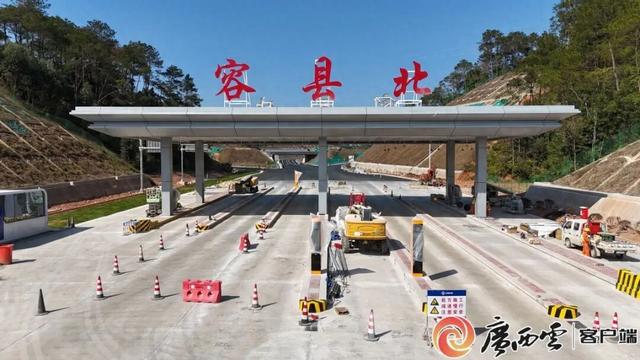
Core Viewpoint - The construction of three major transportation projects in Rongxian, including the Nanzhu High-speed Railway, Cangrong Expressway, and Pingrong Expressway, is progressing rapidly, significantly enhancing the region's connectivity to the Guangdong-Hong Kong-Macao Greater Bay Area and elevating its status as a transportation hub [1][5]. Group 1: Nanzhu High-speed Railway - The Rongxian section of the Nanzhu High-speed Railway is nearing completion, with key construction milestones achieved, including 98.9% completion of the ballastless track base and 94.5% of the roadbed slab [1][3]. - The total investment for the Rongxian Nanzhu Station is 166 million yuan, with the Yulin-Cenxi section expected to open this year, reducing travel time from Nanning to Cenxi from nearly 5 hours to just over 1 hour [1][3]. Group 2: Cangrong Expressway - The Cangrong Expressway's Rongxian section has seen significant progress, with the main bridge construction completed and the main line successfully connected, entering the final stages of road surface work [3][6]. - This project will connect to the Guangkun Expressway, further enhancing the regional road network [3]. Group 3: Pingrong Expressway - The civil engineering work for the Pingrong Expressway's Rongxian section is nearing completion, with ongoing progress in electromechanical and traffic safety projects [3][6]. - The project aims to effectively divert traffic from the inbound routes to Guangdong, helping to establish a regional high-speed outer ring [3]. Group 4: Overall Impact - The total investment for the three projects exceeds 10 billion yuan, which will fundamentally reshape the transportation landscape of Rongxian and strengthen the "two bays linkage" [5]. - The completion of these transportation projects is a crucial step in implementing the national "Transportation Power" strategy, facilitating industrial upgrades, attracting investments, and improving the quality of life for local residents [8].

中国银河资产与山东省路桥集团落地市场化债转股合作
Jin Rong Shi Bao· 2026-01-08 02:36
Group 1 - The core viewpoint of the articles highlights the increasing importance of market-oriented debt-to-equity swaps as a key financial tool for optimizing corporate capital structures and mitigating debt risks in the context of supply-side structural reforms and the transformation of the real economy [1][2] - China Galaxy Asset Management successfully implemented a market-oriented debt-to-equity swap with Shandong Road and Bridge Group, a leading enterprise in the domestic road and bridge infrastructure sector, which plays a significant role in major projects under national initiatives like "Transportation Power" and the "Belt and Road" [1] - The collaboration aims to help Shandong Road and Bridge Group optimize its debt structure, supplement equity capital, and enhance its resilience for sustainable investment and international cooperation, thereby contributing to the high-quality development of the regional economy [1][2] Group 2 - The successful implementation of the debt-to-equity swap project reflects China Galaxy Asset Management's commitment to the principles outlined in the Central Economic Work Conference and the Central Financial Work Conference, emphasizing the importance of balancing risk mitigation and development promotion [2] - By acting as a strategic investor, China Galaxy Asset Management introduces long-term stable equity capital to enterprises, enhances governance structures, and improves operational efficiency, thereby creating a virtuous cycle of capital structure optimization, operational vitality release, and core competitiveness enhancement [2] - The role of financial asset management companies is underscored as a "stabilizer" and "accelerator" in the economic cycle, demonstrating their capacity to support economic stability and growth [2]

“十四五”期间江苏交通完成1万亿元投资
Xin Lang Cai Jing· 2026-01-07 17:12
Core Insights - Jiangsu Province has significantly invested in transportation infrastructure, completing an investment of 1 trillion yuan during the "14th Five-Year Plan" period, which is 1.6 times that of the "13th Five-Year Plan" [1] - The province has made substantial progress in building a modern comprehensive transportation network, adhering to the "Transportation Power" development strategy [1] Group 1: Infrastructure Investment - Jiangsu's transportation infrastructure investment reached 1 trillion yuan, marking a 60% increase compared to the previous five years [1] - The total highway mileage in the province has reached 5,560 kilometers, with an addition of 635 kilometers compared to the end of the "13th Five-Year Plan" [1] - The proportion of six-lane and above highways is 48.4%, ranking second in the country [1] Group 2: Connectivity Projects - A total of 21 cross-river passages have been completed, with 8 under construction, ensuring connectivity for counties and cities across the river [2] - The high-speed railway mileage in Jiangsu has reached 2,594 kilometers, with an increase of 379 kilometers since the end of the "13th Five-Year Plan" [2] - The province has implemented new maintenance models for highways and roads, with over 11,500 kilometers of preventive maintenance completed [2] Group 3: Air and Urban Transport - The province has established 37 international and regional passenger routes, with an air passenger volume reaching 65 million [3] - Daily passenger train services exceed 750 pairs, showing a growth of over 50% since the end of 2022 [3] - Urban rail transit has opened 41 lines with a total length of 1,279 kilometers, ranking second in the country for newly opened mileage [3]
交通大省迈向交通强省
Xin Hua Ri Bao· 2026-01-07 06:29
Core Viewpoint - The transportation system in Jiangsu province has made significant advancements since the "14th Five-Year Plan," aligning with national strategies to build a strong transportation network and modernize the transportation system, thereby supporting the province's economic development and demonstrating its leadership role in the country [1][2]. Investment and Infrastructure Development - The total investment in transportation infrastructure reached 1 trillion yuan, which is 1.6 times that of the "13th Five-Year Plan" [2]. - The province has achieved a highway network of 5,540 kilometers, with an increase of 615 kilometers since 2020, and 48.4% of highways are six lanes or more, ranking second nationally [4]. - The high-speed railway network has expanded to 2,594 kilometers, with an increase of 379 kilometers since 2020, leading in area density among provinces [4]. Logistics and Transportation Efficiency - The ratio of social logistics costs to regional GDP decreased from 13.8% in 2020 to 12.7%, which is 1.3 percentage points lower than the national average [3]. - Jiangsu has established 42 multi-modal transport hubs and operates 152 multi-modal transport lines, with waterway freight accounting for approximately 38.9% of total freight volume, exceeding the national average by 21.4 percentage points [5][6]. Passenger Transport and Connectivity - The province has opened 37 international passenger routes, including new intercontinental routes from Nanjing to Sydney, Melbourne, and Paris [8]. - Daily average train operations exceed 750 pairs, leading in passenger volume in the Yangtze River Delta region [9]. - Urban rail transit has reached 1,279 kilometers across nine cities, ranking second nationally [10]. Safety and Modernization - By 2024, the number of road transport safety incidents and fatalities is expected to decrease by over 60% compared to the end of the "13th Five-Year Plan" [15]. - The province has built 21,000 video monitoring facilities on highways, leading the nation in density [16]. Innovation and Digital Transformation - Jiangsu is the only province in the transportation sector with two national-level innovation platforms and has been recognized for its digital transformation in transportation infrastructure [13]. - The province has developed a unified digital transportation platform and achieved a 99.64% coverage rate for shore power at ports [14]. Talent Development and Community Engagement - The province has implemented high-level talent initiatives, with numerous individuals recognized as national and provincial labor models and craftsmen [19]. - Community engagement efforts include the establishment of 373 "Driver's Homes" and the promotion of integrity education within the transportation system [18].
交通运输部部长刘伟出席2026年全国民航工作会议并讲话
Zheng Quan Shi Bao Wang· 2026-01-06 13:23
Core Viewpoint - The meeting emphasizes the acceleration of building a strong transportation nation, leveraging the comparative advantages of civil aviation, and enhancing the modern comprehensive transportation system [1] Group 1: Development Goals - The focus is on establishing a policy and institutional framework that promotes high-quality development in the civil aviation sector [1] - The meeting highlights the importance of understanding the characteristics and main directions of transportation development during the "14th Five-Year Plan" period [1] Group 2: Strategic Enhancements - There is a call to improve the national strategic service guarantee capabilities and enhance the development level of world-class airport clusters [1] - The aim is to create internationally competitive air cargo enterprises and continuously improve flight operation quality and passenger travel experience [1] Group 3: Innovation and Sustainability - The meeting stresses the need to cultivate new productive forces in the civil aviation sector, deepen the construction of smart civil aviation, and promote the safe and orderly development of general aviation and low-altitude economy [1] - There is a push for accelerating the green transformation of civil aviation [1] Group 4: Reform and Openness - Continuous efforts are required to deepen reforms and expand openness in civil aviation, enhancing internal motivation and development vitality [1] - The importance of conducting foreign exchanges and cooperation is also highlighted [1]
刘伟出席2026年全国民航工作会议并讲话
Xin Lang Cai Jing· 2026-01-06 13:19
Core Viewpoint - The 2026 National Civil Aviation Work Conference emphasizes the importance of high-quality development in the civil aviation sector, aligning with national strategies and policies to enhance transportation systems and ensure safety [1][2]. Group 1: Development Goals - The civil aviation sector aims for qualitative improvements and reasonable quantitative growth, leveraging its comparative advantages to build a modern comprehensive transportation system [2]. - The industry has seen significant achievements during the 14th Five-Year Plan period, with enhanced service capabilities and improved operational quality [1]. Group 2: Safety and Regulation - Safety is highlighted as the lifeline of the civil aviation industry, with a focus on implementing the revised Civil Aviation Law and enhancing safety management systems [2]. - There is a commitment to prevent and mitigate major safety risks, ensuring that safety regulations are effectively enforced [2]. Group 3: Policy and Reform - The establishment of a policy framework to support high-quality development in civil aviation is crucial, with an emphasis on international competitiveness and service quality [2]. - Continuous reform and opening-up in the civil aviation sector are necessary to boost internal motivation and vitality [2]. Group 4: Spring Festival Transportation - The conference outlines goals for a safe, convenient, and warm Spring Festival transportation experience, emphasizing the integration of civil aviation with other transport modes [3].
交通运输部:长江航运战略地位突出 预计2025年长江干线港口吞吐量可达42亿吨
Xin Hua Cai Jing· 2026-01-05 08:08
Core Viewpoint - The modernization of the Yangtze River shipping is crucial for supporting the high-quality development of the Yangtze River Economic Belt, with a focus on enhancing the main channel's role and promoting green and smart transformation in the shipping industry [1][2]. Group 1: Key Initiatives - The Ministry of Transport is prioritizing the construction of a strong transportation nation, actively supporting major national strategies, and enhancing the role of the Yangtze River main channel [1]. - Key projects include the expansion of 29 main channel sections, such as the Wuhan to Anqing segment and the second phase of the Jingjiang project, along with the approval of the feasibility report for the new Three Gorges waterway [1]. - Support is being provided for 12 hub cities, including Shanghai and Wuhan, to implement national comprehensive freight hub projects, with significant port projects like Xiaoyangshan North and Shanghai Luojing accelerating construction [1]. Group 2: Achievements and Future Goals - The Yangtze River's high-grade waterway mileage has reached 11,500 kilometers, allowing 50,000-ton vessels to reach Nanjing directly, 10,000-ton vessels to Wuhan, and 5,000-ton vessels to Chongqing, significantly improving channel capacity [2]. - By 2025, the port throughput of the Yangtze River main line is expected to reach 4.2 billion tons, with the number of major ports increasing to 18 and the average tonnage of cargo ships exceeding 2,300 tons, representing growth of 71%, 50%, and 67% respectively since 2015 [2]. - Future plans include further implementation of the Yangtze Economic Belt Development Plan and the Inner River Waterway Connectivity Project, focusing on upgrading main channels and enhancing port hub capabilities for a more efficient multi-layered port structure [2].
交通运输部:2025年预计长江干线港口吞吐量可达42亿吨
Zhong Guo Xin Wen Wang· 2026-01-05 05:33
Core Viewpoint - The Ministry of Transport of China announced that the throughput of ports along the Yangtze River is expected to reach 4.2 billion tons by 2025, highlighting the strategic importance of modernizing Yangtze River shipping to support high-quality development of the Yangtze Economic Belt [1][2]. Group 1: Key Work Progress - The Ministry of Transport is focusing on strengthening the role of the Yangtze mainline as a major transportation corridor, with initiatives including the expansion and upgrading of key waterways [1]. - A total of 29 projects for the expansion of mainline waterways have been implemented, including the Wuhan to Anqing section and the second phase of the Jingjiang project [1]. - Major port projects such as Xiaoyangshan North and Shanghai Luojing are accelerating construction, enhancing the professional and large-scale capabilities of ports [1]. Group 2: Construction Achievements - The high-grade waterways of the Yangtze River system have reached a total length of 11,500 kilometers, allowing 50,000-ton vessels to reach Nanjing, 10,000-ton vessels to reach Wuhan, and 5,000-ton vessels to reach Chongqing [2]. - By 2025, the number of major ports with a throughput of over 100 million tons is expected to increase to 18, with an average cargo ship tonnage exceeding 2,300 tons, representing growth of 71%, 50%, and 67% respectively since 2015 [2]. - The Yangtze River's green service facilities are operational, with 20 green service areas, 13 washing stations, 8 LNG refueling stations, and 8 battery swap stations established [2].
16亿定增落地,T3正式起飞:白云机场“双引擎”,开启大湾区枢纽新篇章
Mei Ri Jing Ji Xin Wen· 2026-01-05 05:14
Core Viewpoint - Baiyun Airport has successfully strengthened its capital structure and operational capabilities, marking a significant milestone in its development as a major aviation hub in the Guangdong-Hong Kong-Macao Greater Bay Area, supported by a successful private placement and the launch of new infrastructure [1][2][7]. Capital Market and Financial Structure - In December 2025, Baiyun Airport completed a non-public issuance of shares, raising a total of 1.6 billion yuan from its controlling shareholder, Guangdong Airport Management Group [2]. - The funds raised will be used to supplement working capital, which is crucial for the airport's rapid business recovery and expansion [2][3]. - The company reported a revenue of 5.7 billion yuan for the first three quarters of 2025, a year-on-year increase of 7.5%, and a net profit of 1.1 billion yuan, up 64% year-on-year [2]. Infrastructure Development - The official operation of the T3 terminal and the fifth runway marks a historic leap for Baiyun Airport, enhancing its capacity to handle 120 million passengers and 3.8 million tons of cargo annually [4]. - The T3 terminal represents a transformation towards a "super hub" integrating air and rail transport, significantly improving connectivity and operational capabilities [4][5]. Market Demand and Performance - Baiyun Airport's passenger throughput reached a historical high of approximately 76.37 million in 2024, and after the T3 terminal's launch, it surpassed 80 million passengers by December 17, 2025, with over 16.6 million international passengers [6]. - The strong recovery in air traffic and the anticipated growth in non-aeronautical revenue, particularly from duty-free operations, are expected to drive future profitability [6][7]. Strategic Positioning - Baiyun Airport is positioned as a key player in the Greater Bay Area's airport cluster, collaborating with the upcoming Guangzhou New Airport to enhance competitive advantages [5][6]. - The airport aims to strengthen its international network, focusing on markets in Southeast Asia, the Middle East, Australia, New Zealand, and Africa, while expanding its coverage of European and American routes [5][6].
