储备资产多元化

Search documents
“柬埔寨将成首批在华储存黄金的国家,还有…”
Guan Cha Zhe Wang· 2025-11-07 00:42
Core Viewpoint - Cambodia is set to become one of the first countries to store gold in China, marking early progress in China's efforts to establish itself as a global gold hub [1] Group 1: Cambodia's Gold Storage Plans - Cambodia plans to store part of its gold reserves in a vault located in Shenzhen's free trade zone, as part of a new agreement with China [1][2] - The agreement involves the storage of newly purchased gold rather than the transfer of existing reserves [2] - The Cambodian National Bank has not commented on the matter, but previously indicated it was considering several locations for gold storage [3] Group 2: Bilateral Trade and Relations - China and Cambodia have a long-standing friendship, with bilateral trade projected to reach $17.834 billion in 2024, a year-on-year increase of 20.3% [3] - In 2024, China's exports to Cambodia are expected to be $15.336 billion, up 20.2%, while imports from Cambodia are projected at $2.498 billion, an increase of 20.7% [3] Group 3: Global Gold Market Trends - Central banks worldwide are increasing their gold reserves in response to rising geopolitical risks, contributing to a historic high in gold prices last month [3] - Since the beginning of this year until the end of October, international gold prices have risen nearly 60% [4] - The World Gold Council reported that global official gold reserves increased by 166 tons in the second quarter of this year, reaching historical highs [4] Group 4: Future Outlook for Gold Reserves - A significant 95% of surveyed central banks expect an increase in global official gold reserves over the next 12 months, with 43% indicating they will also increase their own gold holdings [4]
柬埔寨被曝将成为首批在华储存黄金的国家之一,“还有他国在评估”
Sou Hu Cai Jing· 2025-11-06 08:02
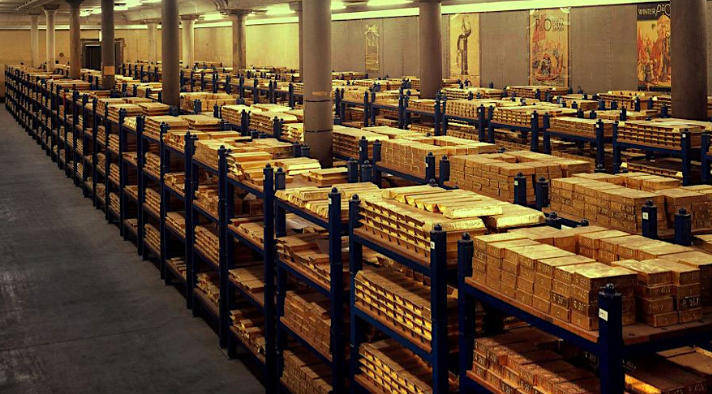
【文/观察者网 齐倩】 英格兰银行的地下金库资料图 彭博社称,中国和柬埔寨有着悠久的传统友谊,两国关系素来紧密。据外交部网站数据,2024年,中柬 双边贸易额178.34亿美元、同比增长20.3%。其中,中国对柬出口153.36亿美元、同比增长20.2%,自柬 进口24.98亿美元、同比增长20.7%。 报道还指出,全球各国央行一直在增加黄金储备以应对日益增长的地缘政治风险,推动黄金价格上月创 历史新高。目前,各国持有黄金大多储备在英国、瑞士和美国等传统中心。中国希望加入这一行列,成 为他国黄金的托管方,以建立一个较少依赖美元和西方中心的全球金融体系。 11月5日,彭博社援引消息称,柬埔寨将成为首批在中国储存黄金的国家之一,并指出这标志着中国推 动自身成为全球黄金中心的努力已取得早期进展。 有消息人士表示,柬埔寨计划将其部分储备存放在位于深圳保税区的金库中。 据透露,中方与柬埔寨的相关协议涉及存储新购黄金,而非转移现有库存。 消息人士还提到,除柬埔寨之外,还有其他几个国家也表达了在中国储备黄金的兴趣,正在权衡从伦敦 等传统中心分散黄金储备的好处。 各国央行负责管理储备资产。柬埔寨国家银行未立即置评。 上个月, ...

维持看涨!摩根大通预计金价明年底均价升至5055美元
Di Yi Cai Jing· 2025-10-23 23:17
Core Viewpoint - JPMorgan analysts maintain a bullish stance on gold, predicting an average price of $5,055 per ounce by Q4 2026, based on an assumption of average quarterly investor demand and central bank purchases of 566 tons [1][2]. Group 1: Market Dynamics - The expectation of a Federal Reserve rate cut cycle is seen as a factor that will support gold prices [1][3]. - Concerns about stagflation, the independence of the Federal Reserve, and currency devaluation risks create a favorable environment for gold [1][3]. - Recent price consolidation in gold is viewed as a healthy phenomenon, reflecting market digestion of rapid gains since August [1][5]. Group 2: Long-term Demand Drivers - A trend of "de-dollarization" is prompting some overseas investors to shift from dollar assets to gold, with potential price increases if the allocation to gold rises [2][3]. - Central banks are expected to maintain strong gold purchasing rates, averaging 566 tons quarterly over the next two years [2][3]. Group 3: Institutional Outlook - JPMorgan's price target is among the most optimistic, with other institutions like HSBC, Bank of America, and Goldman Sachs forecasting lower targets for gold prices by the end of 2026 [4]. - The consensus among institutions highlights that rate cut expectations and central bank buying will be key drivers in the next two years [4][5]. Group 4: Price Performance - Gold has risen over 50% this year, and while short-term volatility is expected, it is considered part of a bull market's phase of consolidation [5][6]. - Investor risk appetite, dollar performance, and U.S. bond yield changes are identified as primary variables influencing future gold prices [5][6].
地缘“完美风暴”酿危机红利 金价剑指4000
Jin Tou Wang· 2025-09-22 02:09
Core Viewpoint - The gold market is experiencing a bullish trend driven by global demand, geopolitical risks, and central bank strategies, with potential for prices to rise significantly by year-end [2][3][4]. Group 1: Market Dynamics - Gold is currently trading around $3,690 per ounce, showing a slight increase of 0.13% [1]. - In India, gold premiums have reached a 10-month high, indicating strong demand despite record prices [2]. - In contrast, China's gold prices are at a five-year discount, highlighting a divergence in market demand [2]. Group 2: Geopolitical Influences - Geopolitical tensions in regions such as Ukraine, Poland, and the Middle East are providing strong support for the gold market [3]. - The ongoing U.S.-China trade tensions may further escalate, adding to market uncertainty and driving gold prices higher [3]. Group 3: Central Bank Actions - Central banks globally are increasing their gold reserves as part of a de-dollarization strategy, contributing to a 43% surge in ETF holdings [2]. - This trend is expected to continue, reinforcing the bullish outlook for gold prices [2]. Group 4: Price Trends and Projections - Recent market movements show a reversal pattern, with gold prices recovering after a dip influenced by interest rate announcements [4]. - The price has risen approximately 200 points since breaking the $3,500 level, with a key resistance level around $3,705 [4]. - If uncertainties persist, gold prices could potentially reach $3,960 or even surpass $4,000 by year-end [3].
国际金价突破3690美元关口,半月涨幅超5%
Bei Jing Ri Bao Ke Hu Duan· 2025-09-16 14:06
Group 1 - International gold prices have surged significantly, with London spot gold prices exceeding $3,690 per ounce and COMEX gold futures reaching $3,720 per ounce, marking new historical highs [1] - Since August 29, international gold prices have been on an upward trend, breaking through the previous range of $3,200 to $3,450, and have increased by approximately 40% year-to-date, surpassing the strong 27% increase projected for 2024 [1] - Domestic gold jewelry prices have also risen sharply, with major brands reporting prices above 1,080 yuan per gram, reflecting a 50 yuan increase over the past two weeks [1] Group 2 - Key factors driving the continuous rise in gold prices include market expectations of an imminent interest rate cut by the Federal Reserve, ongoing geopolitical tensions, and concerns regarding the independence of the Federal Reserve, leading to increased investment in gold as a safe-haven asset [2] - Central banks in emerging markets are actively diversifying their reserve assets, with global central bank gold purchases increasing nearly fivefold since 2022 [2] - Analysts suggest that while gold is currently in an overbought territory and may face short-term correction risks, the long-term bullish fundamentals for gold remain solid, with projections indicating that gold prices could exceed $4,000 per ounce by 2026, and potentially reach $5,000 in the event of an economic recession [2]
中国央行连续第10个月增持黄金以推动储备资产多元化
Sou Hu Cai Jing· 2025-09-07 08:37
Core Insights - The People's Bank of China has increased its gold holdings for the 10th consecutive month, continuing its strategy to diversify its dollar-dominated reserve assets [1] - In August, China's gold reserves rose by 60,000 troy ounces to 74.02 million troy ounces, with a total increase of 1.22 million troy ounces since November of the previous year [1] - Gold prices have recently reached new highs, breaking a months-long stability, driven by bets on U.S. interest rate cuts and criticism of the Federal Reserve from the White House [1] - Year-to-date, gold prices have surged over 30%, exceeding $3,500 per ounce, with Goldman Sachs suggesting that any damage to the Federal Reserve's independence could push gold prices close to $5,000 [1] - Globally, while the pace of gold accumulation by central banks has slowed, geopolitical risks are expected to continue supporting official sector demand according to a recent report by the World Gold Council [1]
央行连续六个月增持黄金,仲量联行:未来还有继续增持空间
news flash· 2025-05-07 14:25
Core Insights - The central bank has increased its gold reserves for six consecutive months, indicating a strategic shift towards gold accumulation [1] - According to the chief economist of JLL Greater China, the current proportion of gold reserves in China's total reserves is still low, suggesting room for further increases in gold holdings [1] - Factors such as financial security and the diversification of reserve assets are driving the need for continued gold accumulation in China [1]

高盛:美元跌落、亚洲货币崛起,人民币和新加坡元将最受青睐
Hua Er Jie Jian Wen· 2025-04-30 11:26
Group 1 - Goldman Sachs indicates that as central banks seek to diversify their reserve assets and reduce reliance on the US dollar, the Korean won, Singapore dollar, and Chinese yuan are likely to be the biggest beneficiaries in Asia [1] - The report highlights that despite the US dollar and euro remaining primary reserve assets, central banks are expected to increase their allocation to Asian currencies [1] - The Korean won is expected to gain traction as South Korea is likely to be included in the FTSE World Government Bond Index (WGBI) next year, leading to increased global central bank holdings of Korean bonds and thus more demand for the won [1] - The Singapore dollar is favored due to Singapore's AAA rating, stable financial markets, and transparent trading environment, making it attractive for central bank investments [1] - The Chinese yuan benefits from China's position as one of the largest trading nations, providing it with a natural liquidity advantage and making it a "logical candidate" for increased use [1] Group 2 - The trend of "de-dollarization" began in 2022 following the US freezing of Russian dollar reserves amid the Russia-Ukraine conflict, raising concerns among global central banks about the safety of holding US dollars [2] - Uncertainties surrounding potential Trump re-election and fluctuating US fiscal and trade policies have eroded foreign confidence in US assets, contributing to a shift in market sentiment [2] - The Bloomberg Dollar Index has declined over 7% since its peak in February, while gold purchases have reached record highs, indicating a movement towards diversifying reserve currencies [2] - Goldman Sachs estimates that the US dollar is overvalued by approximately 17%, predicting a rotation of global assets towards alternatives, including Asian assets [2]

【招银研究|资本市场专题】从央行购金和投资需求看全球黄金需求变化
招商银行研究· 2025-03-25 09:23
Core Viewpoint - The global demand for gold is projected to reach a record high of 4,974 tons in 2024, driven primarily by central bank purchases and investment demand, despite a slight decrease in central bank purchases compared to previous years [2][5]. Group 1: Central Bank Purchases - Since 2022, central bank gold purchases have significantly increased, primarily led by emerging market central banks, with purchases doubling from around 500 tons to over 1,000 tons, contributing to a rise in gold prices [4][5]. - The increase in gold purchases is not uniform across all central banks; emerging markets like Poland, Turkey, China, Egypt, and India have been the main buyers, while some developed countries have sold gold [7]. - In 2024, central bank purchases are expected to slightly decrease but remain above 1,000 tons, influenced by various factors including market conditions and gold prices [8][16]. Group 2: Investment Demand - Gold investment demand is negatively correlated with U.S. real interest rates; lower real rates typically lead to higher investment in gold [9][10]. - After a peak in 2020, gold investment demand fell significantly due to rising real interest rates, but is expected to see a slight rebound in 2024 as the Federal Reserve signals a shift towards lower rates [13][18]. - Investment demand varies by region, with Asian markets showing net inflows into gold ETFs, while European and North American markets have experienced outflows [14]. Group 3: Future Outlook - Central bank purchases may slow down in the short term but are expected to remain in a long-term net buying cycle, influenced by geopolitical risks and market conditions [16][17]. - Investment demand is unlikely to see a significant rebound due to potential inflationary pressures from U.S. policies and high gold prices, which may suppress demand [18][19]. - Overall, while gold demand may not exceed 2024 levels, it is expected to remain high, with prices experiencing volatility but maintaining a long-term bullish trend [20][21].