原油需求

Search documents
冠通每日交易策略-20250610
Guan Tong Qi Huo· 2025-06-10 11:24
Report Industry Investment Rating No relevant content provided. Core Viewpoints of the Report - Crude oil prices are expected to fluctuate due to a combination of supply and demand factors, with supply pressure easing but demand data not performing well [3]. - Urea prices are expected to continue to weaken, with a possible rebound in the future, and the strength of the rebound depends on export dynamics [4]. - Copper prices are currently oscillating strongly, mainly supported by low inventory, and attention should be paid to inventory changes under the influence of tariff expectations [9]. - Lithium carbonate prices are expected to have a rebound trend at a low valuation, and short positions can be适量closed out, followed by a strategy of shorting on rebounds [10]. - Asphalt prices are expected to oscillate at a high level in the near term, and it is recommended to go long on the 09 - 12 spread [12]. - PP, plastic, PVC, and soybean oil prices are all expected to oscillate at a low level, affected by factors such as supply - demand imbalance and inventory pressure [14][15][17][18]. - Soybean meal prices are expected to maintain an oscillating and strengthening trend [20]. - Coking coal prices are generally bearish due to loose supply - demand and weakening demand [21]. Summary by Relevant Catalogs Crude Oil - Supply: OPEC+ will increase production by 411,000 barrels per day in July, but actual production growth is less than expected. Canadian wildfires have led to a reduction in production, and US oil production is expected to decline [3]. - Demand: Market risk appetite has rebounded, but refined oil demand and inventory data are not good, and the negative impact of the global trade war on the economy has not been fully reversed [3]. - Price trend: Expected to oscillate [3]. Urea - Supply: There are temporary inspections in some factories, and daily production has decreased, but the daily production is still around 200,000 tons [4]. - Demand: Market sentiment is weak, agricultural demand is not strong, and compound fertilizer factories are mainly focused on inventory reduction [4]. - Price trend: The price dropped by nearly 2% today, and the market sentiment is expected to continue to weaken, with a possible rebound in the future [4]. Copper - Supply: The supply of copper concentrates is tight, and smelters face the risk of production reduction due to losses. Other regions' copper inventories have decreased due to steel tariffs [9]. - Demand: Apparent consumption has decreased, downstream开工率has declined, and demand is the main factor restricting price increases [9]. - Price trend: Currently oscillating strongly, supported by low inventory, and attention should be paid to inventory changes under tariff expectations [9]. Lithium Carbonate - Supply: Production is expected to increase in June, and the fundamental situation is still one of oversupply [10]. - Demand: Downstream procurement is cautious, and the support for prices is limited [10]. - Price trend: Oscillating around 60,000 yuan, with a rebound trend at a low valuation, and short positions can be适量closed out [10]. Asphalt - Supply: The starting rate has rebounded, and the scheduled production in June is expected to increase [12]. - Demand: The starting rate of downstream industries has fluctuated, and the demand for road asphalt is restricted by funds [12]. - Price trend: Expected to oscillate at a high level in the near term, and it is recommended to go long on the 09 - 12 spread [12]. PP - Supply: Some overhauled devices have restarted, and new devices have been put into production, increasing supply [13][14]. - Demand: Downstream recovery is slow, new orders are limited, and inventory pressure is high [13][14]. - Price trend: Expected to oscillate at a low level [14]. Plastic - Supply: Some overhauled devices have restarted, and new production capacity has been put into operation [15]. - Demand: Downstream开工率is at a low level, and new orders are slow to follow up, with high inventory pressure [15]. - Price trend: Expected to oscillate at a low level [15]. PVC - Supply: The starting rate has increased, and social inventory is still high [16][17]. - Demand: Downstream开工率has declined, and export is affected by policies. Demand improvement is limited [16][17]. - Price trend: Expected to oscillate at a low level [17]. Soybean Oil - Supply: The inventory of imported soybeans has increased, and the soybean crushing volume is at a historical high, with high inventory [18]. - Demand: Terminal demand is weak, and downstream stocking willingness is low [18]. - Price trend: Expected to oscillate weakly in the short term [18]. Soybean Meal - Supply: The supply in the domestic market is sufficient, and the inventory is gradually accumulating [19][20]. - Demand: The weather in the United States is favorable for soybean growth, and the supply outlook is good [19]. - Price trend: Expected to maintain an oscillating and strengthening trend [20]. Coking Coal - Supply: The customs clearance volume remains high, and the total inventory is at a high level [21]. - Demand: Steel mills' demand for coking coal has decreased, and terminal demand has weakened [21]. - Price trend: Generally bearish [21].
EIA原油周度数据报告-20250530
Ge Lin Qi Huo· 2025-05-30 05:50
Report Summary 1. Report Industry Investment Rating No investment rating information is provided in the report. 2. Core Viewpoints - The peak travel season in the United States supports the demand for crude oil, leading to a decline in crude oil inventories [1]. - The ruling of the US International Trade Court on May 29 improved the market's expectations for the global economy and crude oil demand, causing crude oil prices to rebound. However, on May 30, the US Federal Court's decision to consider the government's appeal and keep the reciprocal tariffs in effect led to a drop in oil prices. Attention should be paid to the impact of the US policy fluctuations on crude oil [1]. 3. Data Summary Inventory Data - As of last week, US commercial crude oil inventories were 440.363 million barrels, a decrease of 2.795 million barrels (-0.63%) from the previous week; Cushing crude oil inventories were 23.51 million barrels, an increase of 75,000 barrels (0.32%); gasoline inventories were 223.081 million barrels, a decrease of 2.441 million barrels (-1.08%); distillate inventories were 103.408 million barrels, a decrease of 724,000 barrels (-0.70%); total oil product inventories were 1.222411 billion barrels, a decrease of 665,000 barrels (-0.05%); strategic petroleum reserve inventories were 401.313 million barrels, an increase of 820,000 barrels (0.20%) [1][2]. Production and Trade Data - The US refinery utilization rate was 90.2%, a decrease of 0.5 percentage points (-0.55%) from the previous week; crude oil production was 13.401 million barrels per day, an increase of 9,000 barrels per day (0.07%); crude oil imports were 6.351 million barrels per day, an increase of 262,000 barrels per day (4.30%); crude oil exports were 4.301 million barrels per day, an increase of 794,000 barrels per day (22.64%) [2].
EIA周度报告点评-20250522
Dong Wu Qi Huo· 2025-05-22 12:04
Report Summary 1. Report Industry Investment Rating No investment rating is provided in the report. 2. Core View of the Report The EIA weekly report is bearish. Crude oil and refined oil inventories unexpectedly increased across the board, crude oil exports continued to weaken, and terminal demand was weak, reducing the possibility of a reversal in crude oil demand [8]. 3. Summary by Relevant Catalogs 3.1 Main Data - As of May 16, U.S. commercial crude oil inventories were 443.158 million barrels, a week - on - week increase of 1.328 million barrels, contrary to the expected decrease of 1.3 million barrels. Cushing inventories decreased by 457,000 barrels, and strategic reserve inventories increased by 843,000 barrels [2]. - Gasoline inventories increased by 816,000 barrels, contrary to the expected decrease of 500,000 barrels, and distillate inventories increased by 579,000 barrels, contrary to the expected decrease of 1.4 million barrels [2]. - U.S. crude oil production increased by 5,000 barrels per day to 13.392 million barrels per day, and net imports increased by 110,000 barrels per day to 2.582 million barrels per day [3]. - The four - week smoothed terminal apparent demand for U.S. crude oil decreased by 211,000 barrels per day to 19.6245 million barrels per day, gasoline apparent demand decreased by 192,500 barrels per day to 8.81325 million barrels per day, distillate apparent demand decreased by 122,750 barrels per day, and jet fuel apparent demand decreased by 68,500 barrels per day to 1.6865 million barrels per day [3]. 3.2 Report Comment - The unexpected increase in U.S. commercial crude oil inventories last week was mainly due to continued low crude oil exports and increased net imports. The four - week smoothed export volume hit a new low, indicating weakening global crude oil demand [4]. - The weekly refinery utilization rate increased for the fifth consecutive week by 0.5% to 90.7%, suggesting that this year's slightly longer maintenance season may be coming to an end [4]. - U.S. crude oil production has declined recently, mainly affected by falling oil prices. The average new well operating cost of U.S. shale oil companies is $65 per barrel of WTI [4]. - The strong gasoline demand momentum that exceeded the seasonal norm suddenly stopped, leading to an unexpected increase in gasoline inventories. With the approaching Memorial Day, the poor performance of gasoline demand is worrying. Distillate demand hit a 13 - month low, corresponding to the weakening manufacturing PMI [6]. 3.3 Market Impact - The EIA report was bearish. Inventory increases, weakening exports, and weak terminal demand all pointed to a weak oil market. The U.S. EIA report on the night before last contributed to the decline in oil prices, resulting in a negative daily line [8]. - Oil prices opened higher yesterday due to news of Israel's potential attack on Iranian nuclear facilities, but the lack of a realistic basis for such an attack led to a subsequent decline in oil prices [8].
EIA周度报告点评-20250515
Dong Wu Qi Huo· 2025-05-15 06:57
Report Summary - **Report Title**: EIA Weekly Data Report - **Report Date**: May 15, 2025 - **Report Author**: Xiao Huo (Z0016296) Report Industry Investment Rating - No investment rating provided in the report Report's Core View - The EIA report for this week is relatively bearish, with the four - week smoothed weekly export data at a 4 - month low and 6 - month second - lowest, indicating a gradual weakening of global crude oil demand. Although falling oil prices have boosted US domestic gasoline demand before the driving peak season, overall demand remains mediocre, and the total inventory of the crude oil chain has increased more than the crude oil inventory, meaning refined products are still accumulating inventory [8] Summary by Relevant Catalog 1. Main Data Overview - As of May 9, US commercial crude oil total inventory was 441.83 million barrels, a week - on - week increase of 3.454 million barrels, contrary to the expected decrease of 1.1 million barrels. Cushing inventory decreased by 1.069 million barrels, and strategic reserve inventory increased by 0.528 million barrels. Gasoline inventory decreased by 1.022 million barrels, exceeding the expected decrease of 0.56 million barrels, and distillate inventory decreased by 3.155 million barrels, contrary to the expected increase of 0.13 million barrels [2] 2. Data Changes from May 2 to May 9 - US commercial crude oil inventory increased from 438.376 million barrels to 441.83 million barrels; Cushing crude oil inventory decreased from 24.961 million barrels to 23.892 million barrels; US strategic reserve inventory increased from 399.122 million barrels to 398.62 million barrels; US gasoline inventory decreased from 225.728 million barrels to 224.706 million barrels; US distillate inventory decreased from 106.708 million barrels to 103.553 million barrels; US crude oil chain total inventory increased from 1.612398 billion barrels to 1.617795 billion barrels; US crude oil production increased from 13.367 million barrels per day to 13.387 million barrels per day; US crude oil net imports increased from 2.05 million barrels per day to 2.472 million barrels per day; US crude oil processing volume increased from 16.071 million barrels per day to 16.401 million barrels per day; US crude oil terminal apparent demand (four - week smoothing) increased from 19.756 million barrels per day to 19.8355 million barrels per day; US gasoline apparent demand (four - week smoothing) increased from 8.92275 million barrels per day to 9.00575 million barrels per day; US distillate apparent demand (four - week smoothing) decreased from 3.708 million barrels per day to 3.68775 million barrels per day; US jet fuel apparent demand (four - week smoothing) decreased from 1.85725 million barrels per day to 1.755 million barrels per day [3] 3. Analysis of Crude Oil Inventory Increase - The unexpected increase in US commercial crude oil inventory last week was mainly due to the decline in export volume. The four - week smoothed export volume dropped to the lowest level since early January, suggesting a weakening of overseas demand. The weekly refinery utilization rate has increased for the fourth consecutive week, rising by 1.2% to 90.2%, breaking through the 90% mark, indicating that this year's slightly longer maintenance season may be gradually ending. US crude oil production has recently declined, mainly affected by falling oil prices. The Dallas Fed's energy survey report for the first quarter of this year shows that the average new well operating cost of US shale oil companies is WTI $65 per barrel [4] 4. Analysis of Product Oil Situation - In terms of refined oil, the apparent demand for gasoline has been continuously strengthening, perhaps boosted by the recent falling prices, resulting in an unexpected decline in gasoline inventory. Diesel inventory has also decreased significantly [6] 5. Impact on Oil Prices - After the release of this week's data, oil prices fluctuated downward. This morning, Iran's inner circle made its first concession on nuclear weapons, causing oil prices to fall further [8]
油价今晚要涨?车主们可以松一口气了
Sou Hu Cai Jing· 2025-04-30 07:00
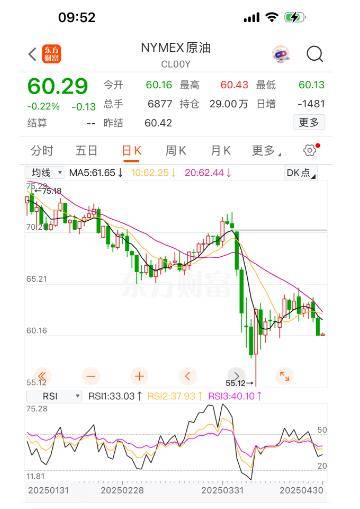
Core Viewpoint - The domestic fuel price adjustment has been suspended due to a recent decline in international oil prices, providing relief for drivers during the holiday period [1][3]. Group 1: International Oil Price Trends - International oil prices have experienced consecutive declines, with New York and Brent crude futures dropping by 1.79% and 1.93% on April 28, and further declines of 3.08% and 2.75% on April 29 [1][3]. - The current average price of crude oil is $64.82 per barrel, with a change rate of 0.65%, not reaching the minimum adjustment threshold [1]. - Factors contributing to the decline in oil prices include the U.S.-initiated tariff war, expectations of reduced oil demand, increasing U.S. oil inventories, and OPEC's proposal to accelerate production increases in June [3]. Group 2: Domestic Fuel Price Adjustments - Since the beginning of the year, domestic gasoline and diesel prices have undergone "three increases, four decreases, and one suspension," resulting in a cumulative decrease of 0.34 yuan per liter for 92-octane gasoline [5]. - On April 17, there was a significant price drop, with 92-octane gasoline decreasing by 0.38 yuan per liter, 95-octane by 0.41 yuan, and 0 diesel by 0.4 yuan [5]. - Current prices in Zhejiang Province are 7.07 yuan per liter for 92-octane gasoline, 7.52 yuan for 95-octane gasoline, and 6.72 yuan for 0 diesel [5].