全球经济预期

Search documents
美银1月基金经理调查 除了乐观还是乐观【播客】
Datayes· 2026-01-21 10:54
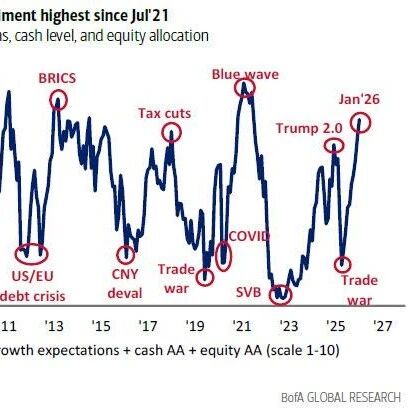
Core Insights - The sentiment among fund managers is extremely optimistic, with a significant shift in macroeconomic expectations from "recession" to "prosperity" [1][2] - Global growth expectations have risen to 38%, an increase of 20 percentage points, marking the highest level since July 2021, while the probability of recession has dropped to 9%, the lowest since January 2022 [1] - Profit expectations are also high, with a net 44% of managers optimistic about EPS over the next 12 months, the highest since July 2021 [2] - Concerns about stagflation have decreased from 58% to 39%, with 34% anticipating a "prosperity" scenario and 18% a "golden age" [3] - Inflation expectations driven by tariffs have significantly declined, with a net 3% believing CPI will decrease [4] Asset Allocation - There is a strong preference for equities and commodities, while bonds are being abandoned [5] - Stock allocation is at a net overweight of 48%, the highest since December 2024, and commodity allocation is at 26%, the highest since June 2022, while bond allocation is at a net underweight of 35%, the highest since September 2022 [12] - The banking sector has become the most overweight industry, while consumer staples are at their largest underweight since February 2014 [12] - High-yield bonds are expected to outperform investment-grade bonds for the first time [12] - The most crowded trade is long gold, with 51% of managers favoring it, surpassing the "Seven Sisters" trade at 27% [12] Risk Landscape - The primary risks identified are geopolitical tensions and the potential for an AI bubble, with geopolitical conflict cited by 28% of respondents and AI bubble concerns by 27% [5][6] - Credit events are anticipated to be triggered by private equity/private credit (39%) and large-scale capital expenditures in AI (35%) [6] - Political expectations for the 2026 midterm elections are nearly evenly split between "red wave" and "blue wave" scenarios [7] - There is a notable division regarding AI stocks, with 55% believing they are "not in a bubble" [8] Market Sentiment - The bull-bear indicator stands at 9.4, indicating a deep "sell" zone, with cash levels at 3.2%, a historical low [11] - A record 48% of respondents are "zero hedged" against market downturns, the highest since January 2018 [11] - Risk appetite is above normal by 16%, the highest in four years, with 49% of managers expecting an "impossible landing" scenario for the global economy [11] Strategic Insights - Michael Hartnett warns that in a world filled with good news, low hedging may seem harmless, but any unexpected negative turn could amplify impacts, highlighting current market fragility [9]

2026年有色金属的思考总结与展望
雪球· 2026-01-14 07:41
Core Viewpoint - The article discusses the significant changes in the pricing logic of non-ferrous metals, emphasizing the rise of strategic resource populism as a key factor influencing market pricing, particularly after the implementation of equal tariffs in the second half of 2025 [2][3]. Non-Ferrous Metals Market Analysis - The traditional pricing framework for non-ferrous metals has been driven by global macro liquidity, economic expectations, and the US dollar index, but recent years have shown a divergence between metal prices and global economic indicators [4][6]. - The current economic environment is characterized by low global PMI levels, yet non-ferrous metal prices have outperformed expectations, indicating a shift in market dynamics influenced by monetary attributes and strategic reserve demands [4][7]. Trading Framework and Historical Performance - The core trading framework focuses on the economic cycle, particularly inventory cycles, with liquidity as an important extension. However, this framework has faced challenges in the non-ferrous metals sector due to unique supply and demand dynamics [6][7]. - Historical trading experiences highlight the importance of adhering to a core framework while recognizing the evolving market conditions, leading to successful investments in precious metals and strategic small metals [9][10]. Sector-Specific Insights - Precious Metals (Gold, Silver): The article notes a strong performance in gold and silver due to anticipated changes in US monetary policy and geopolitical tensions, with significant gains observed over the past three years [9][10]. - Strategic Small Metals (Antimony, Tungsten, Rare Earths): The author emphasizes early positioning in strategic small metals, benefiting from export controls and geopolitical shifts, resulting in substantial price increases [11][12]. - Industrial Metals (Copper, Aluminum): Despite a generally positive long-term outlook, concerns remain regarding the sustainability of demand due to ongoing issues in the real estate sector and uncertainties in US economic growth [13][14]. 2026 Outlook for Non-Ferrous Metals - The market for non-ferrous metals is expected to remain active, but the author advocates for a cautious approach, focusing on identifying clear entry points rather than participating in the current market excitement [16][17]. - Industrial metals are viewed with caution due to unresolved concerns about the real estate market and the sustainability of AI-driven capital expenditures, with a recommendation to monitor these sectors closely [17][18]. - For strategic small metals, the long-term outlook remains positive, but current high prices necessitate waiting for favorable entry points [20][21]. - Precious metals continue to show long-term benefits, but short-term caution is advised due to market volatility and the need for clear buying signals [21][22]. Conclusion - The article concludes that while the non-ferrous metals market is currently vibrant, the focus should remain on waiting for definitive buying opportunities rather than engaging in all market trends, emphasizing the importance of patience and strategic decision-making in investment [22][24].

大宗商品“表情”各异:原油创新低,铜金为何“分道扬镳”?
Sou Hu Cai Jing· 2025-12-13 03:06
Core Viewpoint - The global commodity market is experiencing divergent trends, with oil prices hitting a low, copper prices facing significant drops, and gold showing mixed signals, reflecting complex global economic dynamics driven by supply-demand fundamentals, industry logic, and monetary policy [1][3][5]. Oil Market - Oil prices have fallen to their lowest level since May, primarily due to an oversupply situation, with market expectations indicating that global oil supply will exceed demand next year [3]. - High production levels in the U.S. and concerns about economic prospects are suppressing demand expectations, creating fundamental pressure on oil prices [3]. - The approaching holiday season is leading to thin trading volumes, which can amplify price volatility in response to market movements, such as declines in U.S. stock markets [3]. Copper Market - Copper prices dropped by 3%, influenced by a significant decline in U.S. tech stocks, which are seen as a proxy for future demand [3]. - The market has redefined copper as the "AI metal," essential for AI data center construction and grid upgrades, making its pricing sensitive to shifts in tech stock performance [3]. - The recent price drop is viewed as a correction of previous rapid gains, but the long-term narrative surrounding global green transition and electrification remains strong [4]. Gold Market - Gold's price movements are closely tied to market perceptions of Federal Reserve policy, with recent hawkish comments from Fed officials dampening expectations for rapid rate cuts [3]. - Although gold is supported by safe-haven demand, the momentum for significant price increases has weakened, leading to a narrowing of its price gains [3]. - The core rationale for holding gold should focus on hedging against currency credit risks and extreme uncertainties rather than chasing short-term rate cut benefits [4]. Investment Strategy - For oil, the current oversupply situation suggests that it is better suited as an indicator of global demand and economic cycles rather than a long-term investment, with high short-term trading risks [4]. - For copper, the recent adjustment may provide a better entry point for investors who believe in its long-term value, emphasizing the need to distinguish between "bubble" and "value" [4]. - For gold, the current market conditions suggest a phase of high volatility, where maintaining positions for observation is preferable to aggressive buying [4].

油价冰火两重天!12月10日,92、95汽油新售价,差距大到离谱!
Sou Hu Cai Jing· 2025-12-10 16:58
Core Viewpoint - The oil prices have plummeted to a four-year low, with a significant drop of over 0.6 yuan per liter in just one year, reflecting broader economic implications and consumer sentiment [1] Group 1: Current Oil Prices - As of the latest data, WTI crude oil is priced at $58.23 per barrel, down 1.10%, while Brent crude oil has fallen to $61.91 per barrel [1] - The current price levels indicate a return to the lows seen four years ago, impacting consumer budgets and overall economic sentiment [1] Group 2: Market Dynamics - The oil market is experiencing a complex interplay of supply and demand, characterized by a "supply glut" due to increased production signals from Iraq, which is pressuring prices downward [3] - Geopolitical tensions, particularly the Russia-Ukraine conflict and uncertainties surrounding Venezuela's policies, contribute to market volatility and risk premiums [3] Group 3: Monetary Policy Influence - The Federal Reserve's interest rate decisions significantly affect the strength of the dollar and global economic expectations, which in turn influence oil prices [4] - The next adjustment window for domestic oil prices is on December 22, with a current oil change rate of -0.89%, suggesting a potential price reduction of 40 yuan per ton [4] Group 4: Consumer Sentiment - There is a shift in consumer psychology from passive acceptance of rising prices to a more proactive wait-and-see approach regarding potential further declines in oil prices [4] - The emotional response to falling oil prices is mixed, with consumers feeling both relief and concern about the underlying economic implications of sustained low prices [6][7]

黄金价格多少一克?11月12日黄金价格
Sou Hu Cai Jing· 2025-11-12 10:40
Group 1 - The core point of the news is the fluctuation in gold prices, which reached a high of 4145.39 USD/oz before retreating to around 4122 USD/oz, influenced by the impending end of the U.S. government shutdown, the resumption of economic data releases, and signals from Federal Reserve officials regarding potential interest rate cuts [1] Group 2 - As of 12:50 PM on the reporting day, international gold prices showed strong performance, with London spot gold at 4106 USD/oz and U.S. gold at 4112 USD/oz. Silver prices were reported at 50.8 USD/oz in London and 50.9 USD/oz in the U.S. [3] - In the domestic market, real-time gold prices reached 945.88 CNY/g, silver at 11.6 CNY/g, and platinum at 365 CNY/g, with gold recovery prices at 937 CNY/g [3] Group 3 - Retail prices for branded gold jewelry showed variations, with Shui Bei gold at 1025 CNY/g and other brands like Chow Tai Fook and King Fook at 1313 CNY/g, reflecting a 5 CNY increase from the previous day [5] - Bank gold bar prices were reported as follows: ICBC at 969.17 CNY/g, CCB at 961.80 CNY/g, BOC at 961.68 CNY/g, and ABC at 975.55 CNY/g [5] Group 4 - The recent increase in gold prices is primarily driven by global economic expectations and monetary policy directions, leading to higher costs for consumers purchasing gold jewelry. Investors are advised to consider gold as a safe-haven asset while being cautious of short-term volatility [7] - The gold market remains influenced by multiple factors, and future price trends should be monitored in relation to international economic data and Federal Reserve policy dynamics [7]
黄金再飙新高:突破4070美元/盎司,这一波涨势背后藏着什么?
Sou Hu Cai Jing· 2025-11-10 21:13
Core Viewpoint - The recent surge in gold prices, breaking through $4,070 per ounce, is driven by a combination of macroeconomic expectations, global risks, and long-term institutional buying, rather than mere speculative trading [1][2][3]. Group 1: Macroeconomic Factors - The U.S. economy is showing signs of weakness, leading investors to anticipate a potential interest rate cut by the Federal Reserve early next year, which benefits gold in a low-interest-rate environment [2][4]. - Inflation in the U.S. is declining, and economic slowdown is prompting a shift in investor sentiment towards gold as a safe haven asset [4][7]. Group 2: Global Risks - Ongoing geopolitical tensions and increased volatility in European and American markets are causing capital to flow out of high-risk assets and into safer investments like gold [5][7]. - The rise in gold prices reflects growing global market concerns about economic stagnation, weak consumer confidence, and pressured corporate earnings [7][12]. Group 3: Institutional Buying - Central banks and institutional investors are significantly increasing their gold holdings, with the World Gold Council reporting record net purchases by official sectors this year [6][10]. - The trend indicates a structural return to gold as a long-term investment, moving beyond short-term speculation [7][10]. Group 4: Market Dynamics - The weakening U.S. dollar enhances gold's appeal, making it cheaper for investors using other currencies, thus contributing to rising demand [7][12]. - The breakout above the $4,000 resistance level suggests a new pricing phase for gold, indicating a shift in market dynamics [7]. Group 5: Consumer Behavior - High gold prices are increasing jewelry prices but are also stimulating demand in certain regions, such as China, where initiatives like "old-for-new" and investment in gold bars are gaining popularity [11]. Group 6: Macro Implications - The sustained rise in gold prices signals heightened global risk concerns and reflects a shift in the global economic landscape, indicating a potential preparation for a new economic cycle [12].
EIA原油周度数据报告-20250530
Ge Lin Qi Huo· 2025-05-30 05:50
Report Summary 1. Report Industry Investment Rating No investment rating information is provided in the report. 2. Core Viewpoints - The peak travel season in the United States supports the demand for crude oil, leading to a decline in crude oil inventories [1]. - The ruling of the US International Trade Court on May 29 improved the market's expectations for the global economy and crude oil demand, causing crude oil prices to rebound. However, on May 30, the US Federal Court's decision to consider the government's appeal and keep the reciprocal tariffs in effect led to a drop in oil prices. Attention should be paid to the impact of the US policy fluctuations on crude oil [1]. 3. Data Summary Inventory Data - As of last week, US commercial crude oil inventories were 440.363 million barrels, a decrease of 2.795 million barrels (-0.63%) from the previous week; Cushing crude oil inventories were 23.51 million barrels, an increase of 75,000 barrels (0.32%); gasoline inventories were 223.081 million barrels, a decrease of 2.441 million barrels (-1.08%); distillate inventories were 103.408 million barrels, a decrease of 724,000 barrels (-0.70%); total oil product inventories were 1.222411 billion barrels, a decrease of 665,000 barrels (-0.05%); strategic petroleum reserve inventories were 401.313 million barrels, an increase of 820,000 barrels (0.20%) [1][2]. Production and Trade Data - The US refinery utilization rate was 90.2%, a decrease of 0.5 percentage points (-0.55%) from the previous week; crude oil production was 13.401 million barrels per day, an increase of 9,000 barrels per day (0.07%); crude oil imports were 6.351 million barrels per day, an increase of 262,000 barrels per day (4.30%); crude oil exports were 4.301 million barrels per day, an increase of 794,000 barrels per day (22.64%) [2].
巨富金业:全球经济预期不明,美联储决议焦点,金银低吸机会解读
Sou Hu Cai Jing· 2025-05-06 07:40
Market Overview - The fluctuation of the US dollar index has a significant impact on gold prices, as gold is priced in dollars. The current dollar index trend has led to cautious investor sentiment towards gold, resulting in narrow price fluctuations [2] - Global economic data expectations also influence the gold market. Uncertainty regarding economic outlook leads to investor hesitation, affecting gold demand and causing a lack of clear upward or downward momentum in gold prices [2] - The direction of the Federal Reserve's monetary policy remains a key variable for the gold market. Divergence exists in market expectations regarding future interest rate decisions, leading to cautious investor behavior ahead of the May 8 Federal Reserve rate decision [2] Technical Analysis - Gold - The spot gold price opened at $3239.46 per ounce, experienced a strong intraday rise, reaching a high of $3337.46, and closed at $3333.96, indicating a bullish market trend [5] - On the daily chart, the closing price is significantly above the 20-day moving average, suggesting strong bullish momentum and opportunities for long positions [5] - The hourly chart indicates a departure from the bottom consolidation range, with a strong upward trend along the 20-day moving average, suggesting further upward potential [6] Technical Analysis - Silver - The silver price opened at $32.002, showing wide fluctuations and reaching a high of $32.669, closing at $32.473, indicating a bullish trend [8] - The closing price is back above the 20-day moving average, reinforcing a bullish outlook and opportunities for long positions [8] - The hourly chart shows silver returning to the high point of the consolidation range, with a need to observe if it can effectively break through the previous resistance level [8]