国产自主可控

Search documents
逆势拉升!北方华创大涨5%,半导体设备ETF(561980)盘中上涨2.25%,连续三日“吸金”累计超6500万元
2 1 Shi Ji Jing Ji Bao Dao· 2025-11-18 02:44
Group 1 - The semiconductor industry chain is experiencing a strong performance despite the overall market decline, with the semiconductor equipment ETF (561980) rising by 2.25% during the trading session [1] - Notable stocks within the semiconductor sector include North Huachuang, which increased by over 5%, and several others like Changchuan Technology and Zhongwei Company, which rose by over 3% [1] - Semiconductor equipment ETF (561980) has seen a net inflow of over 65 million yuan in the last three trading days, accumulating nearly 119 million yuan in net inflows over the past ten trading days [1] Group 2 - SMIC reported a significant increase in production capacity, with a monthly output surpassing 1 million wafers, and a capacity utilization rate reaching 95.8% [1] - The high capacity utilization rate at SMIC indicates strong industry demand, and the semiconductor industry is expected to benefit from structural opportunities driven by AI and domestic substitution [1] - Western Securities anticipates a "price cycle" and "product iteration cycle" in the storage sector by 2026, which may lead to sustained growth in orders for equipment companies [2] - The semiconductor equipment ETF (561980) tracks the semiconductor equipment, materials, and integrated circuit design sectors, with over 90% of its index comprising these industries [2] - The index has shown a remarkable annual increase of 51% as of November 17, 2025, with a maximum increase exceeding 80%, outperforming similar indices in the semiconductor materials and equipment sectors [2]




芯片ETF(512760)回调超3% AI拉动下存储芯片迎来“周期与成长共振”
Mei Ri Jing Ji Xin Wen· 2025-10-31 06:01
Core Viewpoint - The electronic industry is experiencing an inflation trend in the upstream sector, with AI driving a "resonance of cycle and growth" in the storage chip market. AI demand is stronger than previously expected, while the non-AI market is showing a mild recovery [1]. Group 1: AI Demand and Market Dynamics - AI demand continues to be robust, exceeding prior expectations, which is leading to supply shortages in storage chips, certain passive components, and high-end CCL segments [1]. - Major cloud service providers are expanding their procurement of NVIDIA GPU solutions, with a forecast that the combined capital expenditure of the top eight CSPs will exceed $420 billion by 2025, representing a 61% year-on-year increase [1]. Group 2: Domestic Market Opportunities - There is a discrepancy in expectations regarding the domestic capabilities and sustainability of demand for computing and storage solutions, with storage prices rising across the board [1]. - The mobile and server markets are opening up opportunities for domestic storage manufacturers, which may lead to a period of simultaneous volume and price increases [1]. Group 3: Semiconductor ETF - The Chip ETF (512760) tracks the China Semiconductor Index (990001), which selects listed companies in semiconductor materials, equipment design, manufacturing, packaging, and testing from the Chinese A-share market to reflect the overall performance of the semiconductor industry [1].
沪指创十年新高!半导体设备ETF(561980)涨3%,机构:国产自主可控逻辑在科技自强战略下更为稳固
2 1 Shi Ji Jing Ji Bao Dao· 2025-10-28 01:48
Group 1 - The Shanghai Composite Index is approaching 4000 points, reaching a ten-year high, with a strong performance in domestic semiconductor stocks [1] - The Semiconductor Equipment ETF (561980) saw a daily increase of 2.97% and a net inflow of 1.283 billion yuan over the last 20 trading days, with a year-to-date share increase of 76.1% [1] - Domestic GPU leader Muxi has passed regulatory approval, and significant technological breakthroughs in the photoresist sector are catalyzing the semiconductor industry [1] Group 2 - Recent developments in photoetching technology are crucial for advancing chip manufacturing processes, with a team from Peking University revealing new insights into the microscopic structure of photoresist molecules [1] - The semiconductor sector is experiencing a structural market trend driven by policy expectations and the AI industry, with strong performance reported by several semiconductor companies in their Q3 results [2] - Companies like Haiguang Information and Cambrian have reported significant year-on-year growth in revenue and net profit, with Jingrui Electric Materials showing a net profit increase of over 192 times year-on-year [2] Group 3 - The Semiconductor Equipment ETF (561980) tracks the CSI Semiconductor Index, focusing on 40 companies in the semiconductor equipment, materials, and design sectors, with a high concentration of top-weighted stocks [3] - The index has a high concentration in the upstream and midstream sectors, with approximately 90% of its composition in equipment, materials, and design, indicating significant potential for domestic innovation [3]
长线看好量子计算,稀缺铲子股为何值得重视?
2025-10-27 00:31
Summary of Quantum Computing Industry Conference Call Industry Overview - The conference call focuses on the **quantum computing industry**, highlighting the transition from research to commercialization, particularly with **Guangdong Quantum** becoming controlled by **China Telecom** [1][3]. - The **15th Five-Year Plan** includes quantum technology as a key economic growth point, ensuring ample funding support for the industry's long-term development [1][3]. Key Points and Arguments - **Strong Growth Indicators**: Domestic quantum computing companies like **Liangxi** and **Guangdong Quantum** have shown significant increases in contract liabilities and revenue, indicating robust growth momentum [1][3]. - **Investment Recommendations**: The call recommends focusing on leading companies such as **Guangdong Quantum** (system integration) and **Core Instruments** (equipment), which are expected to drive sector growth and achieve substantial revenue increases [1][4][5]. - **Market Catalysts**: Key factors driving the market include: - **Policy Support**: Both domestic and U.S. government initiatives are backing quantum computing [2][6]. - **Investment from Major Players**: Companies like **NVIDIA** have invested heavily in quantum computing, indicating confidence in the sector's future [6]. - **Technological Breakthroughs**: Advances in chip technology and the ability to simulate complex problems position quantum computing favorably in sectors like finance, pharmaceuticals, and chemicals [2][7]. Financial Performance - **Contract Liabilities and Revenue Growth**: Companies in the sector are experiencing contract liabilities and revenue growth exceeding 100%, making them attractive investment targets [5][20]. - **Projected Market Growth**: By 2028, the global quantum computing market is expected to reach **$37 billion**, with China potentially capturing one-third of this market [19][21]. Investment Landscape - **Emerging Companies**: Companies like **Benyuan Quantum** and **Guangdong Quantum** are preparing for IPOs, which could significantly increase their market valuations [9]. - **Key Players**: The leading domestic quantum computing companies include **Guangdong Quantum**, **Benyuan**, and **Guoyi**, all of which are expected to expand their market share significantly [18][21]. Technical Insights - **Importance of Cooling Systems**: The cooling systems are critical for maintaining superconductivity in quantum computers, with companies like **Core Instruments** leading in this area [23][24]. - **Role of Measurement and Control Systems**: These systems are essential for the operation of quantum bits, with high precision required for effective functioning [25]. Market Dynamics - **Investment Trends**: The U.S. plans to invest **$5 billion** in quantum computing from 2025 to 2029, while China is expected to invest significantly more annually [19]. - **Supply Chain Insights**: The demand for components like cables and cooling systems is expected to grow exponentially as the number of qubits in quantum computers increases [26]. Conclusion - The quantum computing industry is poised for significant growth driven by technological advancements, strong policy support, and increasing investments from major players. Companies like **Guangdong Quantum** and **Core Instruments** are highlighted as key investment opportunities due to their strong performance and market positioning [27][28].

先扬后震!创业板能否迎来新一轮上涨?
Zhong Guo Jing Ji Wang· 2025-10-24 07:50
Core Viewpoint - The 2025 ChiNext market is expected to experience a "first rise then shake" trend, driven by valuation recovery, significant profit improvement expectations, and supportive capital market policies [1][2]. Group 1: Key Factors Supporting ChiNext in 2025 - Three key factors that align with expectations include valuation repair, with the ChiNext's valuation at historically low levels at the beginning of the year, providing a high safety margin for rebound [1] - Significant improvement in profit expectations, with analysts predicting a profit growth rate of over 25% for the ChiNext in 2025, a notable recovery from negative growth last year [1] - Capital market policy expectations, with multiple regulatory announcements throughout the year aimed at deepening ChiNext reforms, enhancing confidence in the long-term vitality of the sector [1] Group 2: Long-term vs. Short-term Influences - Long-term influences include the deepening of ChiNext reforms and the establishment of a technology finance system, which are expected to provide sustained benefits to the ChiNext [2] - Short-term influences primarily involve monetary policy and new regulations on mergers and acquisitions, which are expected to boost market sentiment and liquidity [2] Group 3: Future Market Trends - In the next 3-6 months, the ChiNext index is anticipated to show a trend of gradual improvement amidst fluctuations, driven by both fundamental and capital market factors [3] - The macro environment remains supportive, with a generally loose monetary policy and high margin financing balances, benefiting technology-focused ChiNext [3] Group 4: External Factors Affecting ChiNext - Three overseas factors that may disrupt the ChiNext's market performance include global macroeconomic policies, international competition and geopolitical issues, and foreign capital movements [4] - The U.S. Federal Reserve's policy is a core variable, with potential pauses in interest rate cuts possibly leading to a global valuation adjustment for growth stocks [4] Group 5: Beneficiaries of M&A Policy Relaxation - Three types of ChiNext companies likely to benefit from relaxed M&A policies include technology innovation enterprises that can acquire quality assets to enhance key technology levels [5] - Industry consolidation leaders that can quickly engage in mergers through simplified review processes [5] - Transformation explorers facing bottlenecks that can accelerate industry upgrades through cross-industry acquisitions [5] Group 6: Current Valuation and Investment Potential - The current ChiNext index PE ratio is approximately 41 times, positioned at the 36th percentile since its inception in 2010, indicating a relatively low valuation compared to international markets [6] - The ChiNext index is heavily concentrated in sectors representing China's industrial upgrade direction, suggesting significant potential for valuation uplift amidst the current AI industry cycle [6] Group 7: Internal Market Dynamics - The ChiNext has shown structural differentiation in 2025, with AI computing and innovative pharmaceuticals responding positively to favorable conditions [7] - Sectors like semiconductors and new energy are still in the valuation repair phase, with the latter benefiting from policy support and technological breakthroughs [7] Group 8: Investment Tools for Retail Investors - Retail investors are encouraged to invest in ChiNext index ETFs due to their advantages in risk diversification, lower costs, and ease of trading [8] - ETFs allow for investment in a basket of stocks, effectively spreading risk, and typically have lower management fees compared to individual stock investments [8] Group 9: Signals for Portfolio Adjustment - Key signals to monitor for adjusting ChiNext allocation include policy signals, business performance indicators, technological advancements, and capital flow trends [9] - Risks to be cautious of include U.S.-China trade tensions, unexpected changes in U.S. monetary policy, and potential underperformance in corporate earnings [9]

国芯科技四名股东减持或套现4.8亿 推进半价股权激励目标2026年盈利
Chang Jiang Shang Bao· 2025-09-26 01:24
Core Viewpoint - Guoxin Technology (688262.SH) is facing significant pressure to achieve profitability, leading to a planned sell-off of shares by several shareholders, including a complete exit by some funds [1][2][6]. Shareholder Reduction - Four shareholders plan to collectively reduce their holdings by up to 4.5% of the company's total shares, which amounts to 15.12 million shares [3][4]. - The shareholders include Xizang Jinsengtai Investment Co., Ltd., Tianjin Tianchuang Baoxin Venture Capital Partnership, Tianjin Tianchuang Huaxin Modern Service Industry Venture Capital Partnership, and Wei Hongkun [2][3]. - The total potential cash-out from the reduction, based on the closing price of 32.01 yuan per share, could exceed 480 million yuan [4]. Financial Performance - Guoxin Technology has experienced continuous losses over the past two and a half years, with revenues of 4.49 billion yuan in 2023 and 5.74 billion yuan in 2024, reflecting a year-on-year change of -9.65% and 27.78%, respectively [7]. - The company reported a net loss of 1.69 billion yuan in 2023 and 1.81 billion yuan in 2024, continuing into the first half of 2025 with a revenue of 1.71 billion yuan, down 34.74% year-on-year [7][8]. - High research and development costs are a contributing factor to the ongoing losses, with R&D expenses accounting for 89.47% of revenue in the first half of 2025 [7][8]. Incentive Plans - Guoxin Technology is implementing an employee stock incentive plan, allowing nearly 40% of employees to purchase shares at half the market price [8][9]. - The plan includes performance targets for revenue growth in key business areas, aiming for significant increases by 2026, alongside a return to profitability [9][10].

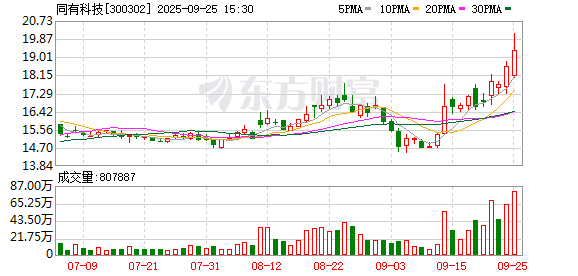
同有科技:公司将聚焦主业,继续深耕企业级国产自主可控存储领域
Zheng Quan Ri Bao· 2025-09-25 08:09
Core Insights - The company, Tongyou Technology, is focusing on its core business and will continue to deepen its efforts in the domestic, independent, and controllable storage sector for enterprises [2] - The company plans to orderly plan the production capacity of its Changsha industrial park based on future order conditions [2] - The production launch of the Changsha industrial park is expected to enhance the company's scale effect and improve its storage production capacity, specialized software and hardware R&D capabilities, and nationwide after-sales network [2]

*ST仁东拟跨界投资AI芯片!自曝“签8次合作协议,7次未落地”!
Cai Jing Wang· 2025-09-25 01:29
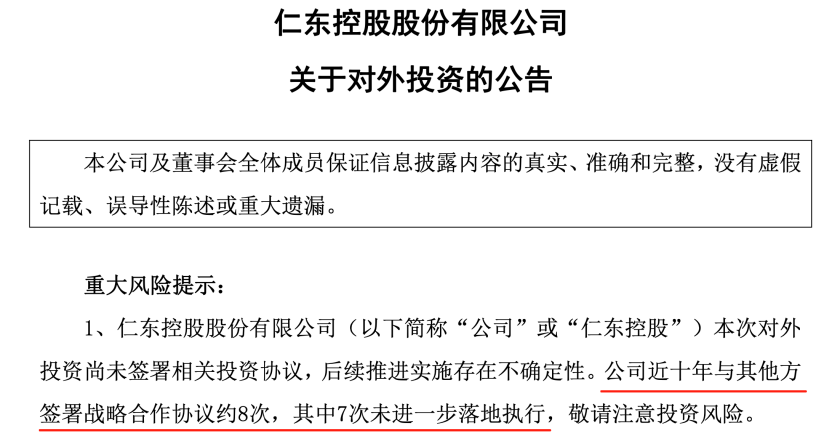
Core Viewpoint - *ST Rendo (002647) plans to make a cross-industry investment in AI chips, aiming to enhance its competitive edge and align with national strategies for autonomous computing power [4][5]. Investment Details - The company intends to invest 100 million yuan in Shenzhen Jiangyuan Technology Co., Ltd., acquiring a 4.1427% stake post-investment [4]. - Jiangyuan Technology, established in November 2022, focuses on domestic AI chip development and has achieved successful mass production of advanced chips [4]. - The pre-investment valuation of Jiangyuan Technology is 2.1 billion yuan, reflecting a valuation increase of 1714.86% [4]. Financial Performance of Jiangyuan Technology - Jiangyuan Technology reported a projected revenue of 12.31 million yuan and a net loss of 68.54 million yuan for the first half of 2025, indicating it has not yet achieved profitability [6]. - The pre-investment valuation for Jiangyuan's previous funding rounds was 1.5 billion yuan, with a post-investment valuation of 1.86 billion yuan in January 2025, showing a 12.90% increase [6]. Strategic Intent - The company aims to diversify its business beyond its core third-party payment services, seeking opportunities in industries aligned with national policy trends [5]. - The AI chip sector is viewed as a critical area for future growth, driven by increasing demand for computing power in AI applications [5]. Historical Context and Risks - The company has a history of signing approximately eight strategic cooperation agreements over the past decade, with seven of them not materializing [6][7]. - The investment in Jiangyuan Technology is characterized as high-risk due to the company's lack of experience in startup investments and the uncertainties surrounding Jiangyuan's future operations [6][7].

阿里积极推进3800亿AI基建,机构称国产自主可控趋势已成
Mei Ri Jing Ji Xin Wen· 2025-09-24 06:11
Core Insights - The A-share market indices experienced a collective rise, with significant gains in sectors such as storage chips, semiconductors, and photoresists [1] - Alibaba's CEO announced at the 2025 Yunqi Conference that large models will serve as the next generation operating system, and AI cloud will be the next generation computer, predicting that there may only be 5 to 6 super cloud computing platforms globally in the future [1] - Alibaba is actively advancing its AI infrastructure construction with an investment of 380 billion, planning to increase this investment further [1] - By 2032, Alibaba Cloud's global data center energy consumption is expected to increase tenfold in anticipation of the super AI era [1] - CITIC Securities highlighted the trend of domestic self-controllable technology, noting the continuous iteration of domestic AI chips and the determination of local cloud vendors to catch up with North American AI companies [1] Industry Summary - The Cloud Computing 50 ETF (516630) tracks the cloud computing index (930851), which has a high AI computing power content and covers popular concepts such as optical modules, computing leasing, data centers, AI servers, and liquid cooling [2] - The Cloud Computing 50 ETF (516630) is noted for having the lowest total expense ratio among ETFs tracking this index [2]

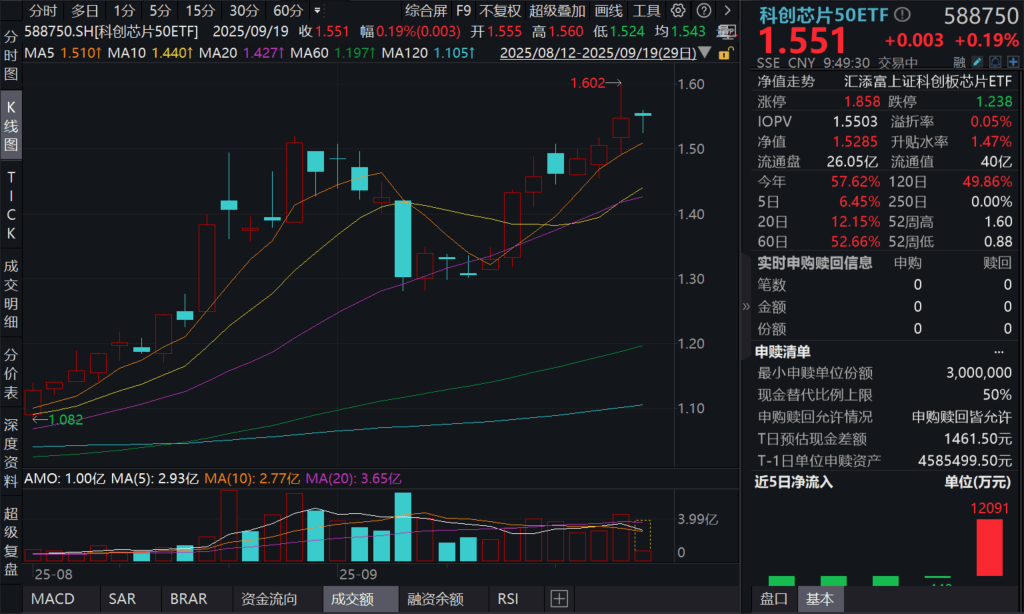
世纪收购!芯片再成市场焦点,科创芯片50ETF(588750)早盘振幅超2%,单日强势吸金超1亿元!三年三代芯,AI芯片演进路线图公布
Sou Hu Cai Jing· 2025-09-19 02:46
Core Insights - The semiconductor sector, particularly the Sci-Tech Chip sector, is experiencing significant movements due to major acquisitions and investments, notably NVIDIA's $5 billion stake in Intel, which is expected to enhance collaboration on x86 CPUs [1] - The domestic AI chip market is rapidly evolving, with increased capital expenditures from cloud vendors and a growing focus on self-sufficiency in chip production, indicating a strong trend towards domestic control [2] - The Sci-Tech Chip 50 ETF (588750) has shown remarkable performance, with a recent inflow of over 120 million yuan, reflecting investor confidence and market optimism [1][3] Group 1: Market Movements - The Sci-Tech Chip 50 ETF (588750) experienced a wide fluctuation of over 2% in early trading, following a seven-day rally that set a new high, with a slight increase of 0.19% noted [1] - Major component stocks of the ETF, such as 澜起科技 (Lanke Technology), saw significant gains, with an increase of over 8%, while others like 海光信息 (Haiguang Information) and 中芯国际 (SMIC) faced slight declines [3] Group 2: Industry Trends - The trend towards domestic self-sufficiency in semiconductor production is gaining momentum, with cloud companies like Alibaba increasing their capital expenditures and procurement of domestic chips, which is expected to drive growth in domestic computing power [2] - The semiconductor sector is experiencing a "Davis Double" effect, characterized by rapid growth in both domestic and North American computing power industries, leading to a bullish market outlook for semiconductor stocks [2][4] Group 3: Investment Opportunities - The Sci-Tech Chip 50 ETF (588750) is highlighted as a high-elasticity investment option, with potential for significant returns due to its exposure to core segments of the semiconductor industry [4] - Investors are encouraged to consider linked funds for easier access to the Sci-Tech Chip sector, which is positioned for substantial growth amid favorable macroeconomic conditions [4]