
多资产策略

Search documents
私募11月备案产品激增近30%,股票策略占比近七成
Sou Hu Cai Jing· 2025-12-04 06:43
Group 1 - The private equity market in China is experiencing a surge in product registrations, with November seeing a 29.28% increase compared to the previous month, totaling 1,285 registered private equity securities products, marking the second-highest monthly registration this year [1] - Equity strategies remain the dominant focus for private equity firms, with 849 equity strategy products registered in November, accounting for 66.07% of total registrations, indicating strong investor interest despite recent adjustments in the A-share market [1] - Multi-asset strategies and futures and derivatives strategies are also maintaining high levels of activity, with 193 multi-asset strategy products registered, representing 15.02% of the total [1] Group 2 - Quantitative private equity products are particularly noteworthy, with 565 products registered in November, making up 43.97% of total registrations; equity strategies dominate this category as well, with 402 products registered [2] - A total of 719 private equity firms registered products in November, with 49 firms registering five or more products, highlighting a strong enthusiasm for product registration, especially among leading quantitative firms [2] - Century Frontier leads in product registrations with 20 products, followed by Starstone Investment with 15, and Mingchao Investment, Shanghai Xiaoyong Private Equity, and Tiansuan Quantitative each with 12 products [2] Group 3 - The A-share market has seen fluctuations around the 3,900-point mark, but long-term trends remain positive according to DWSQ, which believes that current adjustments do not alter the medium to long-term bullish outlook for A-shares [3] - Support for market risk appetite is expected from policy and liquidity environments, with expectations of the Federal Reserve entering a rate-cutting phase and overall liquidity in the A-share market remaining ample [3] - Corporate earnings are showing signs of stabilization, with the technology and advanced manufacturing sectors expected to contribute positively to market opportunities due to external demand and technological upgrades [3]
这类理财,业绩亮眼
中国基金报· 2025-11-30 13:54
Core Insights - The performance of mixed financial products has been outstanding this year, with the highest unit net value growth rate approaching 36% [2][4] - The recovery of the equity market and the increase in structural opportunities in specific sectors have contributed to the explosive performance of mixed financial products [2][4] - There is significant growth potential for mixed financial products, especially in the context of declining deposit rates, prompting financial institutions to enhance their equity research capabilities and innovate product offerings to meet diverse market demands [2][4] Performance Highlights - As of November 27, over 90% of mixed financial products have shown positive unit net value growth this year, with 11 products exceeding a 20% growth rate, the highest being 35.97% [4] - The average annualized returns for mixed financial products over the past week and month were 13.21% and 6.62%, respectively, marking increases of 112.44 percentage points and 35.32 percentage points from the previous quarter [4] - Key drivers for the strong performance include the recovery of the equity market, refined operational strategies, and diversified asset allocation [4] Market Position - Despite the impressive performance, the scale of mixed financial products remains relatively low within the banking wealth management sector, with a total market size of 749.19 billion yuan, accounting for only 2.37% of bank wealth management [5] - The market size has increased by nearly 160 billion yuan since the end of January, with a 0.39 percentage point rise in market share [5] Strategic Recommendations - Financial institutions are encouraged to focus on diversified asset allocation and product innovation to meet the varied investment needs of clients [7] - There is a need to enhance intelligent advisory and dynamic asset allocation technologies to improve management efficiency and customer experience [7] - Institutions should explore opportunities in technology growth sectors, cross-border asset allocation, and alternative fixed-income assets while strengthening research capabilities in equity investment and new stock pricing [7]


产品备案数量仅次于股票策略,私募多资产策略为何越来越火?
Xin Lang Cai Jing· 2025-11-27 05:43
Core Insights - Multi-asset strategy private equity products have gained popularity in 2023, with 1,400 products registered from January to October, second only to stock strategy products [1] - The appeal of multi-asset strategies is attributed to significant global asset price fluctuations expected in 2024-2025, evolving investor demands for risk-return matching, and the search for absolute returns by long-term funds [1][8] Performance Overview - As of November 14, multi-asset strategy products have an average annual return of 20.37%, ranking just below stock strategies, with a slightly higher Sharpe ratio and lower volatility and drawdown [2][3] - The performance metrics for various strategies are as follows: - Stock Strategy: 29.54% average return, 93.14% positive return ratio, 35.96% volatility [3] - Multi-Asset Strategy: 20.37% average return, 91.73% positive return ratio, 25.84% volatility [3] - Composite Fund: 18.98% average return, 96.34% positive return ratio, 39.15% volatility [3] - Futures and Options: 13.79% average return, 82.49% positive return ratio, 48.73% volatility [3] - Bond Strategy: 8.46% average return, 92.10% positive return ratio, 11.76% volatility [3] Sub-strategy Performance - Among sub-strategies, macro strategies outperform in average return, positive return ratio, and Sharpe ratio [4] - Macro Strategy: 25.09% average return, 97% positive return ratio, 25.48% volatility [5] - Composite Strategy: 21.14% average return, 90.93% positive return ratio, 1.63 Sharpe ratio [7] - Arbitrage Strategy: 8.87% average return, 89.95% positive return ratio, lowest volatility and drawdown [7] Market Dynamics - The macro strategy focuses on dynamic allocation across major asset classes based on global macroeconomic analysis [6] - Bridgewater's "All Weather Strategy" exemplifies macro strategies, aiming for stable performance across different economic environments [6] - Local macro strategy firms like Honghu and Banxia are emerging as key players in the market [7] Challenges and Considerations - Successfully implementing multi-asset strategies requires more than just combining different assets; it necessitates creating a synergistic portfolio [8] - The complexity of the Chinese market, with significant differences in Sharpe ratios and economic cycles, demands experienced management and a tailored methodology [8] - A robust IT system covering research, trading, risk control, and operations is essential for distinguishing the capabilities of multi-asset strategy private equity firms [8]

从桥水到本土私募,多资产策略火了!喜世润、路远分别夺冠!国源信达霸榜前5
私募排排网· 2025-11-24 03:39
Core Insights - Multi-asset strategy products have gained popularity in recent years, with 1,400 products registered from January to October 2025, second only to stock strategy products [2] - The average annual return for multi-asset strategies is 20.37%, with a Sharpe ratio of 1.65, indicating stable performance compared to other strategies [3][4] Performance Overview - The average returns and performance metrics for various private equity strategies are as follows: - Stock Strategy: 29.54% return, 93.14% positive return ratio, Sharpe ratio of 1.56, volatility of 35.96%, and drawdown of 11.20% [3] - Multi-Asset Strategy: 20.37% return, 91.73% positive return ratio, Sharpe ratio of 1.65, volatility of 25.84%, and drawdown of 7.41% [3] - Composite Fund: 18.98% return, 96.34% positive return ratio, Sharpe ratio of 1.89, volatility of 15.61%, and drawdown of 6.62% [3] - Futures and Derivatives Strategy: 13.79% return, 82.49% positive return ratio, Sharpe ratio of 1.11, volatility of 48.73%, and drawdown of 8.06% [3] - Bond Strategy: 8.46% return, 92.10% positive return ratio, Sharpe ratio of 1.93, volatility of 11.76%, and drawdown of 3.21% [3] Reasons for Increased Attention - Single asset strategies face limitations in risk resistance, prompting managers to seek new alpha across asset classes [4] - In a low-interest-rate environment and under new asset management regulations, high-net-worth clients and managers need to balance net value fluctuations with absolute returns, which multi-asset strategies can provide [4] - The proliferation of tools such as risk parity, machine learning factors, and cross-asset real-time risk control platforms has enabled managers to effectively expand and reconstruct their research and investment systems [4] Sub-Strategy Performance - Among sub-strategies, macro strategies exhibit the highest average returns, positive return ratios, and Sharpe ratios [5][6] - Arbitrage strategies show lower volatility and drawdown compared to macro and composite strategies, indicating more stable performance [5]

股弱债不强,意味着什么
GUOTAI HAITONG SECURITIES· 2025-11-23 12:19
股债定价各有独立逻辑,定价的结果或均偏向止盈。 投资要点: 市 场 策 略 周 报 股弱债不强,意味着什么 [Table_Authors] 唐元懋(分析师) 本报告导读: 证 券 研 究 报 告 | | 0755-23976753 | | --- | --- | | | tangyuanmao@gtht.com | | 登记编号 | S0880524040002 | | | 杜润琛(研究助理) | | | 021-38031034 | | | durunchen@gtht.com | | 登记编号 | S0880123090079 | | | 孙越(分析师) | | | 021-38031033 | | | sunyue6@gtht.com | | 登记编号 | S0880525080004 | [Table_Report] 相关报告 区间震荡行情延续 2025.11.22 美元流动性收紧何时缓解 2025.11.18 大行短端买入力度减弱 2025.11.18 本轮移仓有何特征和机会 20251117 2025.11.17 大行融出回落,存单发行提升,6M 期限最多 2025.11.17 请务必阅读正文之后 ...
幻方、九坤、钧富等42家私募全部产品新高!但斌、王一平旗下“双十基金”创新高!
私募排排网· 2025-11-15 03:04
Core Insights - In October 2023, A-shares experienced a high-level fluctuation, with the Shanghai Composite Index slightly rising by 1.85%, while the Shenzhen Component and ChiNext Index fell by 1.1% and 1.56% respectively [2] - A total of 2,448 private equity products reached historical highs in net value, accounting for approximately 48.60% of private equity products established for over one year [2][3] - Among these products, 1,367 were non-quantitative, while 1,081 were quantitative [2] - The majority of products employed stock strategies, with 1,344 products (approximately 54.9%), followed by multi-asset strategies (397), futures and derivatives strategies (383), bond strategies (224), and combination fund products (100) [2] Product Types - Non-quantitative products accounted for 1,367, while quantitative products made up 1,081 [2] - Stock strategy products were the most prevalent, with 1,344 products, followed by multi-asset strategies (397), futures and derivatives strategies (383), bond strategies (224), and combination fund products (100) [2] Company Size - The largest number of products came from private equity firms with assets under 500 million, totaling 864 products (35% of the total) [3] - There were 430 products from firms with over 10 billion in assets [3] High-Performing Private Equity Firms - A total of 42 private equity firms had all their products reach historical highs in October, with 20 being subjective private equity firms, 14 quantitative, and 8 combining both strategies [4][5] - Among these, five firms with over 10 billion in assets included Ningbo Huanfang Quantitative, Century Frontier, Jiukun Investment, Qilin Investment, and Honghu Private Equity [5] Notable Products - The "Double Ten Fund" category, which includes products established for over 10 years with annualized returns exceeding 10%, had 18 products, with 13 being subjective long products [9] - Notable high-performing products included those from Beijing Xiyue Private Equity, which topped the subjective long product category, and Jiukun Investment, which had 18 products with significant returns [19][27] Strategy Performance - In the futures and derivatives strategy category, 197 products reached historical highs, with the top five products coming from Yizu Investment and Chiying Private Equity [20] - The multi-asset strategy category had 245 products, with the top performers being from Lu Yuan Private Equity and Hai Sheng Fund [24][27]

黄金税收政策出台,投资策略有哪些影响?
私募排排网· 2025-11-15 03:04
Core Viewpoint - Since 2025, global gold assets have maintained a strong market driven by three main factors: a phase of declining real interest rates, persistent geopolitical risks and uncertainty in U.S. domestic policies, and continued buying by global central banks, particularly from emerging economies [2][3]. Group 1: Market Dynamics - The decline in global real interest rates is influenced by the U.S. fiscal deficit and long-term debt structure, making it difficult for real rates to rise further, while persistent inflation enhances long-term demand for gold [2]. - Geopolitical risks, including conflicts in the Middle East and deteriorating security in Europe, along with uncertainties following the Trump administration's policies, have structurally increased demand for safe-haven assets like gold [2]. - Central banks remain the largest buyers of gold, with emerging market central banks continuing to purchase gold, providing long-term support for gold prices [3]. Group 2: Policy Impact - Recent tax policy adjustments in China regarding gold transactions mark a significant structural change in the gold market, effective from November 1, 2025, to December 31, 2027, affecting standard gold transactions [5][6]. - The new tax policies aim to clarify the tax burden and usage of gold, impacting costs for off-exchange gold, price differentials, retail premiums, and the structure of futures and ETFs, rather than directly altering domestic gold prices [6]. - Gold ETFs are expected to be the most affected by the new policies, as the attractiveness of physical gold for secondary sales diminishes, while virtual gold instruments like paper gold and ETFs remain unaffected by the VAT adjustments [10]. Group 3: Investment Strategies - The high beta sensitivity of gold assets to macroeconomic trends makes them a preferred choice for quantitative CTA, multi-asset strategies, and discretionary long strategies [5]. - The stricter regulations on gold withdrawal and usage declarations may lead to a decrease in arbitrage scale in futures, potentially increasing price volatility and enhancing the correlation of futures with international gold prices during trending markets [10].

私募年均收益超24%
Sou Hu Cai Jing· 2025-11-14 23:15
Core Insights - The A-share market has shown a slow upward trend this year, supported by policy measures in the bond market, which has seen a recovery in the latter half of the year. The commodity futures market has displayed significant differentiation, with stock index futures and precious metals performing particularly well [1] Summary by Category Private Fund Performance - As of the end of October, 91.33% of the 10,969 private funds achieved positive returns, with an average return rate of 24.32%. The top 5% of funds recorded an impressive return rate of 72.03% [1] Strategy Types - Equity strategies led the five major strategies with an average return rate of 29.52%, and 92.73% of these products generated positive returns. Among 6,931 products, 6,427 were profitable, with the top 5% achieving a return of 82.48%, significantly higher than other strategies [1] - Multi-asset strategies ranked second with an average return rate of 19.71% and a positive return product ratio of 91.61%. This strategy effectively captured the equity market's upward momentum while diversifying risks through bonds and commodities [1] - Combination funds demonstrated strong profitability stability, with 96.85% of products yielding positive returns. Out of 476 products, only 15 reported losses, although the average return rate of 17.86% was slightly lower than that of multi-asset strategies [1]
年内私募分红逾150亿元 同比大增逾263%
Xin Hua Cai Jing· 2025-11-14 08:27
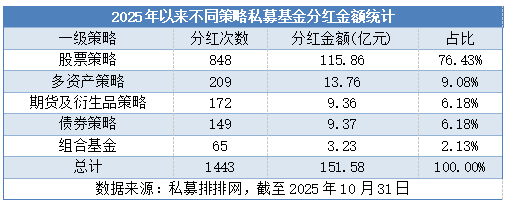
Core Insights - The private equity fund distribution scale has significantly increased this year, with a total distribution amount exceeding 15.158 billion yuan, marking a year-on-year increase of 263.76% compared to 4.167 billion yuan last year [1][2] Distribution Overview - As of October 31, 2025, out of 5,558 private equity products with performance displays, 1,135 products have implemented distributions, accounting for 20.42% of the total [1] - The total number of distributions reached 1,443 times, with the distribution amount surpassing 15.158 billion yuan [1][2] Strategy Analysis - Stock strategy products are the main contributors to distributions, with 848 distributions totaling 11.586 billion yuan, representing 76.43% of the total distribution amount [2][3] - Multi-asset strategies had 209 distributions amounting to 1.376 billion yuan, accounting for 9.08% [2][3] - Futures and derivatives strategies and bond strategies had similar distribution amounts of approximately 936 million yuan and 937 million yuan, each accounting for 6.18% [2][3] - Combination funds had a smaller distribution scale, with 65 distributions totaling 323 million yuan, representing 2.13% [2][3] Performance Drivers - The significant increase in distribution scale is attributed to three main factors: strong overall performance of private equity funds, with an average return of 24% this year, and over 90% of products achieving positive returns [2][4] - Stock strategies performed particularly well, with average returns close to 30%, providing a solid foundation for distributions [2][4] - Distributions help investors convert paper profits into actual gains, enhancing confidence in holding and trust in fund managers [2][4] Management Approach - Subjective private equity funds have shown a higher distribution frequency, with 943 distributions totaling 10.042 billion yuan, accounting for 66.25% of the total [3][4] - Quantitative private equity funds, despite strong performance, had a distribution amount of only 5.116 billion yuan, representing 33.75% [3][4] - The distribution strategy differs, with subjective funds focusing on long-term value investment and quantitative funds being more conservative in distribution frequency and amount [4] Scale Impact - Private equity funds with over 10 billion yuan in assets have a dominant position in distributions, with 152 distributions totaling 5.479 billion yuan, accounting for 36.14% of the total distribution amount [4]
私募年内平均收益超24%,量化多头完胜主观策略
Sou Hu Cai Jing· 2025-11-14 07:19
Core Insights - The A-share market has shown a slow upward trend this year, with 91.33% of private equity funds achieving positive returns and an average return rate of 24.32% as of the end of October [1] - Stock strategies lead the performance among five major strategies with an average return of 29.52%, and 92.73% of products reporting positive returns [1] - Multi-asset strategies have an average return of 19.71% and a positive return rate of 91.61%, effectively capturing market gains while diversifying risks [1] Group 1: Private Equity Fund Performance - As of October, 10,969 private equity funds were tracked, with 91.33% achieving positive returns and an average return rate of 24.32% [1] - The top 5% of funds achieved a remarkable return of 72.03%, indicating a strong performance in high-yield products [1] - Stock strategies outperformed with an average return of 29.52%, and 92.73% of products in this category reported positive returns [1] Group 2: Strategy Analysis - Multi-asset strategies ranked second with an average return of 19.71% and a positive return rate of 91.61%, benefiting from timely stock asset allocation [1] - Bond strategies showed a conservative approach with an average return of 8.77%, but 90.09% of products achieved positive returns, highlighting their risk defense capability [2] - Quantitative long strategies excelled with an average return of 36.76% and a positive return rate of 96.52%, outperforming subjective long strategies by 7.04 percentage points [2]