宏观策略

Search documents
博时基金2025年四季度投资联席会明日重磅开启,共同探讨“乐观其势 力展其长”
Quan Jing Wang· 2025-10-15 09:31
Group 1 - The core event is the "Optimistic Trends and Long-term Strategies" investment conference hosted by Bosera Fund on October 16, 2025, focusing on macro trends and asset allocation strategies for the fourth quarter [1] - The conference will feature both morning and afternoon sessions, gathering insights from internal and external experts to provide deep insights and forward guidance for investors [1] Group 2 - The morning session will focus on macroeconomic strategies, featuring presentations from leading economists on topics such as the current economic landscape and future asset allocation directions for 2026 [2] - Key discussions will include monetary policy directions and industry investment outlooks, with insights from analysts on sectors like pharmaceuticals, retail, and chemicals [2] Group 3 - The afternoon session will delve into the "Fixed Income Plus" strategy, with presentations from Bosera Fund's mixed asset investment team on new macro paradigms and systematic investment applications [3] - Specific topics will include the role of convertible bonds in "Fixed Income Plus" strategies and practical applications in technology, manufacturing, and new consumption sectors [3] - The overall aim of the conference is to provide valuable references for investors' asset allocation and investment decisions in the second half of the year [3]

宏观策略业绩爆发!泓湖私募梁文涛狂揽亚军!李蓓今年强势逆袭!
私募排排网· 2025-10-15 09:00
Core Insights - The A-share market continued its strong performance in September, with all three major indices rising, while gold prices surged due to multiple factors including the onset of the Federal Reserve's rate cut cycle and central bank gold purchases [2] - Despite the strong market performance, the subjective long/short and quantitative long strategies underperformed in September, with average returns of 3.11% and 1.37% respectively, while macro strategies excelled with an average return of 4.08% [2] - Over a longer time frame, macro strategies have shown superior performance, with average returns of 22.45% and 75.33% over the year and the past three years respectively, highlighting their flexibility in capturing asset rotation opportunities [2] Strategy Performance Summary - **Macro Strategy**: 218 products, average return of 4.08% this year, 22.45% over the year, and 75.33% over three years [3] - **Subjective Long/Short**: 2120 products, average return of 3.11% this year, 34.08% over the year [3] - **Quantitative Long**: 862 products, average return of 1.37% this year, 36.94% over the year [3] - **Other Derivative Strategies**: 16 products, average return of 5.17% this year, 18.77% over the year [3] Top Macro Strategy Products - For products with over 5 billion in assets, the top three macro strategies over the past three years are managed by 久期投资 and 泓湖私募, with average returns of 69.86% [4][5] - The leading product in the 10-50 billion category is "路远睿泽稳增" managed by 路文韬, with significant returns [9] - In the 0-10 billion category, "石泉宏观对冲" managed by 孙旭 leads with impressive returns [12] Notable Fund Managers - 梁文涛 from 泓湖私募 is recognized for his strong performance and has a background in macro strategies [4] - 李蓓 from 半夏投资 has shown a significant rebound in performance this year after previous underperformance [6] - 路文韬 from 路远私募 has focused on gold and military sectors, indicating a strategic shift in asset allocation [9]


宏观策略表现强劲!海南思瑞旗下产品夺冠!今年捕捉住了哪些机会? | 大V面对面
私募排排网· 2025-09-29 03:05
Core Viewpoint - The article highlights the strong performance of macro strategy private equity products in August, driven by a robust equity market and rising precious metals, with an average return of 21.13% year-to-date for 209 products [3]. Performance Summary - As of September 19, 2025, the average return for macro strategy private equity products was 21.13%, with July and August returns at 1.91% and 5.58% respectively [3]. - The "Siyu Qianyuan Macro Class B" product managed by Niu Shubin from Hainan Siry Private Equity achieved outstanding performance, capturing opportunities in gold, government bonds, and the subsequent A-share bull market, with a year-to-date return of ***% [3]. Product Rankings - The article lists top-performing macro strategy products, including: 1. Siyu Qianyuan Macro Class B 2. Zhilin Shanjin No. 1 3. Lianhai Xingyue Macro Progress No. 1 4. Guoen Macro Precision No. 6 5. Shen Gao Stable Progress No. 2 [4]. Investment Philosophy - Niu Shubin emphasizes a macro strategy that transcends single asset cycles and aims for maximum diversification across assets, timeframes, and regions to enhance overall asset performance [7]. - The investment approach focuses on identifying macro-driven opportunities within major asset classes, supported by strong macroeconomic research and risk management capabilities [7]. Team and Risk Management - The investment research team at Hainan Siry consists of 25 members, with a dedicated macro research team of 3 [11]. - The risk management framework includes concentration limits, risk budget limits, Value at Risk (VaR), and drawdown limits to ensure controlled risk exposure [13][15]. Asset Allocation - The macro strategy product primarily invests in: 1. Stock index futures and stocks, mainly in China and the US 2. Bonds, focusing on Chinese and US interest rate bonds 3. Commodities, including crude oil, gold, copper, and iron ore 4. Currencies, such as EUR/USD, USD/JPY, and USD/CNY [15]. Market Outlook - The article discusses the outlook for A-shares and US stocks, noting that A-shares are near historical highs but still have potential for growth due to increasing fund inflows [16]. - The US stock market is influenced by economic soft landing expectations and AI trends, with a need for close monitoring of economic indicators and AI industry developments [16].

宏观策略周论【下周一 9:30】:降息后的配置策略
Xin Lang Cai Jing· 2025-09-19 12:17
Core Insights - The article discusses investment strategies following interest rate cuts, emphasizing the need for a revised asset allocation approach in the current macroeconomic environment [1] Group 1: Macroeconomic Context - The macroeconomic landscape is shifting due to recent interest rate cuts, prompting a reassessment of investment strategies [1] - The implications of these rate changes on various asset classes are explored, indicating potential opportunities and risks [1] Group 2: Investment Strategies - The article suggests specific asset classes that may benefit from the new interest rate environment, highlighting sectors that could outperform [1] - Recommendations for portfolio adjustments are provided, focusing on diversification and risk management in light of the changing economic conditions [1]
可能又要创新高了
Xin Lang Cai Jing· 2025-09-19 11:13
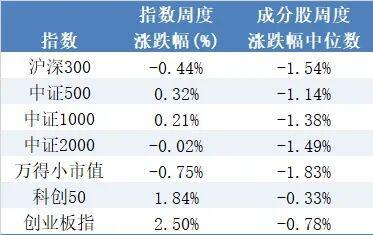
Group 1 - The core event of the week is the Federal Reserve's interest rate cut, but Chairman Powell emphasized that policy decisions will be based on economic data and market changes, which did not signal a strong dovish stance and suppressed expectations for further easing [3] - The macro strategy is expected to maintain stable performance, with some managers potentially reaching new highs despite a generally calm state of various asset classes [2][3] - The correlation between bonds and commodities has increased, while the correlation between stocks and bonds has decreased, indicating a shift in market dynamics [2][3] Group 2 - The performance of quantitative long strategies is expected to show significant differentiation, particularly affecting managers with overly diversified holdings [6][9] - The market's overall volatility has slightly decreased compared to previous weeks, with average daily trading volume remaining around 2.5 trillion [8] - The ChiNext and STAR Market indices performed well, but the median performance of constituent stocks was poor, impacting the ability of quantitative managers to generate excess returns [10][12] Group 3 - The subjective long strategies are expected to perform well, particularly in sectors like semiconductors, new energy batteries, and automotive technology [16] - The liquidity indicators remain favorable, with the market sentiment returning to a neutral to slightly optimistic level [17][19] - The overall environment for subjective strategies is positive in the long term, although short-term volatility is anticipated to increase [19] Group 4 - The quantitative CTA strategies are expected to yield slight profits, with commodity markets showing mixed performance [20][21] - The market's overall volatility has increased across all categories, with a notable rise in trend strength for black and agricultural products [21] - The stock index CTA strategies are expected to show differentiated returns based on signal cycles, with high-frequency strategies potentially performing better [23] Group 5 - The market-neutral strategies are expected to show differentiated returns, with the excess stability of the CSI 500 index falling to near one-year lows, indicating a potential style shift [24] - The arbitrage strategies are anticipated to remain stable, supported by improved liquidity and slight increases in market volatility [25]
2025年私募证券投资机构推荐
头豹· 2025-09-16 12:55
Report Industry Investment Rating - Not provided in the content Core Viewpoints of the Report - In 2025, quantitative strategies are recommended over subjective ones in private securities investment institutions [1] - The private securities investment fund industry in China is characterized by increasing industry concentration with significant advantages for leading institutions, and an enhanced trend of diversified and international investment strategies [23][24] Summary by Relevant Catalogs Market Background - Affected by geopolitical conflicts and US tariff policies, the global stock market rose in the first half of 2025. A-shares showed an "N-shaped" trend, Hong Kong stocks performed better, and US stocks achieved a "V-shaped reversal". By the end of June 2025, the number of A-share listed companies reached 5,420, an increase of 37 from the end of 2024, and the total market value exceeded 100.02 trillion yuan, hitting a record high. The Beizheng 50 Index soared 39.45% in the first half of the year, leading the world in terms of gains. Industries such as non-ferrous metals (17.93%) and enterprise services (16.85%) led the rise, while industries such as coal (-10.02%) and real estate (-6.52%) faced pressure [4] - Chinese private securities investment funds are privately raised from qualified investors and mainly invest in publicly traded financial assets. They have more flexible investment strategies compared to public funds, lower liquidity, and can achieve differentiated returns through personalized strategies. Their operation must meet strict standards for qualified investors and emphasize the principle of self-risk assumption [5] - The development of Chinese private securities investment funds has evolved from disorderly exploration to standardization and specialization. Since 2025, driven by structural opportunities in the A-share market and excess returns from quantitative strategies, the issuance of private securities funds has recovered. In the first half of the year, over 5,400 new products were filed, with the filing scale increasing by 75% year-on-year [6] Market Status - As of the end of August 2025, the outstanding scale of Chinese private securities investment funds reached 5.56 trillion yuan, accounting for 27.4% of the total scale of private funds, a 6.5% increase from 5.24 trillion yuan at the beginning of 2025. Stock strategies dominate, and diversified strategies such as quantitative hedging and macro strategies are also developing rapidly. In July 2025, 1,313 new private securities funds were filed, with a scale of 79.281 billion yuan, a record high for the year. In the first half of the year, a total of 5,461 new filings were made, a 53.6% increase year-on-year, reflecting a significant trend of funds "entering the market through funds" [7][8] - As of the end of August 2025, there were 7,722 private securities fund managers, 385 fewer than at the end of 2024, mainly due to regulatory cleanup of "fake private funds". Geographically, Shanghai, Beijing, and Shenzhen account for over 50% of the total number of managers, and their management scales account for 25.2%, 23.2%, and 9.7% respectively [9] - The market demand for private securities funds shows a trend of diversification and stratification. The number of qualified investors has continued to expand, covering high-net-worth individuals, insurance funds, pensions, and foreign institutions. Insurance funds are accelerating the allocation of equity assets through pilot programs, and foreign institutions are also increasing their layout in the A-share market. Investor demand is significantly differentiated, with conservative funds preferring low-volatility products such as quantitative hedging and macro strategies, and aggressive funds focusing on stock long strategies. Market structural opportunities and policy guidance also affect the flow of funds and drive the continuous iteration of private securities fund strategies [10] Market Competition - The selection of the top ten private securities investment institutions follows a multi-dimensional quantitative evaluation model, with core indicators including management scale and stability, historical performance, and excess return ability [11] - The current industry competition shows a pattern of "siphoning by leading players" and "strategy differentiation". Leading quantitative private funds dominate with technical barriers and excess return ability. In 2025, the number of 10-billion-yuan quantitative private funds reached 41, exceeding that of 10-billion-yuan subjective private funds (40) for the first time. In the first half of the year, the average yield of quantitative private funds was 13.54%, significantly higher than that of subjective private funds (5.51%). Quantitative strategies perform well in volatile markets, while subjective strategies face challenges [12] - Ten institutions, including Gao Yi Asset, Orient Harbor, and Ningbo Magic Square Quantitative, are introduced, each with its own characteristics in terms of management scale, investment strategy, and core team [13][14][15] Development Trends - The Chinese private securities investment fund industry shows a significant "Matthew effect", with leading institutions having significant advantages in terms of funds, talent, technology, data, and trading systems. The number of 10-billion-yuan private fund managers has exceeded 100, and their share of the total industry management scale continues to rise. Small and medium-sized private funds face survival pressure, and foreign private funds are accelerating their localization layout, intensifying industry competition and promoting the concentration of resources to leading institutions [23] - With the deepening of China's capital market reform and the enrichment of financial derivative tools, private securities investment strategies are developing in a diversified direction from traditional stock long to quantitative hedging, macro strategies, event-driven, and cross-border investment. Regulatory authorities encourage private funds to serve the real economy and introduce long-term funds, and the cooperation between private funds and financial institutions such as securities firms and banks is deepening. In the future, strategy innovation and international layout will become core competitiveness [24]
降息预期升温!黄金再创新高,半夏李蓓最新业绩挺进前五
Sou Hu Cai Jing· 2025-09-16 10:45
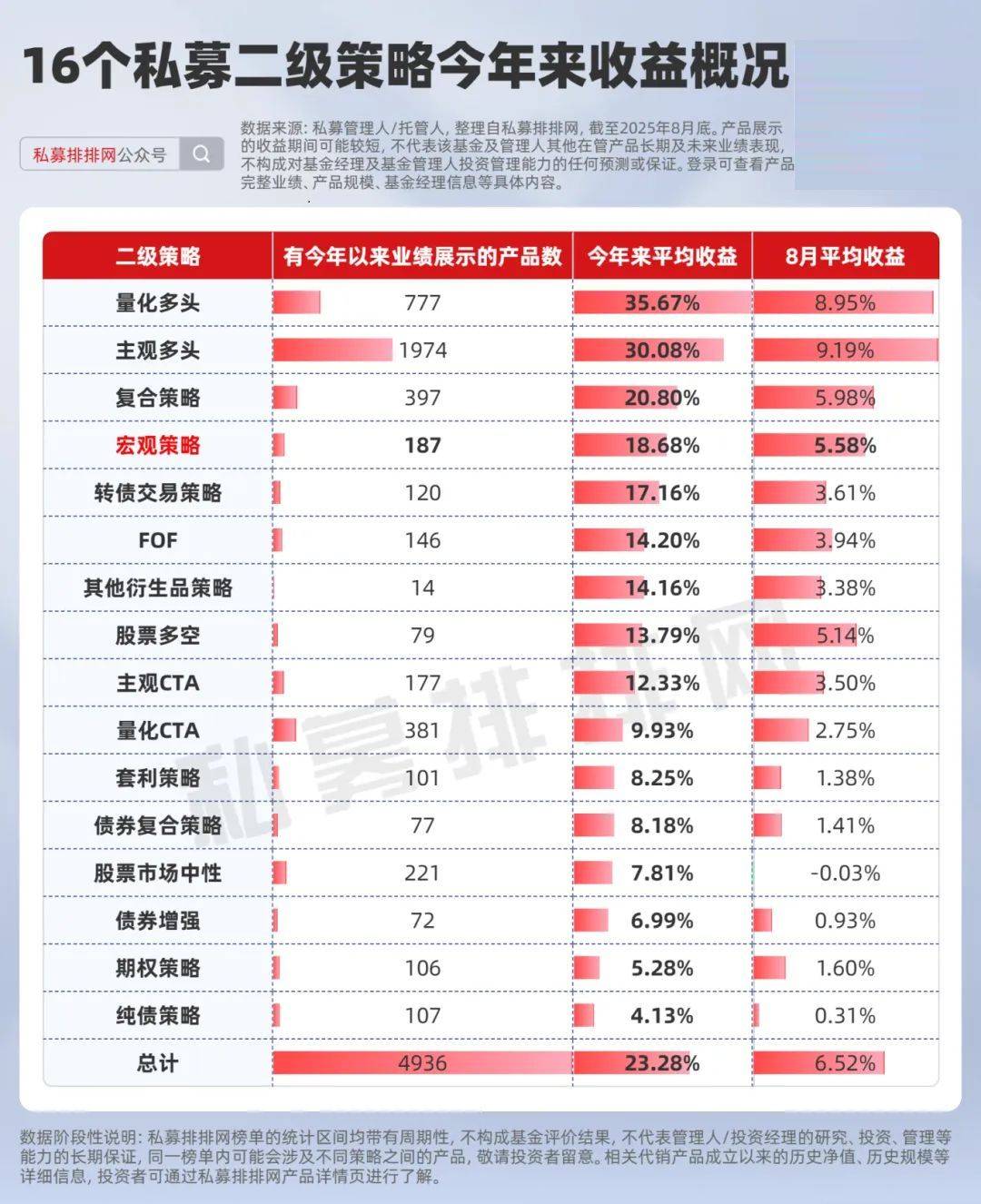
Core Insights - The equity market has returned to a volatile pattern in the past two weeks, with some quantitative and subjective long strategies facing withdrawal pressure, while macro strategies have shown an overall upward trend [1] - As of August 2025, there are 187 macro strategy products with performance data, achieving average returns of 18.68% year-to-date and 5.58% in August, ranking 4th among 16 private equity secondary strategies [1][2] - The proportion of macro strategy products achieving positive returns in August rose significantly to 88.12%, compared to 67.42% in July [1] Summary by Category Macro Strategy Performance - Macro strategies have demonstrated resilience with a year-to-date average return of 18.68% and an August average return of 5.58%, ranking 4th among various strategies [2] - The positive return rate for macro strategies in August was 88.12%, a notable increase from July's 67.42% [1] Top Performing Private Equity Products - In the top 10 private equity products under large private equity firms (over 50 billion), there are 43 macro strategy products with performance data this year [4] - The top three products are managed by 久期投资, with significant returns in August [5][6] - Notable fund managers include 吴星 from 昌都凯丰投资 and 李蓓 from 半夏投资, both of whom have achieved substantial returns this year [7][8] Small to Medium Private Equity Products - Among private equity products with assets under management of 0-50 billion, there are 144 macro strategy products, with the top 10 products having a performance threshold of ***% [10] - The top three products are managed by 京盈智投, 路远私募, and 嘉理资产, showcasing strong performance in the macro strategy space [11] Company Rankings - The top companies in macro strategy include 久期投资, 中安汇富, and 易则投资, with 中安汇富 achieving an average return of ***% this year [13][14] - 中安汇富 focuses on fundamental and pricing research, emphasizing a research-driven investment approach [14]
桥水全天候限额配售一号难求,我们有其他平替选择吗?
雪球· 2025-09-16 08:28
Core Viewpoint - The article discusses the increasing popularity and strong performance of Bridgewater's All Weather strategy, highlighting its appeal to investors and the challenges faced in accessing these investment products [6][8][9]. Group 1: Market Performance - The Shanghai Composite Index approached the 3900-point mark, indicating a bullish sentiment in the A-share market [5]. - Bridgewater's All Weather strategy products have shown exceptional performance, with the worst product line yielding annual returns between 10% and 14%, and an average return of approximately 16% [8]. Group 2: Investment Strategy - The All Weather strategy relies on a risk parity model, diversifying across asset classes to achieve balance, which helps mitigate significant cyclical volatility while providing decent returns [9]. - The strategy's success is attributed to its ability to adapt to different market conditions, where typically, when the stock market declines, the bond market rises, and inflation-hedging assets like gold appreciate [9]. Group 3: Alternative Strategies - Several domestic managers have successfully localized the All Weather strategy, offering various macro-hedging strategies that replicate the classic risk parity model [10]. - The macro-hedging strategies focus on trading core assets in the US and China, utilizing a combination of beta (70%) and alpha (30%) models to capture short-term opportunities [10]. Group 4: Quantitative Models - The beta component constructs a macro risk-balanced investment portfolio based on economic growth and inflation, ensuring that no single asset class dominates the portfolio [11]. - The alpha component enhances returns through unique factor libraries and quantitative models, including CTA and multi-factor models, aiming to improve the overall Sharpe ratio and return-to-drawdown ratio [13]. Group 5: Risk Management - The strategies employ a systematic approach to risk management, with a focus on maintaining a balanced exposure across various asset classes while controlling overall portfolio volatility [18][25]. - The investment strategy covers a wide range of liquid assets, including equities, bonds, and commodities, with a target to keep overall volatility within 8% [24].

降息在即,黄金新高,宏观策略脱颖而出!半夏李蓓今年业绩跻身前5
私募排排网· 2025-09-12 09:00
Core Insights - The equity market has returned to a volatile pattern, with some quantitative and subjective long strategies facing withdrawal pressure, while macro strategies have shown an overall upward trend [2] - As of August 2025, there are 187 macro strategy products with performance data, achieving average returns of 18.68% year-to-date and 5.58% in August, ranking 4th among 16 private equity secondary strategies [2][3] - The proportion of macro strategy products achieving positive returns in August rose significantly to 88.12%, compared to 67.42% in July [2] Performance Summary by Strategy - Macro strategies have 187 products with year-to-date average returns of 18.68% and August average returns of 5.58% [3] - The top-performing strategies include: - Long-short strategies with 777 products, year-to-date average returns of 35.67% and August returns of 8.95% - Subjective long strategies with 1974 products, year-to-date average returns of 30.08% and August returns of 9.19% [3] Top Private Equity Products - In the top 10 private equity products with over 50 billion in scale, there are 43 macro strategy products, with the top 10 threshold for returns being ***% [5] - The top three products are all managed by Duration Investment, with significant returns in August [6][7] - Notable fund managers include Wu Xing from Changdu Kaifeng Investment and Li Bei from Banxia Investment, both of whom have extensive experience and have achieved high returns [7][8] Company Performance Overview - Among companies with at least three macro strategy products, the top three are Duration Investment, Zhong'an Huifu, and Yize Investment, with Zhong'an Huifu achieving an average return of ***% this year [13][14] - Duration Investment leads with five macro strategy products, while Zhong'an Huifu has six, indicating strong performance in the macro strategy sector [14]