流动性紧缩

Search documents
中金:美国近期银行爆雷事件暂不构成对金融系统的系统性冲击
Xin Hua Cai Jing· 2025-10-20 00:54
Core Viewpoint - The recent risks faced by two U.S. banks are smaller in scale and severity compared to the previous round, primarily driven by localized credit risk events that have led to emotional reactions, and do not currently pose a systemic threat to the financial system [1] Group 1 - The current high interest rate environment is contributing to an upward trend in credit risk [1] - A potential decline in risk appetite in the credit market and tightening loan conditions could lead to further liquidity constraints [1] - Credit tightening is expected to be moderate and unlikely to result in a "crisis" scenario before clear signs of economic recession emerge in the U.S. [1]
中金:美国近期两家银行风险事件暂不构成对金融系统的系统性冲击
Zheng Quan Shi Bao Wang· 2025-10-20 00:42
Core Viewpoint - The recent stock price declines of Zions Bank and Western Alliance highlight concerns over loan losses and potential systemic financial risks in the banking sector, although the current situation is deemed less severe than previous crises [1] Group 1: Bank Performance - On October 16, Zions Bank and Western Alliance saw stock price drops of 13% and 11% respectively due to disclosed loan losses [1] - The market is worried about the quality of bank assets and private credit risks stemming from previously loose credit conditions [1] Group 2: Systemic Risk Assessment - The risks associated with Zions Bank and Western Alliance are considered smaller in scale and severity compared to previous banking crises, indicating that the current issues are more localized credit risk events [1] - The situation does not currently pose a systemic threat to the financial system [1] Group 3: Credit Market Implications - The high interest rate environment is contributing to an upward trend in credit risk, which may lead to a decrease in risk appetite in the credit market and tighter loan conditions [1] - Any potential credit tightening is expected to be moderate until clear signs of economic recession emerge in the U.S. [1]


美国流动性短缺,回购市场压力加剧
Di Yi Cai Jing· 2025-10-19 12:07
Core Insights - The current financial market is experiencing significant liquidity tightening, reminiscent of past crises in 2019 and 2023, with rising concerns over potential credit events in the banking sector [1][4][9] Group 1: Banking Sector Challenges - Regional banks are facing severe volatility, particularly due to their reliance on commercial and industrial loans, consumer loans, and exposure to commercial real estate (CRE) [2][3] - Zions Bancorporation reported a $50 million write-off related to fraudulent loans, raising broader concerns about consumer loan challenges and CRE exposure [2] - The stock price of Zions fell sharply, marking a significant decline since the onset of the 2023 regional banking crisis [2] Group 2: Market Reactions - The turmoil in regional banks is beginning to affect larger banks, with notable declines in stock prices for major institutions like Citigroup and Goldman Sachs [3] - The KRE (Regional Bank ETF) experienced its largest single-day drop of 2023, indicating heightened market anxiety [3] Group 3: Liquidity and Repo Market - The repo market is under pressure, with the SOFR (Secured Overnight Financing Rate) showing signs of liquidity shortages, reaching levels not seen since 2019 [5][6] - The use of the Federal Reserve's Standing Repo Facility (SRF) has increased, signaling a need for emergency liquidity support [6][7] - A negative difference between reverse repos and SRF indicates a systemic shift from liquidity surplus to shortage [6] Group 4: Economic Factors - The liquidity shortage is attributed to multiple factors, including a significant fiscal deficit, the rebuilding of the Treasury General Account (TGA), and ongoing quantitative tightening (QT) by the Federal Reserve [8] - The U.S. fiscal deficit has reached 7% of GDP, unprecedented in non-recessionary periods, which is draining liquidity from the financial system [8] Group 5: Credit Risk and Market Outlook - There is a growing risk of credit events, particularly if regional banks continue to face write-offs, which could lead to deposit outflows and stock price collapses [10] - The widening credit spreads, as indicated by the LQD/HYG ratio, reflect deteriorating liquidity and increasing default risks [10] - The S&P 500 futures showed early signs of market confidence erosion, suggesting potential further declines if liquidity issues persist [10] Group 6: Policy Responses - The Federal Reserve may need to reconsider its quantitative tightening stance and potentially reintroduce quantitative easing to inject liquidity into the system [11] - Adjustments to TGA management by the Treasury could also help alleviate liquidity pressures, although any easing must be approached cautiously in a high-inflation environment [11]
银价狂飙!今年以来国际现货银价涨幅超越黄金,未来走势如何?
Sou Hu Cai Jing· 2025-10-19 10:11
Core Viewpoint - Silver prices have surged this year due to multiple factors, including liquidity tightening in the London market, increased investor risk aversion, and growing industrial demand [1][3]. Group 1: Market Dynamics - Silver's price increase has outpaced that of gold, with international spot silver prices recently surpassing $50 per ounce, drawing significant market attention [3]. - The liquidity of the silver market is heavily reliant on the hundreds of millions of ounces stored in London vaults, which have been depleting due to insufficient mining supply and increased industrial demand [5]. - Since mid-2021, London silver inventories have decreased by approximately one-third, with a significant portion held by exchange-traded funds (ETFs) [5]. Group 2: Supply and Demand Factors - Current freely available silver inventory is around 200 million ounces, a sharp decline of about 75% from the peak of approximately 850 million ounces in 2019 [7]. - The tightening liquidity has forced many short-sellers to buy back silver at higher prices to cover their positions, contributing to the price surge [7]. - Analysts highlight that silver serves both as a valuable store of value and has industrial applications, which are critical to its demand [9]. Group 3: Industrial Demand - The global trade tensions, concerns over the independence of the Federal Reserve, and U.S. government shutdowns have heightened market uncertainty, increasing demand for safe-haven assets like precious metals [11]. - Citigroup forecasts that industrial demand will become the largest source of silver demand this year, expected to reach 430 million ounces, with the solar energy sector alone accounting for approximately 299 million ounces [13]. Group 4: Future Outlook - Goldman Sachs notes that while the liquidity tightening has been a significant driver of silver's recent price surge, this situation is expected to be temporary as silver is likely to flow back to London from the U.S. and other regions [15]. - Unlike gold, silver does not have the same level of support from central bank demand, leading to expectations of greater volatility and downside price risks for silver compared to gold [15].


宏观与资产论(20251019):又是新的TACO交易机会吗?
Western Securities· 2025-10-19 06:13
Group 1: Macro Insights - The recent volatility in capital markets reflects ongoing macroeconomic concerns, particularly regarding TACO trading and its implications for global markets[1] - Since April, TACO trading has contributed to a V-shaped recovery in global stock markets, with significant attention on the upcoming APEC summit as a critical juncture[1] - Gold prices have surged unexpectedly, indicating tightening liquidity pressures abroad, while the U.S. faces risks from government shutdowns and credit concerns[1] Group 2: Market Performance and Trends - As of October 17, A-shares and Hong Kong stocks are experiencing increased selling pressure, influenced by geopolitical tensions and profit-taking from previously high-performing sectors[2] - The real estate market shows weakness, with a reported transaction area of 1.28 million square meters in 30 major cities as of the week ending October 12[2] - The overall industrial production remains mixed, with notable declines in certain sectors like soda ash, while precious metals continue to perform strongly[2] Group 3: Policy and Economic Outlook - The upcoming Fourth Plenary Session is expected to focus on long-term strategies, including security, development, and economic rebalancing, with macro liquidity anticipated to remain ample[2] - Recent financial data indicates a shift in liquidity narratives, with a notable increase in household deposits by CNY 2.96 trillion, while non-bank deposits decreased by CNY 1.06 trillion in September[2] - The potential for further monetary easing exists, with expectations for rate cuts and reserve requirement ratio reductions to support economic growth amid external and internal demand concerns[2]
“前所未见”:历史性挤压之下,白银交易商争相将银条运往伦敦;高盛仍看好黄金。
Goldman Sachs· 2025-10-15 03:15
Investment Rating - The report indicates a favorable outlook for silver prices in the medium term, with expectations of further gains due to Fed cuts attracting inflows, although it highlights greater volatility and downside risk compared to gold [18][28]. Core Insights - The current silver market is experiencing unprecedented liquidity issues, with traders rushing to transport silver bars to London to capitalize on significant premiums [1][2]. - A recent surge in silver prices, which has increased by 35% since August 26, is attributed to heightened investment interest driven by concerns over rising debt levels and currency devaluation in the West [25][8]. - The dynamics of the silver market are influenced by a sudden spike in demand from India, coupled with a dwindling supply of available bars and fears of potential US tariffs [9][20]. Summary by Sections - **Liquidity Issues**: There is a severe lack of liquidity in the silver market, with bid-ask spreads widening significantly from typical levels [10][11]. The logistics of moving silver from US vaults to London are complicated and time-consuming, contributing to the current market stress [4][5]. - **Market Dynamics**: The report notes that the silver market is less liquid and smaller than gold's, which amplifies price movements in response to investment flows [23][28]. The absence of a central bank bid for silver means that any pullback in investment could lead to disproportionate corrections [29][30]. - **Investment Trends**: The report highlights that silver and gold prices are typically correlated due to similar investment flows, but silver has lagged behind gold due to the lack of central bank support [21][22]. The recent increase in silver ETF demand has led to a drop in near-term availability and a spike in lease rates [26][25]. - **Future Outlook**: The report anticipates significant physical inflows from China and the US into the London market, which may help restore liquidity, although the path to normalization is expected to be bumpy [6][28].

白银年内涨幅超80% 后市预期开始现分歧
Sou Hu Cai Jing· 2025-10-15 00:30
Core Insights - The precious metals market has seen significant gains this year, with silver emerging as a standout performer, reaching a peak of $53.579 per ounce on October 14, marking a new historical high since 1980, before settling at $51.98 per ounce, reflecting a cumulative increase of over 12% for the month [1] - Gold also performed well, surpassing $4,179 per ounce, with a year-to-date increase of over $1,500 per ounce [1] - Year-to-date, silver has risen over 81%, outpacing gold's 57% increase, with a notable surge of over 35% since the end of August [1] Market Drivers - The recent surge in silver prices is attributed to both its financial and industrial properties. Financially, the onset of a Federal Reserve rate cut cycle and ongoing geopolitical risks have enhanced silver's appeal as a currency and safe-haven asset [1] - On the industrial side, the explosive growth of the solar energy sector has significantly increased demand for photovoltaic silver paste, while a persistent shortage in global physical silver supply has widened the supply-demand gap [1] Market Liquidity and Trends - The liquidity issues in the London market have further exacerbated the rise in silver prices. As the global physical silver trading hub, London has experienced tightening liquidity, with silver stocks in London vaults dropping to 24,581 tons by the end of September, a decrease of 0.3% from August and at a multi-year low [2] - The surge in silver prices has led to a historic short squeeze in the London market, resulting in a significant reduction in market liquidity and an increased price spread between London and New York silver markets [2] Future Outlook - Market opinions on the future of precious metals are divided. Some analysts believe that the overall strength of the precious metals market will continue due to evolving global dynamics and loose monetary policies, with silver's future performance being closely watched. Although there may be short-term pullback risks, prices are expected to rise further next year [2] - Conversely, Goldman Sachs has advised caution regarding silver's rise, noting that the silver market is only about one-tenth the size of the gold market and lacks structural support from central banks. The volatility of silver is significantly higher than that of gold, and any short-term outflow of investment funds could lead to substantial price fluctuations, highlighting the short-term downside risks [2]
狂飙超76%!它,涨幅超黄金
Sou Hu Cai Jing· 2025-10-14 06:52
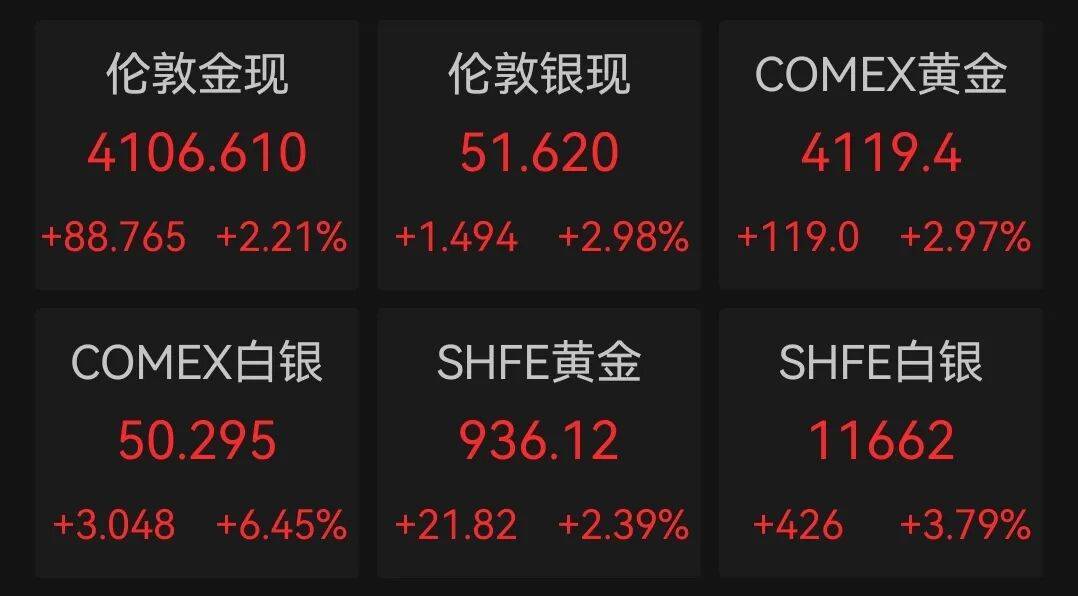
Core Insights - Silver prices in the London market have surged due to a historic short squeeze, with prices reaching levels not seen in decades, and the year-to-date increase exceeding 70%, outpacing gold's performance [2][4]. Price Movements - Spot gold has surpassed $4100 per ounce, marking a new historical high with an increase of over $90 in a single day, and a year-to-date rise of nearly $1500, or over 56% [2][3]. - Spot silver prices approached $52 per ounce, reflecting a daily increase of 3% and a significant rise compared to previous weeks [2][3]. Market Dynamics - The short squeeze in the London silver market is attributed to concerns over liquidity, with physical silver inventories at multi-year lows, leading to a tightening of liquidity [4]. - The premium of the London silver market over the New York market is nearing historical extremes, prompting traders to book transatlantic flights for silver bar transportation to capitalize on the high premiums [4]. Analyst Perspectives - Analysts from Goldman Sachs have cautioned investors about the volatility and potential downside risks associated with silver prices, despite the possibility of further interest rate cuts by the Federal Reserve [4]. - The report emphasizes that silver lacks the institutional and economic support that gold possesses, as it is not included in the International Monetary Fund's reserve framework and is not significantly held by modern central banks [4]. Comparative Analysis - The scarcity of gold is approximately ten times that of silver, making gold significantly more valuable and easier to store and transport [5].
罕见逼空行情上演 现货白银价格“涨疯”
Shang Hai Zheng Quan Bao· 2025-10-13 18:20
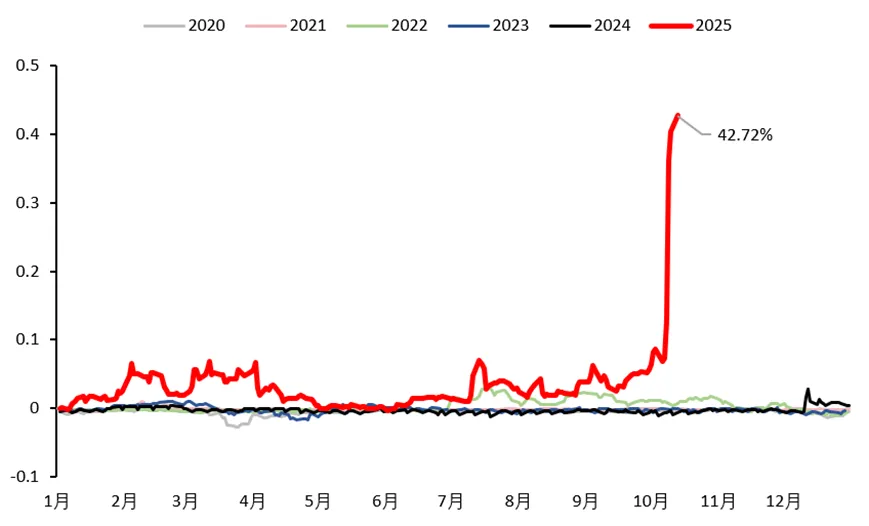
Core Viewpoint - The tightening liquidity in the London market has led to a historic surge in silver prices, with spot silver reaching a record high of $51.714 per ounce on October 13, marking a daily increase of over 3% [1][2]. Group 1: Market Dynamics - The London silver market, being the largest for physical silver trading globally, has seen its inventory decline by one-third since mid-2021, with only 200 million ounces remaining, a 75% drop from over 850 million ounces in mid-2019 [2]. - The current supply-demand imbalance is exacerbated by rising industrial and investment demand, particularly from the photovoltaic industry and increasing ETF absorption, which has led to a significant price increase of over 77% in spot silver this year [3][6]. - The implied leasing rate for January silver has surged to 42.72%, indicating tightness in the physical silver market and triggering a rare short squeeze [1][3]. Group 2: Investment Trends - The total holdings of major overseas silver ETFs have increased by 12.8% from 24,957 tons on February 6 to 28,162 tons by October 10, further tightening the available supply in the market [3]. - The relationship between spot and futures prices has become misaligned, with the premium of London silver over the nearest NY silver futures contract reaching $2.31 per ounce, a high not seen in recent years [5]. Group 3: Future Outlook - Analysts suggest that the current short squeeze and liquidity tightening are temporary phenomena, with expectations of a gradual restoration of liquidity as higher prices attract silver back to the London market [6]. - However, the short-term volatility and downside risks for silver are expected to be significantly higher than for gold, due to the smaller market size and relative illiquidity of silver compared to gold [7].
白银出现罕见逼空行情
Shang Hai Zheng Quan Bao· 2025-10-13 14:53
来源:上海证券报微信公众号 伦敦市场流动性紧缩,直接催化了白银价格的历史性突破。10月13日,伦敦现货白银(下称"伦敦银")快速拉升,盘中最 高触及51.714美元/盎司,续创历史新高,日内最大涨幅超3%。 作为现货借入成本的代表指标,伦敦银1个月期隐含租赁利率已升至42.72%,这意味着白银现货十分紧俏。业内人士向记者 表示,这一数据高企体现了实物交割紧张引发空头挤压的连锁反应,一场罕见的逼空行情正在上演。 白银一月期隐含租赁利率(%) 数据来源:LSEG、五矿期货 "流动性风暴"未止 银价不断突破前高 伦敦是全球最大的白银现货交易市场。 数据显示,自2021年年中以来,伦敦白银市场库存已下降1/3,目前自由流通量仅剩2亿盎司,较2019年年中超8.5亿盎司的 高点下降了75%。相较于年消费量,其缓冲垫已"薄如蝉翼"。 库存"见底"的另一端是不断攀升的价格——今年以来,现货白银涨超77%。 渣打中国财富管理部首席投资策略师王昕杰接受上证报记者采访时解释,矿山产量难以填补日益增长的工业和投资需求, 特别是光伏产业和ETF的持续吸纳,导致供需失衡加剧。 高盛在其10月12日的报告中也认为,年初,由于市场担忧美国 ...