海洋强国

Search documents
抢抓机遇再造一个“海上海南”
Hai Nan Ri Bao· 2025-11-15 01:41
Core Viewpoint - The article emphasizes the importance of high-quality development of the marine economy in Hainan, aiming to establish Hainan as a "marine strong province" and align with national strategies for marine economic growth and ecological sustainability [1][2][4]. Group 1: Strategic Goals - Hainan aims to achieve high-quality development of its marine economy by focusing on deep-sea technology and industries, with a strategic goal of creating a "new marine Hainan" [1][2]. - The initiative reflects the implementation of the spirit of the 20th National Congress and the directives from President Xi Jinping regarding the construction of Hainan Free Trade Port [1][2]. Group 2: Advantages and Foundations - Hainan possesses unique advantages for marine economic development, including vast marine areas, a strategic location connecting major oceanic routes, and favorable policies such as zero tariffs and low tax rates [2][3]. - The establishment of major scientific projects and the influx of top research institutions and enterprises into Hainan's Sanya Yazhou Bay Science and Technology City provide a solid foundation for marine economic growth [2][3]. Group 3: Development Focus - The development of the marine economy requires a clear strategy that emphasizes resource optimization and the integration of land and sea [3]. - The conference highlighted the need for technological innovation to drive the development of deep-sea industries, focusing on aligning the innovation chain with the industrial chain [3]. Group 4: Key Development Areas - Hainan aims to become a hub for deep-sea technology innovation, a center for modern marine industries, and a high ground for international marine cooperation [3]. - The focus will be on building a multi-layered deep-sea technology innovation system, optimizing marine industry layouts, and enhancing international collaboration to increase Hainan's global influence in marine affairs [3]. Group 5: Sustainable Development - The development of the marine economy must adhere to principles of ecological sustainability, ensuring that economic growth aligns with ecological protection and restoration efforts [4]. - Hainan is committed to implementing marine ecological protection projects and regulating marine aquaculture to promote green development [4].
南方海洋实验室: 创新“尖兵”奏响海洋牧歌
Nan Fang Nong Cun Bao· 2025-11-14 11:04
Core Viewpoint - The Southern Marine Laboratory is leading innovations in marine ranching and deep-sea aquaculture technology, contributing to the modernization of marine fisheries and enhancing food security in China [3][7][72]. Group 1: Innovations in Marine Ranching - The Southern Marine Laboratory, in collaboration with Sun Yat-sen University, has developed the "Zhuhai Qin," a new digital intelligent deep-sea aquaculture platform, which will be operational by December in the Zhuhai area [11][12]. - This platform addresses the challenges of traditional cages in harsh sea conditions, offering strong typhoon resistance and lower construction costs, positioning it as a "smart aircraft carrier" for marine aquaculture [13][15]. - The laboratory is also developing a modern comprehensive service platform named "Circumference," aimed at integrating production, living, and ecological functions in marine ranching [25][28]. Group 2: Technological Advancements - The laboratory is advancing a national key research project focused on efficient seawater pond aquaculture technology and ecological farming models, collaborating with nine research institutions [30][31]. - Breakthroughs in breeding technologies for the Pacific white shrimp have led to the cultivation of five new national varieties, significantly reducing reliance on imported shrimp seeds [44][46]. - The laboratory's innovations have resulted in an 80% increase in growth rates and a doubling of disease resistance in cultivated shrimp, with annual sales exceeding 1 trillion shrimp larvae [50][52]. Group 3: Industry Development and Economic Impact - The Southern Marine Laboratory and Zhuhai Marine Group are working together to establish a large-scale sea bass breeding and aquaculture industry, aiming for a 10 billion yuan industry cluster [55][61]. - The laboratory has signed contracts for 13 aquaculture platforms, generating over 100 million yuan in economic benefits for the Zhuhai marine ranching equipment industry [24][25]. - The establishment of high-level scientific platforms, such as the "China-ASEAN Marine Aquaculture Technology" joint laboratory, supports a complete innovation chain from basic research to international cooperation [65][68].


中金 | 水下机器人:开启深海经济新时代
中金点睛· 2025-11-11 23:41
Core Viewpoint - The underwater robotics market in China is expected to experience rapid growth driven by government policies and technological advancements, with the market projected to reach $14 billion by 2024 and $140 billion by 2030, reflecting a CAGR of approximately 46.27% [5][15]. Market Overview - The global underwater robotics market is anticipated to grow from $9.4 billion in 2024 to over $60 billion by 2030, with a CAGR of around 36.30% [5][13]. - In 2024, the application structure of China's underwater robotics market will be dominated by marine engineering (35%), aquaculture (20%), scientific research (10%), and underwater entertainment (10%) [5]. Technology Development - Underwater robots are categorized into ROVs, AUVs, and ARVs, with AUVs expected to account for 51% of the global market by 2024 [5][8]. - The technology barriers for underwater robots are high, with a trend towards lightweight, integrated, and intelligent designs [6][27]. Industry Participants - Key players in China's underwater robotics sector include research institutions like the Shanghai Jiao Tong University Underwater Engineering Research Institute and private companies such as Deep Blue and Boya Engineering [5][41]. - The industrial-grade underwater robots dominate the market, accounting for about 90% of the total market share in China [19]. Product Classification - Underwater robots can be divided into industrial-grade and consumer-grade categories, with industrial-grade robots used for tasks like underwater inspections and scientific research, while consumer-grade robots cater to recreational activities [11][22]. Special Applications - Special underwater unmanned vehicles are emerging as crucial components in marine defense, with advancements in long-endurance and deep-sea capabilities [24]. Material and Design - The materials used in underwater robots are evolving to meet high demands for corrosion resistance, lightweight, and structural integrity, with titanium alloys and composite materials being preferred [28][32]. Power and Propulsion Systems - The propulsion systems of underwater robots are critical for operational efficiency, with various technologies such as propellers, hydraulic systems, and magnetic fluid propulsion being utilized [34]. Communication and Navigation - Sonar systems are essential for underwater robots, facilitating communication, navigation, and detection tasks [35].

奋进“十五五” | 将“蓝图”变成“实景” 筑梦深蓝不停步
Yang Shi Wang· 2025-11-10 07:40
Group 1: Marine Exploration and Resources - The "14th Five-Year Plan" emphasizes the importance of marine development, protection, and the promotion of a high-quality marine economy to build a strong marine nation [1] - The "Haimen" cold spring area in the South China Sea is identified as a significant site for the collection of combustible ice, which is recognized as a future alternative energy source with global reserves twice that of oil, coal, and natural gas combined [5][12] - The "Haimen" deep-sea remotely operated vehicle has over 90% domestic production rate and can dive to depths of 4,500 meters, showcasing advancements in deep-sea exploration technology [5][9] Group 2: Technological Advancements in Shipbuilding - The second domestically produced large cruise ship, "Aida Huacheng," is nearing completion with an 85% progress rate, featuring a length increase of 17 meters and a total tonnage increase of 0.64 million tons [16][19] - The construction efficiency of "Aida Huacheng" has improved by approximately 20% due to innovative technologies and the use of prefabricated cabin technology, allowing for faster assembly [19][21] - The cruise ship will have 2,838 cabins, with over 1,100 utilizing prefabricated technology, reducing the overall interior installation period by 8 months compared to the first ship [21] Group 3: Future of the Cruise Industry in China - The first large domestic cruise ship, "Aida Modu," has successfully completed multiple voyages, indicating a growing domestic cruise market [23][25] - By 2030, China is projected to become a major global cruise market with an estimated 10 million tourists, and by 2035, the cruise industry is expected to exceed 400 billion RMB in annual economic scale [27]
中金:我国水下机器人市场有望迎来快速发展 建议关注产业链总装和配套环节
智通财经网· 2025-11-10 07:39
Core Insights - The global underwater robotics market is projected to grow from $9.4 billion in 2024 to over $60 billion by 2030, with a CAGR of approximately 36.30%. China's market is expected to increase from $1.4 billion to $14 billion, with a CAGR of 46.27% [1][2] Market Overview - In 2024, the application structure of China's underwater robotics market will include marine engineering (35%), aquaculture (20%), scientific research (10%), and underwater entertainment (10%) [2] Technological Development - Underwater robots are composed of ground operating systems, communication navigation systems, motion control systems, and power propulsion systems. Industrial-grade underwater robots face harsher working environments and diverse task requirements, leading to higher technical barriers. Consumer-grade robots are moving towards integration and lightweight designs [3] Investment Recommendations - With policy support and technological advancements across the underwater robotics industry chain, the market is expected to experience rapid growth. Key companies in the industry include: 1. Assembly: China Shipbuilding (600150.SH), China Ship Defense (600685.SH) 2. Suppliers: Titanium alloy: Western Superconducting (688122.SH), BaoTi (600456.SH), Western Materials (002149.SZ), Jintian Titanium Industry (301277.SZ); Carbon fiber: Guangwei Composite (300699.SZ), Zhongjian Technology (300777.SZ), Zhongfu Shenying (688295.SH); Communication systems: China Marine Defense (600764.SH), Zhongke Hai Xun (300810.SZ) [4]

中国记者节丨这一次,镜头转向我们自己
Yang Guang Wang· 2025-11-08 06:43
Group 1 - The articles highlight the dedication and passion of journalists in their pursuit of truth and storytelling, emphasizing the importance of their work in society [1][2][3][4][5][6][7][8][9][10][11][12][13][14][15][16][17][18][19][20][21][22][23][24][25][26][27][28][29][30][31][32][33][34][35][36][37] - Various journalists share personal experiences that illustrate the challenges and rewards of their profession, including live reporting, in-depth interviews, and the emotional impact of their stories [2][3][4][5][6][7][8][9][10][11][12][13][14][15][16][17][18][19][20][21][22][23][24][25][26][27][28][29][30][31][32][33][34][35][36][37] - The narratives reflect a commitment to social responsibility, with journalists aiming to drive change and raise awareness about important issues through their reporting [6][10][12][13][14][15][16][17][18][19][20][21][22][23][24][25][26][27][28][29][30][31][32][33][34][35][36][37] Group 2 - The articles emphasize the evolving nature of journalism, with many reporters adapting to new technologies and platforms, such as live streaming and social media [19][20][21][22][23][24][25][26][27][28][29][30][31][32][33][34][35][36][37] - There is a focus on the emotional and human aspects of reporting, showcasing how journalists connect with their subjects and the impact of their stories on audiences [2][3][4][5][6][7][8][9][10][11][12][13][14][15][16][17][18][19][20][21][22][23][24][25][26][27][28][29][30][31][32][33][34][35][36][37] - The importance of storytelling in journalism is highlighted, with many journalists expressing their belief that the most compelling stories often come from everyday experiences and ordinary people [28][29][30][31][32][33][34][35][36][37]

海通发展业绩会:依托平潭区位优势持续拓展航线运力
Zheng Quan Shi Bao Wang· 2025-11-05 09:48
Core Viewpoint - The company aims to expand its fleet to 100 vessels by 2028-2029, focusing on diverse shipping needs and responding to the Belt and Road Initiative, with a significant growth potential in the heavy-lift shipping segment [1][2]. Group 1: Company Strategy and Performance - The company reported a revenue of 3.009 billion yuan from January to September, marking a year-on-year increase of 16.32% [1]. - In the third quarter, the company achieved a revenue of 1.209 billion yuan, reflecting a quarter-on-quarter growth of 21.56%, and a net profit attributable to shareholders of 166 million yuan, showing a substantial quarter-on-quarter increase of 761.81% [1]. - The company plans to acquire approximately 15 vessels annually over the next three years to reach its fleet target [1]. Group 2: Market Demand and Supply Dynamics - The company anticipates significant demand growth, with the West Simandou iron ore project expected to ship over 20 million tons next year, alongside an additional 50 million tons from Brazil's Vale [2]. - The supply side remains constrained due to low order levels and aging vessels, which, combined with stricter environmental regulations, is expected to tighten supply further [2]. - The company expresses optimism about the market outlook, supported by a tightening effective capacity and the release of overseas mining capacities [2]. Group 3: Location and Policy Advantages - The company benefits from the strategic location of the Pingtan Comprehensive Experimental Zone, which provides opportunities for expanding shipping routes and capacity [2]. - The company is actively involved in transporting bulk commodities like coal and ore, aligning with the strategic development of the marine economy in Fujian [2]. - The company is committed to integrating modern shipping with sustainable marine economic development, supporting the national "Marine Power" strategy [2]. Group 4: Capital Raising and Confidence - The company disclosed a plan for a private placement, with its controlling shareholder intending to fully subscribe to 210 million yuan of newly issued shares to optimize fleet structure and expand international shipping capacity [3]. - This move reflects the controlling shareholder's confidence in the company's growth prospects and its position in the dry bulk shipping sector [3].

政策东风劲吹 海通发展积极布局海峡航运业务
Quan Jing Wang· 2025-11-05 07:58
Core Viewpoint - The recent policy from the Central Committee emphasizes the importance of promoting peaceful cross-strait relations and national unification, which provides policy support for the development of related industries in Fujian and increases market attention on the "cross-strait" concept [1] Group 1: Company Performance - Haitong Development reported a total operating revenue of 3.009 billion yuan for the first nine months, representing a year-on-year increase of 16.32% [1] - In the third quarter, the company achieved an operating revenue of 1.209 billion yuan, a quarter-on-quarter growth of 21.56%, and a net profit attributable to shareholders of 166 million yuan, a significant quarter-on-quarter increase of 761.81% [1] Group 2: Strategic Initiatives - The company is leveraging the policy advantages of the Pingtan Comprehensive Experimental Zone to expand its shipping routes and increase capacity, enhancing its competitiveness in the domestic and international dry bulk shipping market [3] - Haitong Development is actively involved in the transportation of bulk commodities such as coal and minerals, supporting the efficient operation of Fujian's marine economy [3] - The company has a "Hundred Ships Plan" aiming to achieve a fleet capacity of 100 vessels by 2028-2029, focusing on the demand for heavy-lift vessels in response to the diversification of global shipping needs [2] Group 3: Market Outlook - The latest policies from the Ministry of Transport are expected to increase transportation costs for American shipowners, potentially benefiting non-American shipowners, particularly those with Chinese backgrounds [2] - As cross-strait integration policies are refined, trade volume and customs efficiency are expected to grow, providing opportunities for quality enterprises in the economic and logistics sectors [2]
解读“十五五”海洋强国建设图景:潮起深蓝,向海而兴
Yin He Zheng Quan· 2025-11-03 14:46
Group 1: Importance of Marine Economy - The marine economy has become a focal point for major global economies due to unprecedented changes in the world landscape[10] - The shift in domestic economic logic highlights the marine economy as a key breakthrough direction for new productive forces[10] - The technological leap led by AI presents a significant opportunity for marine technology to thrive[10] Group 2: Advantages of China's Marine Economy - China's marine industry structure and scale provide a competitive advantage, with a projected growth rate of 60% by 2024[3] - Key marine industries in China are globally leading, enhancing the country's position in the marine economy[3] - The policy framework supporting the marine economy is becoming increasingly robust, facilitating growth and innovation[4] Group 3: Development Strategies for Marine Power - The "14th Five-Year Plan" emphasizes policy support for marine development, aiming to enhance economic marine capabilities[9] - Six major development directions for the marine economy include technology-driven growth and ecological protection[6] - The regional impact of China's marine economy is becoming more pronounced, with a projected GDP contribution of 1.801 trillion by 2024, representing a 17.1% increase[30]
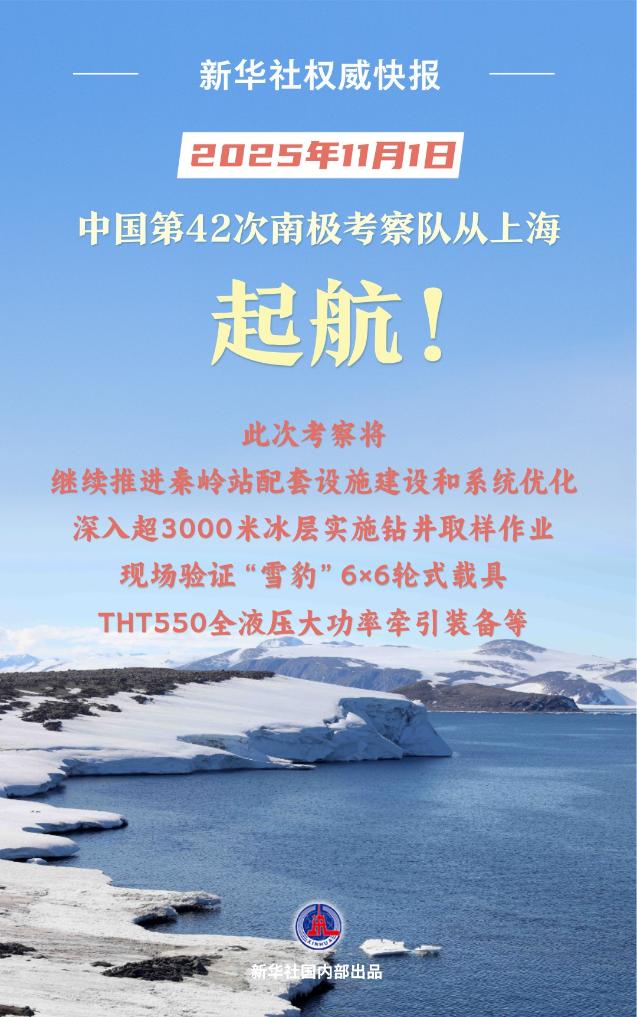
向着8万海里!中国第42次南极考察队起航
Xin Hua Wang· 2025-11-01 02:11
Core Points - The 42nd Antarctic Expedition Team from China has set sail from Shanghai, embarking on an 80,000 nautical mile journey to Antarctica [1] - The expedition aims to enhance China's capabilities in understanding, protecting, and utilizing the Antarctic region, aligning with national goals for ocean development and international cooperation [3] Group 1: Expedition Objectives and Activities - The expedition will conduct clean drilling and sampling in deep Antarctic ice layers, utilizing domestic hot water drilling technology for the first time [4] - Research on subglacial lakes in Antarctica will provide insights into extreme ecosystems and climate change, contributing to the understanding of sedimentation processes and life evolution [5] - The team will gather long-term observational data on the impact of climate change on the Southern Ocean ecosystem in key areas like the Amundsen Sea and Ross Sea [5] Group 2: Infrastructure and Technological Advancements - The Qinling Station, set to officially open in February 2024, will enhance China's research capabilities in the Ross Sea region, featuring advanced facilities for scientific research and operations [6] - The station will implement a smart storage system using polar robots and intelligent platforms, improving material flow efficiency by 40% [6] - The expedition will utilize domestically developed equipment, including the "Snow Leopard" 6×6 wheeled vehicle and various new technologies for automatic observation and satellite remote sensing [8] Group 3: International Collaboration - The expedition involves over 500 team members from more than 80 domestic organizations, as well as international researchers from countries like Thailand, Chile, and Portugal, promoting diverse collaborative research [8] - The mission reflects China's commitment to the Antarctic Treaty and its willingness to participate in international governance of the Antarctic region [8]