
深圳国企改革

Search documents
深圳国企改革概念下跌0.62%,主力资金净流出18股
Sou Hu Cai Jing· 2025-10-27 08:40
Core Viewpoint - The Shenzhen state-owned enterprise reform concept index declined by 0.62%, ranking among the top declines in concept sectors, with notable declines in stocks such as Jian Kexuan, Shen Zhenye A, and Shen Saige A [1] Market Performance - The storage chip sector led the gains with an increase of 3.49%, while the state-owned enterprise reform sector experienced a decline of 0.62% [1] - Among the stocks in the Shenzhen state-owned enterprise reform sector, 11 stocks saw price increases, with Yi Yatong, Agricultural Products, and Lihe Science and Technology rising by 3.12%, 2.93%, and 2.41% respectively [1] Capital Flow - The Shenzhen state-owned enterprise reform sector saw a net inflow of 152 million yuan, with 18 stocks experiencing net outflows [1] - The stock with the highest net outflow was Shen Zhenye A, with a net outflow of 96.96 million yuan, followed by Shen Fangzhi A and Te Fa Service with net outflows of 26.48 million yuan and 25.63 million yuan respectively [1] - The stocks with the highest net inflows included Guo Xin Securities, Shen Saige, and Shenzhen Energy, with net inflows of 196 million yuan, 51.81 million yuan, and 43.13 million yuan respectively [1] Notable Stock Movements - Shen Zhenye A experienced a significant decline of 5.27% with a turnover rate of 8.21% and a net outflow of 96.96 million yuan [2] - Yi Yatong and Agricultural Products saw increases of 3.12% and 2.93% respectively, with net inflows of 33.28 million yuan and 31.37 million yuan [2] - Guo Xin Securities had a net inflow of 195.95 million yuan, reflecting strong investor interest [2]



A股市场大势研判:沪指再创十年新高
Dongguan Securities· 2025-10-26 23:31
Market Performance - The Shanghai Composite Index closed at 3950.31, up by 0.71% with an increase of 27.90 points [2] - The Shenzhen Component Index rose by 2.02%, closing at 13289.18, with an increase of 263.74 points [2] - The ChiNext Index increased by 3.57%, closing at 3171.57, with an increase of 109.41 points [2] - The STAR 50 Index saw a rise of 4.35%, closing at 1462.22, with an increase of 60.97 points [2] Sector Performance - The top-performing sectors included Communication (up 4.73%), Electronics (up 4.72%), and Defense Industry (up 2.34%) [3] - The underperforming sectors were Oil & Petrochemicals (down 1.36%), Coal (down 1.29%), and Food & Beverage (down 1.18%) [3] - Concept sectors showing strong performance included Storage Chips (up 5.66%) and National Fund Holdings (up 4.88%) [3] Market Outlook - The market experienced significant volume increase, with the Shanghai Composite Index reaching a ten-year high, and the ChiNext Index rising over 3% [4] - Positive policy signals from the 20th Central Committee's Fourth Plenary Session are expected to reshape investment themes and boost market risk appetite [6] - Continued focus on dividend assets, technology growth, new energy, and non-ferrous metals is recommended [6]
深圳国企改革概念下跌3.74%,主力资金净流出21股
Sou Hu Cai Jing· 2025-10-24 09:56
Group 1 - The Shenzhen state-owned enterprise reform concept index declined by 3.74%, ranking among the top declines in concept sectors, with companies like Shen Shui Gui Yuan, Shen Wu Ye A, and Jian Ke Yuan experiencing significant drops [1][2] - Among the Shenzhen state-owned enterprise reform sector, only two stocks saw price increases, with Zhao Chi Co., Ltd. and Te Fa Information rising by 1.13% and 1.06% respectively [1][2] - The sector experienced a net outflow of 734 million yuan from major funds, with 21 stocks seeing net outflows, and five stocks having outflows exceeding 50 million yuan, led by Shen Sai Ge with a net outflow of 198 million yuan [2][3] Group 2 - The top gainers in today's concept sectors included storage chips with a rise of 5.66%, while coal concepts fell by 1.91% [2] - Major fund inflows were observed in stocks like Zhao Chi Co., Ltd., Shen Zhen Ye A, and Shenzhen Airport, with inflows of 66.64 million yuan, 51.84 million yuan, and 26.19 million yuan respectively [2][3] - The Shenzhen state-owned enterprise reform sector saw significant declines in individual stocks, with Jian Ke Yuan dropping by 7.96% and Shen Wu Ye A by 8.41% [2][3]


万联晨会-20251024
Wanlian Securities· 2025-10-24 00:44
Core Viewpoints - The A-share market saw all three major indices rise on Thursday, with the Shanghai Composite Index up by 0.22%, the Shenzhen Component Index also up by 0.22%, and the ChiNext Index rising by 0.09%. The total trading volume in the Shanghai and Shenzhen markets reached 16,436.84 billion yuan [2][8] - In terms of industry performance, coal, oil and petrochemicals, and social services led the gains, while telecommunications, real estate, and building materials lagged behind. Concept sectors such as Shenzhen state-owned enterprise reform, horse racing concepts, and MLOps saw significant increases, while cultivated diamonds, CPO, and copper cable high-speed connections experienced notable declines [2][8] - The Hong Kong market also performed positively, with the Hang Seng Index rising by 0.72% and the Hang Seng Technology Index increasing by 0.48%. In overseas markets, all three major US indices closed higher, with the Dow Jones up by 0.31%, the S&P 500 up by 0.58%, and the Nasdaq up by 0.89% [2][8] Important News - The 20th Central Committee's Fourth Plenary Session released a communiqué outlining the main goals for the "14th Five-Year Plan" period, emphasizing significant achievements in high-quality development, enhanced self-reliance in technology, and new breakthroughs in comprehensive deepening of reforms. By 2035, the aim is to significantly elevate China's economic, technological, defense, comprehensive national strength, and international influence, with per capita GDP reaching the level of moderately developed countries [3][9] - A delegation led by Vice Premier He Lifeng will visit Malaysia from October 24 to 27 for economic and trade consultations with the US, focusing on important issues in Sino-US economic relations as agreed upon in previous communications between the two countries' leaders [3][9]
和讯投顾黄儒琛:市场企稳,投资者可积极寻找操作机会
Sou Hu Cai Jing· 2025-10-24 00:14
Core Insights - The market analysis indicates a significant influx of capital during the market's closing phase, driven by anticipatory positioning following a recent meeting [1] - The "155" planning direction highlights two innovative sectors: Shenzhen state-owned enterprise reform and quantum technology, with the latter showing similarities to AI software and smart governance [1] - The coal sector, a traditional blue-chip representative, has shown signs of recovery, suggesting its continued relevance compared to newer energy sources like combustible ice and shale gas [2] Sector Analysis - The focus on nuclear fusion within the "155" planning framework suggests potential investment opportunities in this emerging field [2] - The performance of metals, electrical equipment, and batteries has been strong, but a cautious approach is recommended, particularly regarding solid-state batteries as the market transitions between old and new cycles [2] - Institutional funds have resumed activity, stabilizing components of the Nvidia and Tesla supply chains, indicating resilience in the face of market fluctuations [2] Market Strategy - Following the conclusion of the recent meeting, the market's direction will depend on whether the late-day capital influx aligns with earlier trends, with a focus on volume increases from institutional participation [3] - Investors are advised to adopt a narrow trading range strategy due to the excessive number of buying directions observed, emphasizing the need for core assets to withstand market divergences before confirming a major upward trend [3]
A股市场大势研判:指数探底回升,全线收红
Dongguan Securities· 2025-10-23 23:31
Market Overview - The A-share market showed a rebound with all indices closing in the green, with the Shanghai Composite Index recovering above 3900 points [4] - The market experienced a bottoming out trend, with the three major indices all rising, indicating a preference for profit-making [5] Index Performance - The Shanghai Composite Index closed at 3922.41, up by 0.22%, while the Shenzhen Component Index also rose by 0.22% to 13025.45 [2] - The CSI 300 Index increased by 0.30% to 4606.34, while the ChiNext Index saw a slight increase of 0.09% to 3062.16 [2] Sector Performance - The top-performing sectors included coal (+1.75%), oil and petrochemicals (+1.52%), and social services (+1.07%) [3] - Conversely, the sectors that underperformed included telecommunications (-1.51%), real estate (-0.99%), and construction materials (-0.91%) [3] Concept Index Performance - The Shenzhen State-Owned Enterprise Reform concept led the gains with an increase of 6.62%, followed by the horse racing concept (+2.45%) and MLOps concept (+2.41%) [3] - Underperforming concepts included cultivated diamonds (-2.94%) and co-packaged optics (CPO) (-1.32%) [3] Economic Indicators - In September, the total electricity consumption reached 888.6 billion kWh, reflecting a year-on-year growth of 4.5% [4] - The unemployment rate for urban youth aged 16-24 was reported at 17.7%, while the rate for those aged 25-29 was 7.2% [5] Future Outlook - The market is expected to enter a phase of consolidation, with a potential for a mid-term upward trend [5] - It is recommended to maintain flexible positions and avoid blind chasing of high prices, focusing on optimizing allocation based on economic conditions and valuation [5] - Key sectors to watch include dividend assets, technology growth, new energy, and non-ferrous metals [5]
金十数据全球财经早餐 | 2025年10月24日
Jin Shi Shu Ju· 2025-10-23 23:00
Group 1 - The U.S. is increasing pressure on Venezuela, with Trump seeking land action under the pretext of drug issues [2] - The U.S. has deployed B-1 bombers near Venezuela, heightening geopolitical risks and stimulating demand for safe-haven assets [2] - International oil prices surged to two-week highs due to U.S. sanctions on two major Russian oil companies, with WTI crude reaching $61.74 per barrel, up 3.99%, and Brent crude rising 5.38% to $65.90 per barrel [2][5] Group 2 - U.S. stock indices showed positive performance, with the Dow Jones up 0.3%, S&P 500 up 0.58%, and Nasdaq up 0.89% [3] - Quantum computing stocks saw significant gains, with IonQ rising 7%, Quantum up nearly 10%, and D-Wave up nearly 14% [3] - The Nasdaq Golden Dragon China Index increased by 1.6%, with Alibaba rising 3.6% [3] Group 3 - Hong Kong's Hang Seng Index closed up 0.72% at 25,967.98 points, with a trading volume of HKD 245.256 billion [4] - The A-share market experienced fluctuations, with the Shanghai Composite Index gaining 0.22% and the Shenzhen Component Index also up 0.22% [4] Group 4 - Gold prices rose by 0.66% to $4,125.19 per ounce, while silver increased by 0.86% to $48.85 per ounce [5] - Bitcoin reached $109,656, up 1.92%, and Ethereum rose to $3,832.7, up 2.35% [6]


策略日报:四中全会确定主线-20251023
Tai Ping Yang Zheng Quan· 2025-10-23 15:29
Group 1 - The report emphasizes that the upcoming quarter will see renewed market interest in traditional sectors such as coal, banking, and aquaculture, as indicated by the strong performance of the dividend index [5][18] - The Fourth Plenary Session has established AI as a core focus for the technology sector, alongside military-related themes, which are expected to dominate the market for the next five years [5][10] - The report suggests that the technology sector's high absorption rate and volatility will make it difficult to achieve excess returns, while sectors like coal, banking, and nuclear power are expected to perform well in the fourth quarter [5][18] Group 2 - The report predicts that the bond market will stabilize in the short term but will continue to decline in the long term, with a target near the low point from September 30, 2024 [4][15] - The A-share market is expected to focus on traditional sectors in the upcoming quarter, while the technology sector will be monitored for a potential decrease in absorption rates [10][18] - The report highlights that the U.S. stock market is likely to perform strongly due to anticipated favorable earnings reports, although it may experience low volatility leading up to key meetings [6][23] Group 3 - The report indicates that the onshore RMB has shown strength against the USD, with the central bank guiding the midpoint lower, while the dollar is expected to maintain a strong performance [7][27] - The euro is projected to continue its decline against the dollar, influenced by factors such as Germany's fiscal restructuring narrative and the euro's overvaluation impacting export competitiveness [8][27] - The commodity market is experiencing a positive trend, particularly in oil and new energy sectors, with several domestic commodities showing signs of recovery [8][32]
仅4股获北向资金净买入
Zheng Quan Shi Bao· 2025-10-23 14:19
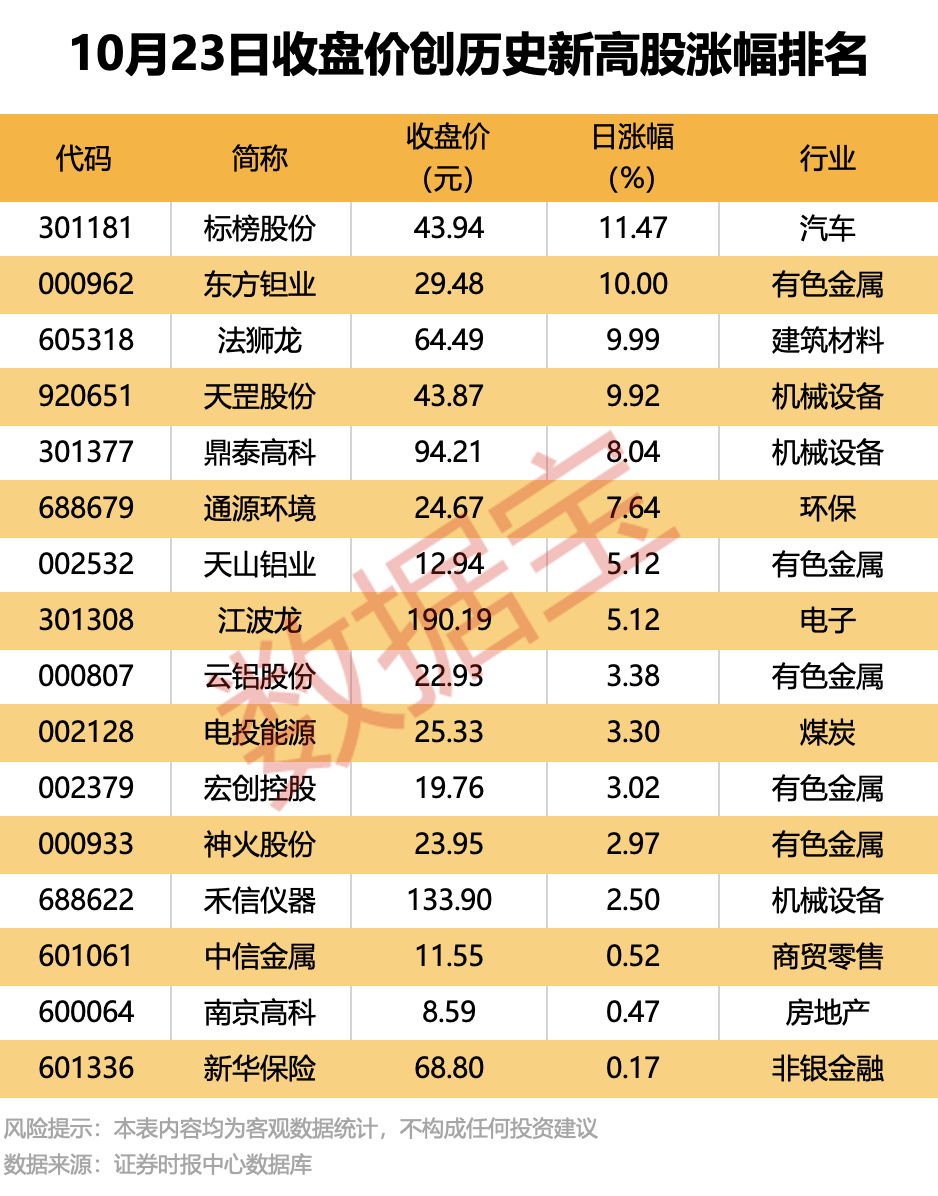
Market Overview - On October 23, A-shares saw all three major indices rise, with the Shanghai Composite Index and Shenzhen Component Index both increasing by 0.22%, and the ChiNext Index rising by 0.09% [1] - The total trading volume for the day was 1.66 trillion yuan, a decrease of over 29 billion yuan compared to the previous trading day [1] - Nearly 3,000 stocks closed higher, with 72 stocks hitting the daily limit up [1] Sector Performance - The Shenzhen state-owned enterprise reform concept led the market, with stocks like JianKexueYuan, GuangTian Group, and TeFa Information hitting the daily limit up [1] - Other sectors that saw gains included coal mining and processing, energy metals, and film and television lines [1] - Conversely, sectors such as cultivated diamonds, engineering machinery, and non-metallic materials experienced significant declines [1] Historical Highs - A total of 16 stocks reached their historical closing highs, with notable concentrations in the non-ferrous metals and machinery equipment sectors, which had 5 and 3 stocks respectively [2] - The average price increase for stocks that hit historical highs was 5.23%, with stocks like Dongfang Tantalum and Fashilong reaching their daily limit up [2] Institutional Trading - In the Dragon and Tiger List, 11 stocks had net purchases, while 16 stocks had net sales [4] - The top net purchase was by Beifang Co., with an amount of 101 million yuan, followed by Xingfu Lanhai and Yunhan Xincheng, both exceeding 31 million yuan [4] - On the selling side, Beifang Changlong saw the highest net sell at 132 million yuan, followed by Huanghe Xuanfeng and Lanfeng Biochemical [4] Company Announcements - Shuangliang Energy reported a net loss of 544 million yuan for the first three quarters, marking a year-on-year decline [7] - Huawu Co. announced a significant increase in net profit by 4202% in the third quarter, with a noticeable recovery in the gross profit margin of wind power brake products [7] - Hush Silicon Industry plans to reduce its stake by no more than 2% [7] - HaiLanXin reported a net profit increase of 290.58% year-on-year for the first three quarters [7] - NewMeiXing reported a net profit increase of 191.95% year-on-year for the first three quarters [7]
每日复盘-20251023
Guoyuan Securities· 2025-10-23 14:12
Market Performance - On October 23, 2025, the Shanghai Composite Index rose by 0.22%, and the Shenzhen Component Index also increased by 0.22%, while the ChiNext Index saw a smaller gain of 0.09%[15] - The total market turnover was 16,607.09 billion yuan, a decrease of 295.50 billion yuan from the previous trading day[15] - Out of 5,296 stocks, 2,994 rose while 2,302 fell, indicating a generally positive market sentiment[15] Sector Performance - The top-performing sectors included Oil & Petrochemicals (up 1.84%), Coal (up 1.70%), and Composite (up 1.28%) while the laggards were Communication (down 1.51%), Real Estate (down 1.02%), and Building Materials (down 0.86%)[21] - Most concept sectors saw gains, particularly Shenzhen State-Owned Enterprise Reform, Horse Racing, and MLOps, while sectors like Cultivated Diamonds and Co-Packaged Optics (CPO) experienced declines[21] Capital Flow - On October 23, 2025, the net outflow of main funds was 337.33 billion yuan, with large orders contributing to a significant portion of this outflow[25] - Small orders, however, saw a continuous net inflow of 394.31 billion yuan, indicating retail investor interest[25] ETF Activity - Major ETFs such as the Huaxia SSE 50 ETF and the Huatai-PB CSI 300 ETF saw varied trading volumes, with the former decreasing by 6.75 billion yuan to 18.16 billion yuan[29] - The net inflow for the CSI A50 ETF was 3.53 billion yuan on October 22, indicating a preference for large-cap stocks[29] Global Market Trends - On October 23, 2025, the Hang Seng Index rose by 0.72%, while the Nikkei 225 fell by 1.35%[34] - The U.S. stock market saw declines across major indices, with the Dow Jones Industrial Average down 0.71% and the S&P 500 down 0.53%[34]