科教兴国战略

Search documents
学习笔记|上半年财政运行:强化民生导向与经济发展新动能
2 1 Shi Ji Jing Ji Bao Dao· 2025-07-28 13:47
Core Insights - The overall public budget revenue in the first half of 2025 was approximately 11.56 trillion yuan, a year-on-year decrease of 0.3%, with tax revenue declining by 1.2% and non-tax revenue increasing by 3.7% [1] - Public budget expenditure reached 14.13 trillion yuan, reflecting a year-on-year growth of 3.4%, with significant increases in social security and employment spending [2][3] Revenue Analysis - Tax revenue totaled 9.29 trillion yuan, down 1.2%, while non-tax revenue was 2.27 trillion yuan, up 3.7% [1] - Central government revenue was 4.86 trillion yuan, a decrease of 2.8%, while local government revenue increased by 1.6% to 6.7 trillion yuan [1] - Monthly tax revenue has shown growth for three consecutive months since April, indicating a positive trend in certain industries [1] Expenditure Analysis - Social security and employment spending was 2.45 trillion yuan, up 9.2%, making it the fastest-growing expenditure category [2][3] - Education spending reached 2.15 trillion yuan, growing by 5.9%, while health spending was 1.1 trillion yuan, increasing by 4.3% [2] - Significant funding was allocated to improve basic pension benefits and healthcare services, reflecting a focus on enhancing social welfare [3][4] Strategic Focus - The increase in science and technology spending highlights the emphasis on developing new productive forces and improving overall productivity [4] - The government aims to strengthen the social safety net while fostering high-quality economic growth through investments in education and technology [4] - Future fiscal policies will continue to prioritize social welfare and economic recovery, with an emphasis on effective budget execution and increased funding for public services [4]
推动科技自主创新和人才自主培养良性互动(专题深思)
Ren Min Ri Bao· 2025-07-09 22:32
Group 1 - Education, technology, and talent are foundational and strategic supports for China's modernization, emphasizing the need for a virtuous cycle among education, technology, and talent [1] - Higher education institutions are crucial for developing technology and nurturing talent, which are essential for driving innovation and supporting China's modernization efforts [1] Group 2 - Talent is recognized as the primary resource for innovation, and higher education institutions must integrate moral education with talent cultivation to produce innovative talents [2] - The reform of ideological and political courses is highlighted as a means to instill values and enhance students' capabilities, ensuring a comprehensive talent development system [2] - The role of artificial intelligence in personalizing and optimizing talent training is emphasized, alongside the need for a global perspective in nurturing innovative talents [2] Group 3 - There is a call for collaboration between basic and interdisciplinary sciences to cultivate composite talents needed for economic and social development [3] - Higher education must innovate its discipline systems to activate innovation potential and support high-level technological self-reliance [3] - The focus is on long-term support strategies for foundational disciplines and the establishment of interdisciplinary collaborative entities to drive technological innovation [3] Group 4 - Deep integration of industry, academia, and research is essential for accelerating the cultivation of innovative talents and leading technological innovation [4] - Higher education institutions are urged to enhance their talent cultivation systems and collaborate with industries to address technological challenges [4] - The establishment of specialized technology transfer institutions and a differentiated talent cultivation model is necessary to align talent supply with regional industrial upgrades [4]
《环球时报》锐评:韦东奕“二次出圈”折射出什么
Huan Qiu Wang· 2025-06-09 13:30
Core Viewpoint - The phenomenon of Wei Dongyi, a mathematics scholar from Peking University, gaining immense popularity on social media highlights the increasing societal value placed on knowledge and talent in contemporary China [1][3]. Group 1: Social Media Impact - Wei Dongyi's short video on a social media platform garnered over 1 million comments within 24 hours and attracted more than 23 million followers by June 9, indicating a significant public interest in intellectual figures [1]. - The event coincided with the Chinese college entrance examination period, with many young fans expressing a desire to connect with Wei's academic prowess [3]. Group 2: Public Response and Values - The public's concern for Wei's health and well-being reflects a broader societal respect for intellectuals and a desire to support their contributions to academia [1][3]. - Media and platforms are encouraged to focus on the professional achievements of scholars rather than their private lives, promoting a culture that values knowledge and protects the academic environment [3]. Group 3: Cultural Significance - Wei Dongyi's rise to fame is seen as part of a larger trend in China that honors outstanding intellectuals, showcasing a collective admiration for dedication to knowledge and simplicity in personal life [4]. - The event serves as a testament to the national strategy of promoting scientific education and the importance of nurturing young talent in the country [4][5].


加快形成教育、科技、人才“三位一体”协同高效运行机制
Ren Min Ri Bao· 2025-06-04 21:48
Group 1 - Education, technology, and talent are foundational and strategic supports for building a modern socialist country, emphasizing the need for an integrated approach to their development [1][3] - The relationship among education, technology, and talent forms a cyclical system of knowledge production, application, and reproduction, where education is the foundation for technological advancement and economic revitalization [2][3] - The coupling effect among education, technology, and talent is increasingly significant in the context of global technological innovation, necessitating a coordinated mechanism for their efficient operation [3][4] Group 2 - Various regions and departments are implementing the central government's decisions to promote a collaborative and efficient operational mechanism for education, technology, and talent, with examples such as Beijing's regulations on technology transfer and Hunan's policy framework for R&D centers [4] - Challenges remain in the education, technology, and talent sectors, including a lack of coordination and resource allocation issues, which hinder the formation of an effective integrated mechanism [4][5] - The need for comprehensive reforms in the education, technology, and talent systems is highlighted, with a focus on enhancing leadership, systemic integration, and collaboration across departments [5][6] Group 3 - The reform in the education sector should focus on enhancing systemic, holistic, and collaborative approaches, ensuring that foundational education supports innovation from an early stage [6][7] - The technology system reform aims to strengthen national strategic technological capabilities and improve the efficiency of research institutions and innovation systems [6][7] - Talent development reforms must eliminate institutional barriers that restrict talent vitality, with an emphasis on establishing diverse evaluation standards for different types of talent [7]
《求是》杂志发表习近平总书记重要文章《加快建设教育强国》
news flash· 2025-05-31 07:03
Core Viewpoint - The article emphasizes the importance of education in building a strong nation and revitalizing the nation, highlighting that education is a fundamental aspect of national development and party strategy [1] Summary by Relevant Sections - **National Strategy**: Since the 18th National Congress, education has been prioritized as a major national and party strategy, with significant decisions made to implement the strategy of invigorating the country through science and education [1] - **Goals and Achievements**: The article sets a goal to establish a strong education system by 2035, aiming for historic achievements and structural changes in the education sector during the new era [1]
以人才友好型城市建设赋能城市高质量发展
Xin Hua Ri Bao· 2025-05-27 06:45
Group 1 - The core viewpoint emphasizes the importance of education, technology, and talent as foundational and strategic supports for China's modernization, advocating for a talent-friendly city construction to align with the national strategy [1] - Jiangsu province is focusing on a "1650" industrial system to enhance emerging and future industries, with cities like Nanjing and Suzhou leading in fields such as artificial intelligence and biotechnology [2] - The government is encouraged to match talent recruitment with industrial needs through targeted policies and professional exchanges, leveraging a provincial talent database for precise talent acquisition [2] Group 2 - Universities are identified as key players in cultivating innovative talent, with a call for aligning educational programs with industry needs to enhance local production capabilities [3] - There is a push for deep collaboration between enterprises and universities to form innovation research institutes, facilitating talent training and technology development [3] - Jiangsu aims to improve talent policies to retain high-end talent and foster innovation, focusing on attracting skilled youth and high-level innovators in cutting-edge fields [4] Group 3 - Creating a livable environment is crucial for attracting and retaining talent, particularly for young professionals aged 20-30 who consider both career opportunities and quality of life [5] - The development of youth-friendly policies and services is highlighted, with examples of integrating public services through technology to support young talent in various aspects of life [6] - Urban planning should prioritize areas where young talent congregates, enhancing public transport and amenities to improve the overall livability and attractiveness of cities [6]
从“跟跑”到“领跑”,科教兴国重塑中国发展逻辑
Ke Ji Ri Bao· 2025-05-15 01:09
Group 1 - The "Science and Education to Prosper the Country" strategy has fundamentally changed China's development logic and reshaped its technological landscape over the past 30 years, transitioning from "catching up" to "keeping pace" and finally to "leading" in technology [2][3] - The implementation of this strategy has significantly contributed to China's modernization and economic strength, as evidenced by the growth of internet companies like 360 Group, which have capitalized on national strategies in cybersecurity and artificial intelligence [2][3] - The strategy has also led to a substantial increase in research output and quality in higher education institutions, exemplified by Tsinghua University's rise in global rankings and publication frequency in top journals [3][4] Group 2 - Recent reforms have emphasized the integration of education, technology, and talent development, accelerating the pace of technological reforms and enhancing the strategic importance of the "Science and Education to Prosper the Country" initiative [5][6] - There is a strong call for a focus on original and disruptive technologies, with suggestions to create a more inclusive research ecosystem that encourages exploration and tolerates failure [5][6] - The need for a collaborative approach involving experienced scientists and the establishment of specialized funds to support significant research projects has been highlighted, aiming to leverage the intellectual resources of senior scientists [6]
产学研协同培养创新型人才
Jing Ji Ri Bao· 2025-05-14 22:08
Core Viewpoint - The article emphasizes the importance of strengthening the integration of education, technology, and talent to support China's modernization and enhance its competitive edge in global technology [1] Group 1: Strengthening Talent Development - The need to attract skilled professionals from enterprises to join the teaching workforce, breaking down barriers in talent introduction, training, evaluation, and mobility [2] - Establishing a dual-employment mechanism between higher education institutions, research institutes, and industry enterprises to enhance talent flow and collaboration [2] - Implementing a multi-dimensional evaluation standard that combines academic papers, technical patents, and results transformation to assess the contributions of talent effectively [2] Group 2: Improving Support Systems - Clarifying the responsibilities and rights of higher education institutions, industry enterprises, and research institutes to create a supportive environment for cultivating innovative talents [3] - Establishing a government-led policy framework for collaborative education that aligns with enterprise technology needs and promotes joint research and development [3] - Increasing funding for collaborative education efforts, particularly in strategic fields like integrated circuits, cybersecurity, and biomedicine, to ensure long-term support [3] Group 3: Optimizing Educational Mechanisms - Adjusting academic disciplines and reforming curriculum systems to meet the demands of emerging industries and future talent needs [4] - Promoting innovative educational models and integrating real-world cases and cutting-edge technologies into teaching [4] - Enhancing practical training and establishing a three-in-one training model that connects classroom learning, laboratory work, and production lines [4]
一体推进教育发展科技创新人才培养
Jing Ji Ri Bao· 2025-05-06 22:02
Group 1 - The core viewpoint emphasizes the interdependence of education, technology, and talent as foundational elements for China's modernization strategy, highlighting the need for a coordinated approach to advance these areas together [1][2][3] - Education serves as the primary support for technological innovation and talent cultivation, with a focus on high-quality, multi-level education systems that foster original and disruptive innovations [2][3] - Current challenges include a lack of synergy among education, technology, and talent, with issues such as weak foundational education, insufficient innovation, and a disconnect between educational outcomes and societal needs [3][4] Group 2 - Higher education is identified as a critical area for strengthening technological innovation, requiring alignment with scientific advancements and optimization of academic programs to meet national strategic needs [4][5] - The cultivation of strategic talent is crucial for maintaining competitiveness in high-tech fields, with an emphasis on developing young scientists and engineers who can lead innovation efforts [5][6] - Systematic reforms in resource allocation, evaluation mechanisms, and management structures are necessary to enhance the integration of education, technology, and talent development [6][7]
在中国最南端的海岛学校,教育让梦想成真
Xin Hua Wang· 2025-04-24 09:06
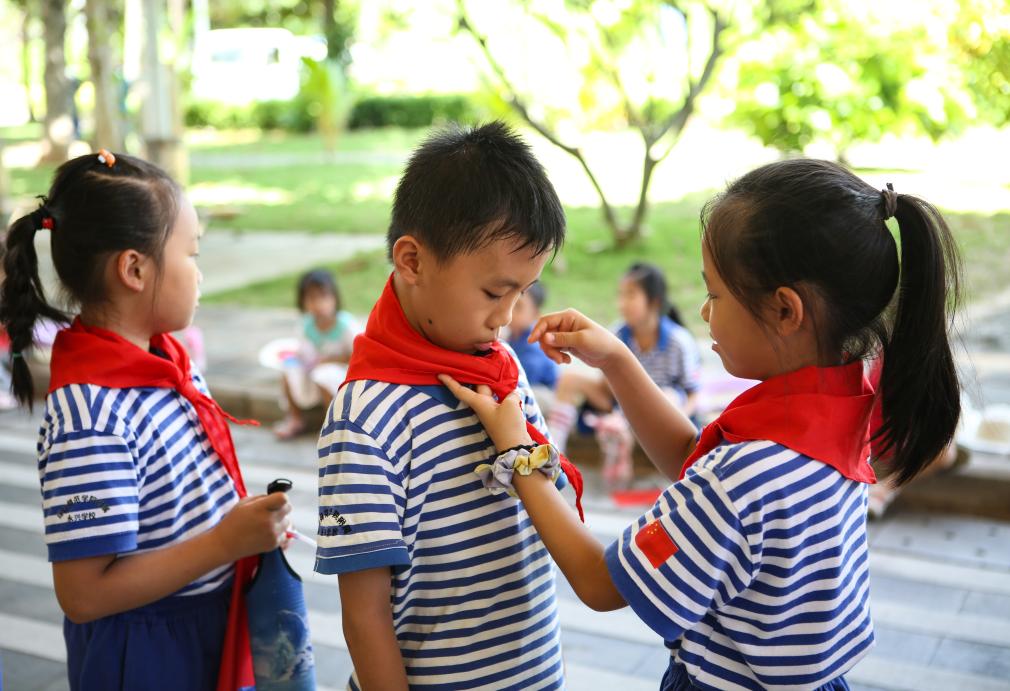
早上8点,9岁的邓子豪穿着校服,背着书包去上学。对这个小贩的儿子来说,这是平凡的一天。 他是中国南海永兴岛上唯一的学校——三沙市永兴学校的50多名学生之一。他们的父母主要是渔民、商贩、建筑工人和职工等。 海南省三沙市永兴学校的少先队员们在"童心向祖国,我为祖国献首歌"活动中佩戴红领巾。(资料照片)新华社记者 樊雨晴 摄 新华社海口4月24日电 题:在中国最南端的海岛学校,教育让梦想成真 新华社记者程露、钟群、陈子薇 这是中国地理上最南端的学校。今天的课从语文开始,教"贝"字。 "作为海岛的儿女,他们熟悉贝壳。但语文课要教更多跟语言相关的文化和历史。"23岁的老师李芳敏说。 她向孩子们讲述了为什么贝壳会成为中国最早的货币之一,以及贝壳蕴含的财富的意义。 "现在,你们说说贝的故事,并造句。"李芳敏说。 邓子豪回答:"古时候人们把'贝'当作装饰品。" 另一个孩子补充:"'贝'字通常与珍贵的东西有关。" 为了让课程更生动,李芳敏播放了自制的短视频,追溯中国货币从贝壳到数字支付的历程。 海岛上的教学内容和大陆上的完全一样。邓子豪接下来,还要上数学、历史、美术等课。 几千年前,中国渔民、水手发现了西沙群岛并定居下来。李芳 ...