通用大模型

Search documents
除了宇树,美团其实投了大半个中国AI独角兽,或与被投企业相互敞开所有商业、技术场景
Sou Hu Cai Jing· 2026-03-27 05:00
Core Insights - Meituan has reported a significant investment return of 40 billion yuan from foreign investments, with actual value exceeding this figure [1] - The company is actively investing in various technology sectors, including robotics, AI, semiconductors, and autonomous driving, indicating a strategic focus on physical AI [3] Investment Overview - Meituan's investments span multiple sectors, including: - **Robotics**: Investments in companies like Yushun Technology and Galaxy General, with valuations reaching up to 30 billion USD [1] - **AI & Large Models**: Notable investments in companies like Zhi Yu AI and Yue Zhi An, with valuations exceeding 180 billion yuan [1] - **Semiconductors & AI Hardware**: Investments in firms like Rongxin Semiconductor and Moer Thread, with current valuations around 250 billion yuan [2] - **Autonomous Driving & Smart Vehicles**: Investments in companies like Li Auto, with a current market valuation of approximately 130 billion yuan [2] Strategic Focus - The company emphasizes the importance of physical AI, stating that the digitalization of the physical world will be a crucial foundation for AI development [3] - Meituan aims to align its strategic investments with its core business operations, leveraging its extensive data and scenarios in the offline physical world [3]



《方略》上新!方三文对话张鹏:通用大模型最后不会只剩一家
雪球· 2026-03-04 08:29
Core Viewpoint - The article discusses the evolving landscape of AI technology, emphasizing the importance of model diversity and commercialization as key themes in the global AI competition. It highlights the significance of Chinese large model enterprises in understanding this competitive landscape [1]. Group 1: AI Development and Historical Context - The development of AI spans over seventy years, beginning with the perceptron in 1958 and evolving through milestones such as the first chatbot Eliza in 1966 and the introduction of GPU technology. The 2017 Transformer paper is noted as a foundational element for large model technology [6]. - The evolution of AI is described as a "tension structure," where the gap between long-term goals and available resources drives continuous exploration and innovation [6]. Group 2: Current Competitive Landscape - The current landscape of general large models is characterized by diversity, with the assertion that "there will not be just one player." This diversity is seen as a crucial driver for ongoing technological advancement [7]. - The large model industry is expected to experience varied paths of technological innovation and a broad market space, with different players carving out their niches. Although there may be a tendency towards consolidation, the ecosystem of applications based on general models is anticipated to thrive [7]. Group 3: Company Insights - Zhiyu, as a representative company in the general large model field, has focused on AGI as a long-term goal, prioritizing research and development in large model technology while avoiding distractions from non-core businesses. The company emphasizes that computational power is a core component of R&D costs [7][8]. - Zhiyu has recently completed its IPO, becoming the "first stock of global large models," providing a new perspective on how large model enterprises transition from technological exploration to commercial practice [2].

AI正在复刻2006年房地产的“黄金十年”
3 6 Ke· 2026-02-02 03:15
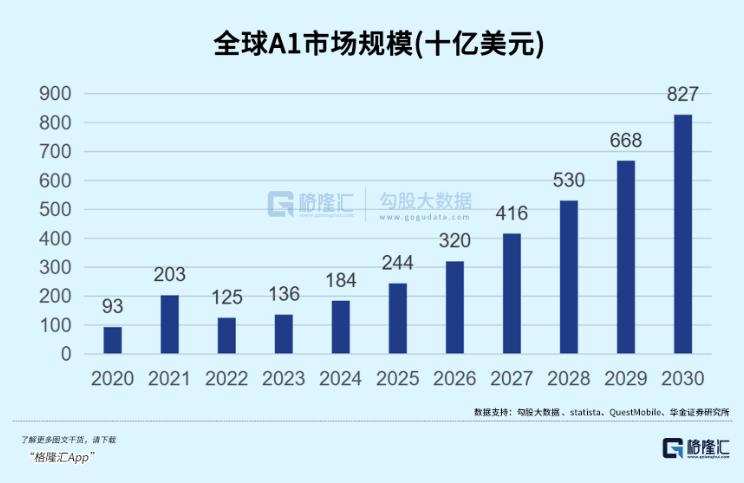
Core Insights - The AI industry is experiencing a significant growth phase, similar to the real estate boom of 2006, with applications expanding across various sectors and a projected market size increase from $244 billion in 2025 to $827 billion by 2030, reflecting a compound annual growth rate of 24% [1] Group 1: Technological and Policy Support - The rapid development of the AI industry is driven by technological breakthroughs and supportive policies, with major models improving in language understanding, code generation, and computer vision [2] - The Chinese government has outlined a clear path for AI development through the "Artificial Intelligence+" action plan, setting milestone goals for 2027, 2030, and 2035 [4] - The AI industry ecosystem is becoming more complete, with upgrades in AI chips and servers, innovations in general models, and accelerated penetration into various application fields [6] Group 2: Diverse Application Scenarios - AI technology is being applied in various fields such as content creation, marketing, software development, and gaming, leading to new business models and significant efficiency improvements [7] - In the first half of 2025, global downloads of generative AI applications reached nearly 1.7 billion, with in-app purchase revenue hitting $1.9 billion and total user engagement time reaching 15.6 billion hours [7] - The domestic market is also thriving, with AI comics experiencing a 900% revenue growth from Q4 2024 to Q3 2025, and platforms like Douyin and Kuaishou launching AI creation tools [9] Group 3: Commercialization and Business Growth - The growth of the AI industry is supported by both platform companies and vertical industry leaders, creating a clear path for commercialization [12] - Major platforms like Douyin and Kuaishou are integrating AI technologies into their content production processes, significantly enhancing user engagement and revenue [12] - Companies like Meitu and Duolingo are leveraging AI to drive substantial revenue growth, with Duolingo reporting a 41% increase in revenue and an 84% increase in net profit in Q2 2025 [14] Group 4: Investment Opportunities - The explosive growth of the AI industry presents numerous investment opportunities, particularly in content and traffic platform companies, AI marketing leaders, and vertical AI application pioneers [17]
资本长情陪伴 北京金融科技共生成长
Bei Jing Shang Bao· 2026-01-29 14:47
Core Viewpoint - Beijing is positioning itself as the "global artificial intelligence capital" during the "15th Five-Year Plan" period, focusing on the integration of finance and hard technology to foster innovation and high-quality development [3][12]. Group 1: Financial Support for Hard Technology - Financial support for hard technology is evolving from traditional metrics of "heavy reports and collateral" to a focus on "technology and potential," enabling startups to access necessary funding [4][7]. - The successful IPO of the domestic GPU leader, Moore Threads, exemplifies the deep financial support that hard tech companies require, highlighting the importance of equity financing in their early stages [4][5]. - The China Bank Beijing Branch plans to provide at least 50 billion yuan in comprehensive financial support for the artificial intelligence industry over the next three years, demonstrating a commitment to nurturing the sector [6][11]. Group 2: Challenges in Financing Hard Technology - Hard technology companies often face challenges in securing financing due to their asset-light nature and high R&D costs, making traditional financing routes difficult [7][8]. - Many banks are adapting their services to better meet the needs of hard tech firms, focusing on understanding the technology's value rather than relying solely on financial statements [8][10]. - The shift towards a more supportive financial ecosystem is crucial for the growth of hard technology companies, as they often lack the collateral typically required for loans [7][9]. Group 3: Collaborative Growth and Innovation - The integration of finance and hard technology is seen as a "marathon," requiring sustained support rather than quick wins, which is essential for the long-term success of these companies [3][10]. - Banks are increasingly forming partnerships with technology firms, research institutions, and investment entities to create a comprehensive support system that addresses the unique needs of hard tech [11][12]. - The collaborative approach aims to enhance the overall efficiency of financial services while ensuring that hard technology firms receive the necessary backing to thrive in a competitive landscape [10][11].

“十五五”开局 西湖区要从五个方面发力
Mei Ri Shang Bao· 2026-01-28 23:32
Core Insights - The West Lake District aims for a GDP growth of 5.5% to 5.8% in 2026, with a focus on high-quality development and enhancing the overall effectiveness of its science and education sector [1][2] Economic Goals - The district's public budget revenue is expected to achieve positive growth, maintaining a scale similar to the previous year [1] - Per capita disposable income for residents is targeted to grow in line with economic growth [1] Industrial Development - The district is accelerating the construction of a modern industrial system integrating cloud innovation, scientific innovation, and cultural innovation, with a focus on advancing platform economy projects and digital economy growth [2] - Five new platform economy projects with over 100 million yuan are planned, with a target of 6.5% growth in the core digital economy sector [2] Science and Technology Initiatives - Over 30 major national, provincial, and municipal technology projects will be implemented, aiming for more than 200 project outcomes and a technology transaction volume exceeding 30 billion yuan [2] - The district plans to enhance its robotics industry service hub and establish a ten-meter EMC laboratory [2] Cultural and Creative Industry - The district is focused on branding its cultural and creative highland, with initiatives to upgrade consumption carriers and innovate business formats [3] - Key projects include the expansion of the Black Myth IP influence, the creation of a "3A game highland," and the introduction of new retail and cultural formats in various districts [3]
2025年央企战略性新兴产业营收规模超12万亿元 连续三年年增1万亿
智通财经网· 2026-01-28 03:39
Core Viewpoint The State-owned Assets Supervision and Administration Commission (SASAC) of the State Council presented the high-quality development goals for state-owned enterprises (SOEs) by 2025, highlighting significant growth in strategic emerging industries and the overall economic contributions of central enterprises. Group 1: Economic Performance - By the end of 2025, the total assets of central enterprises are expected to exceed 95 trillion yuan, with an average annual growth rate of 6.9% [4] - The total profit is projected to reach 2.5 trillion yuan in 2025, with fixed asset investments of 5.1 trillion yuan and tax contributions of 2.5 trillion yuan [4] - The added value of central enterprises is anticipated to be 51.3 trillion yuan, marking a 44.6% increase compared to the previous five-year plan [15] Group 2: Strategic Emerging Industries - Revenue from strategic emerging industries is expected to surpass 12 trillion yuan by 2025, achieving a consistent annual growth of 1 trillion yuan over three years [1][42] - Cumulative investments in strategic emerging industries have exceeded 10 trillion yuan, increasing their share of total investments from 22% to over 40% [1][42] - Key sectors such as integrated circuits, biotechnology, and new energy vehicles are experiencing accelerated development, while artificial intelligence and quantum technology are emerging as competitive fields [1][42] Group 3: Technological Innovation - Central enterprises are projected to invest 1.1 trillion yuan in R&D by 2025, maintaining an annual investment above 1 trillion yuan for four consecutive years [5] - The number of academicians in central enterprises has increased, with significant breakthroughs in various frontier fields [5] - Collaborative innovation efforts have expanded, with over 100 innovation entities participating in joint research initiatives [5] Group 4: Corporate Reform and Governance - The reform actions for state-owned enterprises have shown positive results, enhancing their strategic functions and core competitiveness [10][11] - The revenue from sectors critical to national security and the economy accounts for over 70% of central enterprises' total revenue [10] - Governance improvements include the establishment of a modern enterprise system and enhanced regulatory effectiveness [11] Group 5: Social Responsibility and Community Engagement - Central enterprises have actively participated in rural revitalization efforts, with significant investments and support for local communities [57] - Emergency response capabilities have been strengthened, with substantial resources allocated for disaster relief and public safety [57] - Environmental sustainability initiatives have led to reductions in energy consumption and carbon emissions, contributing to national goals [57]
为何企业AI转型普遍失败?执掌全球最神秘AI公司的CEO直言:白领时代将彻底结束
3 6 Ke· 2026-01-27 12:54
Core Insights - The conversation between Alex Karp of Palantir and Laurence D. Fink of BlackRock highlights the transformative impact of AI on job markets and business operations, emphasizing the need for a robust AI implementation strategy rather than merely purchasing large models [3][4][5] Group 1: AI Implementation and Business Strategy - Karp asserts that simply buying a large model without integrating it into a company's specific operational framework is a misguided approach [4][6] - He emphasizes the importance of a "ontology layer" that tailors AI to the unique logic of a business, as many companies fail in their AI transformation due to inadequate foundational architecture [6][7] - The core strength of Palantir lies in its ability to develop software under extreme conditions, which reveals the limitations of many AI implementations that look good in theory but fail in practice [5][8] Group 2: Job Market Implications - Karp predicts that white-collar jobs, particularly those involving basic information processing, will face significant threats from AI, while skilled blue-collar workers will gain prominence [4][7] - He notes that individuals with practical skills, such as those in technical roles, will become indispensable as AI enhances their capabilities [7][8] - The future workforce will favor those who can leverage AI to amplify their unique talents and solve real-world problems, marking a shift away from generalists [7][8] Group 3: Global Economic Impact - Karp warns that AI will exacerbate global economic disparities, with the U.S. and China leading in AI implementation while Europe risks falling behind if it does not acknowledge its structural challenges [8] - The next three years will serve as a "load test" for society, revealing the true market value of skills and roles as AI exposes inefficiencies and redundancies [8]

为何企业AI转型普遍失败?执掌全球最神秘AI公司的CEO直言:白领时代将彻底结束!
Sou Hu Cai Jing· 2026-01-27 11:33
Core Insights - The discussion between Alex Karp of Palantir and Laurence D. Fink of BlackRock highlights the misconceptions surrounding AI implementation in businesses, emphasizing that merely purchasing a large model will not lead to transformative results [3][4]. Group 1: AI Implementation Challenges - Karp asserts that general large language models (LLMs) are merely commodities and lack the precision needed for regulated industries such as insurance and finance [5]. - He emphasizes the necessity of an "ontology layer" to effectively integrate AI into business processes, stating that without it, AI systems will fail to deliver meaningful results [5]. - The failure of many companies in AI transformation is attributed to their underlying architecture being inadequate for real-world applications [4]. Group 2: Employment Impact of AI - Karp predicts that traditional white-collar jobs will face significant threats from AI, particularly roles that involve basic text processing or are held by individuals with degrees from elite institutions [7]. - Conversely, skilled blue-collar workers are expected to thrive, as AI will enhance their capabilities, allowing them to perform tasks previously reserved for higher-level professionals [7]. - The future workforce will favor those who can leverage AI to amplify their unique talents and solve real-world problems, rather than generalists [7]. Group 3: Global Economic Implications - Karp warns that AI will exacerbate global economic imbalances, with the U.S. and China leading in AI deployment while Europe risks falling behind due to political inaction [8]. - The advent of AI is described as a "load test" for society, companies, and individuals, revealing inefficiencies and outdated structures that cannot withstand the pressures of AI [8]. - The next three years are expected to unveil the true market value of companies as AI continues to reshape economic landscapes [8].

11只新股登陆港交所 港股2026年开局火热
Shang Hai Zheng Quan Bao· 2026-01-14 17:53
Core Insights - The Hong Kong stock market has seen a resurgence in new IPOs, with 11 companies listed in 2026, all experiencing price increases on their debut, marking the best start in recent years for the new stock market [1][2] Group 1: New IPOs and Market Sentiment - The new IPOs include companies from popular sectors such as GPU, AI, and biomedicine, reflecting strong global capital interest in these areas [1][3] - Among the 11 companies listed, 10 had their public offerings oversubscribed by over 100 times, with 6 companies exceeding 1000 times, indicating high investor enthusiasm [1][2] - BBSB INTL, listed on the GEM board, achieved over 10,000 times subscription, with a debut price increase of over 400% [1] Group 2: Performance of Technology Companies - Companies in the tech sector, such as 壁仞科技 and MINIMAX-WP, received exceptionally high subscription rates, with figures of 2347.53 times and 1837.17 times respectively [2] - The performance of new stocks has improved significantly since December 2025, with no major instances of price drops on the first day of trading for the 2026 listings [2] Group 3: Funding and Future Prospects - The new listings have raised substantial capital, with 9 out of 11 companies raising over 1 billion HKD, and 5 companies raising over 4 billion HKD [4] - The pipeline for new listings remains strong, with over 300 companies waiting to go public, primarily in technology, biomedicine, and consumer sectors [4]
大模型纷纷上市:紧箍咒,还是补给站?
财富FORTUNE· 2026-01-14 13:05
Core Viewpoint - The capital market has recently become more favorable towards large model companies, indicating a shift towards a need for stable funding in the industry [1][3]. Group 1: Market Developments - Zhiyu Technology went public on the Hong Kong Stock Exchange on January 8, followed by MiniMax on January 9, with both companies seeing their stock prices rise post-IPO, valuing Zhiyu at approximately HKD 91.3 billion and MiniMax at around HKD 112.8 billion [1]. - The financing of approximately USD 500 million for "The Dark Side of the Moon" at a valuation of about USD 4.3 billion highlights the need for a longer and more stable funding line for Chinese large model companies [3]. Group 2: Industry Dynamics - The past two years have been characterized as a "speed race" for the large model industry, but it is now transitioning into a "marathon" requiring sustained effort and resources [4][5]. - The primary challenge for large model companies has shifted from "can it be done?" to "can it be sustained?" as they face increasing costs associated with model training, service maintenance, and user acquisition [6][7]. Group 3: Profitability Challenges - Unlike companies like OpenAI, Meta, and Google that have stable cash flows to support their AI initiatives, companies like Zhiyu, MiniMax, and "The Dark Side of the Moon" operate independently without a strong financial backbone [8][10]. - These companies lack a long-term revenue source, making them more vulnerable in a competitive landscape where rapid growth necessitates significant capital [11]. Group 4: Market Structure and Commercialization - The Chinese market presents unique challenges, including high product homogeneity and a lack of a strong first-mover advantage, making it difficult to establish stable pricing for subscriptions [14][15]. - B2B clients are willing to pay but often require customized solutions, leading to longer sales cycles and increased organizational costs [15]. Group 5: Capital Market Implications - Going public provides a larger and more sustainable funding channel, but it also subjects companies to greater scrutiny regarding their performance and financial health [16][17]. - The transition to public markets requires companies to balance long-term technological goals with short-term market expectations, potentially shifting the competitive focus from model capabilities to cash flow quality and organizational efficiency [18][19].