美元微笑理论

Search documents
2.5万亿美元大逃亡?日韩关键时刻“倒戈”?中国早有准备
Sou Hu Cai Jing· 2025-05-13 08:57
Group 1 - The core viewpoint is that the potential for a massive sell-off of US dollars, estimated at up to $2.5 trillion, is increasing as Asian countries reduce their dollar reserves due to trade tensions and a shift in investment strategies [1] - Asian investors are significantly withdrawing from the US dollar, leading to a new investment theme of "sell America, buy Asia," which has resulted in a strong appreciation of Asian currencies and a decline in the US dollar index [1] - The structural break in the external financing chain caused by US tariffs is leading to a significant reduction in capital inflows into the US, impacting trade and investment dynamics [1] Group 2 - The US faces a daunting debt situation, with $10.8 trillion in maturing debt this year, including $6 trillion maturing in June, prompting the government to consider tax increases to alleviate fiscal pressure [3] - Trump's aggressive tax policies have led to market panic, with significant drops in the stock market and concerns over the independence of the Federal Reserve, which could undermine the credibility of the US dollar [3] - The ongoing trade war and rising tariffs have not revitalized US manufacturing but have instead contributed to a "stagflation spiral," with core PCE inflation rising to 4.2% [3] Group 3 - Despite the US dollar accounting for 60% of global foreign exchange reserves, trust in the currency is eroding due to erratic tariff policies and political interference in the Federal Reserve [5] - Countries like Japan are selling off US Treasuries to intervene in their currency markets, while Saudi Arabia is considering settling oil transactions in yuan, indicating a shift towards "de-dollarization" [5] - Analysts suggest that the US dollar is overvalued by 20%, and the high debt-to-GDP ratio of 123% along with a growing trade deficit is straining global confidence in the currency [5] Group 4 - China's gold reserves have increased to 73.77 million ounces, reflecting a growing trend in gold investment as a response to economic uncertainty and diversification of investment channels [7] - Investment strategies in gold, such as using gold ETFs and dollar-cost averaging, are recommended to mitigate short-term volatility while monitoring macroeconomic indicators [7] - Future gold price movements are contingent on the US economic outlook, with potential upward trends if the Federal Reserve lowers interest rates, while a recession could lead to a temporary decline in gold prices [7]

关税加速亚洲“去美元化”浪潮:非美货币交易增加,人民币结算量飙升
智通财经网· 2025-05-09 03:31
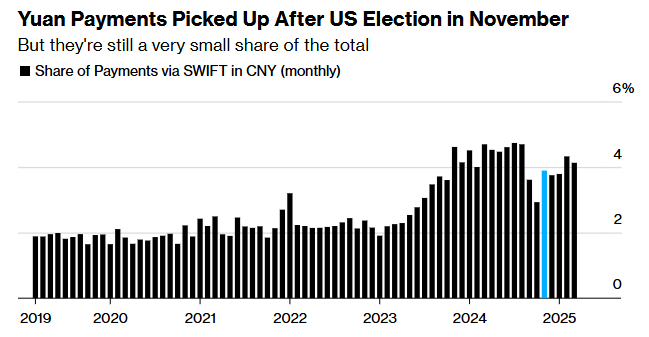
Core Insights - There is a rising demand for foreign exchange derivatives that bypass the US dollar, driven by trade tensions and a long-term trend towards de-dollarization [1][4][5] - Financial institutions are increasingly receiving requests for hedging transactions involving currencies like the Chinese yuan, Hong Kong dollar, UAE dirham, and euro [1][4] - The trend of de-dollarization is accelerating, with more companies and investors seeking alternatives to the dollar as a global reserve currency [4][5] Group 1: Demand for Non-Dollar Transactions - Financial institutions report a growing number of requests for transactions that avoid the dollar, particularly in regions with increasing commercial ties, such as between China, Indonesia, and the Gulf [4][5] - A Singapore-based commodity trading company noted that European financial institutions are launching more yuan derivatives that exclude the dollar [4] - The establishment of a dedicated team by a foreign bank in Indonesia to facilitate transactions in the Indonesian rupiah against the yuan indicates a shift towards non-dollar hedging [4] Group 2: Structural Changes in Dollar Usage - The dollar's role in global trade is being eroded, with estimates suggesting that transactions using the dollar as an intermediary account for about 13% of its daily volume [5][6] - The rise of the yuan in international transactions is supported by China's efforts to promote its currency through bilateral agreements with countries like Brazil and Indonesia [5][6] - The global payment company Swift reported that the yuan accounted for approximately 4.1% of global payments in March, while the dollar held a dominant 49% [7] Group 3: Cost and Liquidity Considerations - Although hedging based on the yuan is often more expensive than dollar-based hedging, the lower interest rates on yuan-denominated loans may still make it attractive for borrowers [7] - The cost of hedging against the dollar has increased over the past year, indicating heightened demand for options to protect against dollar depreciation [8] - Analysts suggest that significant changes in the international environment are necessary for a true replacement of the dollar, but the risk of such a shift is growing [10]
见证历史!人民币,重磅信号来袭!
券商中国· 2025-05-08 23:19
Core Viewpoint - The offshore RMB liquidity is currently abundant, as indicated by the decline in the CNH Hibor rates, which have reached historical lows, reflecting the ease of obtaining RMB in the Hong Kong market [2][5][6]. Group 1: Offshore RMB Hibor Rates - On May 8, the CNH Hibor rates showed a decline across major tenors, with the three-month Hibor falling by 11 basis points to 1.67788%, marking a record low [2][5]. - The overnight Hibor decreased to 1.42848%, a near one-week low, while the one-week Hibor dropped to 1.54303%, reaching a near two-week low [5][6]. - The People's Bank of China conducted a 7-day reverse repurchase operation of 158.6 billion yuan at a rate of 1.40%, down from 1.50%, resulting in a net injection of liquidity [5]. Group 2: Dollar Weakness and Market Dynamics - Stephen Jen warned of a potential $2.5 trillion sell-off of the dollar as Asian countries gradually reduce their dollar reserves, driven by increasing trade surpluses with the U.S. [3][9]. - The trend of "selling the dollar" is ongoing, with significant capital returning to Asia, which is seen as a strong driver behind the appreciation of Asian currencies [8][9]. - Concerns over the long-term safety of U.S. assets are rising due to increasing government debt and uncertain tariff policies, which may weaken the dollar's appeal [10].

startrader:亚洲或引爆2.5万亿美元抛售潮,疯狂囤金真相曝光!
Sou Hu Cai Jing· 2025-05-08 03:40
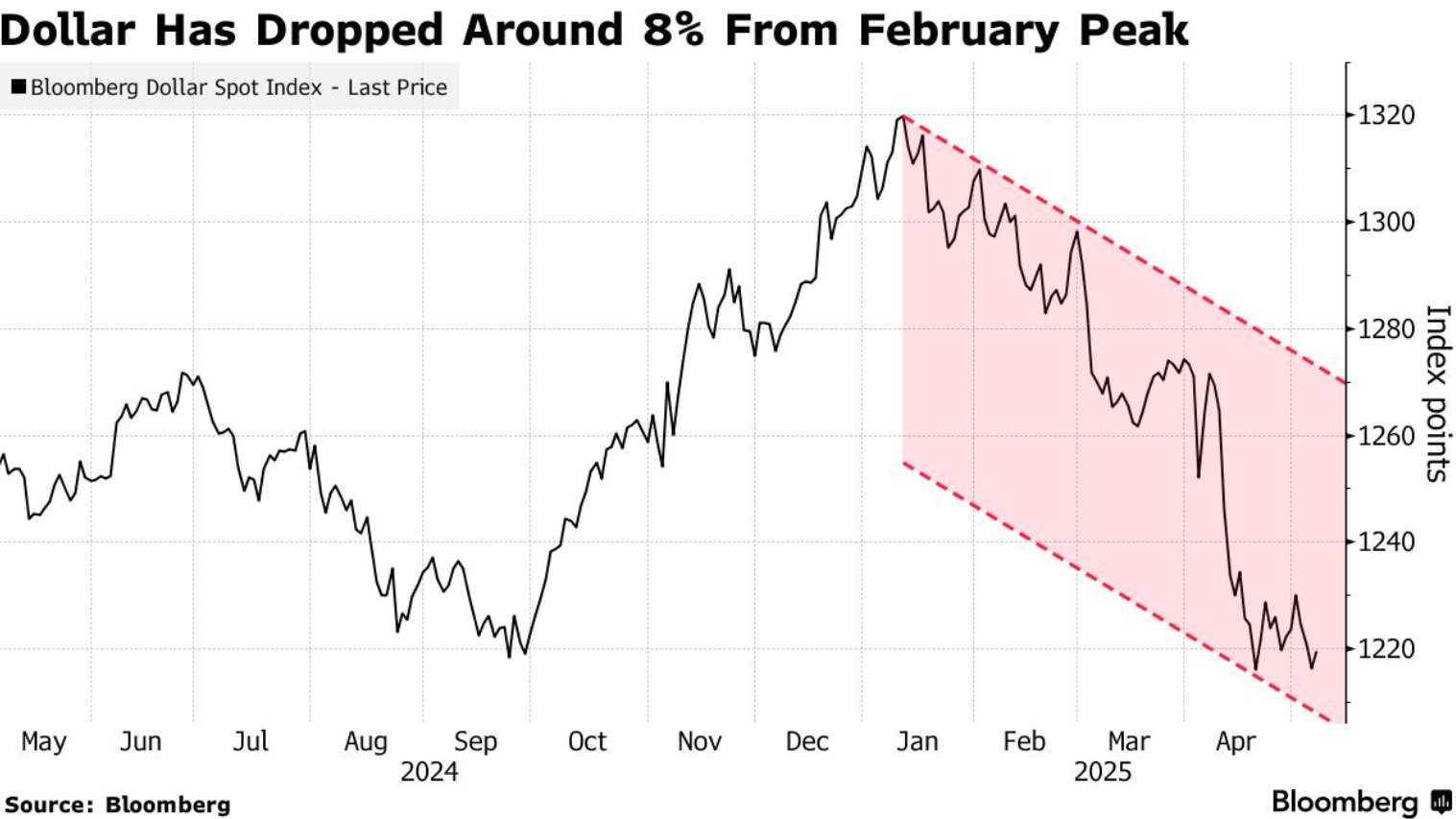
Core Viewpoint - The dollar is facing unprecedented challenges as Asian countries begin to sell off their dollar reserves, potentially leading to a massive $2.5 trillion sell-off [1][3]. Group 1: Potential Crisis Analysis - Stephen Jen and Joana Freire from Eurizon SLJ Capital highlight that Asian exporters and investors have accumulated a vast amount of dollar assets due to active international trade, which has created a trade surplus with the U.S. [3][4]. - The ongoing trade war led by the U.S. has prompted Asian investors to reassess their asset allocation strategies, potentially withdrawing funds to stabilize their domestic economies or to hedge against a weakening dollar [3][4]. Group 2: Dollar Vulnerability - Jen and Freire estimate that the dollar assets held by Asian exporters and institutional investors could be around $2.5 trillion, posing a significant downside risk to the dollar against Asian currencies [4]. - The Bloomberg Dollar Index has dropped approximately 8% since reaching its peak in February, with all Asian currencies appreciating against the dollar in the past month, indicating a potential shift in market dynamics [4]. Group 3: Market Reactions - The New Taiwan Dollar has notably surged, with a single-day increase of 5%, marking the largest daily gain since 1988, and a year-to-date increase of nearly 8%, suggesting that Asian policymakers may be preparing to strengthen local currencies as part of trade negotiations with the U.S. [4][5]. - Jen previously warned that if the Federal Reserve implements interest rate cuts, around $1 trillion could flow back to China as Chinese companies sell off dollar assets [5].
中美将举行经贸高层会谈,央行宣布降息降准 | 财经日日评
吴晓波频道· 2025-05-07 18:21
Monetary Policy - The People's Bank of China announced a reduction in the reserve requirement ratio by 0.5%, expected to release approximately 1 trillion yuan in long-term liquidity into the market [1] - The policy interest rate was lowered by 0.1%, with the 7-day reverse repurchase rate decreasing from 1.5% to 1.4%, which is anticipated to lead to a similar decline in the Loan Prime Rate (LPR) [1] - A structural monetary policy tool rate was reduced by 0.25%, and the personal housing provident fund loan rate was also cut by 0.25% [1] - The central bank will establish a 500 billion yuan re-lending facility to support consumption and elderly care, and increase the re-lending quota for technological innovation from 500 billion yuan to 800 billion yuan [1][2] Trade Relations - High-level economic talks between China and the U.S. are scheduled in Switzerland, with discussions expected to focus on tariff adjustments and trade relations [3] - The U.S. has shown interest in negotiating tariff measures, which could ease trade tensions and provide a buffer for the global economy [4] Fund Management - The China Securities Regulatory Commission (CSRC) released an action plan to promote the high-quality development of public funds, including linking management fees to fund performance [5] - The plan aims to improve the reputation of the public fund industry and accelerate the exit of underperforming funds, enhancing overall profitability [6] Logistics Industry - China's logistics industry prosperity index for April was reported at 51.1%, indicating continued expansion despite a slight month-over-month decline [7] - The index reflects a mixed performance across regions, with the western region showing significant recovery while the eastern and central regions experienced a slowdown [8] Mobile Gaming Market - In April, 33 Chinese companies entered the global mobile game revenue top 100, collectively generating $2 billion, accounting for 38.4% of the market [9] - Tencent's flagship game "Honor of Kings" saw a 71% revenue increase, reclaiming the top position in global mobile game revenue [10] Skechers Acquisition - Skechers announced an agreement to be acquired by 3G Capital for approximately $9.4 billion, with the deal expected to close in the third quarter [11] - The acquisition may provide financial support to Skechers amid declining sales in China and rising costs due to trade policies [12] Currency and Trade Dynamics - A potential "avalanche" sell-off of up to $2.5 trillion in U.S. dollars is anticipated as Asian countries reduce their dollar reserves amid escalating trade tensions [13] - The shift in currency dynamics may lead to significant changes in global trade relationships and impact the demand for U.S. dollars [14]

2.5万亿美元大逃亡:亚洲资本倒戈恐引发美元雪崩?
财联社· 2025-05-07 07:25
Core Viewpoint - The potential for a massive sell-off of up to $2.5 trillion in U.S. dollars is looming as Asian countries gradually reduce their dollar reserves, driven by an expanding trade surplus with the U.S. and escalating trade tensions [1][6]. Group 1: Dollar Sell-off Risks - Stephen Jen and Joana Freire highlight that the accumulation of dollar reserves by Asian exporters and investors could lead to significant downward pressure on the dollar against Asian currencies [1]. - The report suggests that the scale of dollar reserves held by Asian exporters and institutional investors may be extremely large, estimated at around $2.5 trillion, posing a major risk to the dollar's value [1][5]. - The recent unusual appreciation of the New Taiwan Dollar has drawn attention, with the Bloomberg Dollar Index having declined approximately 8% from its February peak [1]. Group 2: Capital Flows and Trade Dynamics - Jen previously predicted that a Federal Reserve rate cut could lead to about $1 trillion in dollar-denominated assets being sold off by Chinese companies, resulting in capital returning to China [4]. - The existence of "naked long" dollar positions in Asian countries, which lack hedging against dollar fluctuations, could accelerate capital flows amounting to trillions of dollars [5]. - Market analysts, including those from JPMorgan, have noted that the return of accumulated dollar assets from years of trade surpluses is a significant factor behind the strengthening of Asian currencies [6]. Group 3: U.S. Trade Deficits and Financial Accounts - The U.S. has experienced a current account deficit exceeding $1 trillion over the past 12 months, correlating with foreign investors' net purchases of U.S. assets [7]. - The relationship between trade and capital is emphasized, suggesting that tariffs could reduce the U.S. trade and current account deficits while also impacting other countries' surpluses [8]. - The imbalance in financial accounts may lead to capital outflows and risks of asset price declines and currency depreciation for the U.S., while countries with trade surpluses may experience capital inflows and currency appreciation [9][10]. Group 4: Future Implications - Analysts predict that the U.S. is likely to face net capital outflows, with significant amounts of capital potentially leaving the U.S. stock market in the future [11]. - Tariffs are expected to suppress global exports, leading to a decline in foreign demand for dollar assets, which are heavily utilized in international trade [12].
亚洲或掀2.5万亿美元抛售潮 美元霸权遭遇“雪崩式”挑战?
智通财经网· 2025-05-07 06:48
智通财经APP获悉,Eurizon SLJ Capital首席经济学家斯蒂芬·任(Stephen Jen)最新警告,随着亚洲国家加速调整外汇储备结构,美元可能面临高达2.5万亿美元 的"雪崩式"抛售压力。这家资管机构在周三发布的报告中指出,亚洲出口商与投资者长期积累的巨额美元头寸,正因美国贸易政策转向与汇率波动风险加剧 而面临瓦解风险。 报告分析称,过去数十年间,亚洲经济体凭借对美贸易顺差积累了规模庞大的美元资产。以中国大陆、中国台湾、马来西亚、越南为代表的出口导向型经济 体,其央行及机构投资者持有的美元储备可能达到2.5万亿美元量级。Jen团队强调:"这些未对冲美元波动的'裸多头寸'犹如悬在美元头上的达摩克利斯之 剑,一旦集中撤离将引发全球货币市场剧烈震荡。" 特朗普政府推动的贸易保护主义政策正成为催化剂。报告指出,亚洲政策制定者可能通过两种路径应对:一是将海外美元资产汇回本土以支撑本币升值,作 为贸易谈判筹码;二是加速多元化外汇储备配置,降低对美元的依赖。值得注意的是,仅中国就可能因美联储降息周期启动,推动约1万亿美元计价的海外资 产回流国内——这一数字与Jen去年提出的"美元微笑"理论预测一致。 市场已 ...
智库报告:2025年或是美债崩盘元年
Sou Hu Cai Jing· 2025-04-28 08:43
Core Viewpoint - The report highlights the imminent crisis of U.S. sovereign credit and debt, suggesting that the U.S. debt situation resembles a Ponzi scheme on the verge of collapse, with significant implications for global economic stability and trade [1][3][4]. Group 1: Current U.S. Debt Situation - The U.S. national debt has reached $36.2 trillion, accounting for 123% of GDP, significantly exceeding the internationally recognized warning line of 60% [3][4]. - The report predicts that by 2025, the U.S. may face a debt crisis, with approximately $9.3 trillion of public debt maturing, representing one-third of total debt [3][4]. - Interest payments on U.S. debt are projected to exceed military spending for the first time in fiscal year 2024, with interest expenses expected to grow by 8% to $952 billion in 2025 [3][4]. Group 2: Economic Impact of Policies - Trump's policies, including "reciprocal tariffs" and extreme fiscal tightening, have led to a significant rise in one-year inflation expectations to 4.3%, the highest level in nearly two years, and a drop in consumer confidence to 67.8, down 11.8% year-on-year [1][3]. - The combination of tariffs and tax cuts is expected to exacerbate social inequality, with the lowest 20% of earners facing an average annual loss of $1,125, while the top 1% could gain an average of $43,500 annually [1][3]. Group 3: Global Financial System and Dollar Dependency - There is a growing trend of "de-dollarization," with global central banks reducing their holdings of U.S. debt, leading to a decline in the dollar's share of global official foreign exchange reserves to 57.4%, the lowest in 30 years [5][6]. - The report indicates that the collapse of U.S. debt is not the end of the international financial system but rather the beginning of a long process of restructuring the global credit system, with emerging economies and a multipolar currency system reshaping the order [6][7]. Group 4: Recommendations for China - The report suggests that China should proactively lead global cooperation to mitigate the risks associated with U.S. debt, including establishing a monitoring mechanism for U.S. debt defaults and enhancing financial infrastructure [6][7]. - It emphasizes the need for China to diversify its foreign reserves, increase holdings in gold and emerging market assets, and enhance domestic consumption to counteract global demand shrinkage [6][7].