
贷款利率

Search documents
本周聚焦:2025上半年各地信贷增速及贷款利率有何变化?
GOLDEN SUN SECURITIES· 2025-08-24 10:17
Investment Rating - The report maintains a "Buy" rating for the banking sector, indicating a positive outlook for selected banks based on recent economic policies and market conditions [4][7]. Core Insights - The report highlights that the credit growth rate in China as of June 2025 is 6.7%, a decrease of 0.4 percentage points compared to 2024. Household and corporate loan growth rates are at 3.0% and 8.6%, respectively, also showing declines [1][2]. - Key provinces such as Sichuan, Jiangsu, and Anhui are leading in credit growth, with rates above 9%. Notably, Beijing and Chongqing have seen increases in credit growth rates, contrary to the overall trend [1][2]. - The average interest rate for newly issued corporate loans has decreased to 3.22%, down 41 basis points year-on-year, with many regions reporting rates below 4% [3]. Summary by Sections Credit Growth Analysis - As of June 2025, the total loan balance in China reached approximately 2,676.33 billion yuan, with a year-on-year growth rate of 6.7%. The corporate loan balance was about 1,824.68 billion yuan, growing at 8.6%, while household loans stood at 840.09 billion yuan, growing at 3.0% [16]. - Provinces with notable corporate loan growth include Sichuan (14.1%), Jiangsu (13.6%), and Shandong (13.1%). Beijing's corporate loan growth surged by 4.2 percentage points to 9.3%, marking a 14-month high [2][16]. Interest Rate Trends - The report indicates a continued decline in corporate financing costs, with the average interest rate for new corporate loans at 3.22%, reflecting a downward trend across various regions [3]. - Regions such as Beijing, Shanghai, and Guangdong have seen rates drop below 3%, contributing to a favorable borrowing environment for businesses [3]. Sector Outlook - The report suggests that expansionary policies aimed at stabilizing the real estate market and boosting consumption are expected to support economic growth in the medium term. The banking sector is likely to benefit from these policies, particularly for banks with improving fundamentals [4][7]. - Specific banks such as Ningbo Bank are recommended for attention due to positive changes in their financial performance [4].
7月社融金融数据点评:银行行业:财政持续发力,社融同比多增
Dongxing Securities· 2025-08-14 09:56
Investment Rating - The industry investment rating is "Positive" [8] Core Viewpoints - The continuous fiscal efforts have driven a year-on-year increase in social financing (社融) by 9% as of the end of July, with a month-on-month improvement of 0.1 percentage points [2][15] - In July, the total social financing increased by 1.16 trillion yuan, a year-on-year increase of 390.1 billion yuan, primarily supported by government bond financing [2][15] - The demand for credit remains weak, with a year-on-year growth rate of 6.9% for RMB loans, reflecting a decrease of 500 billion yuan in July [3][17] Summary by Sections Social Financing - As of the end of July, social financing stock increased by 9% year-on-year, with a month-on-month improvement of 0.1 percentage points [2][15] - The net financing of government bonds reached 1.24 trillion yuan, a year-on-year increase of 555.9 billion yuan, indicating strong fiscal support for the real economy [2][15] - The total social financing added in July was 1.16 trillion yuan, with direct financing performing better than the previous year [2] Credit Demand - The demand for credit is weak, with RMB loans decreasing by 500 billion yuan in July, a year-on-year reduction of 3.1 trillion yuan [3][17] - Corporate credit demand is particularly weak, with the main increase coming from bill financing [3] - Residential loans also saw a significant decrease, with a reduction of 4.893 trillion yuan in July, reflecting a year-on-year decline of 2.793 trillion yuan [3] Monetary Supply - M1 and M2 growth rates increased to 5.6% and 8.8% year-on-year, respectively, with month-on-month improvements of 1 percentage point and 0.5 percentage points [7] - The total RMB deposits increased by 500 billion yuan in July, a year-on-year increase of 1.3 trillion yuan [17] Investment Recommendations - The report maintains a positive outlook on the banking sector, highlighting the stable performance of banks amid ongoing fiscal support and a favorable liquidity environment [8] - It suggests focusing on banks with historical risk clearance, low valuations, and those that are significantly underweighted by active funds [8]
前7个月人民币贷款增加12.87万亿元
Chang Jiang Shang Bao· 2025-08-14 06:05
Core Insights - The People's Bank of China reported that as of July 2025, the total RMB loan balance reached 268.51 trillion yuan, reflecting a year-on-year growth of 6.9% [1] - The total social financing scale stood at 431.26 trillion yuan, with a year-on-year increase of 9% [1] - The broad money supply (M2) was recorded at 329.94 trillion yuan, growing by 8.8% year-on-year, while the narrow money supply (M1) was 111.06 trillion yuan, up by 5.6% [1] Lending and Financial Structure - In the first seven months, RMB loans increased by 12.87 trillion yuan, with corporate loans accounting for a significant portion, totaling 11.63 trillion yuan [1] - Long-term loans for enterprises rose by 6.91 trillion yuan, making up nearly 60% of the new loans [1] - Loans in sectors such as technology, green finance, inclusive finance, elderly care, and digital economy showed growth rates exceeding the overall loan growth [1] Interest Rates and Monetary Policy - Loan interest rates remained at historical lows, with new corporate loan rates around 3.2% and new personal housing loan rates at approximately 3.1%, down by about 45 and 30 basis points year-on-year, respectively [2] - The difference in growth rates between M1 and M2 narrowed to 3.2%, indicating improved liquidity and efficiency in the financial system [2] Government Bonds and Fiscal Policy - Over 6.1 trillion yuan in new special bonds were issued in the past month, marking a record high for the year, which is expected to accelerate government bond issuance [3] - The proactive fiscal policy and moderately loose monetary policy are anticipated to support economic recovery and reasonable growth in effective credit demand [3]
央行重磅数据,最新解读!
天天基金网· 2025-08-14 05:05
Core Viewpoint - The article highlights the current state of China's monetary policy, indicating a moderately loose monetary environment that supports the real economy through favorable financing conditions [1][4]. Group 1: Monetary Policy and Loan Rates - As of July, the social financing scale and broad money (M2) grew by 9% and 8.8% year-on-year, respectively, indicating a stable monetary environment [1]. - New personal housing loan rates are approximately 3.1%, while new corporate loan rates are around 3.2%, both reflecting a decline of about 45 and 30 basis points compared to the previous year [2][3]. - The sustained low interest rates signal a relatively abundant supply of credit, making it easier and cheaper for borrowers to access bank loans [3][4]. Group 2: Loan Growth and Composition - In the first seven months of the year, RMB loans increased by 12.87 trillion yuan, with household loans rising by 680.7 billion yuan and corporate loans increasing by 11.63 trillion yuan [5][6]. - The total balance of RMB loans reached 268.51 trillion yuan, growing by 6.9% year-on-year, while the total balance of foreign and domestic currency loans was 272.48 trillion yuan, up by 6.7% [6]. - The increase in loans reflects a strong support for the real economy, with loan growth outpacing nominal economic growth [7]. Group 3: Loan Issuance and Economic Impact - The article emphasizes the importance of new loan issuance as a key indicator of actual bank lending activity, which can provide insights into the effective financing needs of the economy [8]. - It is noted that while loan balance growth may stabilize over time, the flow of new loans and repayments remains significant, ensuring that both corporate and household financing needs are met [8].


社融规模431.26万亿元,贷款利率降至3.1%,资金循环效率显著提升
Sou Hu Cai Jing· 2025-08-14 01:58
Group 1 - The core viewpoint of the articles indicates that the financial support for the real economy remains strong, with significant growth in social financing and monetary aggregates [1][3][4] - As of the end of July, the total social financing stock reached 431.26 trillion yuan, reflecting a year-on-year growth of 9%, which is higher than the economic growth rate [1][3] - The broad money supply (M2) stood at 329.94 trillion yuan, with an annual increase of 8.8%, indicating robust liquidity in the market [1][3] Group 2 - The efficiency of fund circulation has improved significantly, with M1 growing by 5.6% year-on-year to 111.06 trillion yuan, and M0 increasing by 11.8% to 13.28 trillion yuan [3] - The net cash injection in the first seven months was 465.1 billion yuan, contributing to enhanced market confidence and economic activity [3] - The gap between M2 and M1 growth rates has narrowed, reflecting improved liquidity and circulation efficiency [3] Group 3 - The structure of loans has optimized, with the RMB loan balance growing by 6.9% year-on-year, influenced by seasonal characteristics and macroeconomic factors [4] - The balance of inclusive small and micro loans reached 35.05 trillion yuan, with an annual growth of 11.8%, indicating strong support for smaller enterprises [4] - The impact of local government debt replacement and the reform of small and medium banks has also contributed to the loan dynamics, with local debt replacement affecting loans by approximately 2.6 trillion yuan [4] Group 4 - The interest rates for newly issued corporate loans were around 3.2%, and for personal housing loans, approximately 3.1%, both showing a decline compared to the previous year [5] - This decline in loan rates reflects a relatively abundant credit supply and easier access to bank credit for borrowers [5] - The continued reduction in loan rates since 2018 has resulted in a favorable borrowing environment for both individuals and businesses [5]

7月金融数据发布 释放哪些信号?专家解读
Yang Shi Xin Wen Ke Hu Duan· 2025-08-14 00:44
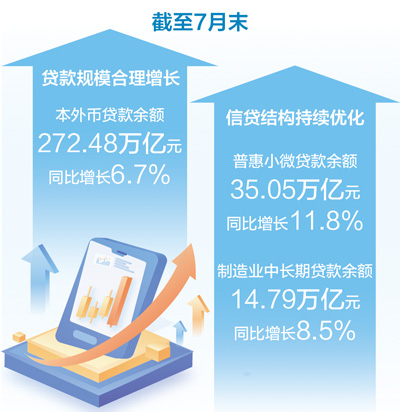
Core Insights - The People's Bank of China reported that in July, social financing scale, broad money M2, and RMB loans continued to exceed economic growth rates, indicating strong financial support for the real economy [1][2] Group 1: Financial Statistics - As of the end of July, the balance of broad money (M2) reached 329.94 trillion yuan, with a year-on-year growth of 8.8%, showing an accelerated growth rate [1] - The social financing scale stood at 431.26 trillion yuan at the end of July, with a year-on-year increase of 9% [1] - From January to July, the incremental social financing was 23.99 trillion yuan, which is 5.12 trillion yuan more than the same period last year [1] - RMB loans increased by 12.87 trillion yuan in the first seven months [1] Group 2: Credit Support and Structure - The balance of inclusive small and micro loans reached 35.05 trillion yuan, with a year-on-year growth of 11.8%, while medium and long-term loans for the manufacturing sector amounted to 14.79 trillion yuan, growing by 8.5% [2] - Loans for technology, green initiatives, inclusive finance, elderly care, and digital economy sectors grew significantly faster than the overall loan growth rate [2] - Structural monetary policy tools have enhanced the ability and willingness of financial institutions to support key areas [2] Group 3: Loan Rates and Financing Demand - In July, the interest rate for newly issued corporate loans was approximately 3.2%, and for personal housing loans, it was about 3.1%, both remaining at historically low levels [3] - The new corporate loan rate decreased by about 45 basis points compared to the same period last year, while the personal housing loan rate fell by about 30 basis points [3] - The low interest rates reflect a relatively abundant credit supply, making it easier for borrowers to obtain bank credit at lower costs [3]
金融政策精准发力 信贷结构持续优化
Sou Hu Cai Jing· 2025-08-13 23:14
Core Insights - The People's Bank of China (PBOC) reported stable growth in credit and improvements in its structure, indicating effective financial policies [1] Group 1: Financial Data Overview - As of the end of July, the balance of RMB loans reached 268.51 trillion yuan, a year-on-year increase of 6.9% [1] - The total social financing stock was 431.26 trillion yuan, growing by 9% year-on-year [1] - The broad money supply (M2) stood at 329.94 trillion yuan, with an 8.8% year-on-year increase [1] Group 2: Credit Structure and Allocation - In the first seven months, loans to enterprises increased by 11.63 trillion yuan, with medium and long-term loans accounting for nearly 60% of this amount [4] - By the end of July, inclusive small and micro loans reached 35.05 trillion yuan, up 11.8% year-on-year, while medium and long-term loans in the manufacturing sector were 14.79 trillion yuan, increasing by 8.5% [5] - The financial policies have been refined to support key sectors and weak links, enhancing the ability and willingness of financial institutions to provide quality credit [5][6] Group 3: Interest Rates and Financing Costs - Loan interest rates remain at historical lows, with new corporate loan rates around 3.2% and new personal housing loan rates at approximately 3.1%, down by about 45 and 30 basis points year-on-year, respectively [8] - The sustained low interest rates reflect a relatively abundant credit supply, indicating a high level of satisfaction in financing demand from the real economy [8]
7月末社会融资规模、广义货币增速均保持较高水平 信贷供给总体充裕 有效满足实体经济融资需求
Zhong Guo Zheng Quan Bao· 2025-08-13 22:17
Core Viewpoint - The People's Bank of China (PBOC) has maintained a moderately loose monetary policy, supporting the real economy through high levels of social financing and broad money (M2) growth as of the end of July [1] Group 1: Credit Growth - In the first seven months, RMB loans increased by 12.87 trillion yuan, with a loan balance of 268.51 trillion yuan at the end of July, reflecting a year-on-year growth of 6.9% [2] - The fluctuations in credit data during June and July are attributed to financial institutions' half-year reporting and the settlement period for enterprises, as well as the significant impact of local government debt swaps on loan data [2][3] - The impact of debt resolution and risk mitigation factors on current loan growth exceeds 1 percentage point, with local government debt swaps affecting loans by approximately 2.6 trillion yuan since last November [3] Group 2: Loan Interest Rates - Loan interest rates have remained low, with new corporate loan rates around 3.2% and new personal housing loan rates at approximately 3.1%, both down by about 45 and 30 basis points year-on-year, respectively [4] - The decline in financing costs reflects adequate monetary and credit conditions, indicating that the real economy's financing needs are being met [4] Group 3: Monetary Aggregates - As of the end of July, M2 stood at 329.94 trillion yuan, growing by 8.8% year-on-year, while M1 was 111.06 trillion yuan, with a year-on-year increase of 5.6% [7] - The narrowing gap between M1 and M2 indicates improved liquidity and efficiency in fund circulation, aligning with the recovery of economic activities [7] Group 4: Economic Outlook - The cumulative social financing scale for the first seven months reached 23.99 trillion yuan, exceeding the previous year's figure by 5.12 trillion yuan, with a total stock of 431.26 trillion yuan at the end of July, reflecting a year-on-year growth of 9% [7] - The macroeconomic indicators have performed better than expected in the first half of the year, supporting the reasonable growth of monetary credit and meeting the effective financing needs of the real economy [7]
前7月人民币贷款增加12.87万亿元
Ren Min Ri Bao· 2025-08-13 21:50
Group 1 - The core viewpoint of the articles highlights the robust growth of loans and the effective financial support for the real economy in China, with a total increase of 12.87 trillion yuan in loans in the first seven months of the year [2] - As of the end of July, the balance of RMB loans reached 268.51 trillion yuan, reflecting a year-on-year growth of 6.9%, while the total balance of loans in both RMB and foreign currencies was 272.48 trillion yuan, growing by 6.7% [2] - The structure of credit is continuously optimizing, with notable increases in inclusive small and micro loans, which reached a balance of 35.05 trillion yuan, growing by 11.8% year-on-year, and medium to long-term loans for the manufacturing sector, which totaled 14.79 trillion yuan, up by 8.5% [2] Group 2 - Loan interest rates remain low, with new corporate loan rates around 3.2% and new personal housing loan rates at approximately 3.1%, both showing declines of about 45 and 30 basis points compared to the same period last year [2][3] - The total social financing scale increased by 23.99 trillion yuan in the first seven months, which is 5.12 trillion yuan more than the same period last year, with RMB loans to the real economy increasing by 12.31 trillion yuan [3] - The broad money supply (M2) reached 329.94 trillion yuan by the end of July, growing by 8.8% year-on-year, while the narrow money supply (M1) was 111.06 trillion yuan, up by 5.6% [4] Group 3 - In terms of deposits, RMB deposits increased by 18.44 trillion yuan in the first seven months, with household deposits rising by 9.66 trillion yuan and non-financial enterprise deposits increasing by 3.109 trillion yuan [5] - The total balance of deposits in both RMB and foreign currencies reached 327.83 trillion yuan, reflecting a year-on-year growth of 9%, while the balance of RMB deposits was 320.67 trillion yuan, growing by 8.7% [5] - The implementation of a series of monetary policies has effectively supported the recovery of the real economy, with macroeconomic indicators showing overall positive performance [5]
信贷供给总体充裕 有效满足实体经济融资需求
Zhong Guo Zheng Quan Bao· 2025-08-13 21:10
Core Viewpoint - The People's Bank of China has maintained a suitable monetary environment for the real economy, reflecting a moderately loose monetary policy orientation, with significant support for economic recovery in the first half of the year [1][4]. Credit Growth - In the first seven months, RMB loans increased by 12.87 trillion yuan, with a loan balance of 268.51 trillion yuan at the end of July, showing a year-on-year growth of 6.9% [1][2]. - The fluctuations in credit data in June and July were influenced by financial institutions' half-year report disclosures and the settlement period for real enterprises, as well as the impact of local government debt replacement [1][2]. Loan Rate Trends - The new corporate loan rate was approximately 3.2% and the new personal housing loan rate was about 3.1% at the end of July, both showing declines of about 45 and 30 basis points year-on-year, respectively [2][3]. - The overall decline in financing costs reflects a favorable monetary and credit condition, indicating that the effective financing demand of the real economy is being met [2][3]. Credit Structure and Quality - The economic structure's transformation has led to adjustments in credit structure, emphasizing the need for high-quality credit allocation [3]. - The People's Bank of China has been guiding financial institutions to increase credit support for key areas and weak links, enhancing the effectiveness of structural monetary policy tools [3]. Money Supply and Efficiency - By the end of July, M2 balance was 329.94 trillion yuan, with a year-on-year growth of 8.8%, while M1 balance was 111.06 trillion yuan, growing by 5.6% year-on-year [3]. - The narrowing gap between M1 and M2 indicates improved liquidity and efficiency in fund circulation, aligning with the recovery of economic activities [3]. Economic Outlook - The overall economic performance has been stable and improving, supporting reasonable growth in financial totals, which is crucial for meeting the effective financing needs of the real economy [4][5]. - The macroeconomic policies are expected to remain consistent and stable in the second half of the year, ensuring a smoother domestic economic cycle and reasonable growth in effective credit demand [5].