AI硬件

Search documents
未知机构:东财策略每日复盘20260303一市场概况3月-20260304
未知机构· 2026-03-04 02:50
Summary of Conference Call Notes Industry Overview - The conference call discusses the A-share market performance on March 3, 2023, highlighting a significant decline across major indices. The Shanghai Composite Index fell by 1.43% to close at 4122 points, while the Shenzhen Component Index and the ChiNext Index dropped by 3.07% and 2.57%, respectively. The total trading volume reached 3.13 trillion yuan, an increase of over 100 billion yuan compared to the previous trading day [1][1][1]. Key Points on Industry Performance - **Top Performing Industries**: - Oil and Petrochemicals: +6.75% - Coal: +1.76% - Transportation: +1.13% - Banking: +1.07% - Public Utilities: +0.49% [1][1][1] - **Underperforming Industries**: - Defense and Military: -6.74% - Non-ferrous Metals: -5.61% - Electronics: -5.30% - Computers: -4.94% - Media: -4.29% [1][1][1] Market News - The Ministry of Industry and Information Technology, along with five other departments, released guidelines to promote the comprehensive utilization of photovoltaic components, aiming to enhance technology and equipment levels by 2030 [3][3][3]. - In the first week following new policies in the Shanghai real estate market, there was a rapid increase in demand-side activity, with online inquiries rising by 97.6% and conversion rates improving by 180% [3][3][3]. - Qatar Energy, the world's largest natural gas producer, announced a halt in liquefied natural gas exports due to military attacks on its facilities [3][3][3]. Market Outlook and Considerations - The Shanghai Composite Index's recent performance has created a situation of trapped capital and pessimism that will require time to resolve. If the intensity of the U.S.-Iran conflict continues, short-term risk aversion may persist. However, there is no need for excessive pessimism as the current economic resilience and cycle position have improved compared to 2022. The impact of war and high oil prices on inflation affecting AI hardware and other assets is expected to be limited [4][4][4]. - Despite the overall market decline, sectors with solid supply-demand dynamics, such as gas turbines, remain strong. Core assets with robust supply-demand support are crucial indicators. As the Two Sessions approach, the deeply corrected technology growth sector may see a rebound in funding due to policy catalysts [4][4][4]. Recommendations - It is advised to closely monitor the situation in the Middle East and oil price trends, while also paying attention to policy signals from the Two Sessions that may influence market risk appetite [5][5][5].
早盘直击|今日行情关注
申万宏源证券上海北京西路营业部· 2026-03-04 02:13
Group 1 - The core viewpoint of the articles highlights the impact of geopolitical tensions in the Middle East on market risk appetite, leading to significant declines in A-shares, particularly in the technology sector, while the oil and chemical sectors see gains [1] - The A-share market is experiencing a rotation where the strong performance of the oil sector negatively affects the technology growth sector, indicating a clear negative correlation between these sectors [1] - The uncertainty surrounding the Middle East situation and its potential impact on global oil supply is difficult to assess, with rising oil prices likely to exacerbate market concerns and influence sector performance [1] Group 2 - As March approaches, the annual report season is expected to focus on high-performance sectors, with technology hardware, advanced manufacturing, and price-increasing cycles showing promising results [2] - The trend of AI hardware remains strong, with increasing token usage for major AI models, suggesting a peak in AI applications by 2026, warranting continued attention on this growth trajectory [2] - The domestic and overseas demand for new energy materials is rapidly increasing, leading to supply shortages and price hikes, with this trend expected to continue into 2026 [2]


报名丨雷峰网 AWE 探展计划启动,和大佬团深度逛展、吃喝玩乐
雷峰网· 2026-03-03 12:08
Core Insights - The article emphasizes the shift in global AI investment focus from software to hardware between 2025 and 2026, highlighting the importance of physical AI in industry implementation and clearing [2] - AWE (China's Appliance and Consumer Electronics Expo) is positioned as a key venue for discovering potential unicorns, featuring over 1,000 brands and 300 global launches [2] - The article identifies six major pain points for decision-makers attending AWE, including mismatched communication levels, lack of expert insights, and ineffective networking opportunities [2][5] Pain Points in Attending AWE - Mismatched communication levels lead to limited access to key strategic information, as attendees often interact with lower-level sales staff instead of decision-makers [2][5] - The absence of a knowledgeable expert team results in insufficient technical evaluation and industry trend analysis, leading to a noisy information environment [2][5] - Low efficiency in navigating the exhibition space and connecting with influential figures diminishes the potential for valuable networking [5] Proposed Solutions - The article proposes a solution through the 雷峰网-鲸犀 team’s exploration plan, which aims to enhance the experience of attending AWE by providing access to decision-makers and expert insights [4][6] - The exploration plan includes a structured approach to visiting key companies, maximizing time efficiency, and facilitating high-value networking opportunities [6] - Participants will benefit from direct interactions with CXOs, expert-led discussions, and informal networking settings to build trust and long-term relationships [6] Recruitment for Exploration Team - The article invites professionals from various sectors, including VC/PE investors, industry executives, and researchers, to join the exploration team for a more impactful experience at AWE [8][9] - The recruitment emphasizes the importance of contributing insights and engaging in content co-creation, enhancing the overall value of participation [8] Conclusion - The article concludes by encouraging industry stakeholders to actively participate in the AI hardware industrialization wave rather than remaining passive observers, positioning the exploration team as a means to become integral to this transformation [12][13]

0302狙击龙虎榜
2026-03-03 02:51
Summary of Key Points from Conference Call Records Industry Overview - The overall market sentiment is mixed, with a significant trading volume reaching 3 trillion, indicating a slightly better-than-expected performance compared to previous downturns in other global markets [2][9] - The main sectors driving the market are price increases and AI hardware, with resource stocks showing strong performance due to geopolitical factors [2] Company Insights 石化油服 (PetroChina Oilfield Services) - The rise in oil prices is expected to enhance the profitability and expansion willingness of oil and gas companies, leading to increased capital expenditure in exploration and development [4] - 石化油服 is recognized as a leading integrated oilfield service provider in China, benefiting from strong overseas business development and partnerships with national oil companies in Saudi Arabia, Kuwait, and Ecuador [4] 悦安新材 (Yuean New Materials) - The global inductor industry is experiencing a price surge, with major Japanese companies like Murata and TDK expected to follow suit with price increases potentially reaching multiples [5] - The demand for high-performance inductors, particularly for AI servers, is driving the need for specialized materials like powdered iron, which is crucial for maintaining stable power supply under extreme current conditions [5] - Yuean New Materials is recognized as a leader in the powdered iron field and is positioned to benefit significantly from the AI hardware wave due to its vertical integration in the supply chain [5] 部格精机 (Boge Precision Machinery) - The company specializes in solder paste printing machines, which are essential for SMT production lines, with over 60% of quality defects arising from this stage [6] - As electronic components become more integrated, the demand for high-end solder paste printing products is increasing, and the company is seeing a notable rise in revenue from these products [6] - Boge has successfully delivered fully automated assembly lines for 800G and 1.6T optical modules to overseas clients, indicating strong international demand [6] Additional Insights - The market is expected to see a further strengthening of resource stocks, with a potential divergence in performance among different stocks as the market reaches peak levels [2] - The differentiation between leading and lagging stocks is becoming clearer, with early movers in resource stocks likely to perform better [2] - The overall sentiment is that more sectors will gradually detach from the impacts of geopolitical tensions, leading to a strengthening of market emotions [2]



AI硬件元年将至:中美谁能造出下一个iPhone?
美股研究社· 2026-03-02 11:18
Core Viewpoint - The article emphasizes that AI is transitioning from cloud computing to terminal devices, marking a significant structural change in the technology industry by 2026 [2][6][16]. Group 1: AI Hardware Era - The Mobile World Congress (MWC) 2026 will focus on the deep integration of AI and communication, signaling the arrival of the AI hardware era [4][6]. - The global AI server market is projected to exceed $150 billion by the end of 2025, but growth is slowing, indicating a shift in focus from cloud computing to terminal devices [6][8]. - By 2026, it is expected that the penetration rate of AI in smartphones will reach 55%, and 45% for AI PCs, indicating a significant increase in local AI processing capabilities [7][8]. Group 2: Investment Focus Shift - Investors should shift their focus from upstream companies like TSMC and NVIDIA to downstream brand manufacturers and component suppliers as AI moves to terminal devices [8]. - The transition to terminal devices represents the final mile in the AI business loop, emphasizing the importance of hardware in the AI ecosystem [8][18]. Group 3: Differentiated Approaches in China and the U.S. - The U.S. approach emphasizes "chip + system integration," with companies like Apple enhancing AI capabilities through self-developed chips, while China's approach focuses on "model-driven hardware" [10][11]. - Chinese companies are rapidly launching AI smartphones and AIoT devices, leveraging their advantages in diverse scenarios and fast iteration [11][12]. Group 4: Conditions for Success - For AI hardware to replicate the success of the iPhone, three conditions must be met: stable and frequently usable model capabilities, a balance between processing power and energy consumption, and the formation of an application ecosystem [13][15]. - The average selling price (ASP) of the first AI smartphones is expected to be 15%-20% higher than that of regular flagship models, indicating a willingness among consumers to pay for AI features [15][18]. Group 5: Future Outlook - The article concludes that the hardware war is a critical area of focus for investors, as the shift from cloud to terminal devices will redefine wealth distribution in the tech industry [18][19]. - The ability to create products that genuinely address user pain points and achieve a commercial loop will determine the winners in this evolving landscape [18][19].


0301狙击龙虎榜
2026-03-01 17:21
Summary of Key Points from Conference Call Records Industry Overview - The market showed resilience despite initial declines, with a strong recovery in sentiment observed in the afternoon. The overall market performance was positive, influenced by the dynamics of AI hardware and pricing trends in various sectors [1][1]. - The geopolitical situation is expected to impact market conditions, particularly in resource sectors, but the long-term outlook remains optimistic [1][1]. Company Insights Yunnan Zhiye - Yunnan Zhiye is a key player in the production of phosphor aluminum, essential for 800G/1.6T optical modules. The global supply-demand gap is projected to reach 70%, with supply concentrated among US and Japanese companies [4][1]. - The company is positioned favorably in the domestic market, covering major optical module and chip manufacturers, and is expected to benefit from the transition to CPO technology [4][1]. Zhongman Petroleum - Zhongman Petroleum is a leading private oil and gas exploration company with a comprehensive industry chain from equipment manufacturing to exploration and development. The company has proven and assessed oil reserves of approximately 147 million tons (about 1.07 billion barrels) [5][1]. - Unlike state-owned enterprises, Zhongman Petroleum exhibits greater earnings elasticity, with profit increases significantly higher during price surges. The company’s operations in Kazakhstan are insulated from risks associated with the Strait of Hormuz [5][1]. Hangzhou Steel - Hangzhou Steel is transforming its operations by leveraging scarce industrial land in urban areas, having established over 5,500 machine frames and hosting more than 26,000 servers [6][1]. - The company is extending its business model beyond just renting out machine cabinets to manufacturing computing equipment, with plans for a 300,000 square meter computing equipment industrial park [6][1]. - The integration of land, power, and customer relationships creates a high barrier to replication, positioning the company for potential valuation restructuring amid the HALO asset wave [6][1]. Market Trends - The market is currently focused on price increases and AI-related trends, which are seen as key drivers of future growth [1][1]. - The demand for electrical and electronic equipment is surging due to the expansion of AI data centers, leading to longer delivery times for critical components like power transformers [1][1]. Stock Performance - Notable stock movements include Zhongman Petroleum (+0.33%), Hangzhou Steel (+9.96%), and Yunnan Mingye (+8.72%) [7][1]. Additional Insights - The ongoing discussions around "HALO" assets highlight the intersection of pricing power and AI demand, particularly in sectors experiencing explosive growth due to technological advancements [1][1].
智元机器人正式进入德国市场;AITO问界在阿联酋斩获200台首批订单|36氪出海·要闻回顾
36氪· 2026-03-01 14:03
Core Insights - The article discusses the expansion of various companies into international markets, particularly in the robotics and automotive sectors, highlighting strategic partnerships and product launches aimed at enhancing global presence [4][6][12]. Group 1: Robotics Industry Developments - Zhiyuan Robotics officially entered the German market, launching a full range of general-purpose embodied robot products and signing a strategic cooperation agreement with Minth Group to accelerate local deployment in Europe [4]. - Five companies, including Sanhua Intelligent Control and Top Group, received approval to establish humanoid robot component factories in Thailand, closely linked to Tesla's Optimus robot production plans [4]. - Yushu Technology aims to ship 10,000 to 20,000 humanoid robots by 2026, showcasing their autonomous group control technology during a performance at the Spring Festival Gala [4]. Group 2: AI Hardware and Automotive Innovations - Alibaba's AI assistant "Qianwen" is set to launch multiple AI hardware products globally, including AI glasses, rings, and headphones, with the first product debuting at the 2026 Mobile World Congress [7]. - AITO Wenjie secured 200 initial orders in the UAE, marking a successful entry into the Middle Eastern market [7]. - CATL and BMW signed a memorandum to explore battery passport applications, enhancing digital management and compliance with global regulations [7]. Group 3: Automotive Export and Market Expansion - Greenland Century reached an agreement to export 5,000 domestic vehicles to the UAE, focusing on enhancing customer experience through comprehensive service offerings [8]. - TikTok Shop in Southeast Asia launched a special incentive policy to boost business recovery post-holiday, targeting increased sales through promotional measures [8]. - The Chinese automotive industry has transitioned from "product export" to "industry export," with overseas sales surpassing 9 million units, indicating a significant shift in global market strategy [12].






两融余额“三连增”杠杆资金回归科技主线
Shang Hai Zheng Quan Bao· 2026-02-27 19:04
Group 1 - The core viewpoint of the articles highlights a significant increase in margin trading balances in the Chinese stock market, indicating a return of leveraged funds to the technology sector after the Spring Festival [1][2][3] - The total margin trading balance across the Shanghai, Shenzhen, and North markets reached 26,670.4 billion yuan, with an increase of 789.15 billion yuan over three consecutive trading days [1] - The increase in margin trading is attributed to the resolution of uncertainties post-holiday and a recovery in market sentiment, with northbound capital inflows contributing to a heightened risk appetite [1][2] Group 2 - Data shows that from February 24 to 26, 29 out of 31 primary industries experienced net buying of financing, with the electronics sector leading at a net purchase of 155.04 billion yuan [1] - Specific industries such as non-ferrous metals, power equipment, and computers also saw significant net buying, each exceeding 50 billion yuan, while industries like coal and comprehensive sectors faced reductions in financing [1][2] - Individual stocks such as Cambrian, Northern Rare Earth, and Zhongji Xuchuang saw substantial net purchases, indicating a clear focus on sectors related to computing power, semiconductors, and high-end manufacturing [2] Group 3 - The outlook suggests that the margin trading balance is expected to continue its upward trend, approaching pre-holiday highs, driven by incomplete capital replenishment and a generally loose liquidity environment [3] - The future market performance will depend on the actual effects of policy implementations, the profitability of listed companies, and changes in liquidity constraints and external environments [3]


新华财经晚报:中国人民银行决定将远期售汇业务的外汇风险准备金率下调为0
Xin Hua Cai Jing· 2026-02-27 16:53
Key Points - The Central Political Bureau of the Communist Party of China held a meeting to discuss the draft of the 14th Five-Year Plan and the government work report, emphasizing the need for a proactive fiscal policy and moderately loose monetary policy to strengthen domestic market construction and promote high-level technological self-reliance [1] - The People's Bank of China announced a reduction in the foreign exchange risk reserve ratio for forward foreign exchange sales from 20% to 0% starting March 2, 2026, to support enterprises in managing exchange rate risks [2] - The State Council Tariff Commission decided not to impose additional tariffs on certain Canadian imports, including a 100% tariff on oilseed meal and peas, and a 25% tariff on lobsters and crabs, from March 1 to December 31, 2026, to enhance China-Canada economic cooperation [2] - The China Securities Regulatory Commission released new regulations on private fund information disclosure, prohibiting certain predictive behaviors regarding investment performance and requiring clear disclosure of fund information to investors [3] Domestic News - The air quality in China is reported to be at its historical best in 2025, with an average PM2.5 concentration of 28.0 micrograms per cubic meter and a good air quality day ratio of 89.3% [3] - The Yangtze River Delta region's economy reached a total of 34.66 trillion yuan in 2025, with the number of trillion-yuan cities increasing to 10, highlighting the region's economic strength [4][5]
资金动向 | 北水连续6日净买入小米,抛售快手、中芯国际
Ge Long Hui A P P· 2026-02-27 12:28
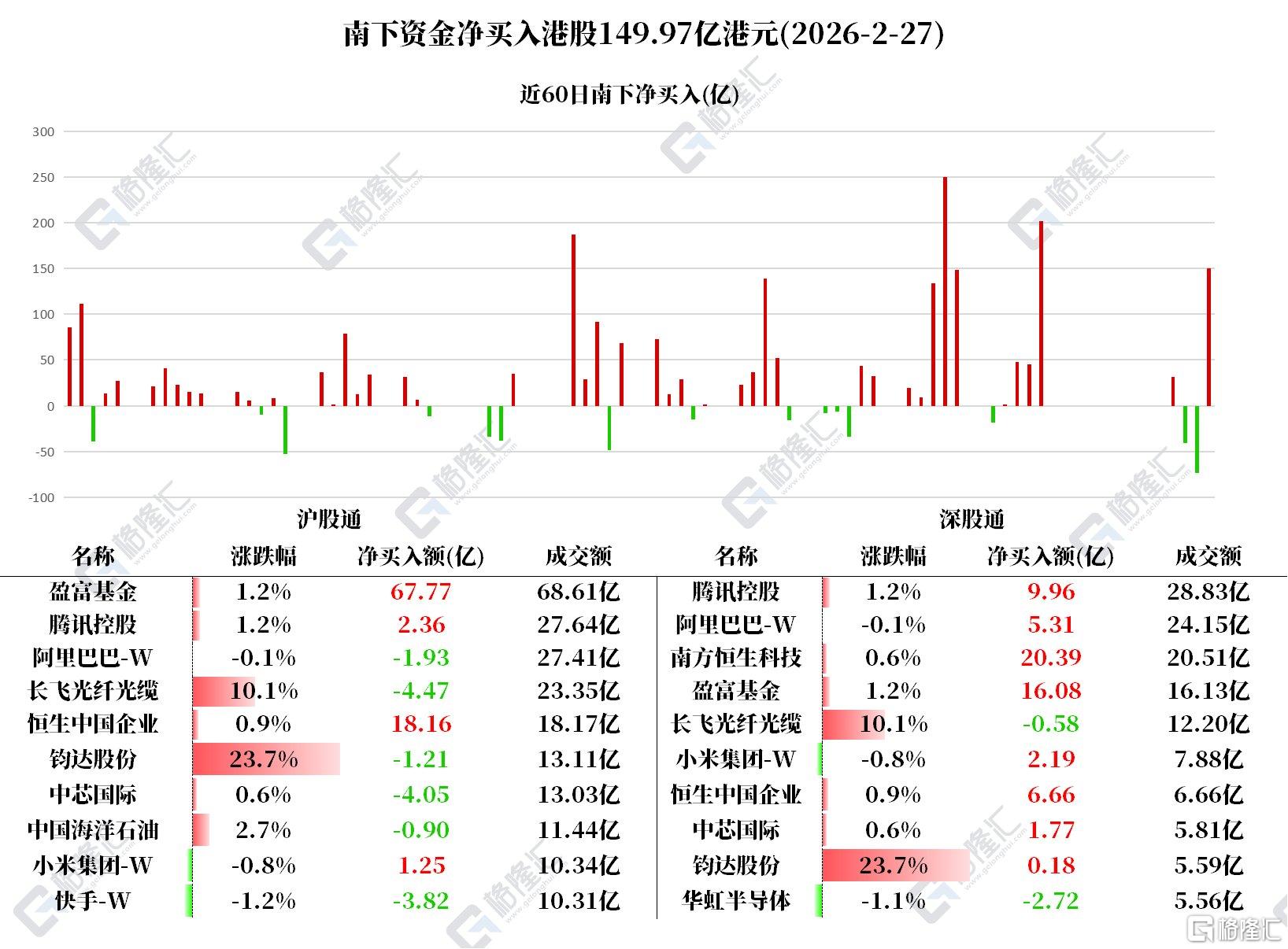
Group 1: Market Movements - Net purchases included 8.385 billion in Yingfu Fund, 2.482 billion in Hang Seng China Enterprises, 2.039 billion in Southern Hang Seng Technology, 1.232 billion in Tencent Holdings, 0.343 billion in Xiaomi Group-W, and 0.338 billion in Alibaba-W [1] - Net sales included 0.505 billion in Changfei Optical Fiber, 0.381 billion in Kuaishou-W, 0.272 billion in Huahong Semiconductor, 0.228 billion in SMIC, and 0.103 billion in Junda Co. [1] - Southbound funds have recorded net purchases in Xiaomi for six consecutive days, totaling 3.56896 billion HKD [1] Group 2: Stock Performance - Yingfu Changjin saw a 1.2% increase with a net purchase of 6.777 billion, while Tencent Holdings also increased by 1.2% with a net purchase of 0.236 billion [4] - Alibaba-W experienced a slight decrease of 0.1% with a net sale of 0.193 billion, while Southern Hang Seng Technology had a net purchase of 1.816 billion with a 0.9% increase [4] - Changfei Optical Fiber saw a significant increase of 10.1% despite a net sale of 0.447 billion [4] Group 3: Company Developments - Alibaba-W's AI assistant "Qianwen" is entering the AI hardware market, planning to launch various AI hardware products globally, including AI glasses at the 2026 Mobile World Congress [5] - Kuaishou-W reported record high daily active users (DAU) during the 2026 Spring Festival, driven by activities like "Shake the Fortune Tree" [6] - Xiaomi Group-W repurchased 2.832 million B shares for approximately 99.997 million HKD [7] - SMIC is expected to maintain high capital expenditure in 2026, with optimistic revenue growth guidance and a Q1 sales revenue forecast to remain stable [7][8]