
先进制造

Search documents
帮主郑重:创业板综大升级!你的投资逻辑该变了?
Sou Hu Cai Jing· 2025-07-11 16:28
Core Viewpoint - The Shenzhen Stock Exchange has announced a significant reform for the ChiNext Composite Index, which involves removing ST stocks and companies with poor ESG performance, enhancing the overall quality of the index and its constituents [3][4]. Group 1: Index Reform Details - The reform will remove ST stocks monthly, ensuring that any company labeled as ST will exit the index the following month [3]. - Companies with an ESG rating below C will be excluded, improving the index's resilience by eliminating firms with environmental, social, or governance issues [3]. - The number of sample stocks will increase from over 1,300 to 1,316, broadening the index's coverage [3]. Group 2: Industry Composition - The top three sectors represented in the index are industrial, information technology, and healthcare, which together account for 70% of the index [3]. - High-tech enterprises make up 92% of the index, while strategic emerging industries represent 79%, indicating a strong focus on innovation and future growth sectors [3]. Group 3: Historical Performance and Investment Implications - Over the past 15 years, the ChiNext Composite Index has increased by 197%, with an annualized return of 7.6%, and has risen by 10% this year [4]. - Current valuations, particularly in the healthcare and renewable energy sectors, are at historical lows, presenting potential buying opportunities [4]. - The reform is expected to make index funds more attractive, with over 200 billion yuan in products tracking the "Chuang" series index, and increased liquidity anticipated for ETFs like the Wanjiada ChiNext Composite ETF [4]. Group 4: Investment Strategy Recommendations - Investors are encouraged to consider adding ChiNext Composite ETFs to their portfolios, especially those newly included high-quality companies, which may benefit from an "inclusion effect" [4]. - A cautious approach is advised during market fluctuations, suggesting a strategy of incremental buying rather than chasing high prices [4].


毅达资本发布第六份ESG报告:在创新星系中锻造韧性增长力
2 1 Shi Ji Jing Ji Bao Dao· 2025-07-11 08:07
Core Insights - The report emphasizes the theme of "Resilience and New Journey," reflecting the company's commitment to ESG principles amid economic uncertainties [1][2] - The report serves as a systematic response to the challenges faced by venture capital institutions, highlighting the importance of building long-term capabilities [1][2] Investment Performance - In 2024, the company invested in 84 innovative startups, with over 96% of investments in key technology sectors, and 5 companies successfully went public [3] - The company has cumulatively invested in over 1,000 enterprises, facilitating 204 companies to enter the capital market [2][3] Fund Management and Regional Development - The company expanded its fund management capabilities, managing mother funds outside Jiangsu Province for the first time, and established funds in Ma'anshan and Chihu District [3][4] - The "Jiang Hai Plan" led to 69 project investments across eight provinces, accounting for over 80% of total investments, with 6 investments in the Sichuan-Chongqing region [3] Organizational Structure and Innovation - The company underwent a structural reorganization to enhance efficiency, establishing six new divisions including AI Research Center and Angel Investment [5][6] - This structure supports a comprehensive investment coverage model, integrating research and investment decision-making across various sectors [6] ESG Integration and Governance - The company has developed a three-tier governance system for ESG, embedding ESG metrics throughout the investment process, resulting in 34 projects being paused due to governance and compliance issues [7] - The report highlights several green investment cases, showcasing the company's commitment to sustainable development and regional collaboration [8] Future Outlook - The company distributed over 4.9 billion yuan to investors in 2024, demonstrating robust returns and confidence in future growth supported by national policies [9]
宏观深度报告20250711:房地产对中国经济的影响已明显减弱
Soochow Securities· 2025-07-11 05:23
Macroeconomic Perspective - The contribution of the real estate sector to GDP has significantly decreased, with its share dropping from 16.9% in 2016 to 9.6% in 2024, a decline of 7.3 percentage points[9] - Real estate investment recorded a negative growth of -9.9% in Q1 2025, slightly improving from -10.6% in 2024, with its impact on economic growth reducing from -0.9% to -0.7%[12] - By the end of 2024, residential investment's share of GDP is expected to fall to 5.2%, nearing the lower bound of rigid demand[17] Supply and Demand Dynamics - The supply-demand relationship in the real estate market is improving due to ongoing adjustments in the supply side, with residential sales area showing a reduced decline of -2.6% in the first five months of 2025 compared to -14.1% for the entire year of 2024[18] - The inventory of unsold residential properties has improved, with a year-on-year growth of 6.5% in the first five months of 2025, down from 16.2% in 2024[18] - The average annual new housing demand in China is projected to be between 730 million to 890 million square meters from 2025 to 2030[20] Microeconomic Perspective - The credit risk of bond-issuing real estate companies has largely been cleared, with only a few companies like Vanke and Evergrande showing relatively high credit spreads[22] - As of June 30, 2025, there are 139 non-state-owned real estate companies with a total credit bond stock of approximately 1.57 trillion yuan, with 94 companies having a total of 1.17 trillion yuan in bonds that have not defaulted[22] - Vanke has received significant financial support from its shareholder, Shenzhen Metro Group, totaling 231.69 billion yuan in 2025, which covers 88% of its bond repayment needs for the year[23]
先进制造、芯片赛道投融资活跃,智谱AI获10亿元战略融资
2 1 Shi Ji Jing Ji Bao Dao· 2025-07-08 09:00
Core Insights - The primary focus of the article is the resurgence of financing activities in advanced manufacturing, chips, and artificial intelligence sectors during the first week of July, indicating a recovery in the primary market [1]. Financing Activities - In the healthcare sector, Shanxi Jinbo Bio completed a strategic financing round of 34.03 billion RMB, backed by Yangshengtang, while Tianyan Pharmaceutical (Suzhou) secured 25 million USD from Sanofi [2][11][15]. - The technology and manufacturing sectors saw multiple financing rounds, with Beijing Zhipu Huazhang raising 1 billion RMB from Pudong Venture Capital Group and Zhangjiang Group [2][29]. - A total of 36 financing events were reported in the domestic primary market from June 30 to July 6, with 25 disclosing amounts totaling approximately 7.28 billion RMB [2][3]. Sector Distribution - The advanced manufacturing sector led with 6 financing rounds, exceeding 700 million RMB; the chip sector had 3 rounds, also exceeding 700 million RMB; and the artificial intelligence sector completed 3 rounds, surpassing 1 billion RMB [4][5]. Regional Distribution - The financing activities were concentrated in Jiangsu Province (10 rounds), Guangdong Province (5 rounds), Beijing (5 rounds), and Shanghai (4 rounds) [6][7]. Active Investors - Yida Capital was notably active, completing 2 investments, including Shanghai Yiyi Industrial Co. and Hangzhou HeWu System Technology Co. [8][9]. Notable Company Developments - Mosska completed a 30 million RMB A-round financing to enhance its offline store layout in the premium coffee sector [10]. - Shenzhen Carbon Cloud Peptide Technology secured strategic financing from Hanyu Pharmaceutical, focusing on AI drug discovery [12]. - Suzhou Zhongxi Bio received nearly 100 million RMB in A-round financing led by CITIC Capital, aimed at advancing its automated laboratory solutions [13]. - Hangzhou Quanzhen Medical Technology raised several million RMB in B-round financing, focusing on AI medical products [14]. - Tian Tong Vision completed a 500 million RMB D-round financing to optimize its shareholder structure and enhance its automotive intelligent driving systems [31].

★A股系列指数定期例行调样今日生效
Zheng Quan Shi Bao· 2025-07-03 01:56
3条深市指数此次调样合计更换31只样本。其中,深证成指样本股调整20只样本,创业板指调整8只,深 证100指数调整3只。据悉,深证成指本次调样后制造业样本公司权重占73%;创业板指中,战略性新兴 产业权重占92%;深证100指数战略性新兴产业权重占比提升至76%,先进制造、数字经济、绿色低碳 三大重点领域权重占73%。 4条沪市指数合计更换61只样本。其中,上证50指数更换4只样本,上证180指数更换18只样本,上证380 指数更换38只样本,科创50指数更换1只样本。 调样后,沪市指数样本质量进一步提升,将更好地发挥市场表征、投资引领的作用。比如,上证50指 数、上证180指数2024年营收增速分别提升0.6个百分点、0.2个百分点,归母净利润增速分别提升1.4个 百分点、0.1个百分点。同时,信息技术等"新经济"行业权重有所提升,体现沪市上市公司结构转型升 级不断加速的趋势。 6月16日为A股系列指数定期例行调整的生效日。此次调样的指数包括上证50、上证180、上证380、科 创50等沪市指数,深证成指、创业板指、深证100等深市指数,以及沪深300、中证500、中证1000、中 证A50、中证A100、 ...
券商7月“金股”出炉高景气产业结构性机会受关注
Zhong Guo Zheng Quan Bao· 2025-07-01 21:04
Group 1 - Over 200 A-shares and Hong Kong stocks have been included in the July "golden stock" list by brokerages, with high attention on stocks like Kaiying Network, Zijin Mining, Huadian Technology, and Muyuan Foods [1][2] - Kaiying Network has been recommended by five brokerages, making it the most favored stock for July, with a stock price reaching 20.31 yuan per share, a new high in over nine years [1][2] - The performance of the June "golden stocks" was strong, with 61.40% of the 272 stocks achieving positive returns, and the median increase being 8.10% [3][4] Group 2 - The Hong Kong Stock Exchange has seen a significant increase of over 44% year-to-date, with its stock price reaching a three-year high [2] - Analysts suggest that the A-share market will maintain a volatile trend in July, with a focus on high-growth sectors and a "barbell" strategy for Hong Kong stocks [1][5] - Key sectors to watch include domestic technology innovation, advanced manufacturing, non-ferrous metals, and financial sectors benefiting from reforms and high dividends [5]


洞见 | 申万宏源董事长刘健:强化专业能力 服务现代资本市场体系建设
申万宏源证券上海北京西路营业部· 2025-07-01 03:02
Core Viewpoint - The article emphasizes the importance of a stable and active capital market as a key goal for economic health and wealth management in China, supported by recent policy initiatives and the improvement in the quality of listed companies [1][2]. Group 1: Policy and Market Stability - The central government has prioritized the stability of the capital market as a crucial aspect of financial regulation, with multiple meetings highlighting the need for coordinated policies to promote healthy market development [2]. - A series of targeted policies were introduced in response to external shocks, aiming to consolidate the market's recovery and stability [2]. Group 2: Company Performance and Market Fundamentals - The quality of listed companies is seen as a foundational element for the stability and strength of the capital market, with 2024 projections indicating total revenue of 72 trillion yuan and a net profit of 5.22 trillion yuan for A-share companies [3]. - Nearly 60% of listed companies are expected to report revenue growth, and around 80% are projected to be profitable, indicating a robust support for market recovery [3]. - Key sectors such as artificial intelligence, advanced manufacturing, and biomedicine are experiencing significant profit growth, with net profits in chip design and integrated circuits, consumer electronics, and innovative pharmaceuticals expected to rise by 19%, 13%, and 13% respectively [3]. - Cash dividends from A-share companies have shown consistent growth, with total cash dividends increasing from 2.1 trillion yuan in 2022 to 2.4 trillion yuan in 2024, and the average dividend payout ratio also rising [3]. Group 3: Funding and Investment Trends - Domestic long-term funds are becoming a stabilizing force in the market, with professional investment institutions holding approximately 13 trillion yuan in A-share market value, accounting for over 16% of the total [4]. - The social security fund has significantly increased its market presence, holding nearly 500 billion yuan in A-shares by the end of 2024, contributing to market stability [4]. - Policies have been implemented to encourage long-term funds, such as insurance and pension funds, to enter the market, fostering a long-term investment environment [4]. Group 4: Attractiveness to Foreign Investors - The attractiveness of the Chinese capital market to foreign investors is on the rise, with significant inflows of cross-border capital noted since the fourth quarter of 2024 [5]. - Major foreign investment banks have raised their economic growth forecasts for China, indicating increased confidence in the market [5]. - The development of AI technology ecosystems is emerging as a new investment hotspot, contributing to the revaluation of Chinese tech assets [5]. Group 5: Company Strategy and Services - The company aims to enhance its professional service capabilities across various dimensions, including research, institutional services, wealth management, and investment trading [6][7]. - A comprehensive service system has been established to meet the diverse needs of institutional investors, supporting the growth of long-term funds [6]. - The company is focused on developing stable, low-volatility investment products to cater to the wealth preservation and growth needs of individual investors [7].


申万宏源董事长刘健:强化专业能力 服务现代资本市场体系建设
Shang Hai Zheng Quan Bao· 2025-06-29 19:11
炒股就看金麒麟分析师研报,权威,专业,及时,全面,助您挖掘潜力主题机会! 从基本面来看,刘健认为,上市公司质量的提升为资本市场走稳走强提供坚实基础。上市公司是资本市 场之基,2024年A股上市公司合计实现营业收入72万亿元,近六成上市公司实现营收正增长,合计实现 净利润5.22万亿元,近八成上市公司实现盈利,有力支持资本市场企稳回升。分行业领域看,代表中国 经济新动能的人工智能、先进制造、生物医药等行业盈利快速提升,其中芯片设计和集成电路、消费电 子、创新药2024年分别实现净利润同比增长19%、13%、13%。与此同时,市场现金分红的稳定性、持 续性和可预期性均持续提升,2022年至2024年间,A股上市公司现金分红规模分别为2.1万亿元、2.2万 亿元、2.4万亿元,分红公司的平均股利支付率持续提升,当前沪深300指数成分股年化股息率重新回到 3%以上。另外,2024年有超过2000家上市公司实施了股份回购,累计回购金额超1500亿元。 从资金面来看,境内中长期资金成为市场稳定的 "压舱石"。近十年来,专业投资机构持股市值占比逐 年提升,特别是2022年以来,各类中长期资金持有A股市值和占比进一步上升,对 ...
发起式基金的“陷阱”?!富安达先进制造基金即将解散?基民们该怎么办?
Sou Hu Cai Jing· 2025-06-24 12:56
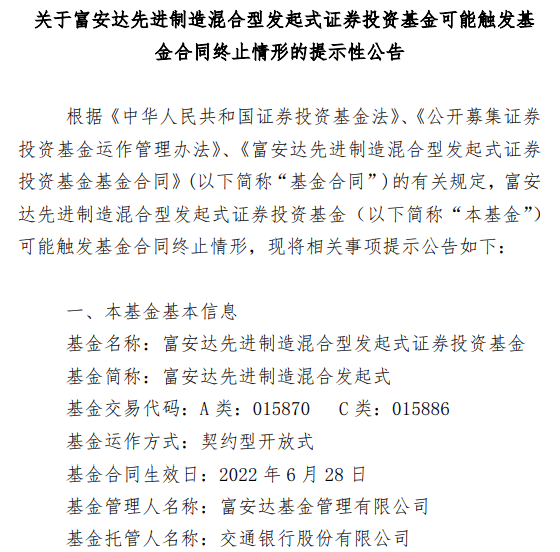
Core Viewpoint - The fund "Fuan Da Advanced Manufacturing Mixed Initiation Fund" is at risk of termination due to its net asset value falling below 200 million yuan by June 28, 2025, leading to the suspension of subscription and investment activities to mitigate potential impacts on investors [1][3]. Fund Performance and Status - The fund was established on June 28, 2022, during a peak interest in advanced manufacturing sectors like new energy and semiconductors, but has since experienced a decline in scale and performance [3][7]. - As of March 31, 2025, the fund's net asset value was only 80 million yuan, with a net asset change rate of 2.14% [5]. - The fund has consistently shown a downward trend in net asset value since its inception, with significant declines noted in various reporting periods [5][6]. Regulatory and Market Context - The fund's potential termination reflects a broader issue with initiation funds, where poor performance and shrinking scale ultimately harm retail investors more than fund companies [7][12]. - The 200 million yuan liquidation threshold is seen as a reasonable regulatory measure to ensure operational efficiency and fairness to remaining investors, although it poses challenges for those who may be forced to redeem at unfavorable times [11][12].
在华拓展业务是跨国企业“必选项”而非“可选项”——访奥纬咨询董事合伙人贝哲民
Xin Hua She· 2025-06-24 03:11
Group 1 - China is not only the "world's factory" but is gradually becoming the "global innovation center," making it essential for multinational companies to establish and expand their businesses in China [1][2] - The World Economic Forum's Summer Davos Forum emphasizes the importance of open and equal dialogue among political, business, and academic leaders to promote understanding and cooperation in an uncertain world [1] - Multinational companies can continue to trust China for three main reasons: its large consumer market, extensive industrial chain, and high production efficiency [1] Group 2 - China is a key player in the global supply chain, providing strong production support through numerous factories, while also enhancing regional supply chain stability and resilience [1][2] - The future of foreign investment in China is expected to focus on advanced manufacturing, artificial intelligence, biopharmaceuticals, precision medicine, and clean energy, leveraging China's technological innovation and consumption upgrades [2] - China is positioned as a frontier of global innovation, with expectations to continue exporting innovative technologies, products, and business models to drive global economic growth [2]