
光伏

Search documents
伦铜价格创历史新高!注销仓单暴增802%,铜精矿供应增量腰斩,高盛为何逆势唱空?
Hua Xia Shi Bao· 2025-12-05 00:15
Core Viewpoint - Recent surge in copper prices driven by strong demand from emerging sectors such as AI, energy storage, photovoltaics, wind power, and electric vehicles, alongside supply constraints and structural inventory issues [3][4][10] Market Dynamics - LME copper futures reached a historical high of $11,540 per ton, marking a 31% increase since 2025 [3][4] - Shanghai copper futures surpassed 90,000 yuan per ton for the first time, closing at 90,780 yuan, with a daily increase of 2% [3] - The market sentiment is influenced by a macro environment of loose monetary policy and a tight balance in copper supply and demand [3][10] Supply Constraints - Major copper mines in Indonesia, Chile, and the Democratic Republic of Congo have reduced output due to various disruptions, leading to a negative growth rate in copper production [5] - The processing fees for copper concentrate have dropped to negative values, forcing reductions in smelting output [5] - LME registered warehouse stocks decreased by 32.3% year-on-year, indicating a significant reduction in available copper for delivery [5][6] Demand Growth - Global copper consumption is expected to grow by nearly 800,000 tons annually, driven by both traditional and emerging sectors [4][7] - Asian demand contributes over 60% of the increase, primarily through aggressive purchasing rather than a sudden spike in absolute consumption [8] - The demand for copper in the domestic market remains resilient, particularly in the real estate and appliance sectors [7][10] Investment Outlook - Analysts suggest that the current copper price trend is supported by long-term structural factors, including the rise of new industries and persistent supply shortages [9][10] - The expectation of continued monetary easing by the Federal Reserve is likely to sustain high copper prices [10] - Goldman Sachs predicts that the recent surge in copper prices may be temporary, as supply is expected to meet global demand in the long run [11]


“疾驰”的白银与“熄火”的黄金 金银走势为何分化
Shang Hai Zheng Quan Bao· 2025-12-04 23:32
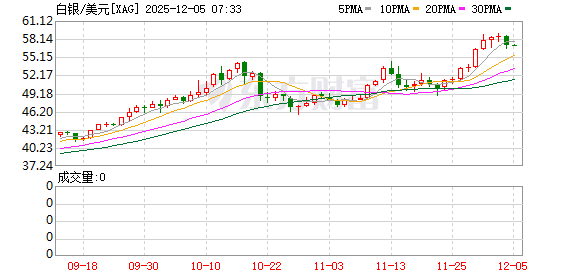
近日,现货白银连续刷新历史纪录,向上逼近59美元/盎司,国内外白银期货价格跟涨。而此前"闪 耀"的黄金略显后劲不足,在10月中旬创下历史新高后便在高位反复震荡。在业内人士看来,白银的强 工业属性为其带来了强劲需求预期,叠加低库存的极致博弈,让白银对美联储宽松政策预期的反应更为 敏感,较黄金展现出了更大的价格弹性。 北京时间12月4日亚洲交易时段,黄金、白银现货与期货市场均出现不同程度的回调。贵金属市场会否 就此偃旗息鼓?机构人士普遍认为,贵金属价格重心上移中长期趋势不变,但短期须关注资金获利了 结、白银供应紧缺程度有所缓解带来的价格波动加剧风险。 "割裂"的金银 近段时间,金、银市场表现分化特征愈发显著。 Wind数据显示,北京时间12月3日亚洲交易时段,现货白银再度刷新历史纪录,离升破59美元/盎司仅一 步之遥。此前,现货白银已连续7个交易日收涨,累计涨幅超过16%。现货黄金则表现平平,在10月中 旬创下4381.484美元/盎司的历史新高后便进入高位盘整期,其间一度跌破4000美元/盎司,随后在每盎 司4000美元至4200美元的区间震荡。 期货市场也呈现出同样的状态。Choice数据显示:COMEX白银 ...
锡行业分析及展望
2025-12-04 15:36
Industry Analysis and Outlook on Tin Key Points Industry Overview - Domestic hidden inventory of tin is continuously depleting, with an expected peak gap of approximately 15,000 tons by July 2025, indicating a tight supply situation that is unlikely to ease in the short term, thus supporting tin prices [1][2] - Myanmar's tin mines are expected to gradually resume operations starting August 2025, with production anticipated to reach around 1,500 tons by November, but the recovery pace is slow, and the supply gap will only improve by about 2,000 tons by year-end, which is insufficient for a relaxed supply state [1][3] Supply Forecast - Global tin supply is expected to become more relaxed in 2026, with Myanmar's production potentially recovering to between 26,000 tons and 32,000 tons, and Indonesia's tin ingot exports possibly reaching between 65,000 tons and 72,000 tons, while Africa also has production potential, albeit with uncertainties due to policy and investment environments [1][5][10] - The active replenishment demand in the supply chain will absorb some raw material increments, meaning that even if raw material increments reach between 16,000 tons and 30,000 tons, the actual increase in smelting output may be reduced by about 10,000 tons, potentially affecting market supply-demand balance [1][8] Policy and Market Dynamics - Indonesia's tin mining policy adjustments, including foreign exchange controls, quota regulations, and anti-smuggling measures, may lead to a gradual decline in overall supply stability as the world's second-largest tin ingot supplier, necessitating ongoing attention to long-term impacts [1][9] - The political and investment environment in Africa presents significant uncertainties for long-term supply, despite the region's potential for increased production due to low extraction costs and high grades [1][10] Demand Trends - Tin demand is primarily concentrated in consumer products such as electronic solder (40%) and packaging materials (10%), with a strong correlation to economic cycles. Emerging demand areas include electric vehicles, photovoltaics, and AI servers, but their current market share remains limited [1][13][14] - Global tin demand growth is projected to slow to around 3% in 2025, with a potential range of -1% to 1% in 2026, indicating a cautious outlook for demand in the coming years [1][18][19] Price Dynamics - The relationship between supply and prices is expected to remain constrained, with new products and applications driving higher demand elasticity. Annual supply-demand balance and mismatches will be more significant for price assessments, with macroeconomic factors playing a substantial role in pricing [1][21][22] - Seasonal price increases typically occur at year-end due to reduced supply from major producing countries during the Chinese New Year and increased pre-holiday stocking by downstream enterprises [1][23] Regional Insights - The Democratic Republic of the Congo (DRC) has experienced supply disruptions due to conflict, but major mines remain largely unaffected. The establishment of new smelting facilities by the U.S. is expected to improve local production conditions [1][27] - South American tin production is projected to be stable, with Peru, Bolivia, and Brazil producing approximately 33,000 tons, 21,000 tons, and 19,000 tons respectively in 2024, although economic and operational uncertainties may impact stability [1][30] Conclusion - The tin industry faces a complex landscape of supply constraints, policy changes, and evolving demand dynamics. Investors should remain vigilant regarding market fluctuations and potential risks associated with geopolitical factors and economic cycles.
价格突破32万元!供需失衡下锡产业链或迎新机遇
Xin Hua Cai Jing· 2025-12-04 11:45
Core Viewpoint - Recent tin prices have reached new highs due to tight supply and macroeconomic expectations, with Shanghai futures hitting 323,000 yuan per ton, a 28% increase year-to-date [1] Supply and Demand Dynamics - Analysts highlight that tin supply remains a core concern, with slow recovery in Myanmar's Wa State mines and a significant drop in Indonesia's refined tin exports in October, leading to continued supply constraints [2] - The geopolitical conflict in the Democratic Republic of Congo is causing logistical disruptions and rising costs, limiting tin imports [2] - Tin is currently one of the most scarce non-ferrous metals, with low static reserve-to-production ratios globally and in China, indicating sustainability challenges [2] Market Trends and Future Outlook - The global supply of tin is under pressure from resource depletion and regulatory changes in major producing countries like Indonesia and Myanmar, which are facing declining grades and increased extraction difficulties [3] - Demand for tin is primarily driven by emerging sectors such as photovoltaics and semiconductors, with a projected compound annual growth rate (CAGR) of 7% for solder demand from 2024 to 2030 [3] - Traditional demand is expected to benefit from global fiscal and monetary easing, with an estimated CAGR of 4.3% for global tin demand from 2024 to 2030 [3] Industry Performance - Companies in the tin industry have reported significant profit growth due to rising tin prices, with several listed companies in the A-share market benefiting from the upward trend [5] - Xiyu Tin Industry reported a revenue of 34.417 billion yuan for the first three quarters of 2025, a 17.81% increase year-on-year, with a net profit of 1.745 billion yuan, up 35.99% [6] - Xingye Silver Tin reported a revenue of 4.099 billion yuan for the first three quarters of 2025, a 24.36% increase year-on-year, with a net profit of 1.364 billion yuan, up 4.94% [6] Strategic Insights - Companies are optimistic about the future of the tin industry, citing tightening policies in Southeast Asia and the strategic importance of tin resources [7] - The demand for tin is expected to grow due to the recovery of the global economy and the rapid development of emerging industries such as semiconductors and photovoltaics [7]


伦铜价格创历史新高!注销仓单暴增802%,铜精矿供应增量腰斩
Xin Lang Cai Jing· 2025-12-04 11:25
Core Viewpoint - Recent strong upward movement in copper futures prices, with LME three-month copper reaching a historical high of $11,540 per ton on December 3, reflecting a cumulative increase of 31% since 2025 [2][12] Market Dynamics - The macroeconomic environment is characterized by a loose monetary policy, a tight balance in fundamentals, and structural inventory issues, which have created a positive feedback loop for price increases [2][12] - The first-time breach of 90,000 yuan per ton for Shanghai copper futures, with a peak of 91,450 yuan per ton on December 4, indicates strong market sentiment [2][12] Supply and Demand Factors - The rise in copper prices is driven by increased consumption from emerging sectors such as AI computing power, energy storage, photovoltaics, wind power, and electric vehicles, with an annual increase in global copper demand of nearly 800,000 tons [3][14] - Supply bottlenecks have been exacerbated by production disruptions at major mines in Indonesia, Chile, and the Democratic Republic of Congo, leading to a negative growth rate in annual mineral output [3][15] - The COMEX-LME premium remains significant, with an average of $330 per ton, despite a drop in the third and fourth quarters [3][14] Inventory Changes - As of December 3, registered LME copper warehouse receipts decreased by 32.3% year-on-year, while canceled receipts surged by 802.78%, indicating a sharp reduction in available spot copper [4][15] - The shift in market structure from contango to backwardation has amplified price elasticity, driven by concerns over local inventory shortages in Asia [4][16] Future Outlook - The ongoing demand growth in sectors such as electric vehicles and renewable energy is expected to continue driving copper consumption, with potential supply shortages anticipated post-2025 [5][17] - Analysts suggest that the current copper price trends are influenced by macroeconomic factors, fundamental supply-demand dynamics, and market sentiment, particularly in light of Federal Reserve interest rate expectations [7][20] - Investment strategies should focus on trend-following approaches, given the long-term nature of supply constraints and emerging industry growth [8][19]

微导纳米20251203
2025-12-04 02:21
Summary of MicroGuide Nano's Conference Call Company Overview - **Company**: MicroGuide Nano - **Industry**: Semiconductor and Photovoltaic Equipment Key Points Semiconductor Equipment Growth - MicroGuide Nano's semiconductor equipment orders are expected to grow at over 50% in 2025 and 2026, driven by capacity expansion from storage manufacturers and increased capital expenditure from downstream clients [2][3] - New orders are projected to reach between 1.8 billion to 2 billion CNY in 2025, and conservatively estimated at 2.5 billion to 3 billion CNY in 2026, with optimistic estimates reaching 4 billion CNY [2][10] Management Team Expertise - The management team has extensive experience in the semiconductor industry, with founder Li Weiming having deep expertise in ALD technology, and other key members having backgrounds in CVD and photovoltaic sectors [2][4] ALD and PECVD Technology Advantages - MicroGuide Nano has a significant advantage in ALD technology, with a process coverage of 70%-80%, particularly in depositing HAKI materials like hafnium dioxide, achieving a market share of 70%-80% in advanced logic devices [2][6] - In PECVD, the company holds a 90% market share in high-temperature hard mask PECVD, effectively becoming a sole supplier [2][6] Market Demand for ALD and CVD Technologies - The complexity of 3D NAND structures is increasing, leading to higher demand for ALD technology due to its superior film quality, which is essential for advanced logic and memory devices [7] - ALD penetration is expected to rise from 10% to 20% as process nodes advance [6][7] Strategic Partnerships - MicroGuide Nano has formed strategic partnerships with leading battery manufacturers to advance ALD technology applications in solid-state batteries, enhancing performance metrics such as cycle life and charge capacity [3][11] Photovoltaic Business Performance - The photovoltaic business has seen fluctuations, with new orders dropping to less than 1 billion CNY in 2025 after reaching over 5 billion CNY in 2023. However, recovery is anticipated as industry policies stabilize [3][13] - The company has made significant investments in perovskite technology, positioning itself for future growth in the photovoltaic sector [14] Financial Performance and Projections - The company’s revenue from semiconductor equipment is approaching 20% of total revenue as of the first half of 2025, indicating a shift towards semiconductor reliance [5] - The photovoltaic sector's profitability is expected to improve as the market stabilizes, contributing positively to overall revenue [3][13] Future Outlook - MicroGuide Nano is poised to benefit significantly from the industrialization of solid-state batteries and the recovery of the photovoltaic market, with strategic investments and partnerships enhancing its competitive position [12][14]

深夜,集体狂飙!美国资本,杀疯了!
券商中国· 2025-12-03 15:13
在2026年铜冶炼加工费谈判的关键节点上,铜矿供应紧张的背景下,金属铜市场的博弈正在日趋激烈。 12月3日,伦敦金属交易所(LME)的铜价,刷新历史新高, 交易所数据显示,提货订单出现自2013年以来 最大单日增幅。 沪铜期货主力合约站上9万元/吨大关,亦创历史新高。 由于纽约商品交易所(COMEX)—伦敦金属交易所(LME)之间的价差持续存在,资金囤铜流入美国的迹象 始终不断。 目前,COMEX铜库存已突破40万吨,较去年年底增加了超过300%,COMEX铜库存占国际三大 交易所铜库存的比例已达62%。 铜价刷新历史高点 12月3日,伦敦金属交易所(LME)三个月期铜价格创历史新高。伦铜日内一度涨近3%,截至发稿,涨 2.59%,报11435美元/吨,创下历史新高。沪铜期货主力合约站上9万元/吨大关,现涨1.4%,创历史新高。 此外, 伦敦金属交易所(LME)三个月期锡涨3.45%,报40385.0美元/吨;沪锡期货主力连续合约涨 3.05%,报318770元(人民币)/吨。 价格均创2022年5月以来新高。 现货白银涨0.27%,报58.59美元/盎司;现货黄金涨超0.50%,报4226美元/盎司;WTI ...

周期团队联合展望 - 2026年度策略报告汇报会议
2025-12-03 02:12
Summary of Key Points from Conference Call Records Industry Overview - **Copper Market**: Expected price increase to 120,000 CNY/ton due to lower global copper mine production growth compared to demand growth, leading to a persistent supply-demand gap. A weak dollar environment is favorable for copper's financial attributes [1][4][3] - **Aluminum Market**: Benefiting from domestic supply-side reforms and strong demand, with projected consumption growth of 1.5% to 2.3% for electrolytic aluminum by 2028. Raw material prices are relatively weak, but product prices remain strong, leading to substantial profits [1][4][5] - **Precious Metals Market**: Long-term outlook remains positive due to global financial order restructuring, dollar credit issues, and geopolitical factors supporting gold prices. Silver has seen rapid price increases, and attention is drawn to the gold-silver ratio recovery [1][6] - **Minor Metals**: Thorium and tantalum show investment potential, with thorium's supply-demand mismatch due to global energy shortages and nuclear power development. Tantalum prices are expected to recover due to export controls [1][7] - **New Materials**: Fields such as AI chips, inductors, capacitors, and new materials for robotics have significant growth potential, driven by expanding applications of emerging technologies [1][7] Steel Industry Insights - **Challenges and Opportunities**: The steel industry faces a contradiction between the increasing proportion of high-end products and supply surplus. Attention is needed on production restriction policies, new iron ore capacity releases, and cost changes. High-end special steel is expected to see development opportunities [1][13] - **Demand Structure Changes**: The demand for construction steel has significantly declined, with manufacturing becoming the primary growth point, accounting for over 50% of demand. Key sectors include machinery, automotive, and energy [1][21][22] - **Profit Influencing Factors**: Steel industry profits are influenced by cost factors (iron ore and coking coal prices), demand from real estate and manufacturing, and the effectiveness of production restriction policies [1][28] Market Projections - **Iron Ore Market**: Supply is expected to increase significantly in 2026, with new projects contributing substantial increments. Iron ore prices are projected to be under pressure, potentially dropping from approximately 101 USD to around 90 USD [2][26] - **Coking Coal Market**: Expected to remain stable in 2026 after significant fluctuations in 2025, with supply gradually recovering from various regions [2][27] Investment Strategies - **Investment Recommendations**: Investors are advised to focus on high-dividend, high-return leading companies across various sectors. Continuous monitoring of real estate sales and construction starts is crucial, along with the development potential in special steel [1][30]
工业硅:偏弱运行为主,多晶硅:震荡行情,关注后续仓单注册情况
Guo Tai Jun An Qi Huo· 2025-12-03 01:59
2025 年 12 月 03 日 工业硅:偏弱运行为主 多晶硅:震荡行情,关注后续仓单注册情况 张 航 投资咨询从业资格号:Z0018008 zhanghang2@gtht.com 【基本面跟踪】 工业硅、多晶硅基本面数据 | | | 指标名称 Si2601收盘价(元/吨) | T | T-1 15 | T-5 205 | T-22 -10 | | --- | --- | --- | --- | --- | --- | --- | | | | Si2601成交量(手) | 9,145 216,787 | 18,896 | 2,775 | -104,204 | | | | Si2601持仓量(手) | 203,274 | -8,525 | -59,402 | -24,490 | | | 工业硅、多晶硅期货市场 | PS2601收盘价(元/吨) | 57,705 | 1,280 | 4,390 | - | | | | PS2601成交量(手) | 338,696 | 157,433 | 150,820 | - | | | | PS2601持仓量(手) | 142,133 | -2,626 | 13,706 | - ...
因势而动,精耕个券 - 2026年转债策略展望
2025-12-01 16:03
Summary of the Conference Call on Convertible Bond Strategy for 2026 Industry Overview - The conference call focuses on the convertible bond market in China, particularly the performance and outlook for 2026, influenced by macroeconomic factors and policy changes [1][3][8]. Key Points and Arguments Market Performance and Characteristics - The convertible bond market showed strong performance in 2025, with a cumulative increase of approximately 16.5% by the end of November [3]. - High-rated large-cap convertible bonds saw a rapid decline in scale due to tightened refinancing policies since 2024, particularly affecting bank convertible bonds [3][6]. - The rapid increase in ETF scale, reaching 620.682 billion, accounted for 12.5% of the convertible bond market, growing over 50% since the beginning of the year [1][5]. - The valuation of convertible bonds is increasingly aligned with the stock market, indicating a shift towards equity-like characteristics [1][3]. Future Supply and Demand Dynamics - Supply pressure in the convertible bond market is expected to persist into 2026, with a significant reduction in issuance anticipated due to strong redemption and delisting pressures [1][6][10]. - Despite the anticipated supply challenges, there is a strong willingness among major shareholders to issue new bonds due to lower financing costs [6][10]. - The demand for fixed-income products is expected to support valuations, preventing significant declines despite the shrinking supply [7][10]. Economic Outlook - The outlook for the A-share market in 2026 is optimistic, driven by expectations of economic recovery, structural adjustments, and policy reforms [8][9]. - Low-risk interest rates are likely to encourage a shift of savings and long-term capital into the equity market, enhancing the attractiveness of equity assets [9]. Investment Strategies for 2026 - Investment strategies should focus on two main opportunities: low-priced convertible bonds as a stabilizing asset and flexible equity-linked convertible bonds [11][14]. - Specific sectors to watch include technology growth (AI, humanoid robots), green energy (energy storage, hydrogen), and defensive positions in banking and public utilities [3][18]. - The strategy should involve active selection of bonds that are less likely to trigger strong redemption and those with a solid underlying stock logic [12][20]. Risks and Considerations - The potential for strong redemption events remains high, necessitating caution with high-priced and high-premium bonds that may trigger such actions [12][20]. - The shrinking scale of the convertible bond market may lead to capital inflows into the stock market, which could compress time value [2][10]. Conclusion - The convertible bond market in 2026 is expected to maintain high valuations supported by favorable policies and low-interest rates, despite challenges in supply and potential strong redemption pressures [10][14]. - A balanced approach with a focus on both defensive and flexible investment strategies will be crucial for navigating the market dynamics in the coming year [11][14].