资产证券化

Search documents
8月份资产管理信托发行数量与规模同比双增
Zheng Quan Ri Bao· 2025-09-10 16:51
Core Insights - The asset management trust market showed strong performance in August, with significant year-on-year growth in both issuance and establishment [1] - The issuance of asset management trust products reached 2,654, marking a 4.12% increase month-on-month and a 25.79% increase year-on-year, with a disclosed issuance scale of 132.76 billion, reflecting a 1.87% month-on-month and a 37.67% year-on-year growth [1] - The establishment of asset management trusts also saw a year-on-year increase of over 10%, with 2,265 products established, although this represented a slight month-on-month decline of 1.31% [1] Issuance Market - The issuance of standard products (标品信托) was a key driver for the stable growth of the asset management trust issuance market, with 1,506 products issued in August, a month-on-month increase of 1.01% [1] - The internal structure of standard products showed mixed results, with fixed-income product issuance declining by 9.11%, while mixed products and equity products saw increases of 89.29% and 75.51% respectively [1] Establishment Market - In August, the disclosed establishment scale for asset management trusts was 71.67 billion, reflecting a month-on-month decline of 7.74% but a year-on-year increase of 14.92% [1] - Non-standard products saw a significant month-on-month decline in establishment scale by 20.11%, particularly in financial and infrastructure sectors, with financial products decreasing by 5.16 billion and infrastructure products by 8.48 billion [2] Market Dynamics - The decline in non-standard financial products was attributed to a significant drop in credit asset rights transfer business, with banks shifting towards standardized asset transfer methods like ABS, which can lower financing costs to below 2% [2] - The establishment of standard products saw a month-on-month decrease of 4.75%, but the disclosed establishment scale increased by 23.71%, indicating a shift in investor preferences towards equity markets [3] Strategic Insights - The development of standard trust products is seen as a necessary transition for trust companies under new asset management regulations, facilitating direct financing support for enterprises and enhancing the proportion of direct financing in the economy [3] - Standard trust products are expected to accelerate the industry's transition to net value management, aligning with investors' diverse financial needs and helping trust companies leverage their institutional advantages for competitive differentiation [3]
2025年Auto-ABS存续期表现:证券信用风险持续下降,未来资产将更趋多元化
Lian He Zi Xin· 2025-09-10 07:12
Market Overview - In the first seven months of 2025, the issuance scale of Auto-ABS decreased to 107.29 billion yuan, a year-on-year decline of 11.06%[4] - A total of 70 Auto-ABS products were issued, with 49 being exchange-traded ABS, accounting for 54.75% of the total issuance[4] - Credit ABS issuance dropped significantly, with 11 products totaling 36.94 billion yuan, a year-on-year decrease of 48.03%[4] Issuer Concentration - The number of issuers increased slightly, with 41 issuers in total, including 27 financing leasing companies, which surpassed automotive finance companies in issuance scale[6] - The largest issuer, a Ping An financing leasing company, accounted for 22.12% of the total issuance, while the top five issuers collectively held 75.82% of the market[6] Performance Metrics - As of July 2025, the cumulative default rate for Auto-ABS products was low, with financing leasing companies averaging 2.95% and automotive finance companies at 0.63%[12] - The overall cumulative early repayment rate was 7.05%, with automotive finance companies at 7.39% and financing leasing companies at 6.72%[17] Credit Risk Assessment - The credit risk of Auto-ABS products has been decreasing, supported by initial over-collateralization and dual deleveraging effects during the product's lifespan[22] - The majority of Auto-ABS products maintained stable credit performance, with over 90% of projects showing actual cumulative default rates aligning closely with predicted rates[16] Future Outlook - The Auto-ABS issuance scale is expected to face challenges due to ongoing price wars in the automotive industry and weak consumer demand, although short-term improvements may arise from policy support[21] - Automotive finance companies are diversifying their offerings, including leasing and second-hand vehicle financing, to stimulate demand and expand their asset base[23]
让资产证券化架起体育产业“流量”与“资金”的桥梁
Zheng Quan Ri Bao· 2025-09-07 16:12
Core Viewpoint - The Chinese sports industry is experiencing a growing consumer interest, yet many sports enterprises face challenges in venue upgrades and event IP cultivation due to a lack of funding, which hinders the development of the sports sector [1] Group 1: Sports Industry Asset Securitization - The State Council's recent opinion supports asset securitization for qualifying sports enterprises, providing a pathway to convert "traffic" into funding [1] - Sports industry asset securitization involves transforming predictable cash flow assets, such as broadcasting rights and ticket revenues, into tradable securities, alleviating short-term cash flow pressures and injecting capital for long-term growth [1] - The exploration of asset securitization in China's sports industry began in 2018 with the issuance of the "Vanke Songhua Lake Trust Beneficiary Rights Asset Support Special Plan," focusing on ski resort operations [1] Group 2: Current State and Challenges - Despite the potential, sports industry asset securitization remains limited, contrasting sharply with the booming asset securitization market, which saw a 17.94% increase in issuance quantity and a 15.65% increase in scale this year [2] - Key challenges include a scarcity of quality underlying assets, a need for improved risk management systems, and a lack of clear policies regarding the ownership and transfer of intangible sports assets [2] Group 3: Recommendations for Development - Sports enterprises should focus on creating and optimizing assets, such as consolidating regional events into league IPs to stabilize cash flow and enhance asset appeal [3] - A dual protection system combining professional rating and dynamic management should be established to improve risk assessment and alleviate investor concerns [3] - Policies should be accelerated to clarify ownership and transfer rules for intangible sports assets, introduce tax incentives, and reduce transaction costs for sports asset securitization products [3] Group 4: Future Outlook - With coordinated efforts in asset creation, risk control, and supportive policies, asset securitization can become a crucial bridge connecting the "traffic" and "funding" of the sports industry, promoting a transition from "traffic heat" to "industry strength" [4]
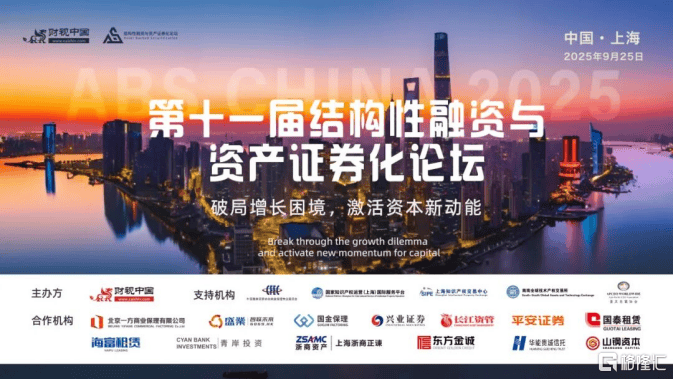
激活资本新动能——第十一届结构性融资与资产证券化论坛即将启幕
Sou Hu Cai Jing· 2025-09-05 07:30
Group 1 - The core viewpoint of the articles highlights the significant growth and recovery of China's asset securitization market in the first half of 2025, with an issuance scale of approximately 0.96 trillion yuan, representing a year-on-year increase of 28.74% [2] - By the end of June 2025, the market's outstanding scale reached approximately 3.77 trillion yuan, up from 3.09 trillion yuan at the end of May 2025 [2] - Several targeted policies have been introduced to support the development of the asset securitization market, including the promotion of credit asset securitization in key sectors [2] - The issuance of asset-backed notes (ABN) surged to 258.28 billion yuan, marking a year-on-year growth of 48.70%, establishing itself as a significant growth driver in the market [3] Group 2 - The first half of 2025 saw the emergence of innovative asset securitization products, including green ABS, data asset ABS, and new energy ABS, driven by supportive policies [2] - The first data asset ABS was issued in Shenzhen Stock Exchange with a scale of 130 million yuan, exploring new paths for the marketization of data elements [2] - The asset securitization forum scheduled for September 25, 2025, in Shanghai will focus on current market trends and feature discussions on cross-border ABS, consumer infrastructure REITs, and digital asset securitization [3] - The forum will also include the "Jiefu Award" ceremony to recognize outstanding achievements in the financial sector [3]

财通资管创新投融联动 为科创企业融资打开一扇新窗
Zheng Quan Shi Bao· 2025-09-03 21:52
Group 1 - Asset securitization is becoming an important battleground for financial institutions to serve the real economy, with broker asset management having unique advantages in investment and financing linkage and capital market innovation [1] - The focus on technology finance is highlighted as a key area in the "Five Major Articles" of finance, with the integration of intellectual property and digital assets into innovative financing methods like ABS being particularly suitable for tech enterprises [2][3] - The issuance of the "Caitong - Hangzhou Binjiang Intellectual Property Phase 1 Asset-Backed Special Plan (Technology Innovation)" in December 2024, managed by Caitong Asset Management, raised 104 million yuan at a financing rate of only 1.43%, involving 13 specialized enterprises and 114 intellectual properties [2][3] Group 2 - Caitong Asset Management has established a comprehensive product matrix covering ABS, Pre-ABS, private REITs, and public REITs, providing full-chain services from asset selection to financing design and subsequent operations [3] - In 2024, Caitong Asset Management achieved historical highs in both new ABS issuance scale and ranking, with a new issuance scale of 42.842 billion yuan, marking over 30% growth for three consecutive years [3] - As of June 30, 2024, Caitong Asset Management has cumulatively issued 206 ABS products with a total issuance scale of 165.09 billion yuan [3] Group 3 - The digital asset market is seen as a growing opportunity, with the expectation that high domestic digitalization levels will lead to more digital asset monetization, despite current challenges in application scenarios and asset dispersion [4] - The demand for computing power is rapidly increasing globally, driven by advancements in AI and data economy, positioning data centers as ideal underlying assets for public REITs due to their stable cash flow [5] Group 4 - The public REITs market has gained significant traction this year, with multiple new products experiencing immediate success upon listing, highlighting the importance of stable and growth-oriented cash flow assets in asset allocation [6] - The global REITs market is approximately $1.8 trillion, while the domestic public REITs market is only about 220 billion yuan, indicating that it is still in its early stages [6] - Caitong Asset Management is focusing on developing REITs as a key area, establishing a multi-level REITs business chain and targeting projects related to green, inclusive, and technological innovation [6] Group 5 - In addition to public REITs, private REITs are also innovative products under the asset securitization framework, designed to raise long-term equity funds for issuers, thus supporting sustainable development [7]

财通资管创新投融联动为科创企业融资打开一扇新窗
Zheng Quan Shi Bao· 2025-09-03 18:24
Core Viewpoint - Asset securitization is becoming a crucial battleground for financial institutions to serve the real economy, with brokerage asset management holding unique advantages in investment and capital market innovation [1] Group 1: Financial Innovation and Support for Tech Enterprises - Financial institutions are focusing on guiding funds towards key areas and weak links as outlined in the "Five Major Articles," with a strong emphasis on financial functionality [1] - The issuance of the "Caitong-Hangzhou Binjiang Intellectual Property Phase 1 Asset Support Special Plan (Technology Innovation)" by Caitong Securities and Caitong Asset Management achieved a financing rate of only 1.43%, involving 13 specialized small and medium-sized enterprises and 114 intellectual properties [2] - Knowledge property ABS provides a low-cost, sustainable financing channel for tech enterprises, which traditionally rely on intangible assets for valuation [1][2] Group 2: Growth in Asset Securitization Products - Caitong Asset Management has established a comprehensive product matrix covering ABS, Pre-ABS, private REITs, and public REITs, achieving a historical high in both issuance scale and ranking in 2024 [3] - The new issuance scale of Caitong Asset Management's ABS reached 428.42 billion yuan, marking a continuous growth of over 30% for three consecutive years [3] - As of June 30, Caitong Asset Management has issued 206 ABS products with a cumulative issuance scale of 1,650.9 billion yuan [3] Group 3: Digital Asset Market Opportunities - Digital assets, with their strong monetization capabilities, are seen as a promising area for future asset securitization, although challenges remain in integrating various digital platforms [3][4] - The demand for computing power is growing rapidly, driven by advancements in AI, which positions data centers as ideal underlying assets for public REITs due to their stable cash flow [4][5] Group 4: REITs Market Development - The public REITs market has gained significant traction this year, with multiple new products experiencing immediate price surges upon listing [5] - The global REITs market is valued at approximately $1.8 trillion, while the domestic public REITs market is still in its early stages, valued at around 220 billion yuan [5] - Caitong Asset Management is prioritizing the development of REITs, focusing on green, inclusive, and tech innovation sectors to accelerate the implementation of quality projects [5][6]
财通资管叶晓明:投融联动探索差异化发展,精耕细作试写“五篇大文章”
Sou Hu Cai Jing· 2025-09-03 08:11
Core Insights - Asset securitization has become a crucial battleground for financial institutions to serve the real economy, with firms holding both brokerage and asset management licenses having a competitive advantage [1] - Financial institutions are increasingly focusing on innovative financing methods, such as linking intellectual property and digital assets to asset-backed securities (ABS), to support technology-driven enterprises [2][3] - The issuance of ABS products by financial institutions is on the rise, with significant growth in new issuance scale and industry rankings [1][3] Group 1: Financial Performance and Market Position - In 2024, the new issuance scale of ABS reached a historical high of 428.42 billion yuan, ranking eighth in the industry, with a continuous growth rate of over 30% for three consecutive years [1] - As of June 30, 2024, the company has issued a total of 206 ABS products, with a cumulative issuance scale of 1,650.9 billion yuan [1] Group 2: Innovation in Financing - The company is actively developing a full-cycle product matrix that includes ABS, Pre-ABS, private REITs, and public REITs, providing comprehensive services from asset selection to financing design and subsequent operations [3] - The company aims to support technology enterprises through innovative financing solutions, including the securitization of digital assets and intellectual property [2][3] Group 3: Case Studies and New Initiatives - A notable project is the "Caitong-Hangzhou Binjiang Intellectual Property Phase 1 Asset-Backed Special Plan (Technology Innovation)," which achieved direct financing of 1.04 million yuan and involved 13 specialized enterprises [4][8] - The project highlights the complexity of valuing diverse intellectual properties and the collaborative efforts among various stakeholders, including local government and financial institutions, to facilitate financing [8][9] Group 4: Future Opportunities in Digital Assets - The company sees significant potential in the digital asset market, emphasizing the need for improved infrastructure and valuation methods to unlock financing opportunities [10][11] - The recent approval of data center REITs by regulatory authorities indicates a growing recognition of the importance of digital assets in the financing landscape [11] Group 5: REITs Market Development - The public REITs market is experiencing a resurgence, with multiple new products achieving significant market interest, indicating a shift towards more sustainable financing solutions [12][13] - The company is focusing on expanding its REITs offerings across various sectors, including green finance and technology, to enhance investment opportunities [12][13]

财通资管叶晓明:投融联动探索差异化发展,精耕细作试写“五篇大文章”
券商中国· 2025-09-03 07:09
Core Viewpoint - Asset securitization has become a crucial battleground for financial institutions to serve the real economy, with companies like Caitong Asset Management leveraging their dual licenses in brokerage and asset management to enhance their capabilities in this area [1][2]. Group 1: Asset Securitization Growth - Caitong Asset Management achieved a historical high in both the issuance scale and ranking of Asset-Backed Securities (ABS) in 2024, with a new issuance scale of 42.842 billion yuan, ranking eighth in the industry, and maintaining over 30% growth for three consecutive years [2]. - As of June 30, 2024, Caitong Asset Management has issued a total of 206 ABS products, with a cumulative issuance scale of 165.09 billion yuan [2]. Group 2: Support for Sci-Tech Enterprises - The company is focusing on supporting sci-tech enterprises through innovative financing methods, particularly by integrating intangible assets like intellectual property into ABS structures, which can provide a more sustainable financing route for these companies [3][4]. - Caitong Asset Management has developed a comprehensive product matrix covering ABS, Pre-ABS, private REITs, and public REITs, offering full-chain services from asset selection to financing design and subsequent operations [4]. Group 3: Innovative Projects - A notable project is the "Caitong-Hangzhou Binjiang Intellectual Property Phase 1 Asset-Backed Special Plan (Technology Innovation)," which raised 10.4 million yuan and involved 13 specialized enterprises, marking a significant step in intellectual property securitization [5][9]. - The project faced challenges due to the complexity of valuing diverse intellectual properties, but it successfully garnered support from local government and financial institutions, resulting in a favorable financing rate of 1.43% [8][9]. Group 4: Digital Asset Opportunities - The market for digital assets is emerging, with expectations for improved valuation and monetization as infrastructure develops, although challenges remain in integrating various digital assets across platforms [10][11]. - The recent approval of the first two data center REITs in China indicates a growing recognition of the potential for securitizing new asset classes, including data and digital assets [11]. Group 5: REITs Market Potential - The public REITs market is gaining momentum, with Caitong Asset Management focusing on expanding its involvement in this area, aiming to cover a wide range of economic entities from state-owned to large private companies [12][14]. - The current global REITs market is valued at approximately $1.8 trillion, while China's public REITs market is still in its infancy, valued at around 220 billion yuan, presenting significant growth opportunities [13].

九州通:上半年实现营业收入和归母净利润双增长
Quan Jing Wang· 2025-09-03 04:25
Core Viewpoint - The company demonstrated steady growth in revenue and net profit in the first half of 2025, despite industry challenges, by focusing on its core business and enhancing asset liquidity through securitization [1] Financial Performance - In the first half of 2025, the company achieved operating revenue of 81.106 billion yuan, representing a year-on-year increase of 5.10% [1] - The net profit attributable to shareholders reached 1.446 billion yuan, reflecting a year-on-year growth of 19.70% [1] - The net cash flow from operating activities increased by 380 million yuan compared to the same period last year, primarily due to enhanced collection of accounts receivable [1] Operational Strategy - The company maintained a focus on its main business operations while actively managing its assets to drive growth [1] - The expectation for the full year is that the net cash flow from operating activities will align positively with the company's performance [1]

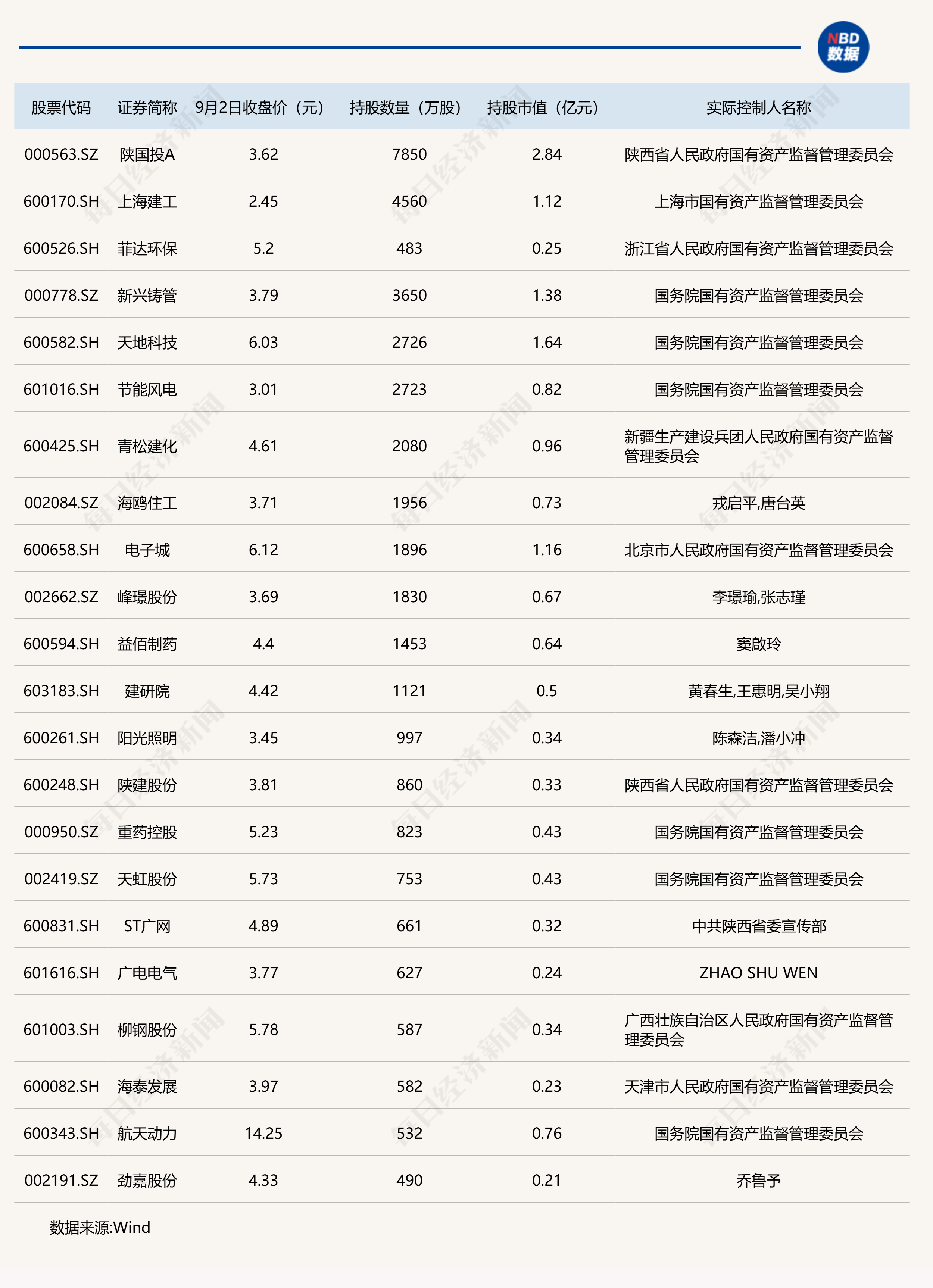
埋伏14只低价、国资背景股,持仓市值高达16亿!揭秘“另类”牛散淘金术
Mei Ri Jing Ji Xin Wen· 2025-09-02 22:25
Core Viewpoint - Zhang Sufen, a prominent investor, focuses on undervalued stocks with state-owned backgrounds, diverging from popular investment trends in sectors like chips and innovative drugs [1][2]. Group 1: Investment Philosophy - Zhang Sufen's investment strategy emphasizes a "low price + state-owned background" approach, with 14 out of 22 stocks in her portfolio controlled by state-owned entities, accounting for 63.64% [2]. - The stocks in her portfolio are primarily low-priced, with most trading below 10 yuan, and only one stock, Aerospace Power, exceeding this price [2][6]. Group 2: Recent Investments - In Q2, Zhang Sufen entered the top 10 shareholders of six companies, including Energy Wind Power, Feida Environmental, and Haite Development, all of which have low stock prices [1]. - Feida Environmental's stock price increased from 4.8 yuan to a peak of 5.83 yuan, reflecting a more than 20% rise since Q2, driven by new government policies on carbon emissions [8]. Group 3: Market Timing and Strategy - Zhang Sufen demonstrated patience and strategic flexibility with Aerospace Power, initially buying at around 10 yuan and later averaging down during price dips, leading to a significant price increase to 16.9 yuan [6]. - The investment in Feida Environmental showcases her ability to identify opportunities in overlooked sectors, aligning with government initiatives for green transformation [8].