
农业新质生产力

Search documents
农业农村部:加力实施新一轮千亿斤粮食产能提升行动
Xin Hua Cai Jing· 2025-10-24 13:59
Core Viewpoint - The Ministry of Agriculture and Rural Affairs emphasizes enhancing agricultural production capacity and quality, promoting various forms of agriculture, and ensuring sustainable rural development [1] Group 1: Agricultural Development Initiatives - The Ministry plans to implement a new round of actions to increase grain production capacity by 100 billion jin (approximately 50 million tons) [1] - There is a focus on developing technology-driven, green, quality, and brand agriculture to optimize agricultural structure and promote a comprehensive green transformation [1] Group 2: Poverty Alleviation and Rural Support - Continuous efforts will be made to consolidate and expand the achievements in poverty alleviation, establishing mechanisms to prevent large-scale poverty recurrence [1] - The Ministry aims to enhance support policies and strengthen assistance in key areas to boost internal development momentum [1] Group 3: Rural Development and Community Building - The Ministry encourages the application of successful experiences from the "Ten Thousand Projects" to promote livable and workable rural areas [1] - There is a strong emphasis on developing rural industries that benefit the population and improving rural living environments [1] Group 4: Policy and Reform Enhancements - The Ministry seeks to improve the effectiveness of agricultural support policies and promote urban-rural integration [1] - Further reforms in rural areas are planned to unleash development potential and ensure that farmers benefit more from modernization [1]
农业农村部:加力实施新一轮千亿斤粮食产能提升行动 加快推进高水平农业科技自立自强
Di Yi Cai Jing· 2025-10-24 13:20
Core Viewpoint - The Ministry of Agriculture and Rural Affairs emphasizes enhancing agricultural production capacity and quality, promoting various forms of agriculture, and ensuring sustainable rural development [1] Group 1: Agricultural Development - The meeting highlighted the need to improve agricultural comprehensive production capacity and quality efficiency [1] - There is a strong focus on developing technological, green, quality, and brand agriculture [1] - A new round of actions to increase grain production capacity by a billion jin is being implemented [1] Group 2: Poverty Alleviation and Rural Support - Continuous efforts are required to consolidate and expand the achievements in poverty alleviation [1] - Establishing a mechanism to prevent large-scale poverty and enhancing support policies are crucial [1] - The focus is on strengthening assistance in key areas to ensure no large-scale return to poverty occurs [1] Group 3: Rural Development and Environment - The experience from the "Ten Thousand Projects" initiative will be utilized to promote livable and workable beautiful villages [1] - There is a push to develop rural industries that benefit the population and improve rural living environments [1] - Efforts will be made to cultivate a civilized rural culture and create quality living spaces in the countryside [1] Group 4: Policy and System Improvement - Enhancing the effectiveness of agricultural support and protection policies is a priority [1] - The aim is to promote urban-rural integration and improve the modern agricultural management system [1] - Further rural reforms are necessary to unleash development potential and allow farmers to share in modernization benefits [1]
乡村振兴新动向:推动农村基本具备现代生活条件
2 1 Shi Ji Jing Ji Bao Dao· 2025-10-24 00:18
Core Insights - The 20th Central Committee's Fourth Plenary Session emphasized the importance of addressing "agriculture, rural areas, and farmers" (referred to as "three rural issues") as a top priority for the party's work, aiming for a comprehensive modernization of agriculture and rural areas [1][3][6] Group 1: Agricultural Modernization - The session highlighted the need to accelerate agricultural modernization and promote comprehensive rural revitalization, with a focus on enhancing agricultural production capacity and quality efficiency [1][3][6] - A significant change in the report is the emphasis on improving agricultural production capacity and quality efficiency, indicating a shift towards technology-driven agriculture and smart agriculture as key drivers for building an agricultural powerhouse [2][6][7] Group 2: Rural Living Conditions - The meeting proposed that rural areas should have basic modern living conditions, which includes improving education, healthcare, and infrastructure to enhance the quality of life in rural areas [5][6] - The focus for the upcoming "15th Five-Year Plan" period will not only continue infrastructure development but also emphasize the need for rural areas to meet modern living standards [5][6] Group 3: Urban-Rural Integration - Urban-rural integration is a key focus, with plans to promote the free flow of resources between urban and rural areas, breaking down institutional barriers to facilitate this integration [4][6] - Key initiatives include land system reforms to establish a unified construction land market and increasing public resources in rural areas to reduce urban-rural disparities [4][6] Group 4: Policy Support - The government is expected to introduce more targeted policies to support rural innovation, entrepreneurship, and digital infrastructure, alongside encouraging urban talent and resources to flow into rural areas [8] - Since the "14th Five-Year Plan," significant financial support has been allocated to agriculture, with over 10.8 trillion yuan spent on agricultural and rural affairs, indicating a growing commitment to enhancing agricultural policies [8]
乡村振兴新动向:推动农村基本具备现代生活条件丨四中全会解读
2 1 Shi Ji Jing Ji Bao Dao· 2025-10-24 00:15
Core Insights - The core focus of the article is on the recent Fourth Plenary Session of the 20th Central Committee of the Communist Party of China, which emphasizes accelerating agricultural and rural modernization and promoting comprehensive rural revitalization as a priority for the next five years [1][2]. Agricultural Modernization - The meeting highlights the need to enhance agricultural comprehensive production capacity and quality efficiency, marking a shift towards technology-driven agriculture and smart agriculture as key drivers for building an agricultural powerhouse [2][5]. - Achievements during the 14th Five-Year Plan include a grain output of 1.4 trillion jin, with significant advancements in agricultural modernization, such as over 100 million acres of high-standard farmland and a mechanization rate exceeding 75% [2][5]. Urban-Rural Integration - Urban-rural integration is emphasized as a key aspect of rural revitalization, with a focus on promoting the free flow of resources and balanced allocation of public resources between urban and rural areas [3]. - Key initiatives include land system reforms to establish a unified construction land market and increasing public resources in healthcare, education, and elderly care to reduce urban-rural disparities [3]. Modern Living Conditions - The meeting stresses the importance of ensuring that rural areas meet modern living conditions, focusing on improving education, healthcare, and infrastructure to enhance the quality of life for rural residents [4][5]. Policy Effectiveness - The article discusses the need to improve the effectiveness of agricultural support policies, with a focus on expanding agricultural insurance coverage and optimizing subsidy mechanisms to ensure sustainable rural prosperity [7]. - The government has allocated 10.8 trillion yuan for agricultural and rural affairs during the 14th Five-Year Plan, with over 10% of land transfer revenues directed towards agriculture [7]. Rural Development Focus - The upcoming Five-Year Plan will shift the focus of rural development from merely infrastructure to a balanced approach that includes both hardware and software aspects, fostering local industries and job creation [6]. - The government is expected to introduce targeted policies to support rural innovation and entrepreneurship, as well as enhance digital infrastructure in rural areas [6].
我市部署开展第四次全国农业普查
Nan Jing Ri Bao· 2025-10-22 02:31
Core Viewpoint - The upcoming Fourth National Agricultural Census in Nanjing will comprehensively assess the agricultural sector, focusing on various aspects of rural and agricultural development, with a scheduled date for completion by December 31, 2026 [1] Group 1: Overview of the Agricultural Census - The Fourth National Agricultural Census is a significant national survey that occurs every ten years, alongside economic and population censuses, with the first census conducted in 1996 [1] - The census will cover rural households, urban agricultural production operators, agricultural production units, and local government bodies within Nanjing's administrative region [1] Group 2: Key Focus Areas of the Census - The census will gather data on agricultural production conditions, food production, new agricultural productivity, rural development, and the living conditions of rural residents [1] - It aims to reflect the modernization process of agriculture and rural areas in Nanjing, addressing new situations such as diversified food supply and rural construction [1]
镜观中国|良田舒卷!夯牢中国饭碗新底气
Xin Hua She· 2025-10-21 11:23
Core Viewpoint - The article emphasizes China's significant advancements in agricultural productivity and food security, highlighting the implementation of the national food security strategy during the "14th Five-Year Plan" period. Group 1: Agricultural Development - Since the beginning of the "14th Five-Year Plan," China has built over 1 billion acres of high-standard farmland, equivalent to the total area of Heilongjiang and Henan provinces combined [6] - By 2025, Jilin Province aims to achieve a comprehensive mechanization rate of 94.6% for crop planting and harvesting through integrated pilot demonstrations in agricultural machinery research, manufacturing, promotion, and application [3] Group 2: Food Production and Security - China's grain production is projected to exceed 1.4 trillion jin in 2024, an increase of 74 billion jin compared to 2020, with per capita grain availability reaching 500 kilograms [10] - New technologies are enhancing the entire grain production and circulation chain, improving quality and efficiency [14] Group 3: Technological Innovations - Recent advancements in agricultural technology include the application of intelligent inspection platforms, AI pest monitoring systems, and mobile cleaning equipment, significantly improving storage efficiency and quality [21] - The integration of new technologies from seed cultivation to harvesting and storage is fostering a new development pattern in agricultural productivity [14]

乡村产业绘新貌
Ren Min Ri Bao Hai Wai Ban· 2025-10-21 00:43
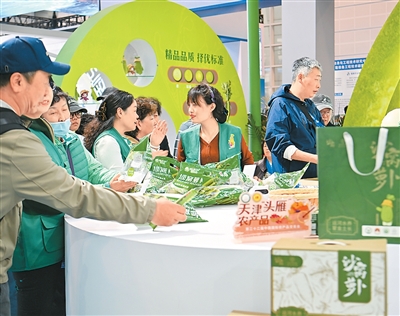
Core Insights - The 12th China International Agricultural Products Trade Fair showcased the vibrant development of rural industries in China, highlighting local specialties and the growth of agricultural processing enterprises [1][2]. Group 1: Agricultural Production and Processing - In 2024, China's grain production is expected to reach 1.4 trillion jin, an increase of 74 billion jin compared to 2020 [2]. - The number of large-scale agricultural processing enterprises is projected to exceed 100,000, with total revenue around 18 trillion yuan [1][2]. - Over 94,000 leading enterprises at the county level are primarily engaged in agricultural processing, with more than 80% of them focused on this sector [3]. Group 2: Rural Development and New Industries - Various regions are developing unique local industries, such as Yunnan coffee and Yan'an apples, which are driving the growth of rural e-commerce and leisure industries [4]. - The income from leisure agriculture is expected to approach 900 billion yuan in 2024, an increase of nearly 50 billion yuan since 2020 [4]. Group 3: Poverty Alleviation and Income Growth - The transition period for consolidating poverty alleviation results and rural revitalization is crucial, with 832 poverty-stricken counties cultivating 2 to 3 leading industries, generating a total output value exceeding 1.7 trillion yuan [5]. - The per capita disposable income of rural residents is projected to reach 23,119 yuan in 2024, indicating a gradual narrowing of the income gap between urban and rural residents [5]. Group 4: Agricultural Modernization and Reforms - The trade fair highlighted advanced agricultural equipment, such as multifunctional robots in orchards, showcasing the new productive forces in agriculture [7]. - Ongoing rural reforms, including the extension of land contracts and the management of rural homesteads, are providing strong momentum for the development of rural industries [7].
“十四五”亮点丨年收入约18万亿元!乡村产业绘新貌
Xin Hua She· 2025-10-20 08:46
Core Insights - The 22nd China International Agricultural Products Fair showcased the vibrant development of rural industries in China, highlighting local specialties such as Ningxia's salt pool sheep and Heilongjiang's organic selenium-rich rice [1] - By 2024, the number of large-scale agricultural processing enterprises in China is expected to exceed 100,000, with an estimated revenue of approximately 18 trillion yuan [1] Group 1: Agricultural Production and Processing - In 2024, China's grain production is projected to reach a new high of 1.4 trillion jin, an increase of 74 billion jin compared to 2020 [3] - The supply of cotton, oil, sugar, fruits, vegetables, meat, eggs, milk, and aquatic products is abundant and diverse, reflecting the enhancement of the agricultural processing industry [3] - There are currently 94,000 leading enterprises at the county level and above, with over 80% focused on agricultural processing [3] Group 2: Rural Development and New Industries - Local specialties are being integrated into new industries, with products ranging from traditional items like dumplings and ham to emerging products like spicy noodles and tea beverages gaining popularity [3] - The rise of rural tourism, e-commerce, and leisure agriculture has become a new consumption trend among urban and rural residents, with leisure agriculture revenue expected to approach 900 billion yuan in 2024, an increase of nearly 50 billion yuan since 2020 [3] Group 3: Poverty Alleviation and Income Growth - The rural industry has injected internal momentum into the sustainable development of poverty-stricken areas, with 832 poverty alleviation counties cultivating 2 to 3 leading industries, generating a total output value exceeding 1.7 trillion yuan [4] - By 2024, the per capita disposable income of rural residents is projected to reach 23,119 yuan, indicating a gradual narrowing of the income gap between urban and rural residents [4] Group 4: Agricultural Modernization and Reforms - The fair highlighted advanced agricultural equipment, such as multifunctional robots for orchards, showcasing the new productive forces in agriculture [4] - Ongoing rural reforms, including the extension of the second round of land contracts for another 30 years and the steady advancement of rural collective property rights reform, are expected to provide strong support for rural industry development [4]
黄河故道边的小镇新事
Ren Min Wang· 2025-10-19 01:41
Core Viewpoint - The establishment of the "Xiao Jian Feng Qiao E Station" in Jiangsu Province aims to provide legal assistance and support to local farmers, enhancing their understanding of contracts and legal rights, thereby promoting agricultural development and conflict resolution in rural areas [2][4][6]. Group 1: Legal Assistance and Community Engagement - The "Xiao Jian Feng Qiao E Station" serves as a legal aid contact point, providing both online and offline judicial services to the community [4]. - The station is staffed by party members and legal professionals who offer legal consultations, mediation, and assistance in litigation [4][6]. - The initiative has fostered collaboration between local village leaders and the judiciary, enhancing communication and support for residents facing legal issues [4][6]. Group 2: Agricultural Development and Conflict Resolution - Farmers in the region are increasingly aware of the importance of clear contracts and legal standards, as evidenced by their proactive approach to seeking legal advice before entering agreements [2][4]. - The station has successfully mediated over 70 disputes and provided legal assistance on more than 300 occasions since its establishment [6]. - The case of a farmer disputing payment for agricultural services highlights the need for better understanding of agricultural policies and the role of legal support in resolving conflicts [5][6].
韩俊在“强农论坛”上指出:我国农产品供给体系正在加快从“量的满足”向“质的提升”转变
Nan Fang Nong Cun Bao· 2025-10-18 09:31
Core Viewpoint - The Chinese agricultural supply system is transitioning from "quantity satisfaction" to "quality improvement," emphasizing the need for high-quality agricultural development and modernization [16][17]. Group 1: Agricultural Development Strategy - The construction of an agricultural powerhouse is a strategic deployment by the central government, focusing on five key areas: supply security, technological strength, operational systems, industry resilience, and competitiveness [8][9][10]. - The grain production reached a record of 1.4 trillion jin last year, with a per capita grain availability of over 500 kg, and a grain self-sufficiency rate exceeding 95% [11][12]. Group 2: Key Dimensions for Agricultural Strength - **Enhancing Comprehensive Production Capacity**: Ensuring national food security remains a top priority, with a focus on increasing grain production capacity and optimizing agricultural production structure [22][26]. - **Advancing Agricultural Technology and Equipment**: Emphasizing the importance of agricultural technology as a tool for development, including seed industry revitalization and smart agriculture [30][31]. - **Innovating Agricultural Operating Systems**: Promoting new agricultural operating entities and socialized agricultural services to connect small farmers with modern agricultural practices [33][34]. - **Improving Industry Resilience**: Addressing extreme weather and market fluctuations by enhancing climate resilience and strengthening supply chains [36][37]. - **Boosting Quality, Efficiency, and Competitiveness**: Committing to a path of technological, green, quality, and brand-driven agriculture, with strict quality supervision and the promotion of ecological agriculture [39][40].

