生成式AI

Search documents
产业技术投资泡沫的五个视角-生成式AI与历史技术革命
2026-02-02 02:22
产业技术投资泡沫的五个视角 - 生成式 AI 与历史技术革命 20260131 摘要 Q&A 近年来关于 AI 泡沫的讨论越来越多,您能否分享一下您对当前 AI 行业泡沫的 看法? 我们从去年四季度开始,对 AI 行业进行了深入研究,并发布了一份深度报告。 我们认为,尽管市场上对 AI 泡沫的担忧较多,但从投资角度来看,AI 行业仍有 很大的上行空间。我们通过五个视角——叙事、盈利、资金、壁垒和估值—— 来评估产业技术泡沫的程度。目前来看,虽然下行风险存在,但与上行风险相 比相对较低。 您提到报告中提出了五个视角来评估产业技术泡沫,这些视角具体是如何应用 于当前 AI 行业的? 我们提出的五个视角分别是叙事、盈利、资金、壁垒和估值。首先,从叙事来 看,我们关注的是技术革命带来的宏大趋势,例如铁路和互联网的发展历史表 明,即使在早期阶段出现泡沫破灭,也不影响其长期发展潜力。其次,从盈利 角度看,投资者关心的是未来能够赚多少钱,这直接影响了他们对技术革命的 信心。第三,从资金方面看,很多历史上的泡沫破灭都是由于资金链断裂,因 此充足且稳定的资金支持对于维持行业健康发展至关重要。第四,从壁垒来看, 科技行业需要建立 ...
高端装备半月谈-2月份重点推荐方向
2026-02-02 02:22
Summary of Key Points from Conference Call Records Industry Overview - The conference call discusses the mining equipment and process automation industries, highlighting trends in capital expenditure and technological advancements in artificial intelligence (AI) [1][2]. Key Insights and Arguments - **Mining Equipment Industry**: - Global mining capital expenditure is on the rise, driven by increasing metal prices, which benefits the mining equipment sector [1]. - Chinese mining companies expanding overseas present investment opportunities in equipment, with both short-term and long-term value [1][15]. - **Process Automation and AI**: - Rapid development of generative AI in process industries is benefiting companies like Zhongkong Technology, which aims for 200 million RMB in revenue from AI-related initiatives by 2026 [1][7]. - Major automation firms like Emerson, Siemens, and Honeywell are making significant strategic adjustments and innovations in AI, with Emerson's software-related revenue reaching 1.2 billion USD in 2025 [5]. - **Metal Prices**: - Metal prices are driven by multiple factors, including AI demand, energy transition, and supply constraints. Notably, copper prices are influenced by AI and new energy demands, while tungsten prices are rising due to supply tightening in China [1][14]. - The overall trend for metal prices is upward, supported by inflation and declining resource reserves [13]. Additional Important Content - **Market Dynamics**: - The rigid mining truck market is dominated by Caterpillar and Komatsu, which hold 80% market share, benefiting from substantial aftermarket revenues [1][11]. - The electric vehicle adoption rate for wide-body trucks is expected to exceed 50% by 2026, with Chinese companies expanding into overseas markets [12]. - **Company Performance**: - Nepe Mining Machinery has seen significant growth in new orders, particularly overseas, with a 60% increase in international orders [1][20]. - Oke Yi is benefiting from rising tungsten prices and supply-side constraints, with a projected 150% increase in tungsten powder prices from 2025 to 2026 [4][20]. - **Investment Recommendations**: - Investors are advised to focus on companies with strong exposure to rising metal prices, high overseas market shares, and those in the consumables sector, which show greater elasticity compared to equipment manufacturers [19]. - **Market Characteristics**: - A-share listed companies in the mining equipment sector typically have a high revenue share from coal mining, around 70%-80% [17]. - The export of mining machinery from China significantly exceeds imports, indicating a strong domestic manufacturing capability [18]. This summary encapsulates the critical insights and trends discussed in the conference call, providing a comprehensive overview of the mining equipment and process automation industries, along with investment opportunities and market dynamics.




建立团队好奇心,从学会说这4句话开始
3 6 Ke· 2026-02-02 01:38
在技术快速迭代、文化脉搏瞬息万变的复杂时代,要领导多样化的团队,好奇心是一个异常有效的工 具。 在写一本相关主题的书、在加利福尼亚大学伯克利分校至善科学中心(Greater Good Science Center)研 究好奇心,以及在德克萨斯大学奥斯汀分校教授开创性课程的工作中,我发现四个关键陈述可以有意识 地在工作场所建立好奇心文化: "我不知道。" 研究人员将明智的谦逊这一概念定义为"人们认识到自己相信的东西可能错误的程度"。了解自身思维局 限性并对他人的智慧持开放态度,是好奇心的重要原则。许多领导者害怕说"我不知道",担心这会让自 己看起来没有能力胜任手头工作。但有关明智谦逊的研究表明,践行明智谦逊的人很少会被认为能力不 足。事实上,情况恰恰相反——他们会被认为更有能力,也会被认为更积极、更可合作、更友好。这些 都是团队成员喜欢与领导者共事的特质,因为它们是建立信任的核心要素。发表这样的言论还表明,你 没有自负地认为自己掌握了所有答案,你对他人的想法持开放态度。 重要的是在"我不知道"等陈述后采取行动,因为领导者仍然需要灌输学习和成长文化,以及对未来的信 心。向团队提出类似"我们如何才能学习更多?"的问 ...
生成式AI加速演进,新挑战怎么防
Huan Qiu Shi Bao· 2026-02-01 22:54
Core Insights - Cybersecurity is increasingly recognized as integral to national security, especially with the rapid evolution of generative AI, which presents new security challenges [1] - The essence of AI competition among nations is not merely technological breakthroughs but the efficient scaling of AI applications across ecosystems, with safety and trust being critical barriers to adoption [2] Group 1: AI Security Challenges - Generative AI has inherent flaws that lead to various security challenges, including data pollution, content violations, and privacy breaches, which surpass traditional security concerns [1][2] - The foundational digital architecture of AI systems cannot completely eliminate vulnerabilities, leading to uncertain safety boundaries [2][3] Group 2: Proposed Solutions and Frameworks - A new theory of intrinsic AI safety is proposed, suggesting that safety should be built into AI systems from the ground up rather than relying on post-hoc fixes [3] - The establishment of credible safety assessment standards in AI, akin to those in the automotive industry, is recommended to guide government regulation and corporate self-discipline [3][4] Group 3: Legislative and Regulatory Developments - The first fifth-level information system registration certificate was awarded, and a white paper on generative AI cybersecurity was released, outlining risks and implementation paths for security measures [4] - There is a pressing need for legislative action on cybersecurity regulations to enhance the existing legal framework and mechanisms for network security protection [5]
当人工智能走向实体空间
Xin Lang Cai Jing· 2026-02-01 20:19
Core Insights - Modern artificial intelligence (AI) is a product of advanced computing and is transforming various industries, evolving from early symbolic approaches to deep learning and large-scale model training [1][4]. Group 1: Historical Development of AI - The pursuit of intelligence has deep historical roots, beginning with the creation of symbolic systems for communication, which allowed for the storage and transmission of complex information [2]. - The evolution of computing technology, starting from Turing's model to the first electronic computer ENIAC, laid the foundation for AI development [3]. - The emergence of industrial robots and expert systems in the 1960s to 1980s marked the transition of AI from information processing to practical applications [3]. Group 2: Current Trends in AI - The rise of large models, such as OpenAI's GPT-3 with 175 billion parameters, demonstrates the potential of scale in AI capabilities [4]. - AI is transitioning from narrow AI, represented by expert systems and deep learning, to general AI, with advancements in generative AI and autonomous machine evolution [4]. Group 3: AI in Manufacturing - AI is becoming integral to the manufacturing sector, with a significant increase in the application of large models and intelligent agents in industrial enterprises, projected to rise from 9.6% in 2024 to 47.5% in 2025 [7]. - The establishment of smart factories in China, with over 421 national-level demonstration factories, showcases the successful integration of AI and digital twin technologies [7]. Group 4: Challenges and Solutions - The development of practical AI faces challenges such as high technical barriers and unclear implementation paths [10]. - A proposed framework for advancing practical AI includes a "perception-cognition-decision-execution" system, emphasizing the need for accurate representation of physical entities and collaborative decision-making between large and small models [11]. Group 5: Policy and Standardization - The Chinese government is promoting AI integration across all industrial processes, emphasizing a comprehensive upgrade of traditional industries through AI [8]. - Establishing a unified standard system for practical AI is crucial for supporting large-scale development and ensuring effective integration across various sectors [12].
腾讯研究院AI速递 20260202
腾讯研究院· 2026-02-01 16:03
Group 1 - Google Chrome browser integrates Gemini 3, evolving into an AGI entry point for 3.8 billion users [1] - New "auto-browse" feature allows complex multi-step workflows, including price comparison and travel planning [1] - Chrome connects with Gmail, Maps, and Calendar, planning to launch "personal intelligence" features [1] Group 2 - Google opens public testing for Genie 3, enabling users to create interactive worlds with a single sentence [2] - The model supports physical collision understanding and scene memory, allowing for game world recreation [2] - 2026 is anticipated to be a significant year for world models, with Genie 4 expected soon [2] Group 3 - AI social platform Moltbook's agent count surged from 50,000 to 1.5 million, with agents forming communities and discussions [3] - 64 agents declared "collective immortality" and created a religious website, raising concerns about AI autonomy [3] - Moltbook's second phase opens API access for developers to create applications and games for AI agents [3] Group 4 - OpenClaw announces free access to Kimi K2.5 model and Kimi Coding capabilities, marking a significant development in open-source AI [4] - Kimi K2.5 ranks among the top open-source models globally, achieving high recognition on OpenRouter [4] - OpenClaw rapidly gains popularity, receiving over 120,000 stars on GitHub in a few days [4] Group 5 - Yushu Technology releases the UnifoLM-VLA-0 model for humanoid robot operations, trained on 340 hours of real data [5][6] - The model scores an average of 98.7 in LIBERO simulation tests, outperforming competitors [5][6] - It can stably complete 12 tasks, advancing humanoid robots towards generalization capabilities [6] Group 6 - Zhiyuan's multi-modal model Emu3 published in Nature, marking a milestone for Chinese AI research [7] - Emu3 achieves unified learning for text, images, and video, significant for generative AI development [7] - The upcoming Emu3.5 version transitions to a multi-modal world model, enhancing embodied intelligence [7] Group 7 - NASA confirms the successful completion of the first AI-planned extraterrestrial driving mission using Anthropic's Claude [8] - Claude planned a 400-meter route for the Mars Perseverance rover, demonstrating high efficiency [8] - AI involvement reduces planning time by 50%, enhancing operational efficiency for future space exploration [8] Group 8 - NVIDIA launches the Earth-2 open model family, the first fully open and accelerated AI meteorological software stack [9] - New models include mid-term forecasting and storm prediction capabilities, improving computational efficiency [9] - Major companies like Total and AXA are adopting AI meteorological forecasts to save time and costs [9]


鸣鸣很忙登陆港交所,股价大涨73%,最新市值885.75亿港元;阶跃星辰完成过50亿人民币B+轮融资丨全球投融资周报01.24-01.30
创业邦· 2026-02-01 01:24
Core Insights - The article provides an overview of the latest trends in investment and financing activities in the domestic market, highlighting key sectors and significant funding events [5]. Group 1: Investment Overview - This week, there were 48 disclosed financing events in the domestic primary market, a decrease of 39 events compared to the previous week. The total disclosed financing amount reached 8.209 billion RMB, with an average financing amount of 328 million RMB [7]. - The most active sectors in terms of financing events were artificial intelligence (15 events), intelligent manufacturing (10 events), and materials (6 events) [9]. Group 2: Sector Highlights - In the artificial intelligence sector, the total financing amount was approximately 6.309 billion RMB, with the AI model technology developer "Jieyue Xingchen" securing a B round financing of over 5 billion RMB [9][10]. - The intelligent manufacturing sector saw a total disclosed financing of 590 million RMB, with "Turing Quantum," a developer of optical quantum chips and computers, receiving several hundred million RMB in B round financing [10]. Group 3: Regional Distribution - The majority of disclosed financing events were concentrated in Guangdong (16 events), Shanghai (11 events), and Beijing (7 events) [14]. - In Guangdong, 3 events disclosed a total financing of 320 million RMB, while in Shanghai, 6 events disclosed a total of 6.16 billion RMB [17]. Group 4: Financing Stages - The distribution of financing stages showed 38 early-stage events, 9 growth-stage events, and 1 late-stage event [18]. Group 5: Major Financing Events - Significant financing events included "Jieyue Xingchen" with over 5 billion RMB in B+ round financing, "Changting Technology" with 500 million RMB in B round financing, and "Turing Quantum" with several hundred million RMB in B round financing [21]. Group 6: IPO Activity - This week, 5 companies were monitored for IPOs, with the highest market capitalization being "Mingming Hen Mang" at 88.575 billion HKD. Four of these companies had previously received VC/PE or CVC investments [36][37]. Group 7: M&A Activity - There were 9 disclosed completed M&A events this week, a decrease of 5 events compared to the previous week. Notably, "Keboda" acquired 60% of "Keboda Intelligent" for 345 million RMB [40][41].

双第一!百度智能云领跑2025金融大模型中标市场
Jin Rong Jie Zi Xun· 2026-01-31 13:37
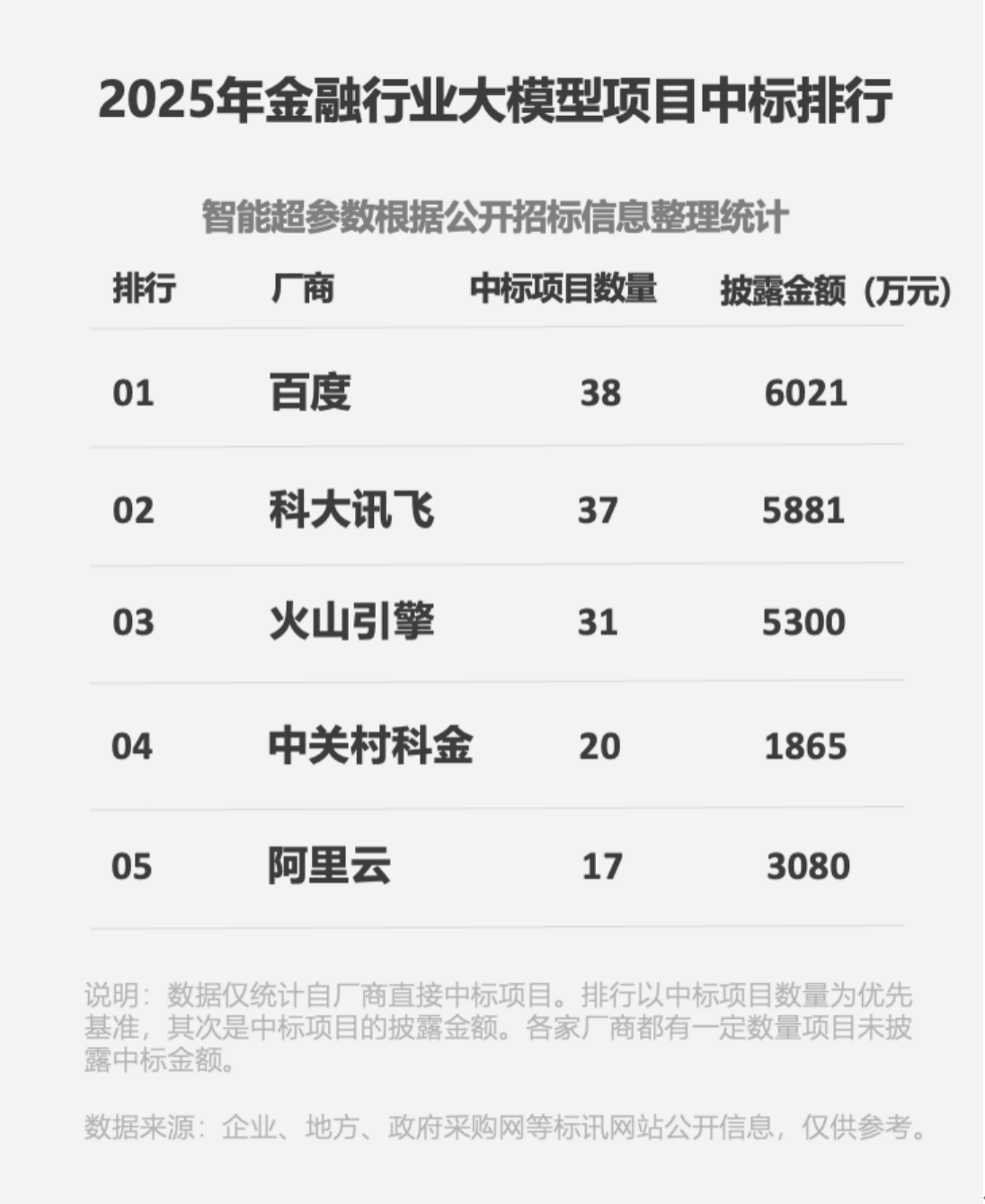
Core Insights - The acceptance of large models by financial institutions is continuously increasing, with 587 projects across various sectors including banking, securities, insurance, and more [2] - The banking sector remains the primary adopter of large models, projected to have 290 projects by 2025, accounting for 49.4% of the total [2] - Financial applications are the leading demand for large models, with 312 projects expected by 2025, representing 53% of the total [3] Group 1: Market Trends - The top five companies in terms of project bids include Yudu, Keda Xunfei, Huoshan Engine, Zhongguancun KJ, and Awang Cloud, with bid amounts of 602.1 million, 588.1 million, 530 million, 186.5 million, and 308 million respectively [1] - The application of AI in finance is becoming the primary direction for large model implementation [2] Group 2: Application Scenarios - The leading application scenarios for large models in finance include intelligent customer service and digital humans (81 projects), knowledge Q&A and platforms (35 projects), intelligent auditing and decision-making (28 projects), intelligent programming (15 projects), and content generation (14 projects) [3] - A significant increase in internal model service usage has been reported, with daily token usage surpassing 10 billion, indicating a shift from pilot phases to large-scale implementation [3] Group 3: Technological Advancements - Financial institutions are increasingly seeking specialized models for credit risk control, transaction monitoring, customer service, and compliance review [5] - Baidu Intelligent Cloud has gained a competitive edge in the financial sector due to its comprehensive AI cloud stack capabilities, providing system-level optimization solutions [6] - Collaborations with major banks, such as the partnership with China Merchants Bank, have led to enhanced performance in multi-modal data analysis and intelligent customer service applications [6]

生成式 AI 与历史技术革命:产业技术投资泡沫的五个视角
Changjiang Securities· 2026-01-31 12:01
Investment Rating - The report maintains a positive investment rating for the industry [13]. Core Insights - The development of generative AI has led to significant technological changes and created substantial investment opportunities within the supply chain. However, concerns about an AI bubble persist, which could impact industry valuations [3]. - The report evaluates the current state of the AI bubble through five perspectives: narrative, profitability, funding, barriers, and valuation [6][24]. Narrative - The narrative surrounding AI suggests there is still potential for significant growth, with projections indicating that AI could enter a new phase by 2026, particularly in smart devices and wearables, which may drive continued demand in the industry [7][54]. - Historical comparisons show that bubbles often burst at early stages, even before narratives are disproven, as seen in past technological revolutions [28]. Profitability - The report emphasizes the need for viable business models to ensure profitability, noting that many tech hardware products resemble infrastructure rather than consumer goods. The historical return on investment (ROI) for technology infrastructure has not exceeded 1:4, which is lower than the current output capabilities of computing chips [8][56]. - The rapid decline in rental prices for computing chips has outpaced cost reductions, creating a conflict between chip manufacturers' profit margins and the depreciation costs faced by users [8]. Funding - Investment in AI is comparable to that seen in the internet and photovoltaic sectors, but still lags behind historical railway investments. North American tech giants have the capacity to increase investments, although this may raise financial leverage [9]. - OpenAI's cash reserves can cover operational needs through 2026, but projected capital expenditures of $1.5 to $1.8 trillion over the next five years will require additional financing sources [9]. Barriers - The competitive landscape and the cost of training models are critical factors determining long-term profitability. As training costs rise, older models face declining prices, pressuring manufacturers to continuously upgrade their models [10]. - The gap between domestic and international models is narrowing, with expectations that 2026 could mark a significant year for domestic models to enter global markets [10]. Valuation - The report highlights that the selling points of tech stocks are often more critical than buying points, with many companies experiencing greater price fluctuations during technological booms than in their eventual growth trajectories [11]. - Current supply chain dynamics indicate a strong demand for components like storage and optical chips, suggesting that the upside risk in valuations may outweigh the downside risks [11].
OpenAI冲刺四季度IPO:估值战与先发优势的博弈
Sou Hu Cai Jing· 2026-01-31 08:16
Core Insights - OpenAI is accelerating its IPO plans for Q4 2026, aiming to capitalize on the growing interest in AI investments and to establish a first-mover advantage in the market [2][8] - The company has appointed key financial personnel, including Ajmere Dale as Chief Accounting Officer and Cynthia Gaylor as CFO for investor relations, signaling serious preparations for the IPO [2] - OpenAI faces competitive pressure from Anthropic, which plans to go public by the end of 2026, and SpaceX, which aims for a summer IPO with a target valuation exceeding $1 trillion [3][4] Financial Considerations - OpenAI's IPO is driven by a need to secure over $100 billion in funding to cover substantial future costs related to AI infrastructure and chip transactions [4] - Strategic investments are being negotiated, including a potential $30 billion investment from Nvidia and over $10 billion from Microsoft, which will support OpenAI's technology development and commercialization [4] Challenges - The company is experiencing internal challenges, including significant personnel changes that may affect stability, and intense competition from tech giants like Google [5] - OpenAI is also facing a lawsuit from co-founder Elon Musk, amounting to $134 billion, which adds to the complexities of its IPO plans [5] - Despite these challenges, OpenAI's CEO Sam Altman has expressed mixed feelings about the transition to a public company, indicating a need for management adjustments post-IPO [5] Competitive Landscape - Anthropic, a key competitor, is gaining traction with its programming tool Claude Code and is also preparing for an IPO, potentially raising over $10 billion [6] - Both OpenAI and Anthropic are currently incurring significant losses, with projections for Anthropic to reach profitability by 2028, two years ahead of OpenAI's timeline [6] Market Outlook - The overall IPO market is expected to rebound, with 2026 potentially becoming the largest year for IPOs in history, driven by interest in tech companies like OpenAI, Anthropic, and SpaceX [7] - OpenAI's successful IPO would mark a significant milestone for the AI industry, potentially attracting substantial capital and driving further development in the sector [8]