
碳中和

Search documents
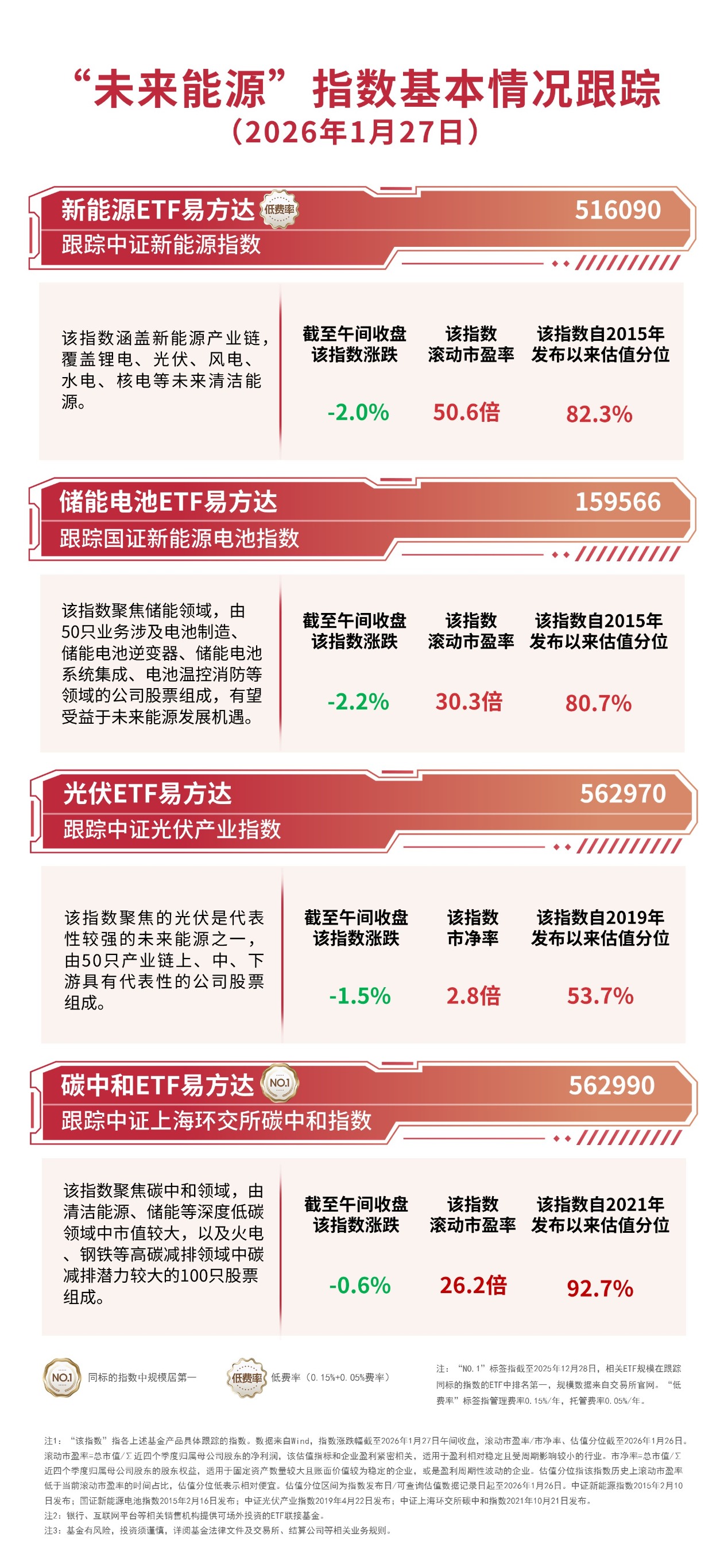
新能源板块震荡调整,资金逆势布局,储能电池ETF易方达(159566)半日净申购达2500万份
Mei Ri Jing Ji Xin Wen· 2026-01-27 05:13
今日早盘,新能源板块震荡调整。截至午间收盘,中证新能源指数下跌2%,国证新能源电池指数下跌2.2%,中证光伏产业指数下跌1.5%,中证上海环交所 碳中和指数下跌0.6%,资金逆势布局,储能电池ETF易方达(159566)半日净申购达2500万份。 | 该指数聚焦的光伏是代表 | 截至午间收盘 | 该指数 | 该指数自20 | | --- | --- | --- | --- | | 性较强的未来能源之一, | 该指数涨跌 | 市净率 | 发布以来估值 | | 由50只产业链上、中、下 | | | | | 游具有代表性的公司股票 组成。 | -1.5% | 2.8倍 | 53.7% | (文章来源:每日经济新闻) | 新能源ETF易方达 雙 | | | 5160 | | --- | --- | --- | --- | | 跟踪中证新能源指数 | | | | | | | | .. ///// | | 该指数涵盖新能源产业链, | 截至午间收盘 | 该指数 | 该指数自20. | | 覆盖锂电、光伏、风电、 | 该指数涨跌 | 滚动市盈率 | 发布以来估值 | | 水电、核电等未来清洁能 | | | | | 濃。 | ...

《分布式能源规划员》(综合能源服务方向)培训通知丨系列培训
中国能源报· 2026-01-27 04:48
二、培训组织机构 主办单位: 人力资源和社会保障部 社会保障能力建设 中心 关于 举办 《分布式能源规划员》(综合能源服务方向)培训通知 各企事业单位: 《中华人民共和国能源法》 提出,鼓励发展分布式能源和多能互补、多能联供综合能源 服务,提高终端消费清洁化、高效化、智能化水平。多能联供综合能源服务 成为现代能 源产业发展的重要方向和实现碳中和的重要路径。 电力、冷热、用户之间的关系变得越来越紧密,打破不同能源品种单独规划、设计、运行 的传统模式,实现横向 "电热冷气水"能源多品种之间、纵向"源网荷储用"能源多供应环 节之间的协同,以及生产侧和消费侧的互动 ,正成为行业趋势。 目前,在我国熟悉用户用能特性,掌握能源规划、转化、智能控制等技术,并具备能效 碳排放 评估,通晓末端节能 减碳 、投资、建设、运营等跨 学科专 业 应用 人才匮乏, 严重影响各能源企业向综合能源服务转型和发展的进程。为此,中国能源报社 特 开 展 《分布式能源规划员》(综合能源服务方向)培训 ,参加培训并经考核合格者,由人力资 源和社会保障部 社会保障能力建设 中 心 颁 发 《 分 布 式 能 源 规 划员 》 (综 合 能 源 服 ...

双良节能2025年业绩减亏 多维创新与政策红利打开增长新空间
Zhong Guo Jin Rong Xin Xi Wang· 2026-01-27 02:49
Core Viewpoint - The company, Shuangliang Energy, has significantly narrowed its overall loss for the 2025 fiscal year, despite the photovoltaic industry facing challenges in the fourth quarter, which is typically a slow season [1] Group 1: Financial Performance - Shuangliang Energy's loss is relatively small compared to leading companies in the photovoltaic sector, which are expected to incur losses between 40 billion to 100 billion yuan [1] - The company has made provisions for fixed asset impairment, reflecting a cautious financial approach, which is a contributing factor to the fourth-quarter loss [1] Group 2: Industry Position and Developments - The company has gained recognition for its zero-carbon park solutions, with its photovoltaic industrial park being selected for a national-level zero-carbon park construction [2] - The industrial park has completed a 24MW rooftop photovoltaic project and is expected to achieve additional projects by 2026, contributing to significant reductions in coal consumption and water usage [2] Group 3: Technological Advancements - Continuous breakthroughs in core equipment technology are crucial for supporting the company's performance, with the energy service industry in China projected to exceed 1.2 trillion yuan by 2025, growing at a compound annual growth rate of over 18% [3] - The company has developed a natural ventilation direct air cooling system that has passed preliminary design reviews, marking a significant advancement in extreme environment applications [3] Group 4: Market Opportunities - The space photovoltaic sector is expected to create a trillion-level market space, with the company positioned to benefit from its technological advancements in photovoltaic silicon materials and smart energy management [4] - The green hydrogen production business is emerging as a new growth driver, with the company’s alkaline water electrolysis technology setting global benchmarks and aligning with low-carbon transformation demands [4] Group 5: Long-term Outlook - The combination of stable profitability in core equipment, rapid growth in green hydrogen, and favorable national policies is expected to drive the company towards sustained profitability and long-term value for investors [5]

中国银河证券:欧洲加码热泵推广 12月热泵出口创新高
智通财经网· 2026-01-27 01:39
Group 1 - The core viewpoint is that China's heat pump exports are recovering, with an expected continuation of industry prosperity in 2026, benefiting both heat pump manufacturers and component exporters [1] - In December 2025, heat pump exports reached a historical high for that month, with an export value of 1.62 billion yuan, representing a year-on-year increase of 21.7% and a 25.9% increase compared to the peak in December 2022 [1] - The European market is the primary destination for China's heat pump exports, with changes in subsidy policies significantly impacting export fluctuations [1] Group 2 - The European heat pump penetration rate is currently low, with expectations for substantial growth, as the International Energy Agency predicts that heat pumps will meet over half of global heating demand by 2050 [2] - By 2024, the penetration rate in Europe is projected to be 12%, with countries like France and Italy at 20.4% and 16% respectively, indicating significant room for improvement [2] - Germany and the UK have very low penetration rates of 5.4% and 1.9%, but are expected to enhance subsidy policies, which will likely drive growth in heat pump adoption [2]

美国前副总统戈尔:中国主导全球能源转型,是我最想不到的结果
Sou Hu Cai Jing· 2026-01-26 18:57
Core Viewpoint - The article discusses Al Gore's transformation from a political figure to a climate change advocate, highlighting the shift in global leadership in clean energy from the U.S. to China, and the implications of this transition for international relations and climate action. Group 1: Al Gore's Journey and Climate Advocacy - Al Gore initially believed in the U.S. leading global environmental efforts but shifted focus to climate change advocacy after losing the 2000 presidential election [1] - He won the Nobel Peace Prize in 2007 for promoting climate change awareness and later founded an investment company focused on sustainable projects [3] - Gore has been critical of U.S. climate policy inconsistencies, particularly the withdrawal from the Paris Agreement, which he believes hampers global emission reduction efforts [3][5] Group 2: China's Role in Clean Energy Transition - Gore expressed surprise at China's emergence as a leader in energy transition, noting its rapid advancements in solar energy and wind power [3][9] - China has become the largest producer of solar panels and electric vehicle batteries, filling the gap left by the U.S. in clean technology [7] - The Chinese government has set achievable carbon emission targets and has made significant investments in renewable energy, which Gore views as a positive signal for global climate action [5][9] Group 3: Implications for Global Climate Action - The shift in clean energy leadership to China has significant implications for international trade and alliances, with many countries seeking closer ties with China [7] - Gore believes that the global energy transition is irreversible, with decreasing technology costs and diminishing influence of fossil fuel industries [7] - He emphasizes the importance of stable policies in the U.S. to accelerate global climate action and warns that failure to catch up with China could lead to a shift in geopolitical dynamics [9]

苹果发布新AirTag:连接范围更广 查找更便捷
Xin Lang Cai Jing· 2026-01-26 14:22
Core Viewpoint - Apple has officially launched an upgraded version of AirTag, enhancing its tracking capabilities and expanding Bluetooth range and speaker volume, allowing users to efficiently track important items through the "Find My" app [1][3]. Product Features - The new AirTag features a second-generation ultra-wideband technology chip, significantly improving location accuracy and expanding the tracking range by up to 50% compared to the previous model [3]. - The speaker volume has been increased by 50%, enabling users to hear the AirTag from twice the distance, making it easier to locate hidden items [5]. - The "Find My" network supports the new AirTag, allowing users to locate their devices and share location information securely with trusted third parties, such as airlines [5][6]. Collaboration and Impact - Apple has partnered with over 50 airlines to enable secure sharing of item location information, which has led to a 26% reduction in delayed luggage and a 90% decrease in lost or unreturnable luggage [6]. - The sharing feature is strictly controlled, ensuring that only authorized personnel can access location data, which is encrypted for privacy [6][7]. Environmental Responsibility - The new AirTag aligns with Apple's 2030 carbon neutrality goals, utilizing 85% recycled plastic for its shell and 100% recycled rare earth elements for its magnets [7]. - The packaging is made from 100% fiber-based materials, promoting recyclability [7]. Pricing and Availability - The new AirTag is priced at 249 RMB for a single unit and 849 RMB for a four-pack, with availability through official channels and retail stores [8]. - Customers purchasing through the official website can enjoy free personalization services [8].


碳中和领域动态追踪(一百七十):英国发布《Warm Homes Plan》,大幅刺激户用光储需求
EBSCN· 2026-01-26 14:09
Investment Rating - The report maintains a "Buy" rating for the electric power equipment and new energy sector, indicating an expected investment return exceeding 15% over the next 6-12 months compared to the market benchmark [4]. Core Insights - The UK has launched the "Warm Homes Plan," committing £15 billion in public funds to retrofit 5 million homes and assist 1 million families in energy poverty by 2030. This plan is expected to significantly boost demand for residential solar storage and heat pumps [1]. - The plan allocates £2.7 billion for subsidies and £2 billion for low-interest loans to support the purchase of residential solar storage and heat pump systems, alongside £5 billion for assistance to low-income households and £1 billion for heating network investments [1]. - The anticipated growth in the residential solar storage and heat pump sectors is substantial, with projections of 3 million new solar installations and over 450,000 heat pumps installed annually from 2026 to 2030 [1][2]. Summary by Relevant Sections Residential Solar PV - By the end of 2025, the UK is expected to have a cumulative installation of 1.6 million residential solar PV systems, with less than 200,000 new installations in 2025. The "Warm Homes Plan" aims for an additional 3 million installations from 2026 to 2030, translating to an annual increase of 600,000 installations [2]. Residential Energy Storage - In 2025, the UK is projected to add 0.7 GWh of residential energy storage, equivalent to 70,000 units based on a 10 kWh per unit calculation. If 600,000 new solar PV systems are installed annually, with a storage integration rate of 50%, this would result in 300,000 new storage units each year, potentially increasing to 600,000 units if the integration rate reaches 100% [2]. Heat Pumps - The report indicates that approximately 60,000 heat pumps will be installed in 2024. The "Warm Homes Plan" targets an average annual installation of over 450,000 heat pumps from 2026 to 2030, representing a significant increase compared to 2024 [2]. Investment Recommendations - The report suggests focusing on companies benefiting from the European and Australian residential storage markets, such as Airo Energy, GoodWe, Jinlang Technology, and Pylontech. It also highlights the potential for valuation increases in the residential storage sector and recommends low-valuation leading companies like Deye Technology [3]. Additionally, it advises attention to companies in the heat pump sector, such as Rujing Technology, and battery cell manufacturers like Penghui Energy, which may see improved profitability with unexpected demand increases [3].
【行业 ESG 周报】五部门印发指导意见支撑零碳工厂建设,我国新型自然保护地体系初步建成-20260126
GUOTAI HAITONG SECURITIES· 2026-01-26 13:48
Investment Rating - The report does not explicitly provide an investment rating for the industry Core Insights - The report highlights the issuance of guidance on zero-carbon factory construction by five departments, emphasizing a systematic approach to decarbonization in various industries, with a focus on innovation and technology [5][8] - The establishment of a new natural protection system in China, primarily based on national parks, effectively protects 90% of terrestrial ecosystem types and 74% of key protected wildlife species [18][20] - The report discusses the release of a new national standard for biodegradable plastic shopping bags, which raises the degradation rate requirement from 60% to 90%, aiming to enhance environmental performance [10][11] Policy Developments - The Ministry of Industry and Information Technology and other departments issued guidance on zero-carbon factory construction, outlining principles such as tailored strategies, systematic advancement, and continuous improvement [5][6] - A new national standard for biodegradable plastic shopping bags has been released, set to take effect in 2027, which includes improved product labeling and quality control requirements [10][11] Industry Trends - The first batch of beautiful rural pilot areas has been announced, showcasing effective environmental governance and sustainable agricultural practices [12][13] - The establishment of a new natural protection system in China is underway, integrating ecological protection with local community development [18][20] - The successful hosting of the Rural Revitalization and Sustainable Development Partners Conference highlights the importance of multi-stakeholder collaboration in achieving sustainable development goals [14][17] International Events - The World Economic Forum's Global Risks Report warns of increasing geopolitical and economic risks, emphasizing the need for global cooperation [21][22] - The EU has achieved a milestone where renewable energy sources, particularly wind and solar, now account for one-third of its total electricity generation, surpassing fossil fuels [21][22][23] - A UN University report indicates that the world has entered a state of global water resource bankruptcy, highlighting severe water scarcity issues affecting billions [23][24][25] Corporate Developments - Greenmei Group has achieved a significant milestone by issuing nearly 90,000 tons of carbon reduction credits from its vehicle recycling project, marking a breakthrough in carbon asset development [26][27] - Lin Qingxuan has become the first carbon-neutral cosmetics company in China, achieving full operational carbon neutrality through various low-carbon technologies [28][29]
中国碳中和(01372.HK)获主要股东沙涛增持391.1万股公司普通股
Ge Long Hui· 2026-01-26 10:40
Core Viewpoint - The major shareholder, Sha Tao, has acquired 3.911 million shares of China Carbon Neutrality (01372.HK) at an average price of approximately HKD 1.20 per share, representing 0.58% of the company's issued share capital, indicating confidence in the company's long-term development prospects [1] Group 1 - Sha Tao's acquisition increases his total shareholding to 160,465,000 shares, which constitutes about 23.77% of the company's total issued share capital [1] - The board believes that Sha Tao's voluntary purchase of shares in the market reflects his confidence in the group's future growth [1]
中国碳中和(01372)获主要股东沙涛增持391.1万股
智通财经网· 2026-01-26 10:36
Core Viewpoint - China Carbon Neutrality (01372) announced that major shareholder Mr. Sha Tao acquired 3.911 million ordinary shares at an average price of approximately HKD 1.20 per share, representing 0.58% of the company's issued share capital, indicating confidence in the company's long-term development prospects [1] Group 1 - Mr. Sha Tao's acquisition of shares occurred on January 26, 2026, in the open market [1] - Following this acquisition, Mr. Sha is considered to hold a total of 160 million shares, which accounts for approximately 23.77% of the company's total issued share capital [1] - The board believes that Mr. Sha's voluntary acquisition of shares reflects his confidence in the group's long-term development [1]