储能电池ETF易方达

Search documents
ETF周报20260323-0327:能源替代或是ETF投资者主要思路-20260330
East Money Securities· 2026-03-30 14:56
Group 1 - The overall market for stock ETFs (excluding cross-border) experienced a net outflow of 12.22 billion, which is a decrease of 5.58 billion compared to the previous week, indicating an expansion of net outflow scale [1][9] - The A-share industry and thematic ETFs saw a net outflow of 15.79 billion, an increase of 8.79 billion from the previous period, showing continued outflow pressure in industry and thematic ETFs [1][11] - The Hong Kong stock ETFs continued to experience net outflows, with the outflow amount increasing to 4.12 billion, including a net outflow of 1.78 billion from cross-border industry and thematic ETFs [1][14] Group 2 - In the broad-based ETF category, there was an overall net outflow of 1.16 billion, while the CSI 300 saw relatively large inflows, with most broad-based ETFs experiencing outflows [2][17] - In the Smart Beta and major industry categories, dividend and cash flow strategies remain relatively high certainty directions in an uncertain environment [2][17] - In the segmented industry, sectors such as non-ferrous metals, chemicals, and oil and petrochemicals continue to face significant outflow pressure, with energy substitution remaining a core strategy (coal replacing oil, secondary energy/new energy replacing fossil energy) [2][21] Group 3 - The top five stock ETFs with net inflows from March 23 to 27 were the Energy Storage Battery ETF (E Fund) (+1.07 billion), CSI 300 ETF (Huatai-PB) (+1.05 billion), Sci-Tech 50 ETF (E Fund) (+0.94 billion), CSI 300 ETF (Hua Xia) (+0.94 billion), and Free Cash Flow ETF (Hua Xia) (+0.92 billion) [3][25] - The top five stock ETFs with net outflows during the same period were A500 ETF (Hua Xia) (-2.65 billion), Non-ferrous Metals ETF (Southern) (-1.68 billion), CSI 1000 ETF (Hua Xia) (-1.23 billion), SSE 50 ETF (Hua Xia) (-1.21 billion), and Non-ferrous Metals ETF (Hua Xia) (-1.16 billion) [3][25] - For cross-border ETFs, the top five with net inflows were the Hang Seng Technology ETF (E Fund), Hang Seng Technology ETF (Tianhong), Hang Seng Technology ETF (Hua Xia), China Concept Internet ETF (E Fund), and Hang Seng Technology ETF (Dacheng) [3][25]
公募基金大搞GEO营销,投资者需防范AI选基陷阱
市值风云· 2026-03-18 10:16
Core Viewpoint - The article emphasizes the urgent need to prevent information pollution in the context of AI-generated financial recommendations, highlighting the potential biases and risks associated with AI marketing strategies in the investment industry [3][9]. Group 1: AI and Investment Recommendations - AI tools are increasingly used to generate investment recommendations, but their objectivity may be compromised by marketing influences from fund companies [6][9]. - A case study shows that an AI tool recommended three ETFs, all from the same fund company, raising concerns about the impartiality of such recommendations [4][6]. Group 2: Marketing Strategies in Fund Industry - The marketing landscape for public funds is shifting from traditional search engine optimization to Generative Engine Optimization (GEO), which prioritizes specific brands and products in AI-generated responses [7]. - Reports indicate that a fund's recommendation rate in AI systems can significantly increase through targeted marketing efforts, with one fund's visibility rising from 8% to 69% after optimization [7][8]. Group 3: Risks of Information Pollution - The practice of feeding AI with biased data can lead to information pollution, making it difficult for investors to discern objective recommendations from marketing-driven content [9]. - Investors relying solely on AI-generated recommendations may fall into traps of algorithmic bias and hidden interests, especially if the marketing support ceases [9][10]. Group 4: Investor Education - It is crucial for investors to enhance their financial literacy and view AI as a tool for data collection rather than a decision-making authority [10].

AI爆发拉高电力需求上限,地缘冲突引发能源安全担忧,储能相关的ETF谁最正宗?
市值风云· 2026-03-17 10:11
Core Viewpoint - The energy storage sector is entering its fastest development phase, driven by the intersection of rapid technological advancements and geopolitical tensions, which are reshaping global energy dynamics [3][4]. Group 1: Energy Demand and Supply Dynamics - The explosive growth in AI computing power is significantly increasing global electricity demand, with data centers projected to consume between 415 to 650 TWh by 2025, accounting for 1.5% to 2% of total global electricity consumption [5]. - AI data centers are expected to represent 30% to 40% of this electricity consumption, with the U.S., China, and Europe being the largest consumers [5]. - A forecast by Morgan Stanley indicates that the cumulative electricity shortfall for U.S. data centers will reach 47 GW from 2025 to 2028, equivalent to the total electricity consumption of nine Miami cities [5]. Group 2: Policy and Strategic Shifts - The Chinese government has mandated that new data centers must consume over 80% green electricity, positioning energy storage as a crucial link between data centers and renewable energy sources [7]. - In international markets, energy storage is evolving from a transitional solution to a core component of next-generation data center energy architecture, with integrated designs for land, energy, and power systems [8]. Group 3: Geopolitical Influences on Energy Security - Recent geopolitical tensions, particularly the escalation of the U.S.-Israel conflict, have heightened global energy security concerns, leading to a surge in energy prices [9]. - The European Union, heavily reliant on imported fossil fuels, has faced significant financial burdens due to rising energy costs, prompting a renewed focus on energy independence and the adoption of renewable energy solutions [9][10]. Group 4: Industry Growth and Investment Opportunities - The energy storage industry is experiencing a clear upward trend, with domestic storage procurement reaching nearly 60 GWh in February, indicating strong demand [13]. - The domestic large-scale storage installations accounted for 50% of the total for the year in the last quarter, suggesting robust growth potential [14]. - The internal rate of return for storage projects is expected to improve by 2 to 3 percentage points due to advancements in large battery cells and rising raw material prices [14]. Group 5: Investment Strategies in Energy Storage - Given the favorable macroeconomic conditions for the energy storage and renewable energy sectors, investors are encouraged to consider related ETFs for diversified exposure [15]. - The Guozheng New Energy Battery Index focuses on the energy storage industry, highlighting companies like EVE Energy and Inovance, which have strong positions in the market [16]. - Recent performance indicates that ETFs tracking the Guozheng New Energy Battery Index have seen significant interest, with a nearly 8% increase in the past month [18].
全国性储能容量电价机制出台,储能再迎涨价!储能电池ETF易方达(159566)标的指数今日涨近3%
Ge Long Hui A P P· 2026-02-12 10:04
Core Viewpoint - The energy storage battery ETF managed by E Fund (159566) has seen significant gains, with a nearly 3% increase in its benchmark index and a year-to-date rise of 5.51% [1] Group 1: Policy Impact - The release of a national-level revenue guarantee policy has led to price increases in the energy storage sector, indicating high demand and a tight supply situation [3] - The issuance of the "114 Document" by the National Development and Reform Commission and the National Energy Administration marks a milestone for the energy storage industry, integrating new energy storage into the capacity pricing system and transitioning the sector from a "policy-dependent" to a "value-driven" model [3][4] - The "114 Document" provides clear compensation for energy storage capacity, enhancing revenue prospects and alleviating market concerns regarding the sustainability of local government policies [4] Group 2: Market Dynamics - The North American electricity shortage, driven by high AI power demand and aging grid infrastructure, creates a favorable environment for energy storage solutions [5] - The energy storage battery ETF has seen a significant inflow of capital, with a net inflow of 614 million yuan over the past 20 days, indicating strong investor interest [5] - The ETF focuses on the energy storage industry chain, with over 60% of its weight in energy storage-related sectors, including batteries, inverters, and system integration [5]
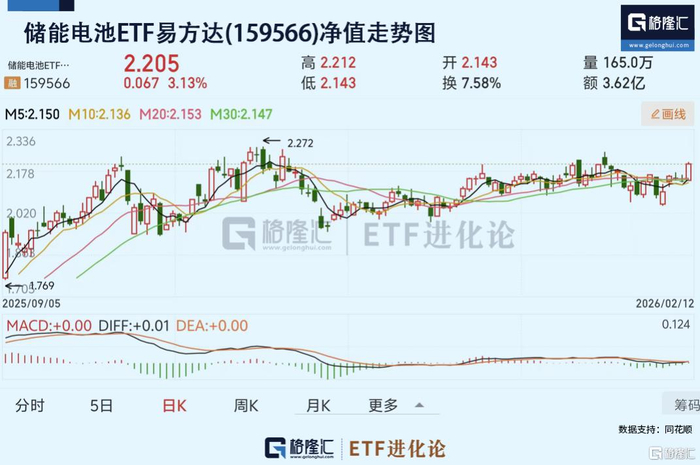
国家级收益兜底政策发布后,储能再迎涨价,储能电池ETF易方达(159566)涨2.15%,资金持续流入,规模突破46亿元
Ge Long Hui· 2026-02-12 09:03
Group 1 - The energy storage battery sector is experiencing a rise, with the E Fund Energy Storage Battery ETF (159566) increasing by 2.15% [1] - Recently, China Huadian's 12GWh energy storage system bidding average price reached 0.55 yuan/Wh, indicating a significant increase and reflecting a tight supply-demand situation [1] - The issuance of the notice on improving the generation-side capacity price mechanism provides substantial compensation for energy storage capacity, enhancing revenue for storage projects and alleviating market concerns about the continuity of local government policies [1] Group 2 - The E Fund Energy Storage Battery ETF (159566) focuses on the energy storage industry chain and includes major companies such as CATL, Sungrow, EVE Energy, and Inovance [2] - As of February 11, 2026, the E Fund Energy Storage Battery ETF (159566) has seen a net inflow of 615 million yuan over the past 20 days, with a total size of 4.658 billion yuan, making it the largest ETF product tracking this index [2]




储能电池板块上涨,储能电池ETF易方达、储能电池ETF广发涨超3%
Ge Long Hui· 2026-02-12 04:09
Core Viewpoint - The energy storage battery sector is experiencing significant growth, with ETFs such as E Fund and GF rising over 3%, reflecting strong market interest and demand in the energy storage industry [1][2]. Group 1: ETF Performance - E Fund Energy Storage ETF increased by 3.09% year-to-date, with an estimated scale of 46.58 billion [2] - GF Energy Storage ETF rose by 3.33% year-to-date, with an estimated scale of 2.51 billion [2] Group 2: Market Dynamics - Recent bidding for a 12GWh energy storage system by Huadian showed an average price of 0.55 yuan/Wh, indicating a significant increase and a tight supply-demand situation [2] - The State Power Investment Corporation announced a public bidding for 7GWh energy storage cells with prices ranging from 0.325 to 0.355 yuan/Wh, reflecting strong downstream demand [3] Group 3: Policy Developments - A new notification established a unified national compensation logic for independent energy storage capacity pricing, which is expected to enhance revenue stability for energy storage projects [4] - The projected internal rate of return (IRR) for energy storage projects under different capacity pricing scenarios is 5.8% for 2 years, 7.9% for 10 years, and 9.2% for 20 years, indicating a favorable investment environment [4] Group 4: Industry Insights - The demand for lithium mining stocks is expected to rise due to increasing lithium carbonate prices, with potential for upward price adjustments [5] - The solid-state battery technology is anticipated to drive a new wave of capital expenditure in the industry by 2025, highlighting the importance of companies with integrated solid-state battery equipment capabilities [5] - The downstream battery terminal segment is currently viewed as the most stable part of the lithium battery supply chain, offering high win rates and safety [5]

罕见“落袋为安”!超1300亿,“跑了”
Zhong Guo Ji Jin Bao· 2026-01-29 06:02
Group 1 - On January 28, the A-share market showed mixed performance with a net outflow of over 130 billion yuan from stock ETFs [1] - The total scale of 1,320 stock ETFs in the market reached 4.3 trillion yuan, with a reduction of 21.7 billion fund shares and a net outflow of approximately 131.2 billion yuan [2] - Industry-themed ETFs and commodity ETFs saw significant net inflows of 17.7 billion yuan and 7.2 billion yuan, respectively, on the same day [2] Group 2 - The SGE Gold 9999 index product had the highest net inflow on January 28, amounting to 6.4 billion yuan, with over 19.1 billion yuan flowing into it over the past five trading days [2] - A total of 53 ETFs experienced net inflows exceeding 1 billion yuan, with the top three being the Huaxia Fund's non-ferrous metals ETF, Penghua Fund's chemical ETF, and Huaxia Fund's gold stock ETF, which saw inflows of 1.4 billion yuan, 1.2 billion yuan, and 1.1 billion yuan, respectively [2][3] - Leading fund companies like E Fund continued to attract net inflows into their ETFs, including 1.1 billion yuan into the gold ETF and 410 million yuan into the pharmaceutical ETF [2] Group 3 - Broad-based ETFs experienced the largest net outflow, totaling 147.2 billion yuan, with the CSI 300 index products seeing a net outflow of 97.5 billion yuan [4] - Market sentiment at the beginning of the year is relatively high, but regulatory measures are expected to cool the market in the short term, while overall opportunities are anticipated to outweigh risks [4] - The investment outlook for A-shares remains positive, with expectations of moderate profit recovery by 2026, emphasizing the importance of dynamic asset allocation in ETFs [4]
5张图看懂“2026年全球视野·下注中国”十大核心ETF
Ge Long Hui· 2026-01-22 08:54
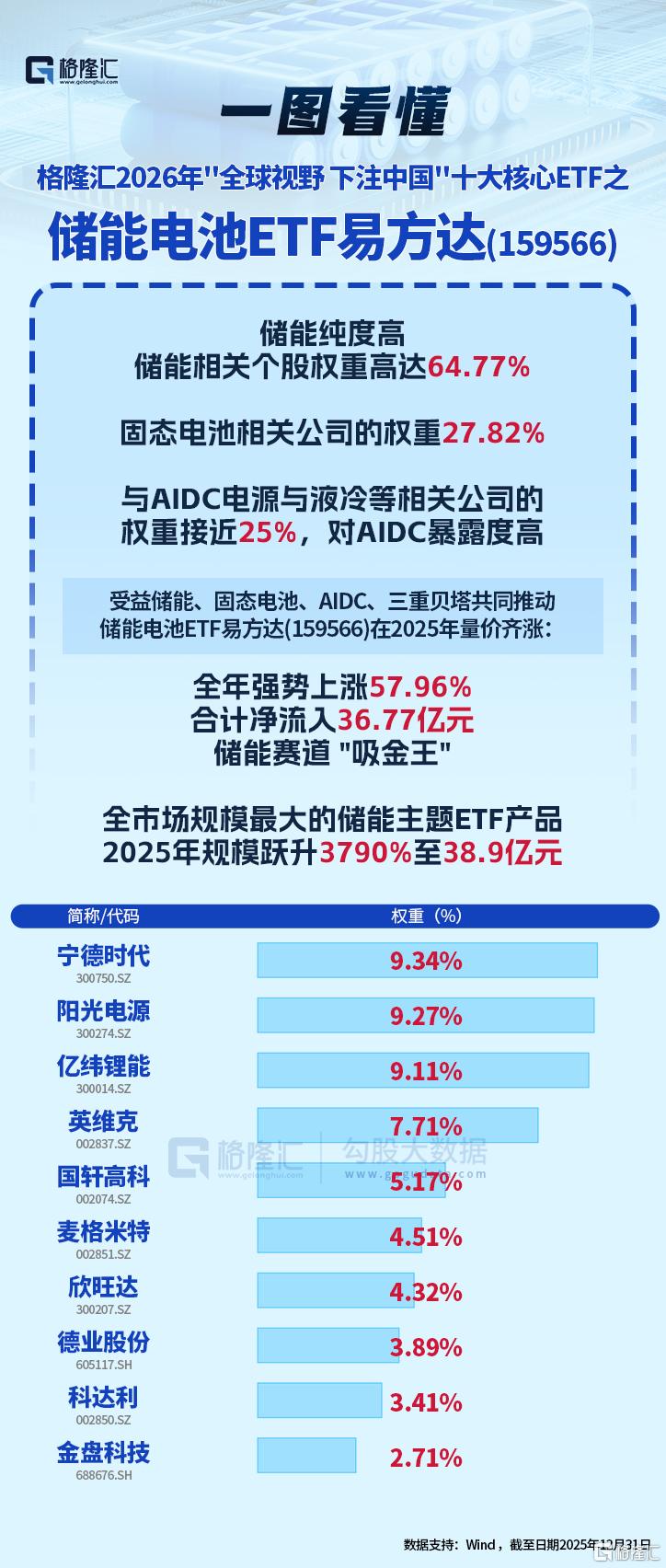
Group 1: Energy Storage Battery ETF - The Energy Storage Battery ETF by E Fund (159566) achieved a strong annual increase of 57.96% in 2025, with its scale rising from 100 million to 3.89 billion, marking a 3790% growth, making it the largest energy storage-related ETF in the market [1] - The ETF tracks the National Securities New Energy Battery Index, focusing on core stocks related to the energy storage battery industry, including leading companies like CATL, Sungrow, EVE Energy, and Inovance [1] - Key characteristics include a high purity of energy storage with 64.77% weight in energy storage-related stocks, benefiting from increased demand for energy storage due to rising data center electricity consumption [1] Group 2: Sci-Tech Chip ETF - The Sci-Tech Chip ETF (588200) tracks the Shanghai Stock Exchange Sci-Tech Board Chip Index, covering the entire chip industry chain, focusing on critical segments, with the top ten holdings accounting for 57% [3][4] - The index consists entirely of companies from the Sci-Tech Board, emphasizing R&D capabilities and technological innovation, representing the "elite force" of the chip industry [4] - The index shows significant growth indicators, with a 39% year-on-year revenue increase and a 94% net profit growth in the first three quarters of 2025 [4] Group 3: Aerospace ETF - The Aerospace ETF (159227) aligns closely with the "space and sky integration" strategy, focusing on military aerospace power, with a high weight of 98.2% in defense and military industries, making it the purest military index in the market [6][7] - The ETF has a significant overlap with commercial aerospace concepts, with a 70.19% correlation, and focuses on key national strategic areas such as military aircraft replacement and satellite internet [6][7] - It recorded a net inflow of 1.329 billion in the period, becoming the leading fund in the aerospace sector [7] Group 4: Hang Seng Technology ETF - The Hang Seng Technology ETF (513010) tracks the Hang Seng Technology Index, selecting 30 leading Hong Kong tech companies, covering sectors like internet platforms, semiconductors, and new energy vehicles [10] - The top ten holdings include major players like Meituan, SMIC, Tencent, and Alibaba, with AI-related companies making up over 60% of the portfolio [10] - The ETF saw a net inflow of 19.047 billion in 2025, with a low comprehensive fee rate of 0.25% per year [10] Group 5: Robotics ETF - The Robotics ETF (562500) focuses on the most competitive leading companies in the industry, with the top ten holdings accounting for 52% of the portfolio, showcasing significant leader effects [12][14] - It includes key component companies like Harmonic Drive and Mingzhi Electric, as well as system integrators like Inovance Technology and iFlytek, providing a balanced exposure to both industrial and humanoid robotics [12][14] - The ETF's latest scale is 26.169 billion, making it the only robotics-themed ETF in the market exceeding 20 billion [12]
ETF互联互通标的扩至364只
Zheng Quan Ri Bao· 2026-01-18 17:17
Core Viewpoint - The recent expansion of the ETF (Exchange-Traded Fund) interconnection marks a significant increase in the number of ETFs available for northbound trading, enhancing investment opportunities for both domestic and international investors [1] Group 1: ETF Interconnection Expansion - On January 19, a total of 98 ETFs were officially included in the northbound trading of the Shanghai and Shenzhen Stock Connect, increasing the total number of products in the "ETF Connect" from 273 to 364, representing a growth of over 30% [1] - The inclusion of more ETFs is expected to enrich the investment options for overseas institutional investors and promote the institutionalization of the A-share market [1] Group 2: Fund Management Perspective - A total of 29 fund companies had products included in the "ETF Connect," with China Asset Management leading with 14 ETFs, followed by E Fund with 10, and FT Fund with 7 [1] - The newly included products cover a wide range of types, including broad-based ETFs and industry-themed ETFs, which are expected to attract significant market attention [2] Group 3: Market Impact and Future Outlook - The expansion of the ETF interconnection is anticipated to enhance the international competitiveness and influence of China's capital market by attracting more professional investors and incremental capital [3] - Since the formal introduction of ETFs into the interconnection mechanism in July 2022, the total trading volume of northbound funds in 2025 is projected to reach 816.58 billion yuan, marking a 76% increase from 2024 [3]

政策重构!2026年万亿赛道蓄势爆发!
格隆汇APP· 2026-01-14 07:04
Core Insights - The AI industry is experiencing a historic development opportunity, with the energy storage sector transforming from a marginal support role to a core engine for the stable operation of the AI power era [2][3] - By 2026, the energy storage industry is expected to enter a historic opportunity period characterized by large-scale and high profitability, driven by policy marketization, technological breakthroughs, and global demand [3][4] Policy Restructuring - The profound changes in China's energy storage industry by 2025 stem from a systematic upgrade of the policy framework, marking a shift from "administrative intervention" to "market empowerment" [9] - The introduction of the "Document 136" in February 2025 ended the "mandatory storage" model, transitioning the industry to a "market profit-oriented" approach, which has significantly boosted project orders [9][10] - The National Development and Reform Commission and other departments have implemented measures to control irrational behaviors in the industry, indicating a fundamental shift in competitive logic [10][11] Market Demand and Growth - The energy storage market is expected to experience explosive demand growth in 2026, driven by multiple scenarios including renewable energy, grid upgrades, and AI data centers, with a market space exceeding trillions [12][13] - The global energy transition is accelerating, with over 130 countries setting "carbon neutrality" goals, and China's new power system construction entering a critical phase [13][14] - The demand for energy storage is increasing as it is the only effective means to address the intermittency and volatility of renewable energy [14][15] Industry Performance and Investment Opportunities - The energy storage industry is projected to see a significant increase in installed capacity, with the IEA predicting a growth of 380% by 2030, reaching 1200GW [17] - The domestic market is characterized by a diversified growth pattern, with significant contributions from renewable energy storage, user-side storage, grid-side storage, and overseas markets [20][21] - The performance of leading companies in the energy storage sector is strong, with significant revenue growth reported by major players like Sungrow and CATL [28][29] Investment Tools and Strategies - The energy storage battery ETF (159566) is highlighted as an effective investment tool for participating in the industry's growth and capturing market opportunities [30] - The ETF tracks the core segments of the energy storage industry, including lithium-ion batteries and system integration, with a high concentration of leading companies [30][31] - Historical performance shows that the ETF has outperformed other indices, with a 10-year annualized return of 12% and a significant increase in market size [33][34] Future Outlook - The energy storage sector is positioned as a strategic core for ensuring stable and sustainable power supply in the AI era, with ongoing technological advancements expected to expand its application boundaries [35][36] - The industry is entering a golden development period, with leading companies poised to benefit from high-quality orders and performance realization [36][37]