AI大模型

Search documents
上海软信业融资笔数全国第一
Di Yi Cai Jing· 2026-01-23 07:33
Group 1 - The core viewpoint of the article highlights that Shanghai's software and information technology industry is projected to see a fixed asset investment growth of 29.1% in 2025, significantly surpassing the city's average growth rate of 5.3% [1] - The total number of financing deals in the software and information technology sector reached 259, accounting for 15.4% of the national total, making it the highest in the country [1] - The disclosed financing amount in this sector was 41.178 billion yuan, primarily focused on areas such as AI large models and applications, internet platforms, integrated circuit design, and industrial software [1]
苹果计划将Siri重塑为内置聊天机器人,科创综指ETF天弘(589860)录得两连阳,机构:AI大模型正推动多行业应用加速商业落地
2 1 Shi Ji Jing Ji Bao Dao· 2026-01-23 01:29
Group 1 - The A-share market saw all three major indices rise collectively, with the Shanghai Stock Exchange Science and Technology Innovation Board Composite Index increasing by 0.14% [1] - The Tianhong ETF tracking the Science and Technology Innovation Board Index recorded a slight increase, achieving two consecutive days of gains, with a trading volume of nearly 30 million yuan [1] - Key stocks in the Tianhong ETF included Tengjing Technology, Mingwei Electronics, and Qingyun Technology, all reaching the daily limit, while other stocks like Godewei and Aotwei saw significant increases of nearly 20% and over 14%, respectively [1] Group 2 - The Robot ETF closely tracks the China Securities Robot Index, with a focus on manufacturing and information transmission, software, and IT services [2] - Major holdings in the Robot ETF include Huichuan Technology, iFlytek, and Stone Technology, and it is supported by two off-market connection funds [2] - The AI industry is experiencing rapid commercialization, with applications in various sectors such as AI search, marketing, office work, and education, indicating a significant technological impact on industry development [2]


百度、阿里巴巴美股收涨超5%!互联网企业是AI商业化的核心受益者
Mei Ri Jing Ji Xin Wen· 2026-01-23 01:16
Group 1 - The core viewpoint of the news highlights the positive performance of Chinese internet companies in the US stock market, with the Nasdaq China Golden Dragon Index rising by 1.59% and notable increases in stocks such as Baidu (up 5.90%), Alibaba (up 5.06%), Bilibili (up over 4%), and JD.com (up over 3%) [1] - Baidu has officially released the 5.0 version of its Wenxin large model, claiming its language and multimodal understanding capabilities are among the best in the world [1] - Alibaba has launched the open-source Qwen3-TTS suite and is reportedly planning to support the independent listing of its chip subsidiary, Pingtouge, although Alibaba has not yet responded to this news [1] - Since the rise of AI, Chinese internet platform companies have increased investments in self-developed chips, cloud computing, AI large models, and AI applications, with Alibaba Cloud's AI business starting to contribute to performance [1] - According to Huaxia Fund, internet companies are the primary beneficiaries of AI commercialization due to their access to vast, active, and structured user and business data, which serves as the "fuel" for training and iterating AI models [1] - The core businesses of internet companies, including advertising, search, e-commerce, social media, and media, are highly aligned with the efficiency optimization goals of AI, which is expected to enhance revenue in the future [1] Group 2 - For individual investors, the Hang Seng Internet ETF (513330.SH) listed on the A-share market offers a low-threshold, diversified investment opportunity, tracking the Hang Seng Internet Technology Index and focusing on internet platform companies and media firms [2] - The current valuation of the index is around 20 times, which presents a relatively high cost-performance ratio compared to Nasdaq and A-share TMT sectors [2]

字节、OpenAI、Meta都在赌一件事
3 6 Ke· 2026-01-22 23:34
Core Insights - Major tech companies are entering the AI hardware market, with OpenAI planning to launch its first AI hardware device in the second half of 2026, indicating a significant shift in strategy from software to hardware [1] - This trend is seen across various companies including ByteDance, Alibaba, and Meta, which are all investing heavily in AI hardware despite past failures in the hardware sector [1][2][4] Group 1: Reasons for Past Failures - Historically, major tech companies have struggled with hardware due to a lack of understanding of the complexities involved, often leading to failed products and financial losses [2][3][5] - The inherent arrogance of internet companies, which thrive on rapid iteration and low marginal costs, has hindered their ability to manage the high stakes and complexities of hardware production [6][7][8] Group 2: Changes in the Market - The emergence of AI models has changed the dynamics of hardware development, allowing for simpler interaction methods that reduce the need for complex designs [9][10] - AI hardware is now viewed as a sensor for AI, enabling companies to gather real-world data that can enhance their models, thus making hardware development more appealing [11][22][23] Group 3: Strategic Shifts - Companies like ByteDance, Meta, and OpenAI are now focusing on creating their own hardware to maintain control over user interactions and data, as the risk of losing direct access to users increases [15][17] - The collaboration between software and hardware companies is becoming more common, allowing for reduced development times and shared risks, making hardware ventures less daunting [25][26] Group 4: Future Implications - The AI hardware trend reflects a broader fear among software companies of being sidelined in the evolving tech landscape, as they seek to embed themselves into users' daily lives [27][28] - The proliferation of AI devices raises questions about the necessity and impact of such technology on human life, suggesting a deeper integration of AI into everyday activities [27][29]

2026年首单A股IPO获受理 燧原科技拟募资60亿元加码主业
Shang Hai Zheng Quan Bao· 2026-01-22 18:37
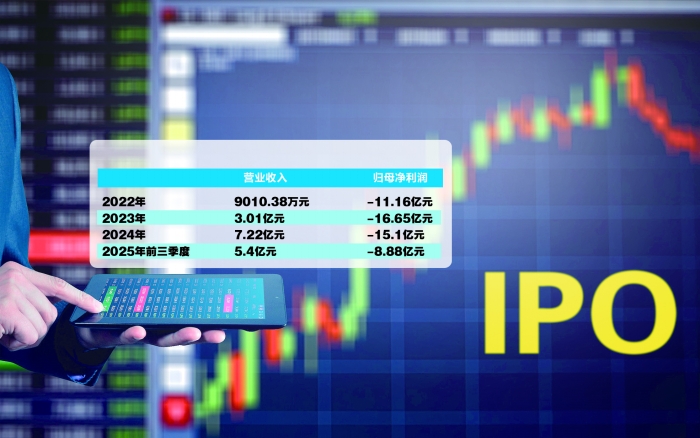
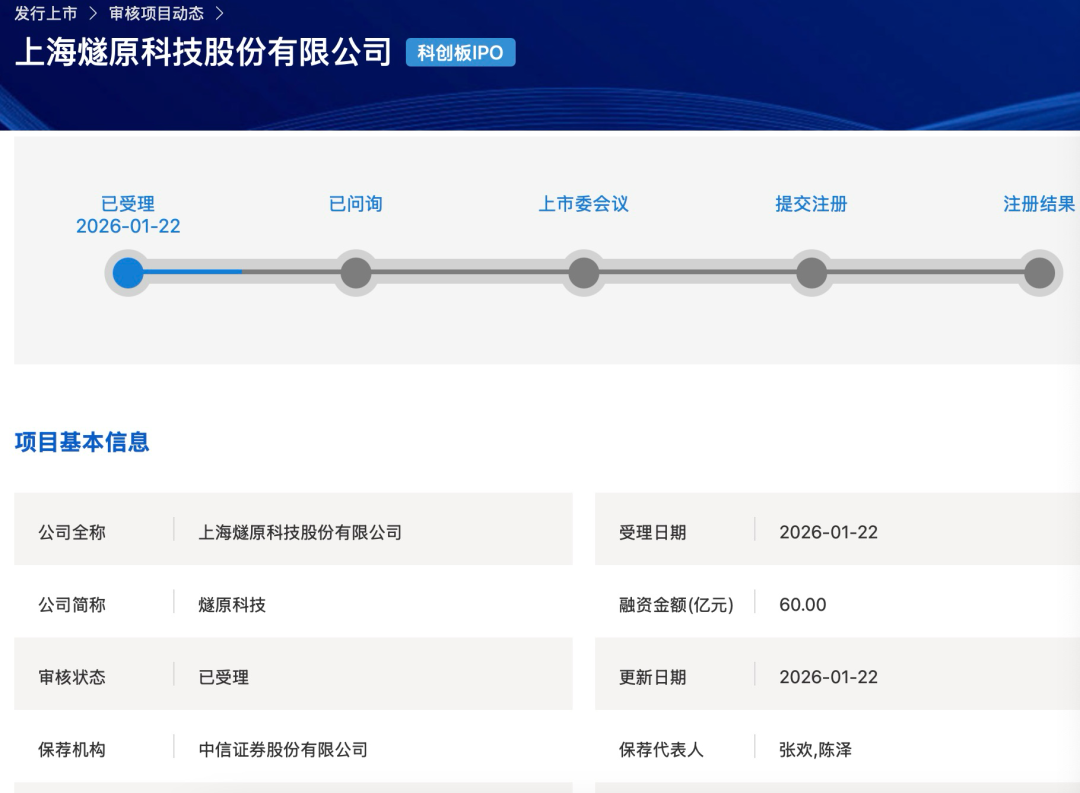
Core Viewpoint - Shanghai Suiruan Technology Co., Ltd. has received approval for its IPO application on the Sci-Tech Innovation Board, aiming to raise 6 billion yuan for product development, business expansion, and supply chain security [1][2] Group 1: Company Overview - Suiruan Technology, founded in March 2018, is one of the "Four Little Dragons" of domestic GPU manufacturers, being the earliest established but the latest to apply for an IPO [1][2] - The company has developed a complete product system including AI chips, AI acceleration cards, intelligent computing systems, and AI programming software platforms, positioning itself as a leading player in China's cloud AI chip market [2][4] Group 2: Financial Performance - The company's revenue from 2022 to 2024 and the first three quarters of 2025 were 90.1 million yuan, 301 million yuan, 722 million yuan, and 540 million yuan respectively, with a compound annual growth rate of 183.15% [4] - The net profit attributable to the parent company for the same periods was -1.116 billion yuan, -1.665 billion yuan, -1.51 billion yuan, and -888 million yuan [4] Group 3: Market Position and Strategy - In 2024, Suiruan Technology sold 38,800 AI acceleration cards, capturing approximately 1.4% of the Chinese AI acceleration card market, ranking among the top domestic AI chip manufacturers [4] - The company aims to become a leader in general artificial intelligence infrastructure, focusing on original innovation and self-research to build sustainable competitive advantages [2][4] Group 4: Investment and Valuation - The company has attracted significant investment from various institutions, including the National Integrated Circuit Industry Investment Fund and notable private capital, achieving a valuation of over 20 billion yuan after its last financing round [5] Group 5: Industry Context - Suiruan Technology is set to become the third GPU company listed on A-shares, joining peers like Moer Thread and Muxi Technology, which have already gone public [6][7] - The global AI chip market is currently dominated by NVIDIA, which holds approximately 76% market share in AI acceleration cards as of 2024 [8]

腾讯重金押宝 燧原科技冲刺科创板IPO 财务细节曝光
Shang Hai Zheng Quan Bao· 2026-01-22 14:31
Core Viewpoint - Shanghai Suiruan Technology Co., Ltd. has received acceptance for its IPO on the Sci-Tech Innovation Board, marking the first IPO acceptance in A-shares for 2026 [1] Group 1: IPO Details - Suiruan Technology plans to raise 6 billion yuan through its public offering, with funds allocated for product R&D, business expansion, and supply chain security [3][4] - The company is one of the "Four Little Dragons" of domestic GPUs, established in March 2018, and is the last among them to go public [3][11] Group 2: Financial and Market Position - The company aims to develop its fifth and sixth generation AI chip series and advanced AI hardware-software collaborative innovation projects to meet the high-quality AI computing power demand in China [4] - Financial data shows that from 2022 to the first three quarters of 2025, the company achieved revenues of 90.1 million yuan, 301 million yuan, 722 million yuan, and 540 million yuan, with a compound annual growth rate of 183.15% [9] - As of September 2025, the company reported total assets of approximately 489 million yuan and a net loss of about 88.8 million yuan for the first nine months of 2025 [9] Group 3: Technological and Competitive Edge - The company has developed a complete product system including AI chips, AI acceleration cards, intelligent computing systems, and AI programming software platforms [6][7] - Suiruan Technology has filed 262 domestic invention patents and participated in over 10 national and local technology projects, contributing to the establishment of key national and industry standards [10] Group 4: Industry Context - The global AI chip market is currently dominated by Nvidia, which holds approximately 76% market share in AI acceleration cards as of 2024 [13] - The "Four Little Dragons" of domestic GPUs are rapidly advancing their ecosystems, with Suiruan Technology benefiting from extensive collaborations with major internet companies [14]
复盘20年汽车行情,探寻总量红利消退期的投资机遇【国信汽车】
车中旭霞· 2026-01-22 13:50
Core Viewpoint - The relationship between the automotive industry's prosperity (sales growth) and the valuation of the automotive sector is complex, influenced by both declining total growth and rapid advancements in AI technology [1][7]. Group 1: Relationship Between Valuation and Prosperity - There is a relationship between automotive sector valuation and industry prosperity, with valuation leading prosperity by about one month [1][10]. - Historically, years of high sales growth have correlated with improved automotive sector performance, indicating a long-term positive correlation between valuation and prosperity [7][10]. - The correlation between valuation and prosperity has weakened since 2019, indicating a decoupling effect where high prosperity does not necessarily drive high valuation [2][15]. Group 2: Decoupling and Asymmetrical Effects - The decoupling effect suggests that prosperity is a sufficient but not necessary condition for valuation, meaning high valuation can exist without high prosperity [2][15]. - Asymmetrical effects indicate that while high prosperity can drive valuation increases, low prosperity does not necessarily lead to valuation declines, allowing for structural opportunities to support valuation [29][30]. Group 3: Three-Cycle Determinism - The automotive industry is influenced by three cycles: macroeconomic, industrial technology, and policy cycles, which together affect the industry's fundamentals and valuation [2][33]. - The shift in dominant cycles from macroeconomic and policy cycles to industrial technology cycles has led to a redefinition of valuation logic, focusing on quality upgrades rather than scale expansion [34][45]. Group 4: Future Outlook Post-2025 - The automotive industry is expected to enter a phase of low growth normalization, with total sales remaining stable and structural opportunities emerging from AI technology and smart vehicles [3][21]. - Valuation is anticipated to remain stable despite fluctuations in sales growth, indicating a continued decoupling trend [21][25].

预计增速超230%!摩尔线程2025年营收有望突破15亿元,国产全功能GPU迈入规模商用阶段
Mei Ri Jing Ji Xin Wen· 2026-01-22 09:44
Core Viewpoint - The domestic GPU sector is experiencing significant growth, with Moores Threads projecting a revenue increase of 230.70% to 246.67% in 2025, reaching between 1.45 billion to 1.52 billion yuan, marking a pivotal moment for the commercialization of domestic GPUs [1][2] Group 1: Revenue Growth and Market Demand - Moores Threads' revenue is expected to surge from 438 million yuan in 2024 to over 1.45 billion yuan in 2025, driven by external market demand and internal technological breakthroughs [2] - The year 2025 is identified as the "year of large-scale deployment of AI models," with a significant increase in demand for high-performance computing across various sectors, particularly under the ongoing domestic substitution policies [2][7] - The flagship product, MTT S5000, based on the fourth-generation GPU architecture, is set to achieve mass production in 2025, serving as the core engine for revenue growth [2][3] Group 2: Product Performance and Technological Advancements - The MTT S5000 supports large-scale model training and has demonstrated high efficiency and performance, achieving a linear expansion efficiency of 95% and effective training time exceeding 90% [2][3] - The S5000 has established new benchmarks for domestic inference performance, with throughput exceeding 4000 tokens/s for Prefill and 1000 tokens/s for Decode [3] - Moores Threads has successfully transitioned from technology development to large-scale commercialization, with the S5000 operating stably in complex scenarios [3][8] Group 3: Strategic Investment and R&D Commitment - The GPU industry is characterized by high capital and talent intensity, and Moores Threads has chosen a challenging path by focusing on full-function GPUs, which require breakthroughs in various computing capabilities [4][6] - The company has invested over 4.3 billion yuan in R&D from 2022 to mid-2025, with funds primarily directed towards developing new AI training and inference chips [6] - Moores Threads aims to build a comprehensive competitive strategy through sustained high-intensity R&D investments, reflecting its long-term vision [6][8] Group 4: Market Position and Future Outlook - The demand for domestic AI computing is projected to grow at an annual rate exceeding 50%, creating a substantial market for domestic GPUs [7] - Moores Threads is one of the few companies in China pursuing a full-function GPU technology route, which enhances user stickiness and ecosystem expansion [7] - The core team, with extensive experience from international GPU giants, is driving the company towards achieving competitive product performance and market presence [7][8]
小米前高管王腾创业完成数千万融资,金主有高瓴、智元机器人等
机器人圈· 2026-01-22 09:17
Core Insights - Wang Teng, a former executive at Xiaomi, has successfully completed a seed round financing for his startup "Today’s Rest," raising tens of millions of yuan with investments from GL Ventures, Zhiyuan Robotics, Xilinmen, and Yunjiu Capital [1][2] - The company plans to launch a series of hardware and software products in the second half of the year and aims to expand internationally [1] - The product development will focus on brain science and artificial intelligence, aiming to reduce cognitive costs and enhance individual sleep and energy states [1] Company Overview - "Today’s Rest" is not merely defined as a smart bed or sleep monitoring device but introduces a long-term concept of "energy asset management," viewing human energy as a core asset that is often overlooked [1] - The company intends to evolve its product offerings based on technological capabilities and user needs, targeting tech-driven categories to create a closed-loop solution for energy perception, state adjustment, and long-term management [1] Leadership Background - Wang Teng was previously recognized as a promising talent at Xiaomi, holding positions such as General Manager of the REDMI brand and later as General Manager of Xiaomi's China marketing department [2] - His notable contributions at Xiaomi include the development of products like Mix2, Xiaomi 8, and Redmi Note 7 [2] - Following a dismissal from Xiaomi due to serious violations, Wang expressed regret and gratitude towards the company while announcing his entrepreneurial venture [2]

计算机行业周报:政策赋能算力升级,AI应用生态持续深化-20260122
BOHAI SECURITIES· 2026-01-22 06:47
Investment Rating - The report maintains a "Neutral" rating for the computer industry and an "Accumulate" rating for Hongsoft Technology (688088) [2][29] Core Insights - The Ministry of Industry and Information Technology (MIIT) is accelerating breakthroughs in key technologies such as training chips and heterogeneous computing power, which is expected to further speed up the development of the domestic computing power industry [13][28] - The AI application ecosystem is deepening, with significant developments such as the integration of Alibaba's Qianwen App into its ecosystem, enabling AI shopping functionalities [14][28] - The report highlights the growth potential of AI applications driven by rapid technological implementation and the release of market demand, suggesting a focus on leading companies with strong AI technology capabilities and scene adaptability [28][29] Industry News - MIIT has announced a special action plan for "Artificial Intelligence + Manufacturing," aiming to promote high-quality development in the AI industry [13] - The GLM Coding Plan by Zhiyuan has announced a temporary sales limit due to a surge in user numbers, indicating a tight supply of computing resources [14] - Alibaba's Qianwen App has integrated with various services, achieving over 100 million monthly active users within two months [14][15] Company Announcements - Hikvision reported a total revenue of 92.518 billion yuan for 2025, with a net profit of 14.188 billion yuan, reflecting a year-on-year growth of 18.46% [17] - Tonghuashun expects a net profit of 2.735 billion to 3.282 billion yuan for 2025, representing a growth of 50% to 80% [18] - Longxin Technology anticipates a net profit of 100 million to 150 million yuan for 2025, with a significant increase due to improvements in its energy digitalization business [20] Market Review - From January 15 to January 21, the CSI 300 index fell by 0.40%, while the Shenwan Computer Industry index dropped by 7.27%, with most sub-sectors experiencing declines [21] - The valuation of the Shenwan Computer Industry as of January 21, 2026, was 223.77 times earnings, with a premium of 1550.55% relative to the CSI 300 [22] Weekly Strategy - The report emphasizes the ongoing high demand for computing power and the expected acceleration in the domestic cloud computing capital expenditure, driven by easing supply constraints [28] - The anticipated launch of the DeepSeek V4 model during the Lunar New Year is expected to drive a new round of technological iteration in domestic large models [28] - The report suggests a focus on leading companies in the AI application sector that demonstrate strong capabilities in technology implementation and scene adaptability [29]