
中美贸易摩擦

Search documents
又涨18元!2025年10月11日各大金店黄金价格多少钱一克?
Jin Tou Wang· 2025-10-11 06:59
Price Movement - Domestic gold prices have surged again, with an overall increase exceeding 10 yuan per gram, particularly notable at Laomiao Gold, which rose by 18 yuan per gram to reach 1183 yuan per gram, marking a new high for gold stores [1] - The price gap between the highest and lowest gold prices has widened to 120 yuan per gram, with Shanghai China Gold maintaining its price at 1063 yuan per gram, the lowest among major brands [1] Brand-Specific Pricing - Detailed pricing for various gold brands on October 11, 2025, includes: - Laomiao Gold: 1183 yuan per gram, up 18 yuan - Liufu Gold: 1180 yuan per gram, up 12 yuan - Chow Tai Fook: 1180 yuan per gram, up 12 yuan - Zhou Liufu: 1123 yuan per gram, down 5 yuan [1][3] - Other brands also showed price increases, with Jin Zun Gold at 1180 yuan per gram, up 12 yuan, and Lao Feng Xiang at 1172 yuan per gram, up 7 yuan [3] Platinum and Recovery Prices - Platinum prices have continued to decline, with Chow Tai Fook's platinum jewelry dropping by 19 yuan per gram to 641 yuan per gram [4] - Gold recovery prices have seen a slight increase of 3.4 yuan per gram, with varying recovery prices across brands, such as: - Cai Bai Gold: 906.20 yuan per gram - Zhou Sheng Sheng: 895.50 yuan per gram - Lao Feng Xiang: 913.70 yuan per gram [4] International Market Influences - The international gold market experienced fluctuations, with spot gold closing at 4018.09 USD per ounce, reflecting a 1.06% increase [6] - The rise in gold prices is attributed to heightened market risk aversion due to President Trump's tariff threats and ongoing U.S. government shutdown, alongside weak U.S. economic data that pressured the dollar index [6] - The preliminary consumer confidence index from the University of Michigan fell to 55, the lowest since May, further fueling concerns about economic slowdown and supporting gold price increases [6]


中方反制见效,美股跳水,特朗普发长文:中国变了,他猜对了
Sou Hu Cai Jing· 2025-10-11 00:31
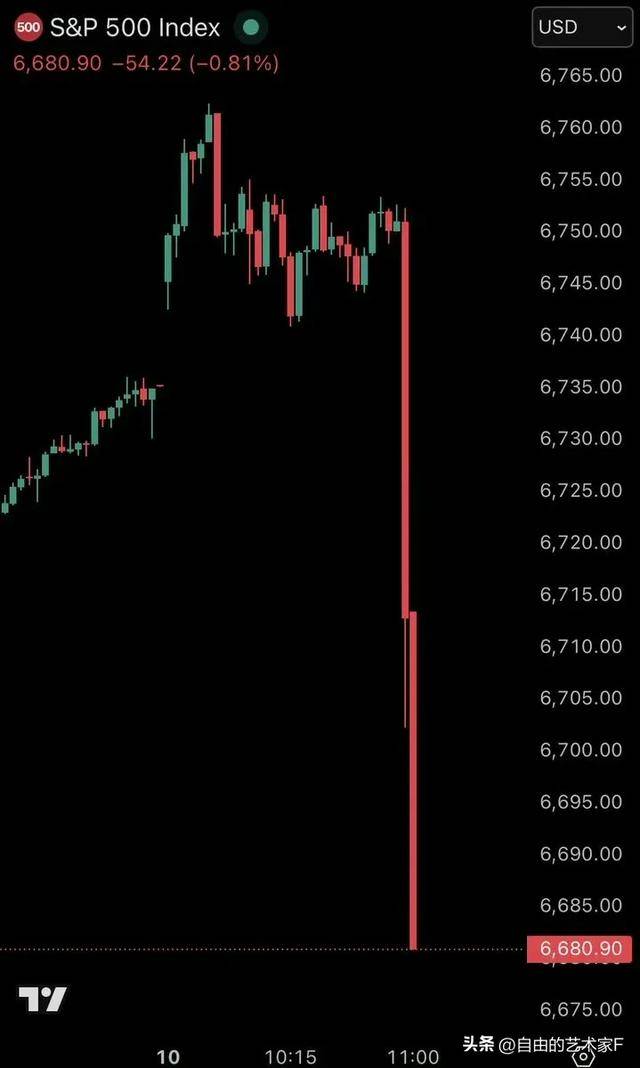
Group 1 - The core issue revolves around the escalating tensions between the U.S. and China, particularly following China's recent countermeasures against U.S. policies, which have led to significant reactions in global logistics and shipping costs [1][3]. - The U.S. stock market experienced a sharp decline, with the S&P 500 index losing $700 billion in market value within three minutes after President Trump's comments regarding the situation [5]. - There is public outrage in the U.S. regarding the government's decision to build military facilities for Qatar, especially amidst concerns about domestic issues such as government shutdowns and military pay [7][9]. Group 2 - China's new regulations have resulted in increased shipping costs for dry bulk carriers transporting coal and iron ore, indicating a ripple effect in the global logistics industry [3]. - Trump's administration is criticized for underestimating China's capabilities to retaliate, with calls for a reassessment of strategies that consider the broader implications of their actions [3]. - The announcement of military infrastructure for Qatar has sparked anger among U.S. citizens, questioning the rationale behind spending on foreign military facilities while domestic issues remain unresolved [7][9].
Stock market jitters are justified given China tariffs: Longview Global's McNeal
Youtube· 2025-10-10 21:56
Group 1 - The current geopolitical climate is more concerning than before, with China seemingly willing to provoke the US and leverage its position [1][2] - China has announced enhanced export controls, indicating a long-term strategy that has been in place for about five years, which could significantly impact sectors reliant on chip production [2][3] - There is a pressing need to address China's dominance in the critical mineral space, which is essential for various industries [4] Group 2 - China's recent military maneuvers, such as naval vessels cruising near Japan, suggest a more aggressive stance in the region [5] - The movement in gold prices reflects China's diversification away from the US, as it holds a significant amount of gold, which supports its currency [6] - China is frustrated with the ongoing 20% tariffs on fentanyl and is seeking to negotiate the removal of export controls on advanced chips, indicating a desire for short-term access to technology [7] Group 3 - Long-term, China aims to assert its role on the global stage and demonstrate that it can compete with the US, which has diplomatic implications [8]
Pres. Trump: Calculating massive increase of tariffs on Chinese products into U.S.
Youtube· 2025-10-10 17:39
Hey there, Courtney. Well, here's the meat of that social media post from President Trump just a short time ago in which he responded to the Chinese government's imposition of export controls on rare earth material. He says, "One of the policies that we are calculating at this moment is a massive increase of tariffs on Chinese products coming into the United States of America. There are many other countermeasures that are likewise under serious consideration. Uh, nobody in the administration uh that I've be ...

如何看待有消息称美国不准备降低对华关税税率
Sou Hu Cai Jing· 2025-10-10 15:01
Core Viewpoint - The U.S. government, under President Trump, is maintaining a hardline stance on tariffs against China, indicating a desire for a long-term compromise without significant concessions [2][3][4] Group 1: Tariff Strategy - The U.S. plans to keep the 55% tariff on China as part of the trade agreement, with no intention to remove the tariffs imposed earlier this year [2][3] - The U.S. aims to persuade China to increase purchases of American goods, such as agricultural products and LNG, while maintaining restrictions on high-tech exports to China [3][4] Group 2: Negotiation Principles - Trump's negotiation strategy is characterized by "extreme pressure" and "high demands," with the recent statements reflecting these principles [4][5] - The focus of future negotiations will shift from whether to engage in a trade war to the conditions under which a trade war can be avoided [5] Group 3: Long-term Trade Relations - The U.S. seeks to normalize the "Fentanyl tariff" to maintain a lower tariff rate on Chinese goods compared to U.S. goods, while China aims to counter this by challenging the U.S. on its tariff practices [5][6] - The broader context of U.S.-China trade relations includes non-tariff barriers and technology restrictions, which are seen as significant obstacles beyond just tariff levels [6]

突发!美国刚宣布制裁15家中国企业,不到24小时,中方就重拳出击
Sou Hu Cai Jing· 2025-10-10 05:32
Group 1 - The U.S. Chamber of Commerce reported that China is systematically deviating from its WTO commitments made 25 years ago, particularly in market reforms and reducing state intervention [1] - The report claims that China uses opaque "national security" laws to bolster its economy while simultaneously engaging in economic warfare against the U.S. [1] - Critics argue that the U.S. has been the primary violator of WTO rules, initiating tariff wars and sanctions against other countries, which has led to retaliatory measures from China [1] Group 2 - The U.S. Department of Commerce announced export controls on 15 Chinese companies for allegedly assisting Iranian-backed armed groups, indicating a strong U.S. intervention stance in the Middle East [3] - The U.S. has provided over $21.7 billion in military aid to Israel in the past two years, raising concerns about its long-term involvement in the region [6] Group 3 - The U.S. military actions in Iraq, Syria, and Iran have been criticized for undermining international law and regional stability, while the U.S. pressures China for its economic relations with these countries [8] - In response to U.S. sanctions, China announced export controls on rare earths and related technologies, aiming to protect its domestic industrial chain [10][12] - This move is expected to increase pressure on the Trump administration, as it complicates the U.S. plans and raises costs for achieving self-sufficiency in the rare earth industry [13]

美国大豆堆成山,特朗普全球急救市!
Sou Hu Cai Jing· 2025-10-09 20:12
Core Insights - The U.S. soybean industry is facing a historic crisis due to a complete halt in soybean purchases by China, which has been the largest importer of soybeans globally [5][6][7] - The trade tensions between the U.S. and China have led to significant tariffs on U.S. soybeans, making them uncompetitive compared to South American soybeans [8][10] - Efforts by the U.S. government to find alternative markets for soybeans have been largely ineffective, as the Chinese market remains irreplaceable [11][15] Group 1: Market Conditions - U.S. farmers are experiencing unprecedented market conditions, with warehouses filled with unsold soybeans, contrasting sharply with previous years when China ordered approximately 13 million tons of U.S. soybeans [3][5] - Since May 2025, China's soybean purchases from the U.S. have dropped to zero, marking a significant shift in the global soybean trade landscape [5][6] Group 2: Trade Dynamics - The U.S. soybean market share in China has plummeted from about 40% in 2016 to approximately 20% by 2024, as China redirects 65% of its soybean import targets to South America [7][10] - The U.S. government is attempting to mitigate losses by seeking buyers in other regions, including Mexico, the EU, and India, but these efforts have yielded minimal results [11][15] Group 3: Competitive Landscape - South American soybeans are gaining a competitive edge due to lower prices and more stable supply chains, with China significantly increasing imports from Argentina and Brazil [10][14] - Argentina has eliminated export taxes on soybeans, leading to immediate orders from China, highlighting the aggressive strategies employed by South American countries to capture the Chinese market [14] Group 4: Future Outlook - Structural changes in China's soybean import strategy, including increased domestic production and the development of alternative feed sources, suggest that U.S. soybeans may struggle to regain market share even if trade relations improve [15][16] - The U.S. soybean industry is at a critical juncture, with the potential for long-term impacts on farmers and the broader agricultural economy due to the loss of the Chinese market [16]

美政府停摆才几天,特朗普对华态度变了,他希望中国给他一个面子
Sou Hu Cai Jing· 2025-10-09 08:14
Core Points - The U.S. federal government shutdown began on October 1 due to the Senate's failure to pass a budget, affecting over 750,000 federal employees who were forced into unpaid leave [1][3] - The shutdown has led to significant disruptions, including the postponement of monthly employment data and the closure of national parks, impacting tourism and causing flight delays [3][14] - President Trump views the shutdown as an opportunity to reduce government spending, threatening large-scale layoffs if negotiations do not progress [5][14] Group 1: Government Shutdown Impact - Over 1.3 million active military personnel are required to continue their duties without pay, affecting morale [1] - The Labor Statistics Bureau's inability to release employment data has resulted in reliance on outdated information for economic analysis [3] - The shutdown has caused delays in services from various departments, including the Department of Veterans Affairs and the Census Bureau, with only 8,300 employees deemed "essential" continuing to work [3][14] Group 2: Economic and Agricultural Concerns - The employment growth in August was only 22,000 jobs, indicating a slowing job market exacerbated by the shutdown [3] - Trump is focusing on international trade, particularly with China, as U.S. soybean farmers face significant challenges due to reduced exports [6][8] - The U.S. soybean import costs have risen to 34% due to tariffs, while Brazil and Argentina offer lower costs, leading to a shift in China's sourcing strategies [8][12] Group 3: Political Dynamics - Trump's administration is pushing for a "2025 plan" aimed at reducing government size and cutting foreign aid, amidst criticism from Democratic leaders [5][12] - The White House is seeking concessions from Democrats to avoid further layoffs, but negotiations have stalled [12][14] - Despite the shutdown, Trump continues to express optimism about reaching a resolution and emphasizes the potential of the Chinese market for U.S. agricultural products [14]
【环球财经】Anec报告:丰产及中国强劲需求推动巴西大豆出口量创历史新高
Xin Hua Cai Jing· 2025-10-09 07:18
Anec同时指出,巴西10月份豆粕出口量预计为192万吨,略低于去年10月的246万吨,但年累计出口预 计仍将超过1900万吨。 除农产品外,巴西铁矿石对华出口同样保持强劲势头。Anec报告称,中国继续是巴西铁矿石出口的主 要目的地,9月份中国进口了约650万吨巴西铁矿石,占巴西铁矿石出口总量的93%,维持历史高位。 分析人士认为,中国基础设施投资稳步推进、钢铁产量回升以及必和必拓长协议谈判未果,中国对巴西 矿产品的需求仍将保持强劲。 新华财经圣保罗10月9日电(记者杨家和) 巴西全国谷物出口商协会(Anec)8日发布报告称,今年1月 至10月,巴西大豆出口量预计达1.022亿吨,将超过2023年和2024年全年出口水平,创下历史新高。受 益于中国采购需求持续增长及创纪录的丰收,巴西正巩固其全球最大大豆出口国地位。 报告显示,2024年因气候影响导致减产,巴西全年大豆出口量为9730万吨;而2023年创下的纪录为 1.013亿吨。Anec表示,预计11月至12月仍有约800万吨的出货计划,这使得巴西全年大豆出口总量有望 达到1.1亿吨。 Anec指出,中国仍是巴西大豆的最大买家,9月进口约650万吨,占巴西当 ...
注意,美国即将对中国船舶征收港口费!对航运市场影响几何?
Qi Huo Ri Bao· 2025-10-08 23:42
Core Viewpoint - The U.S. has introduced a new port fee structure targeting Chinese-owned and operated vessels, effective from October 14, 2025, which is expected to significantly increase operational costs for Chinese shipping companies [1][3]. Group 1: U.S. Port Fee Structure - The U.S. Customs and Border Protection (CBP) has detailed the port fee structure, charging $50 per net ton for Chinese-owned or operated vessels, with increases planned for subsequent years [1]. - Fees for Chinese-built vessels will be $18 per net ton or $120 per container, whichever is higher, with future increases set for 2028 [1]. - Non-U.S. built car carriers will incur a fee of $14 per net ton [1]. - Payment must be completed three working days before arrival at the first U.S. port, with penalties for non-compliance [1]. Group 2: Impact on Chinese Shipping Companies - The new fees will substantially raise operational costs for Chinese shipping companies, with an estimated increase of $304 per TEU for shipowners and $120 per TEU for vessels [3]. - The port fee structure is designed to discourage the use of Chinese vessels in U.S. ports and aims to bolster the U.S. shipbuilding industry [3]. Group 3: Adjustments by Shipping Alliances - Major shipping alliances have begun to adjust their operations in response to the new fees, with some routes being suspended and vessel deployments being altered to reduce reliance on Chinese ships [4]. - Companies like CMA and MSC have stated they will not impose additional fees related to the port charges [4]. Group 4: Market Reactions and Trends - The shipping industry is experiencing a significant number of canceled voyages due to tariff disruptions and weak U.S. demand, with 67 sailings from China to the U.S. canceled recently [5]. - Analysts suggest that the impact of the new port fees on the European shipping market will be limited, but ongoing adjustments in shipping strategies are expected [6]. - The overall shipping costs are anticipated to continue rising, with potential price increases in freight rates as shipping companies negotiate with European clients [7].
